
CIPS L4M5 Practice Exams
Last updated on Oct 22,2026- Exam Code: L4M5
- Exam Name: Commercial Negotiation
- Certification Provider: CIPS
- Latest update: Oct 22,2026
A wide range of factors may be taken into account by suppliers when setting or negotiating prices.
Which of the following are external factors in pricing decisions? Select TWO that apply.
- A . Competition in the market
- B . Cost of production
- C . Where the product is in its lifecycle
- D . Customer perception of value
- E . Costs of sales
A, D
Explanation:
External factors in pricing decisions include Competition in the market (A) and Customer perception of value (D).
These factors are outside the supplier’s direct control but influence pricing strategies to remain competitive and meet customer expectations:
Competition in the market (A): Market competition dictates how much a supplier can charge without losing business to competitors.
Customer perception of value (D): How customers perceive the product’s worth affects its acceptable price range.
These factors are considered external as they relate to market dynamics rather than internal cost structures, according to CIPS’s guidance on pricing influences.
A procurement manager is considering negotiating variable pricing for a contract duration of 12 months. Would this be the right thing to do?
- A . No, because this will not enhance the buyer-supplier relationship
- B . No, because it will prove difficult to budget for the duration of the contract and provide financial uncertainty
- C . Yes, because this method of pricing will always provide value for money
- D . Yes, because it will build relationships with the supplier and provide a stronger platform for the next contract renewal
B
Explanation:
Variable pricing can lead to budgeting challenges and financial uncertainty over a 12-month period. While variable pricing may allow flexibility, it complicates financial planning and forecasting. For predictable budgeting and reduced financial risk, fixed pricing is typically preferred in such contract durations, aligning with CIPS recommendations on pricing models in contract management.
How can having a best alternative to a negotiated agreement (BATNA) support the buyer in a negotiation? Select THREE options that apply.
- A . It helps to be more assertive in a negotiation
- B . It reduces the likelihood of accepting a poor agreement
- C . It guarantees a win-win outcome
- D . It produces an unacceptable outcome
- E . It extends the length of the negotiation period
- F . It helps to identify the point at which the buyer should walk away
A, B, F
Explanation:
Having a BATNA:
Increases assertiveness (A): Knowing the fallback position empowers the buyer to negotiate more confidently.
Reduces the chance of a poor agreement (B): A BATNA ensures the buyer does not feel pressured to accept suboptimal terms.
Identifies walk-away points (F): It sets a clear boundary, allowing the buyer to exit negotiations if terms don’t meet minimum requirements.
These align with CIPS’s guidance on using BATNA to strengthen negotiation strategies.
The buyer’s bargaining power tends to be relatively higher than supplier’s bargaining power in which of the following circumstances?
- A . The buyer does not have the option to move to an alternative supplier
- B . The buyer’s spend takes up a small proportion of supplier revenue
- C . The buyer demand is so urgent that it can’t be postponed
- D . The buyer is large in size relative to its suppliers
D
Explanation:
Buyer power gives customers/consumers (buyers) the ability to squeeze industry margins by pressuring firms (the suppliers) to reduce prices or increase the quality of services or products offered.
There are four major factors to consider when determining the bargaining power of buyers:
Which of the following is the best description of direct cost?
- A . Direct costs are only variable raw materials that constitute a product
- B . Direct costs include raw materials, labour and overheads
- C . Direct costs include only raw materials and labour of making the final product
- D . Direct costs include raw materials, labour and other expenses attributable to the final product
D
Explanation:
Direct costs are those costs of a product/service directly attributable/traceable to its production, for example, the costs of labour and materials directly used to produce the goods/services which the organisation sells.
In which of the following persuasion methods, the influencer uses logics and objective reasons to persuade the others to buy into influencer’s ideas?
- A . Persuasive reasoning (push)
- B . Collaborative (pull)
- C . Visionary (pull)
- D . Directive (push)
A
Explanation:
There are two major persuasion methods: ‘push’ and ‘pull’.
Persuasion can be defined as encouraging someone to do something that you want them to do for you. Persuasion is reasoning with someone so that they will believe or do something they might not otherwise do. Persuasion can be considered as ‘pushing’ on TOP so that they can accept the change in attitude or behaviour as a result of your actions.
Influence is the ability to affect the manner of thinking of another. Influence can be considered as pulling on TOP so that you achieve the same result, but TOP feels they have changed their attitude or behaviour as a result of their reflection and thinking, and not your direct actions.
There are multiple variables to consider when choosing between ‘push’ and ‘pull’. Professor Fiona Dent of Ashridge Business School proposes situations when each style might be most appropriate, breaking down push into ‘directive’ and ‘reasoning’ and ‘pull’ into ‘collaborative’ and ‘visionary’:
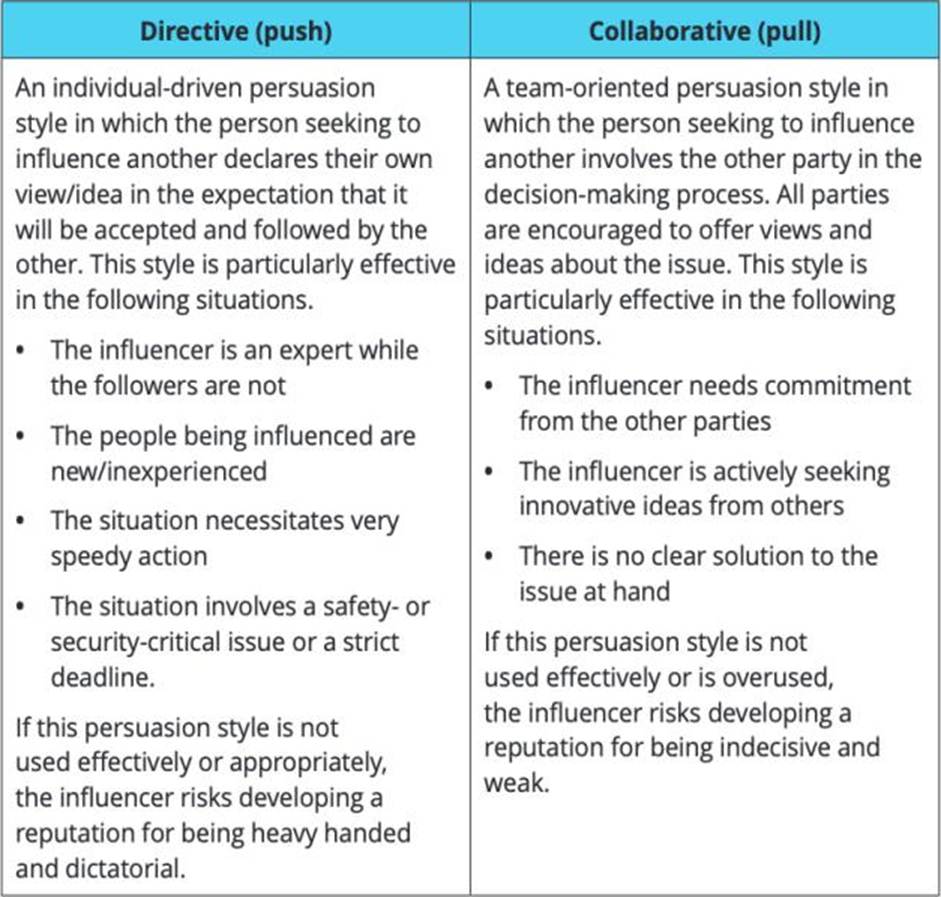
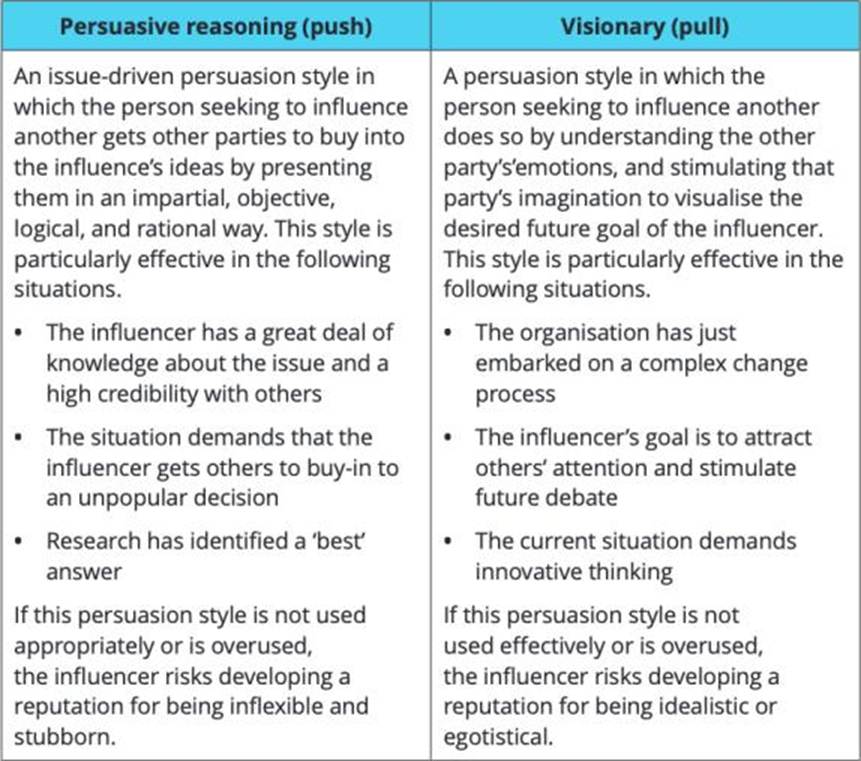
Using logical and objective reasons is one of the typical characteristics of persuasion reasoning method.
In which of the following persuasion methods, the influencer uses logics and objective reasons to persuade the others to buy into influencer’s ideas?
- A . Persuasive reasoning (push)
- B . Collaborative (pull)
- C . Visionary (pull)
- D . Directive (push)
A
Explanation:
There are two major persuasion methods: ‘push’ and ‘pull’.
Persuasion can be defined as encouraging someone to do something that you want them to do for you. Persuasion is reasoning with someone so that they will believe or do something they might not otherwise do. Persuasion can be considered as ‘pushing’ on TOP so that they can accept the change in attitude or behaviour as a result of your actions.
Influence is the ability to affect the manner of thinking of another. Influence can be considered as pulling on TOP so that you achieve the same result, but TOP feels they have changed their attitude or behaviour as a result of their reflection and thinking, and not your direct actions.
There are multiple variables to consider when choosing between ‘push’ and ‘pull’. Professor Fiona Dent of Ashridge Business School proposes situations when each style might be most appropriate, breaking down push into ‘directive’ and ‘reasoning’ and ‘pull’ into ‘collaborative’ and ‘visionary’:
Using logical and objective reasons is one of the typical characteristics of persuasion reasoning method.
At which stage in a negotiation would questions be asked to obtain missing information?
- A . The bargaining stage
- B . The proposing stage
- C . The opening stage
- D . The testing stage
D
Explanation:
There are 5 key phases of negotiation:
The opening phase: confirm understanding and get the issue on the table
The testing phase: check assumption and confirm understanding
The proposing phase: asking ‘if’
The bargaining phase: using tradeables
The agreement and closing phase
The testing could take the form of questions following a presentation by either side or questions on a tender or proposal document received by the buyer from the potential supplier. The testing phase is necessary to confirm that your approach and objectives are appropriate for the negotiation situation you now find yourself in.
Careful listening, observation and interpretation of TOP’s responses may give indication of the following:
Areas where TOP is willing and unwilling to make concessions What factors or issues TOP places a high value on
If there are any non-commercial or emotional factors that may be pertinent TOP’s underlying interests – why they are taking the position they are.