
CIPS L4M5 Practice Exams
Last updated on Oct 23,2026- Exam Code: L4M5
- Exam Name: Commercial Negotiation
- Certification Provider: CIPS
- Latest update: Oct 23,2026
The National Schools Purchasing Forum (NSPF) is a procurement organisation that purchases goods and services on behalf of schools on a national scale. NSPF is close to concluding negotiations in a meeting with Hygienics For All (HFA) for the supply of consumables to school washrooms. Both parties have reached an agreeable position, and NSPF feels it is important that they conclude the negotiation at this point.
What type of questions should NSPF ask HFA to achieve this?
- A . Hypothetical questions
- B . Open questions
- C . Closed questions
- D . Probing questions
C
Explanation:
Closed questions are effective for concluding negotiations, as they often elicit straightforward yes-or-no responses, helping to finalize terms and confirm agreement on specific points. This approach facilitates a clear and concise close to discussions, ensuring that both parties confirm their commitment to the agreed terms, as recommended by CIPS negotiation strategies.
According to Fiona Dent and Mike Brent, which of the following are characteristics of Push approach? Select TWO that apply.
- A . Inspirational
- B . Persuasion
- C . Collaborative
- D . Seeking commitment
- E . Directive
B, E
Explanation:
According to the book ‘Influencing: Skills and techniques for business success’ by Fiona Dent and Mike Brent, there are two major influencing styles. Push tends to be directive. It tells, and is clear and resolute, but needs to be employed in situations where firmness is required because of difficulties that exist or weakness is evident. Pull is more participatory and collaborative. It seeks to incorporate everyone’s perspective. It can appear wishy-washy if not skilfully employed. That approach should be followed which is most likely to secure commitment and not mere compliance. The two divisions can be further divided into four style categories: directive; persuasive reasoning; collaborative C team oriented, people oriented to inspire them with a vision. The directive style relies on your expertise and reputation being respected by others, and where there really does seem to be one answer. It is "I" driven whereas persuasive reasoning is more "we" and issue driven. Directive styles can make the user appear as "a bull in a china shop"; persuasive reasoning can be portrayed as tough guy.
Collaborative influencing takes the "we" element further and seeks to mobilise everyone’s ideas in a journey of discovery. It may have the flavour of "I’m your best friend", which may not go down too well. Visioning style is concerned to stir people’s emotions in support of achieving an objective. This last one has been used by demagogues to stir people’s hearts and minds for evil purposes as well as good.
A useful table offers the benefits, problems, words and body language associated with each style along with advice on when to use and when to avoid each. Cases and exercises illustrate these styles.
Empathy comes in for extended treatment with the definition of "standing in the other’s shoes". This does not necessarily happen just intuitively, and therefore before a specific influencing effort there should be an intense effort to think about the other person or persons and to sense what it might feel like to be them C their hopes, fears, concerns, what turns them on, what turns them off, where are they coming from.
Reference: Influencing by Fiona Elsa Dent and Mike Brent, 2006 (bd-cons.com)
CIPS study guide page 163-165
Neville is a senior procurement specialist in a automaker. He has good relationship with his team mates and other departments because of his amazing purchasing skills and kindness.
Which of the following sources of power is Neville likely to possess?
- A . Reward
- B . Referent
- C . Legitimate
- D . Coercive
B
Explanation:
In 1959, French and Raven described five bases of power:
Which of the following types of questions should be used most often in the proposing phase?
- A . Hypothetical questions
- B . Probing questions
- C . Closed questions
- D . Open questions
A
Explanation:
At the proposing phase either side may start making tentative proposals regarding their offering. In the case of negotiation where TOP has already submitted a tender or proposal, this stage may provide an opportunity for them to make proposals to improve on their initial offers in general or in areas highlighted by the buying side in advance.
The word ‘if’ is very useful at this stage and allows you to test tentative proposals without committing yourself. Skilled negotiators use language very carefully. The questions with ‘if’ are hypothetical ones. LO 3, AC 3.1
If the price of a good is above the equilibrium price, which of the following will happen?
- A . The quantity demanded is equal to the quantity supplied and the price remains unchanged
- B . There is a shortage (i.e. an excess demand) and the price will fall
- C . There is a surplus (i.e. an excess supply) and the price will rise
- D . There is a surplus (i.e. an excess supply) and the price will fall
D
Explanation:
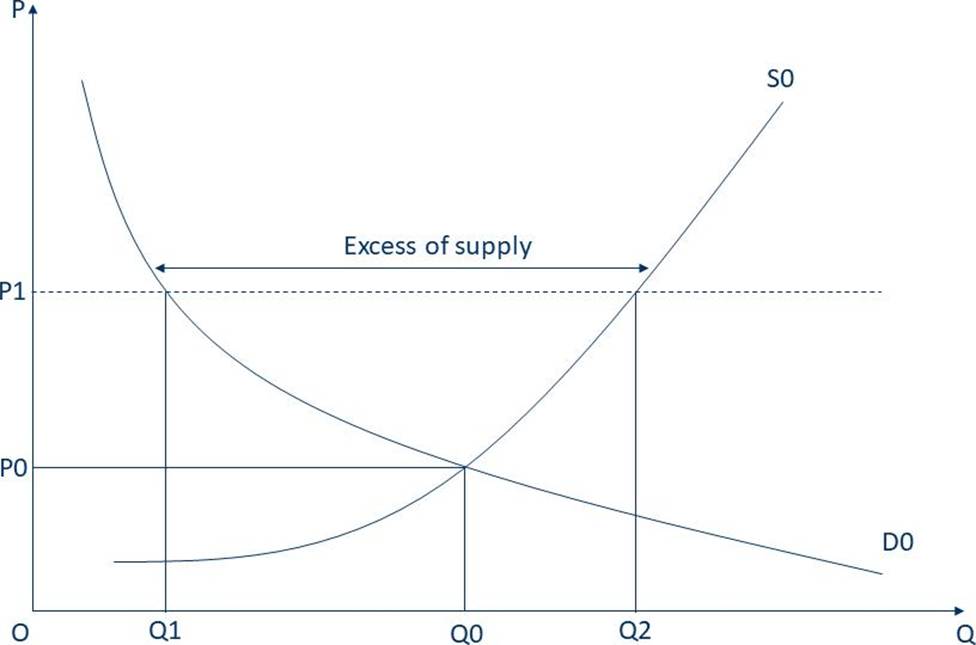
In microeconomics, equilibrium price is determined when the quantity demanded is equal to the quantity supplied at equilibrium price in a market, there will be no shortages and no surpluses. If we combine our supply and demand curves on one graph, the point at which they converge determines the equilibrium price. If the price is set above this price and you read across the graph you will see the supply excess demand and there will be a surplus. In order to reduce this surplus, the price will need to fall.
The scenario is illustrated in the graph below:
Win-lose approach is most likely to be associated with which of the following type of relationship?
- A . Adversarial
- B . Partnership
- C . Strategic alliance
- D . Outsourcing
A
Explanation:
Distributive approach to negotiation used when the interested parties are attempting to divide something up or distribute something of value, also known as zero-sum approach or win-lose. Win-lose approach is useful when the relationship with the other party (TOP) is short-term and once-off.
The question mentions 4 types of relationship:
Adversarial: Both seek to maximize position at the expense of the other. Almost no trust, communication and cooperation. These suppliers will probably provide non-core products or services with the buyer purchasing them on a one-off basis.
Outsourcing relationship: Use competent suppliers to manage non-core businesses previously done in-house. Require high level of trust and collaboration
Partnership: Both work closely on long term development by sharing information, technology and ideas. High level of trust with the aim to benefit both parties (win-win)
Strategic alliance: Both parties identify areas where they could collaborate to create mutual benefits Among these 4 types of relationship, only adversarial is once-off. Then it is the correct answer.
A public agency opens a tendering process for a road building project that lasts approximately 1 year. They post their requirements on public journal and receive some interests. After conducting due diligence process and selecting the lowest bidder, the project commences. However, the supplier complains that price of material increases because of a shortage of supply, then they demands an 5% uptick in contract value. The agency investigates the increment and sees that there is indeed a fluctuation in prices of supplier’s input. They are likely to accept the proposal, but they are also concerned that supplier may demand more.
To avoid making another concession with the supplier, which of the following should be a priority action of the agency?
- A . Disapprove supplier’s demands until they finish the project
- B . Seek approval from higher authority
- C . Document a contract variation that only allows another concession if some specific conditions arise
- D . Postpone the decision making until the budget is ready
C
Explanation:
The agency (buyer) has made a concession about the price. Possibly the supplier will request another concession (the salami tactics). To avoid this to be happened, the agency should only allow a concession as an exception, make sure that the concession is documented and only permitted against some exceptional circumstances, and seek agreement to this from the supplier. LO 3, AC 3.2
A negotiation is coming to the end. Both parties haven’t had any official commitments. Right before leaving the room, the buyer strongly disagrees with supplier’s set up prices and requests a discount. The supplier doesn’t reply but nods and smiles.
Can the buyer consider these actions as an acceptance?
- A . Yes, because smiling shows supplier’s readiness in signing the deal off
- B . No, because nodding and smiling are etiquette of polite rejection
- C . No, because nodding and smiling are not clear signs of neither acceptance nor rejection
- D . Yes, because negotiator should rely on non-verbal communications only
C
Explanation:
Good negotiators are attuned to all stimuli and not just the verbal and written information exchanged. Tone of voice, body language, facial expressions and other clues from TOP are noticed, and with experience and knowledge, interpreted correctly. This interpretation may also involve knowledge of culture norms and values. A smile, a ‘yes’ and the type of hospitality received, (in the business context), can mean very different things in different international business cultures. Trained negotiators will consider non-verbal communication (such as nodding and smiling) and body language as one source of signal from TOP, but will rarely rely wholly on this as a guide to what TOP is thinking or feeling. Furthermore, international and regional cultural considerations must be included here to avoid errors in interpretation. Emotional intelligence also has an important role in forming a more holistic perspective of what TOP may be thinking or feeling.
A procurement professional is negotiating with a supplier on cleaning service. She realises that there
are huge cost-saving opportunities if the supplier agrees to reduce its mark-up and unnecessary employee benefits.
Supplier’s mark-up and employee benefits are examples of which of the following?
- A . Spend waterfall
- B . Spend cube
- C . Spend tree
- D . Addressable spend
D
Explanation:
A key consideration when seeking to negotiate prices is to establish what proportion of the spend is addressable by procurement action such as negotiation. Addressability of spend is influenceable through negotiations or application of other saving effort or leverage with suppliers. LO 2, AC 2.1