
CIPS L4M5 Practice Exams
Last updated on Oct 23,2026- Exam Code: L4M5
- Exam Name: Commercial Negotiation
- Certification Provider: CIPS
- Latest update: Oct 23,2026
A supplier can produce a product for $160. The supplier sells the product to their client for $240, making a profit before tax of $80 on the transaction.
What is the mark-up profit percentage earned by the supplier on this transaction?
- A . 33%
- B . 159%
- C . 50%
- D . 67%
C
Explanation:
The mark-up percentage is calculated as the profit divided by the cost of production, then multiplied by 100 to convert it into a percentage.
Calculation:
(
80
/
160
)
×
100
=
50
%
(80/160)×100=50%
Thus, the supplier’s mark-up percentage is 50%, as per standard pricing calculations used in procurement.
The trust is built based on the other party’s professional qualifications or proven or certified technical capability or experience is known as…?
- A . Goodwill trust
- B . Contractual trust
- C . Irrevocable Trust
- D . Competence trust
D
Explanation:
Trust is the expectation that the other party will behave in a predictable and mutually acceptable way. In inter-firm relationships, the presence and absence of trust can affect the level of cost in a relationship. The existence of trust is taught to lower the transaction cost in a relationship. Dr. Mari Sako identified taxonomy of 3 types of trust in commercial relationship, which is very useful from the perspective of procurement.
Contractual trust: Trust based on the contract with TOP. This is potentially the weakest source of trust if there is nothing else to base the trust on, but it is the quickest to establish.
Competence trust: Trust based on TOP’s professional qualifications or proven or certified technical capability or experience.
Goodwill trust: Trust based on knowing TOP has your interest at heart and will not behave opportunistically. This is potentially the strongest type of trust, but it takes the longest time to build.
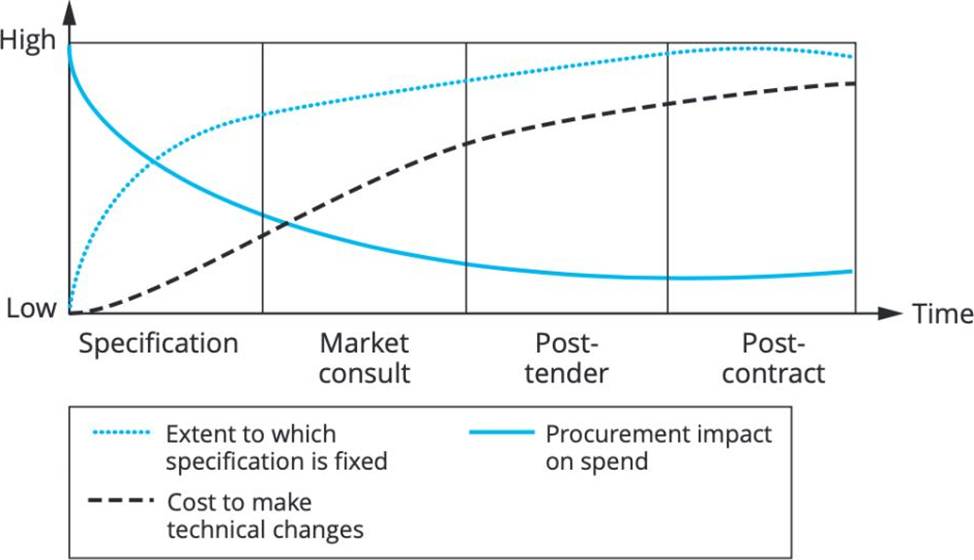
When is the best time in procurement process in which procurement should get involved so that the cost-saving opportunities are the greatest?
- A . Market consult stage
- B . Post-contract stage
- C . Specification stage
- D . Post-tender stage
C
Explanation:
The earlier procurement get involved in the procurement processes, the better. If procurement are involved in design at the specification stage they can feed in prices and costs to designer so they know the likely budget implication of choices made. Sending in a procurement team to negotiate at or close to the end of the procurement process effectively ties their hands and limits their negotiation leverage.
This is illustrated in the graph below:
LO 2, AC 2.1
What is a benefit to the buyer of having a BATNA (best alternative to a negotiated agreement) in a negotiation?
- A . To aid detailed pre-meeting data gathering and analysis
- B . To reduce financial and logistical risk for both parties
- C . To be able to confidently walk away from an unfavorable deal
- D . To facilitate information sharing between both parties
C
Explanation:
A BATNA provides the buyer with the confidence to walk away if terms are not favorable, ensuring they don’t settle for a suboptimal agreement. Knowing the best alternative enables buyers to negotiate from a position of strength, as per CIPS’s guidance on negotiation strategies.
Using compromise and creativity tactics
- A . 1 and 2 only
- B . 3 and 4 only
- C . 1 and 3 only
- D . 2 and 4 only
A
Explanation:
In a win-lose outcome, tactics often involve lowering the other party’s resistance point (1) and convincing them that the offer is the best possible (2). These strategies are designed to maximize advantage for one party at the expense of the other, fitting with CIPS’s win-lose negotiation techniques.
Telephone is most likely to be used for which of the following negotiations?
- A . High value contract
- B . Contract for purchasing a specialised product
- C . Routine transactions
- D . Complex one-off purchase
C
Explanation:
Many commercial negotiations could be considered routine or just not worth the investment for buyers, and using the phone can make more sense and can be more immediate. LO 2, AC 2.4