
CIPS L4M5 Practice Exams
Last updated on Oct 23,2026- Exam Code: L4M5
- Exam Name: Commercial Negotiation
- Certification Provider: CIPS
- Latest update: Oct 23,2026
Premium pricing strategies used by suppliers are characterised by which of the following? Select TWO that apply.
- A . Products are charged at a price based on supplier’s reputation
- B . This strategy is often used when supplier attempts to enter new market
- C . Price is based on cost structures
- D . Typically found in the early part of the product life cycle
- E . Premium price is determined by variable costs only
A, D
Explanation:
There are several pricing strategies used by suppliers:
Cost-plus pricing C Total variable + Fixed cost + profit
Premium pricing C based on branding. Supplier determines to charge a very high price, not connected with cost structures, usually based on its reputation and/or the perception that the product/service is of a superior quality. This strategy typically found in the early part of the product life cycle/when demand exceeds supply.
Penetration pricing – Supplier attempts to enter a new market or extend its share in an established one. It is characterised by price reductions to increase volume, followed by steady price increases; may even be loss leading at start (no profit made)
Marginal cost pricing C covers only variable cost
Market pricing C suppliers prices in line with what the market is willing to pay
Which of the following is a source of information on microeconomic factors?
- A . Published economic indices such as the Retail Price Index (RPI)
- B . Data published by the financial markets and commodity markets and exchanges
- C . Analysis published in the mainstream and financial media
- D . The marketing and corporate communications of suppliers
D
Explanation:
The marketing and corporate communications of suppliers are direct sources of microeconomic information, particularly about individual companies and industry conditions. Other options (RPI, financial market data, etc.) are more aligned with macroeconomic data, focusing on broader economic trends, as outlined in CIPS definitions of micro vs. macroeconomic data sources.
Which of the following should be the final step of a negotiation process if both parties cannot reach an agreement?
- A . Reflecting on performance
- B . Tempting TOP to reopen the negotiation
- C . Asking TOP for another concession
- D . Celebrating publicly about the deal
A
Explanation:
Reflecting on performance should become a natural final step in the negotiation process. ‘Celebrating publicly about the deal’: Public gloating, even in success or failure, if it gets back to the supplier via the press or social media, will likely damage the relationship ‘Tempting TOP to reopen the negotiation’: whether TOP agrees to reopen the negotiation, procurement should reflect on their achievement and what can be improved.
‘Asking TOP for another concession’: TOP can agree or reject this concession. Eventually, reflecting should be the final step. Procurement can learn a lot from reflection on performance. LO 3, AC 3.4
Sumitomo Rubber Industries (SRI) is a Japan-based tyre manufacturer. In order to increase production, SRI is sourcing rubber from Southeast Asian firms.
Which of the following micro factors are most likely to shift the balance of power to supplier? Select TWO that apply
- A . SRI’s purchase amount makes significant proportion of supplier revenue
- B . Costs of changing suppliers are high
- C . Rubber from different suppliers is virtually similar
- D . SRI sets up its own rubber plantation
- E . There are no close substitutes for rubber
B, E
Explanation:
There are many factors that can influence the balance of power in a negotiation.
These factors are classified into 3 levels:
– Macro level: STEEPLE framework: social, technological, economic, environment, political, legal and ethical
– Micro level: Porter’s five forces:
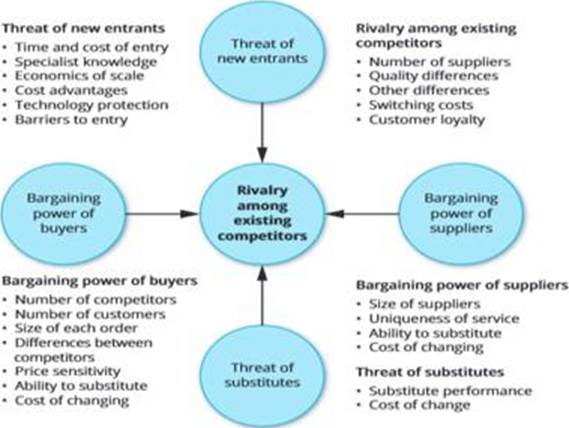
One-to-one buyer-supplier dynamics.
The question asks about the micro factors that increases supplier’s bargaining power. Among 5
answers, only 2 are likely to increase buyer’s power:
There are no close substitutes for rubber: the buyer has to buy rubber, not any other material.
Costs of changing suppliers are high: buyer entails a large barrier if they want to switch supplier.
Other answers cannot be correct because:
SRI sets up its own rubber plantation: Buyer secures its own supply
SRI’s purchase amount makes significant proportion of supplier revenue: Suppliers are reliant on buyer. If the buyer stops buying from them, they can face serious cash flow problems
Rubber from different suppliers is virtually similar: undifferentiated product would shift the power balance towards buyer.
An organization should develop different relationships which are appropriate to each supplier situation.
Which ONE of the following analysis methods could help to identify these?
- A . Resources and cost spectrum
- B . The relationship spectrum
- C . The color spectrum
- D . A spectrum of non-critical items
B
Explanation:
The relationship spectrum categorizes supplier relationships based on factors like strategic importance, allowing organizations to tailor their approach to each supplier relationship. CIPS emphasizes the relationship spectrum as a valuable tool for assessing and managing supplier interactions based on strategic relevance.
Which of the following types of questions are likely to be the most effective to check facts in negotiations?
- A . Hypothetical
- B . Open
- C . Leading
- D . Closed
D
Explanation:
Closed questions are useful for verifying facts, as they prompt specific, concise responses. These questions allow the negotiator to confirm details without ambiguity, which is crucial for clarity in negotiation settings, as highlighted in CIPS’s guidelines on questioning techniques.
A procurement manager has been asked to procure 1,000 pens. He suggests to his manager that to obtain the best value for money, they should undertake a competitive bidding process.
Would this be the best course of action?
- A . Yes, as all procurement processes should go through competitive bidding to achieve the best value for money
- B . Yes, the process will be opened up to many suppliers and therefore will result in a cheaper price for the pens
- C . No, competitive bidding should only be used when the value justifies the time spent on the process
- D . No, competitive bidding should only be used in public sector organisations
C
Explanation:
Competitive bidding is generally recommended for high-value or complex purchases where the cost and time required for the bidding process are justified. For low-value, routine items like pens, the time and resources required for competitive bidding may outweigh the potential cost savings, as noted in CIPS best practices. Hence, Option C is the best answer.
Which of the following is considered a weakness of a ‘dealer’ style negotiator?
- A . May shift position quickly
- B . May be too assertive
- C . Focuses on the facts and not the people
- D . Very precise
A
Explanation:
A useful and simple shorthand for preferred negotiation styles is summarised by four simple descriptor: ‘warm’, ‘tough’, ‘logical’ and ‘dealer’, which can be applied to describe individuals’ dominant preferred style in most circumstances. Warm – a people person
Tough – a hard-nosed negotiator
Logic – a numbers person
Dealer – a trader who loves bargaining
Strengths, weaknesses of dealer style are described below:
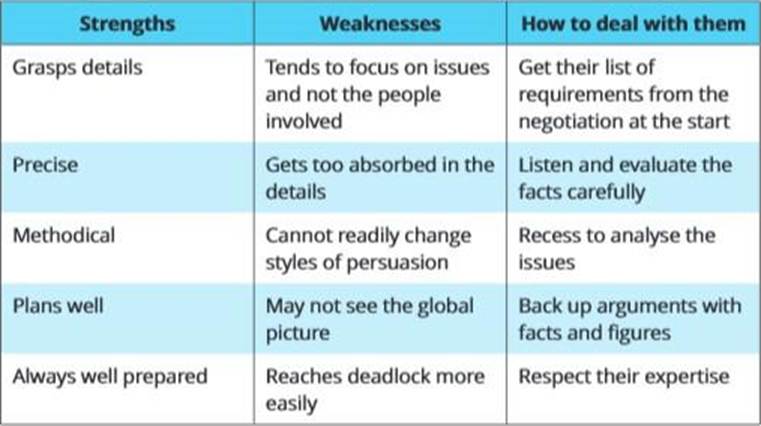
LO 2, AC 2.4
Which of the following is considered a weakness of a ‘dealer’ style negotiator?
- A . May shift position quickly
- B . May be too assertive
- C . Focuses on the facts and not the people
- D . Very precise
A
Explanation:
A useful and simple shorthand for preferred negotiation styles is summarised by four simple descriptor: ‘warm’, ‘tough’, ‘logical’ and ‘dealer’, which can be applied to describe individuals’ dominant preferred style in most circumstances. Warm – a people person
Tough – a hard-nosed negotiator
Logic – a numbers person
Dealer – a trader who loves bargaining
Strengths, weaknesses of dealer style are described below:
LO 2, AC 2.4