
CIPS L4M5 Practice Exams
Last updated on Oct 23,2026- Exam Code: L4M5
- Exam Name: Commercial Negotiation
- Certification Provider: CIPS
- Latest update: Oct 23,2026
Framework contracts are used to identify the supplier
- A . 1 and 2 only
- B . 1 and 3 only
- C . 2 and 3 only
- D . 2 and 4 only
B
Explanation:
Single-sourced relationships often involve exclusivity for a specific product (1) and a high level of trust and collaboration (3) between buyer and supplier. This type of relationship is selected for strategic procurement purposes, often involving long-term partnerships, which align with CIPS’s relationship spectrum guidelines.
A new manager has been appointed with responsibility for an organisation’s category which has major impact on organisational cost base and there are little competitions in the supply market. They have an objective to improve supplier cost structures over time.
Which of the following should they carry out first?
- A . Purchase price cost analysis
- B . Competitive rivalry analysis
- C . Volume concentration
- D . STEEPLE analysis
A
Explanation:
The objective of the buyer here is to improve supplier cost structures over time, which requires them to have insight into supplier’s current cost information. Purchase price cost analysis (PPCA) can help here. PPCA is a method for gathering, analysing and using price and cost information in a systematic way. The process allows the identification of future savings and opportunities to improve current costs.
STEEPLE analysis is used to analyse the macro environment that may have impact on an organisation.
Competitive rivalry is a part of Porter’s Five Forces which is a tool for strategy making. Volume concentration is a way to increase the purchasing quantities in order for a buying organisation to improve its leverage in negotiation.
Which of the following is active listening?
- A . Encouraging the other party to do all the talking
- B . Agreeing with what the other party has to say
- C . Summarising what has been said
- D . Ignoring what the other party has to say
C
Explanation:
Summarising what has been said is a key component of active listening, as it demonstrates understanding and engagement in the conversation. Active listening involves confirming and clarifying information, which helps build rapport and ensures accurate communication, as outlined in CIPS’s guidelines for effective negotiation communication.
Maria is a professional services category buyer within the National Health Service. Due to the severe financial budget cutbacks the National Health Service is facing, the procurement team has been tasked with achieving cost savings so that funding available can be spent on patient care. Maria plans to achieve savings with one of her collaborative suppliers.
Which negotiation approach should she undertake?
- A . Win-Lose
- B . Lose-Lose
- C . Win-Perceived Win
- D . Win-Win
D
Explanation:
The Win-Win approach is the most appropriate negotiation strategy in situations where collaboration and ongoing relationships are prioritized. In this case:
Achieving cost savings: The NHS aims to reduce expenses in order to reallocate funds to critical areas, making it essential that both parties work together to find cost-effective solutions.
Collaborative supplier relationship: Since Maria is working with a collaborative supplier, maintaining a positive relationship through mutual benefit is essential for continued cooperation.
Alignment with public service objectives: A Win-Win outcome aligns with the NHS’s broader objectives of maximizing resources for patient care, as it ensures that savings are achieved without undermining the supplier’s commitment to quality service.
This approach aligns with CIPS guidelines for maintaining productive, ethical partnerships in procurement, especially in critical sectors like healthcare.
Which of the following are variable costs?
- A . Rent
- B . Loan repayments
- C . Insurance
- D . Packaging
D
Explanation:
Packaging is considered a variable cost because it fluctuates with the level of production or sales activity. Variable costs change directly in relation to the volume of output or service.
In contrast:
Rent (A), Loan repayments (B), and Insurance (C) are fixed costs, as they generally do not vary with production levels within a certain range. These are recurring costs that remain constant over time, aligning with CIPS’s cost classification in procurement.
Which of the following are most likely to be abilities of a person with high emotional intelligence? Select TWO that apply.
- A . Complex idea comprehension
- B . Controlling one’s own emotions
- C . Perceiving how others feel
- D . Reasoning and problem solving
Abstract thinking
B, C
Explanation:
Emotional Quotient is the set of skills that enables us to make our way in a complex world – the personal, social and survival aspects of overall intelligence, the elusive common sense and sensitivity that are essential to effective daily functioning. It has to do with the ability to read the political and social environment, and landscape them; to intuitively grasp what others want and need; what strengths and weaknesses are; to remain unruffled by stress; and to be engaging. The kind of person others want to be around and follow.
EQ seeks to measure emotional intelligence and is centred on abilities such as the following:
– Identifying emotions
– Evaluating how others feel
– Controlling one’s own emotions
– Perceiving how others feel
– Using emotions to facilitate social communication
– Relating to others
On the other hand, cognitive ability is defined as a general mental capability involving reasoning,
problem solving, planning, abstract thinking, complex idea comprehension, and learning from
experience (Gottfredson, 1997).
LO 3, AC 3.3
Jasmine and the IHL sales team have a negotiation scheduled with one of AB’s lead buyers, Samuel, at AB’s premises. This is one of the biggest negotiations that Jasmine has been involved in and is eager not to make any mistakes. Jasmine has heard from a colleague that Samuel tends to adopt an integrative negotiation style. IHL senior management decides to send a team of three members to the negotiation. Jasmine is among the team and she is assigned to check body language, reactions, feeds insight to her leader and to record important comments and information from the meeting for minutes.
Which of the following are roles of Jasmine in the forthcoming negotiation? Select TWO that apply.
- A . Secretary (Correct)
- B . Commercial expert
- C . Technical expert
- D . Chief negotiator
- E . Observer
A, E
Explanation:
A negotiating team can be as few as two people, and one person can play one or more of these roles:
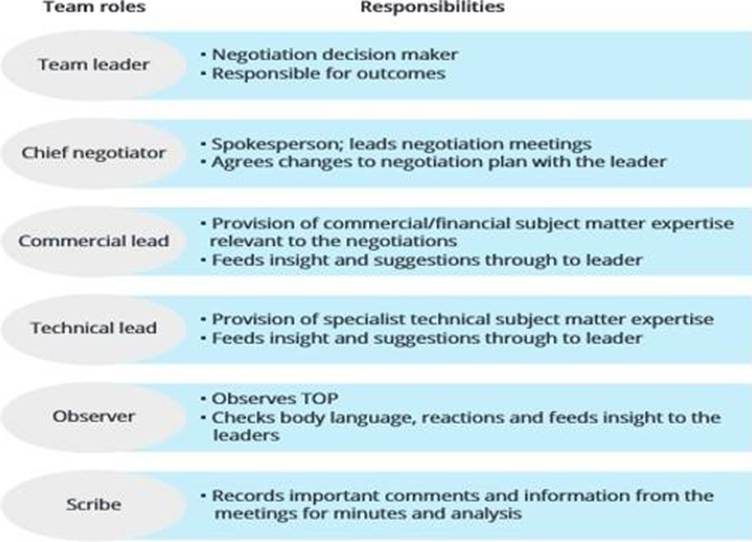
As from the scenario, Jasmine will act as an observer and a scribe (or secretary).
Which of the following is definition of elasticity of demand in microeconomics?
- A . The percentage change in the quantity demanded divided by the percentage change in income
- B . The percentage change in price of a good divided by the percentage change in the quantity demanded of that good.
- C . The percentage change in the quantity demanded of a good divided by the percentage change in the price of that good
- D . The percentage change in income divided by the percentage change in the quantity demanded
C
Explanation:
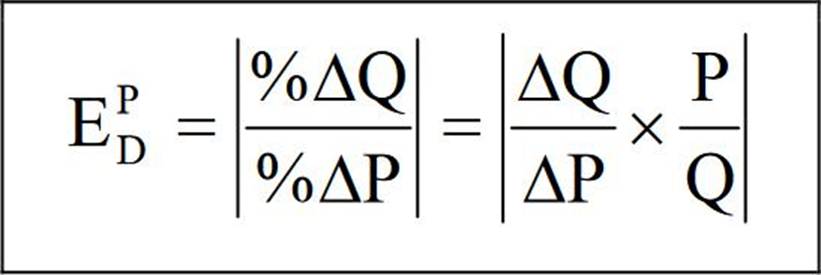
Elasticity refers to the responsiveness of quantity demanded or quantity supplied to a change in price or another factor:
The price of a product can be described as being elastic if a small change in price leads to a big change in demand.
The price of a product can be described as being inelastic if a big change in price leads to a small change in demand.
The formulae of elasticity of demand is known as the following:
Which of the following is a true statement regarding macroeconomic factors and their potential impact on negotiations?
- A . Macroeconomic factors always directly influence the negotiations
- B . Expectations on macroeconomic prospect are always correct
- C . Changes in macroeconomic factors may affect businesses and individuals differently
- D . Macroeconomic factors cannot be influenced by anyone’s expectation or sentiment
C
Explanation:
‘Macroeconomic factors always directly influence the negotiations’: This statement is false. For any given negotiation it is not the macroeconomic factor itself that necessarily influences the negotiation but the change or rate of change that factor.
‘Changes in macroeconomic factors may affect businesses and individuals differently’: This statement is true. Macroeconomic factors are factors that have general effects on the economy and many businesses may be completely unaffected or affected more or less than others in the same industry by a change in a factor.
‘Macroeconomic factors cannot be influenced by anyone’s expectation or sentiment’: This statement is false. When it comes to macroeconomic factors another key consideration is expectation regarding what might happen to these factors, or specifically the measures, metrics or percentage rates associated with these factors in the future.
‘Expectations on macroeconomic prospect are always correct’: This statement is false.
Expectations are not always correct.
LO 2, AC 2.2