
CIPS L4M5 Practice Exams
Last updated on Oct 23,2026- Exam Code: L4M5
- Exam Name: Commercial Negotiation
- Certification Provider: CIPS
- Latest update: Oct 23,2026
Jane is planning for a forthcoming negotiation with a key supplier. She has learned what are important to the supplier and what are important to her company from previous contracts between them. In order to avoid negotiation deadlocks, she has set up several concession plans. But Jane has little experience in dealing with suppliers and doesn’t know when to trade these concessions. When is the best time in a negotiation to trade concessions?
- A . In the testing phase
- B . In the proposing phase
- C . At bargaining stage
- D . At opening stage
C
Explanation:
The question asks about the point in time when Jane should make concessions with the supplier. These concessions should be traded after preliminary stages such as opening, testing and proposing are over and proposals move from being tentative and general to being more definite and specific. This stage is called bargaining phase. The bargaining phase is the ‘meat’ of the negotiation meeting. LO 3, AC 3.1
Which of the following will help to indicate personality preferences in four dimensions?
- A . Thomas-Kilmann Conflict Resolution model
- B . Intelligence quotient
- C . Mill’s RESPECT mnemonic
- D . Myers-Briggs Type Indicator
D
Explanation:
The MyersCBriggs Type Indicator (MBTI) is an introspective self-report questionnaire indicating differing psychological preferences in how people perceive the world and make decisions. MBTI indicates personality preferences in four dimensions.
The ThomasCKilmann Conflict Mode Instrument (TKI) is a conflict style inventory, which is a tool developed to measure an individual’s response to conflict situations.
Mill’s RESPECT mnemonic is set out by Harry
Which of the following are most likely to be sources of conflict that can emerge from the process of commercial negotiations? Select TWO that apply.
- A . Differences in conflict management style
- B . Differences in culture
- C . Types of purchase
- D . Standard terms and conditions
- E . Line of the best fits
A, B
Explanation:
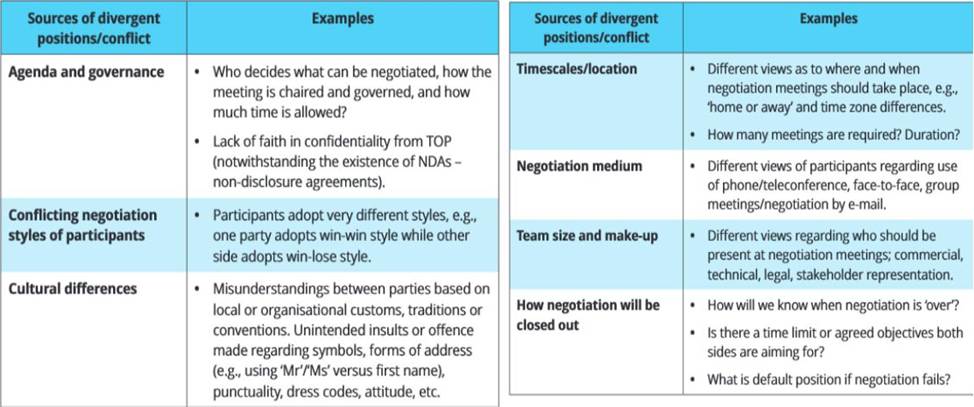
There are multiple sources of divergent positions that can arise in situations where money is exchange for goods and services. There are 2 different types of sources. Those that arise from the content or subject matter of the negotiation (what is being negotiated) and those that arise from the process of negotiation (how it is being negotiated).
Sources of divergent positions – the process of negotiation:
Line of best fits is the line that goes approximately through the middle of the data points with an equal number of data points above and below it. Line of best fits is a method of calculating medium
value in statistics.
Standard terms and conditions are basic terms and conditions of business governing transactions that do not have a definitive contract, usually designed to be included in form documents such as orders. While there may be conflicts regarding standard terms and conditions, they are about the content of negotiation, not the process.
Type of purchase: when buying organisation makes an decision to purchase an item, a buyer is faced with three possible scenarios. The item to be bought could be a straight re-buy, a modified re-buy or a new purchase. Decision on type of purchase is purely an internal decision.
Can a party gain huge advantages in negotiation from setting room layout?
- A . Yes, because the host can freely manipulate the other party’s mind through setting room layout
- B . No, because the advantages gained from manipulating room layout are short-lived
- C . Yes, because the other party can capitulate to the host
- D . No, because room layout contributes nothing to the negotiation outcomes
B
Explanation:
Essentially, for trained negotiators under most circumstances, the physical locations of negotiations and the room layout should not make much difference to the outcomes of the meeting. It is reasonable to assume that most commercial negotiations are based at least initially on a principled-or pragmatic-type approach. It is arguable also that any advantage gained through intentionally creating an uncomfortable environment to put short-term pressure on TOP is likely to be short-lived as TOP will likely reflect on this later and seek means to get even.
Which of the following are the most typical characteristics of integrative approach to negotiation? Select TWO that apply.
- A . Positional-based
- B . Claiming value
- C . Interest-based
- D . Short-term wins
- E . Creating more value
C, E
Explanation:
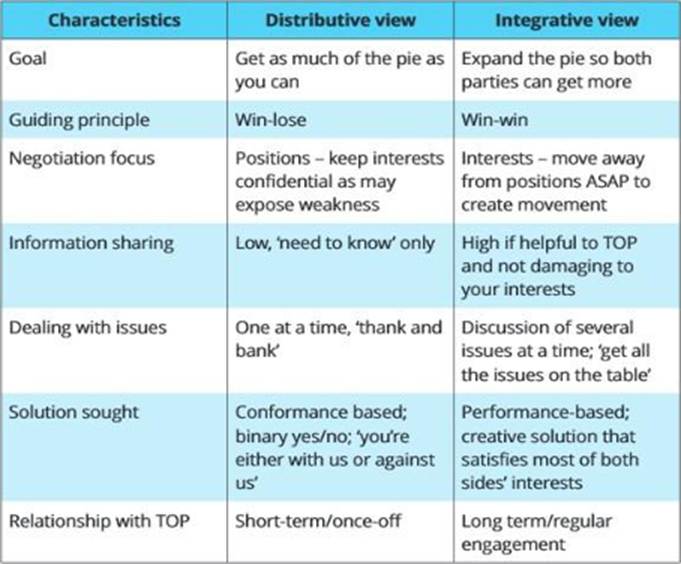
Integrative approach to negotiation used when the interested parties are attempting to create more of something of value to share, also known as collaborative approach or win-win. Integrative, interest-based negotiation can facilitate constructive, positive relationship and establishes contracts between parties on a foundation of goodwill. In integrative bargaining, both parties seek to ‘expand the pie’ by creating more value for both the buyer and the seller. Integrative negotiation ‘shares the pie’ and is interest rather than positional based.
In distributive bargaining, the focus is on claiming value and getting as much of the pie as parties can.
LO 1, AC 1.2
Which of the following are the most typical characteristics of integrative approach to negotiation? Select TWO that apply.
- A . Positional-based
- B . Claiming value
- C . Interest-based
- D . Short-term wins
- E . Creating more value
C, E
Explanation:
Integrative approach to negotiation used when the interested parties are attempting to create more of something of value to share, also known as collaborative approach or win-win. Integrative, interest-based negotiation can facilitate constructive, positive relationship and establishes contracts between parties on a foundation of goodwill. In integrative bargaining, both parties seek to ‘expand the pie’ by creating more value for both the buyer and the seller. Integrative negotiation ‘shares the pie’ and is interest rather than positional based.
In distributive bargaining, the focus is on claiming value and getting as much of the pie as parties can.
LO 1, AC 1.2
Commercial negotiation ends at the award of a contract. Is this statement true?
- A . Yes, because there are no rooms for negotiation after the contract is awarded
- B . Yes, because the supplier will comply with legally binding obligations
- C . No, because improvements can be achieved through post-award negotiation
- D . No, because real commercial negotiation begins after the contract is awarded
C
Explanation:
Negotiation doesn’t end after the contract is awarded. The needs for negotiation can arise in any post-award stages. For example, at supplier development and relationship management stage, improvement in supplier capability, capacity, and product/service range can be negotiated. Negotiations with long-term strategic critical suppliers should be carried out in a partnering style, with a win-win starting point assumed.
In some sectors such as transport, utilities and infrastructure, tenderers may ‘bid low’ or even make a loss to win major contracts with a view to negotiating lucrative changes, variations and ‘add-ons’ over the life of the contract when the supplier is bedded in and the buyer is in the weaker position to push back or challenge. Even in less complex contract, it is very likely that there will be a need to negotiate with that supplier again after the awarding of the contract. LO 1, AC 1.1