
CIPS L4M5 Practice Exams
Last updated on Oct 23,2026- Exam Code: L4M5
- Exam Name: Commercial Negotiation
- Certification Provider: CIPS
- Latest update: Oct 23,2026
Commercial negotiation ends at the award of a contract. Is this statement true?
- A . Yes, because there are no rooms for negotiation after the contract is awarded
- B . Yes, because the supplier will comply with legally binding obligations
- C . No, because improvements can be achieved through post-award negotiation
- D . No, because real commercial negotiation begins after the contract is awarded
C
Explanation:
Negotiation doesn’t end after the contract is awarded. The needs for negotiation can arise in any post-award stages. For example, at supplier development and relationship management stage, improvement in supplier capability, capacity, and product/service range can be negotiated. Negotiations with long-term strategic critical suppliers should be carried out in a partnering style, with a win-win starting point assumed.
In some sectors such as transport, utilities and infrastructure, tenderers may ‘bid low’ or even make a loss to win major contracts with a view to negotiating lucrative changes, variations and ‘add-ons’ over the life of the contract when the supplier is bedded in and the buyer is in the weaker position to push back or challenge. Even in less complex contract, it is very likely that there will be a need to negotiate with that supplier again after the awarding of the contract. LO 1, AC 1.1
The bargaining power of buyers is likely to be high in relation to suppliers in which of the following
situations?
- A . The buyer spend is a low proportion of the supplier’s revenue
- B . The buyer does not have the option to make as an alternative to buy
- C . The buyer demand is urgent and cannot be postponed
- D . The buyer is large in size relative to the supplier
D
Explanation:
The bargaining power of buyers increases when the buyer is large relative to the supplier. A large buyer can leverage its size to negotiate more favorable terms due to its significant impact on the supplier’s business. CIPS notes that a buyer’s size and purchasing volume are key factors that enhance its negotiating power in buyer-supplier relationships.
To buying organisation, savings can be achieved from different saving levers or tactics.
Which of the following are means that deliver savings through optimising specifications?
- A . Value engineering
- B . Part substitution
- C . Budget linkages
- D . Compare total cost of ownership
- E . Volume pooling
A, B
Explanation:
If driving greater value and efficiency from your supply base is your end, you should remember that there are many ways to do this without seeking to negotiate lower prices.
Below are 7 types of saving levers:
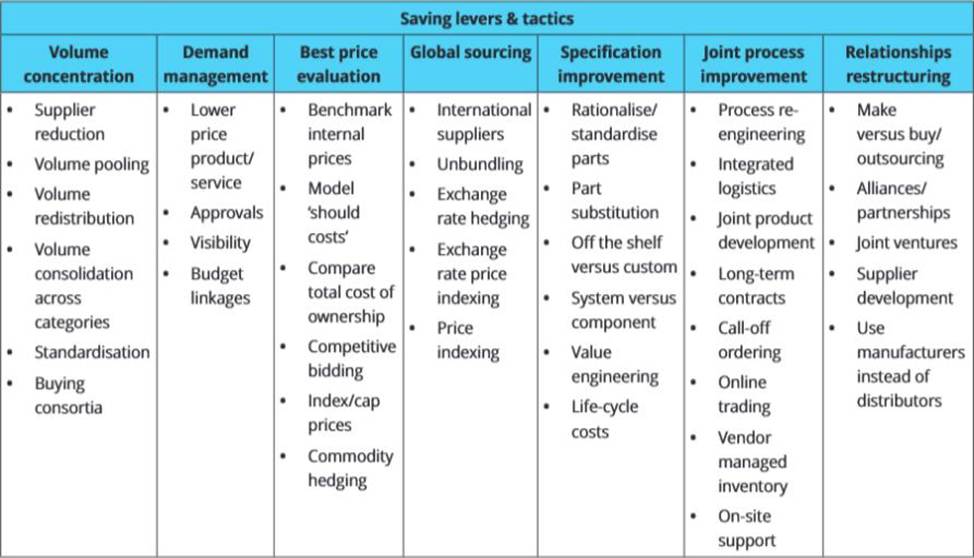
To buying organisation, savings can be achieved from different saving levers or tactics.
Which of the following are means that deliver savings through optimising specifications?
- A . Value engineering
- B . Part substitution
- C . Budget linkages
- D . Compare total cost of ownership
- E . Volume pooling
A, B
Explanation:
If driving greater value and efficiency from your supply base is your end, you should remember that there are many ways to do this without seeking to negotiate lower prices.
Below are 7 types of saving levers:
If the value of the British Pound in other currencies is strong, which of the following is most likely to occur?
- A . The price of UK products in the UK will rise
- B . The price of UK products in the UK will fall
- C . The price of UK products abroad in foreign currency will fall
- D . The price of UK products abroad in foreign currency will rise
D
Explanation:
Currency exchange rates are determined by macroeconomic factors and demand and supply. In general, countries with stable political and economic systems, a growing economy and a strong rule of law will have stronger and more stable currency than those without these characteristics. In this question, the British Pound is stronger than other currency, which means that buyers who import goods from the UK have to pay higher in their own currencies. LO 2, AC 2.2
During a negotiation, the supplier requests for payment term shortened to 45 days from 60 days. Seeing that this proposal lies within the concession plan, the procurement manager asks for 5% discount in return.
Is that right thing to do?
- A . Yes, the procurement manager should keep that 5% for himself because that amount is a fair compensation for his effort
- B . No, it is unethical to exploit the weakness of the other party
- C . No, procurement should insist the payment term remains 60 days
- D . Yes, since procurement manager has his own cost savings target to achieve and he should make use of supplier’s financial status
D
Explanation:
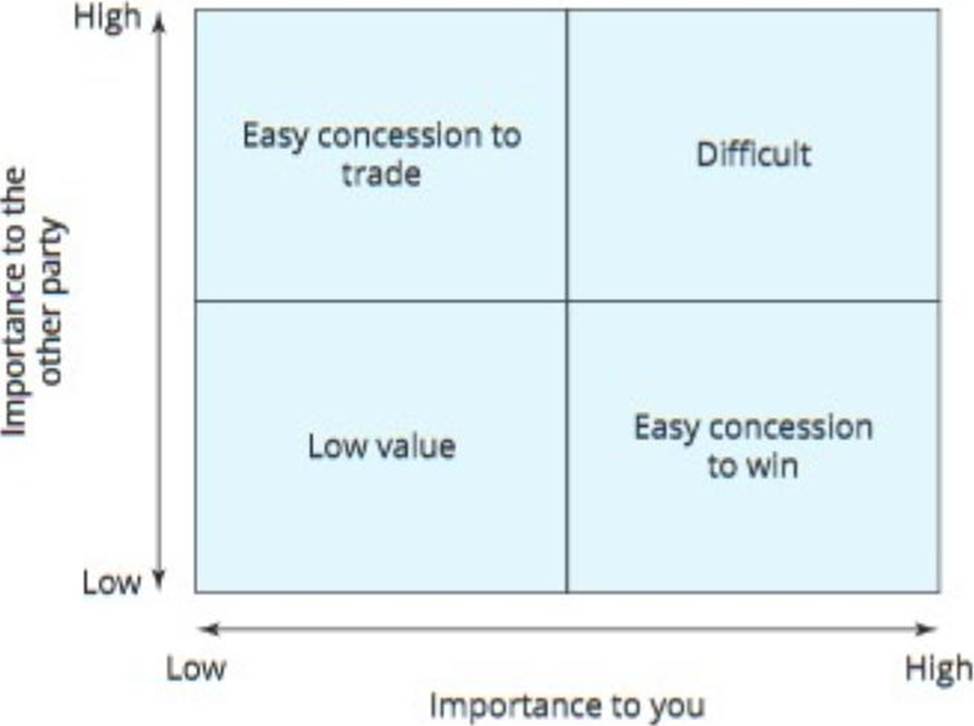
When preparing for a negotiation, negotiator should establish a list of tradeables and a concession plan. Good negotiators never give anything away that has not already been planned as part of the bargaining mix in the concession planning stage.
In the above scenario, the procurement manager has planned his own concession, so he can trade with supplier. The answer should be "Yes, since procurement manager has his own cost savings target to achieve and he should make use of supplier’s financial status"
LO 2, AC 2.3
In which of the following costing methods, overhead costs are applied in proportion to production volume?
- A . Absorption costing
- B . Mark-up costing
- C . Activity-based costing
- D . Marginal costing
A
Explanation:
There are 3 major costing methods:
Marginal costing
• Uses marginal cost of producing addition units
• Uses variable cost to derived a unit cost (does not include fixed cost)
• Fixed cost treated as a ‘period cost’ and deducted, as a total amount, from total contribution to profit for the period, in the firm’s profit and loss account
Absorption costing
• Calculates total cost of producing product
• In addition to variable cost, a fair proportion of fixed cost is allocated to (absorbed) each unit of output, as a fixed cost per unit
Activity based costing
• Similar to absorption costing but with fixed cost allocated to products on the basis of the cost of activities used in producing them
LO 2, AC 2.1
When developing a negotiation approach, according to recognised theory (for example, Mendelow), how should stakeholders with high interest but low power be managed?
- A . Minimal effort
- B . Key player
- C . Keep informed
- D . Keep satisfied
C
Explanation:
According to Mendelow’s Stakeholder Matrix, stakeholders with high interest but low power should be managed by keeping them informed. These stakeholders are invested in the outcome but lack the influence to change it, so keeping them updated helps in maintaining their support and managing expectations without intensive resources or prioritization. This approach aligns with CIPS guidance on stakeholder management in negotiation planning.
A purchasing organisation is discussing its approach to an upcoming negotiation with a key supplier over a contract for critical new services. They have decided they want to find a Win/Win (integrative) solution.
Which TWO of the following would be appropriate in this scenario?
- A . Collaboration
- B . Problem solving
- C . Coercion
- D . Persuasion
- E . Transfer of risk
A, B
Explanation:
In a Win/Win or integrative negotiation approach, the goal is to achieve mutual benefit, which is characterized by a collaborative environment.
According to CIPS principles on integrative negotiation:
Collaboration (A): Actively working together enables both parties to find solutions that maximize joint gains and address the needs of both sides.
Problem solving (B): Focusing on problem-solving allows both parties to address the issues at hand rather than competing over positions, facilitating a solution that satisfies both parties’ needs.
By emphasizing collaboration and problem-solving, the organization increases the likelihood of a successful, sustainable agreement that respects both parties’ interests.