
CIPS L4M5 Practice Exams
Last updated on Oct 23,2026- Exam Code: L4M5
- Exam Name: Commercial Negotiation
- Certification Provider: CIPS
- Latest update: Oct 23,2026
Which of the following are behaviours that builds trust between the buyer and the supplier in business relationship? Select TWO that apply.
- A . Conducting transparent procurement process
- B . Over-inflated contingency funds
- C . Allowing supplier to involve in early product development
- D . Commercial espionage
- E . Tendency to blame other party
A, C
Explanation:
Trust-building behaviours are as following:
Joint-effort issue resolution
Open sharing of information
Open and honest discussion on root cause of failures
Joint planning focusing on value for money and risk sharing
Commercial transparency and co-proposition of cost reduction and service improvement programmes
Joint recognition and celebration of successes
Which of the following roles would support negotiations with an external supplier when planning a negotiation for a low-value, routine purchase? Select TWO that apply.
- A . The Human Resource (HR) manager
- B . A legal advisor
- C . The procurement manager
- D . The Chief Executive Officer (CEO)
- E . An internal business user
C, E
Explanation:
For low-value, routine purchases, the involvement of The procurement manager (C) and An internal business user (E) is appropriate. The procurement manager brings expertise in supplier engagement, while the internal business user provides insights on specific needs for the product or service.
Involving high-level roles, like the CEO or a legal advisor, is unnecessary for routine purchases, as per CIPS guidance on resource alignment in procurement.
Which of the following is the area where two or more negotiating parties may find common ground?
- A . Zone of potential agreement
- B . Zone of proximal development
- C . Walk away area
- D . Best alternative to a negotiated agreement
A
Explanation:
The zone of possible agreement (ZOPA) or bargaining range is considered an area where two or more negotiating parties may find common ground. It is this area where parties will often compromise and strike a deal. In order for negotiating parties to find a settlement or reach an agreement, they must work towards a common goal and seek an area that incorporates at least some of each party’s ideas. The zone of proximal development refers to the difference between what a learner can do without help and what he or she can achieve with guidance and encouragement from a skilled partner. There is no Walk away area. Walk away point is a position from which you cannot concede any more ground and must walk away/decline a deal.
Best alternative to a negotiated agreement is a fallback or backstop position if the negotiation fails to result in an agreement/no deal is agreed.
LO 1, AC 1.2
Which type of question should be used to receive affirmation on statement?
- A . Open
- B . Closed
- C . Leading
- D . Narrow
B
Explanation:
Different questioning styles can be used to elicit desired responses:
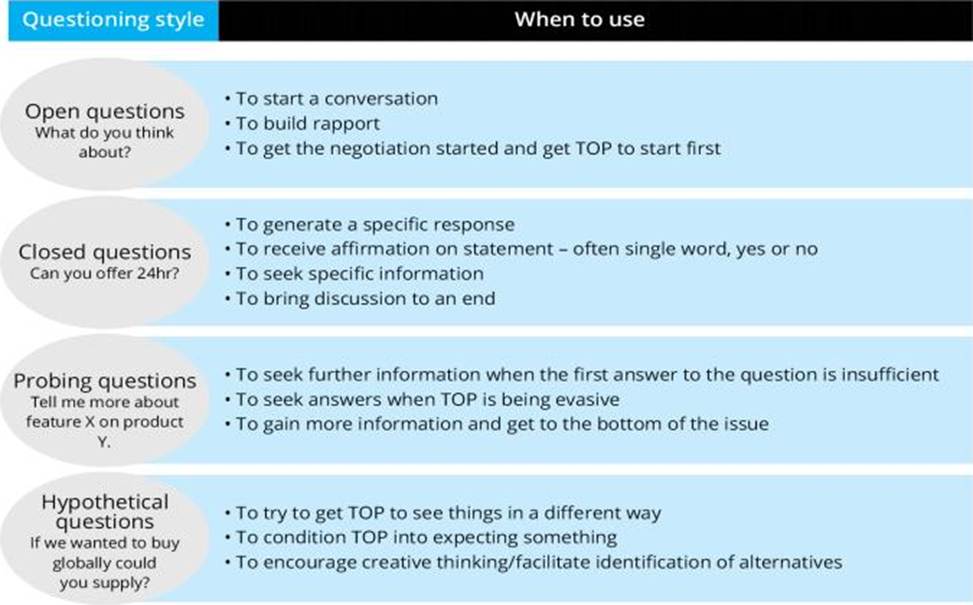
Which of the following is the first step in the development of negotiation strategies?
- A . Determining your BATNA
- B . Developing scenarios around possible options
- C . Recognising TOP’s needs and wants
- D . Defining overarching objectives
D
Explanation:
Developing specific negotiation strategies in areas where risk or spend is high involves analysing a wide range of objectives and variables within the context of the organisation’s business requirements. The first stage in any negotiation preparation is to define your overall objectives which may be related to a single variable such as price in the case of a standardised requirement, or many variables in the case of capital equipment. Your negotiating strategies and tactics will all be focused on achieving overall objectives.
Which of the following are intangible values created by trust in business relationships? Select TWO that apply.
- A . Higher revenues
- B . Positive feedbacks from customers
- C . More focus on core business
- D . Increasing response time to request
- E . Frequent conflict escalation
B, C
Explanation:
Trust may create value as following:
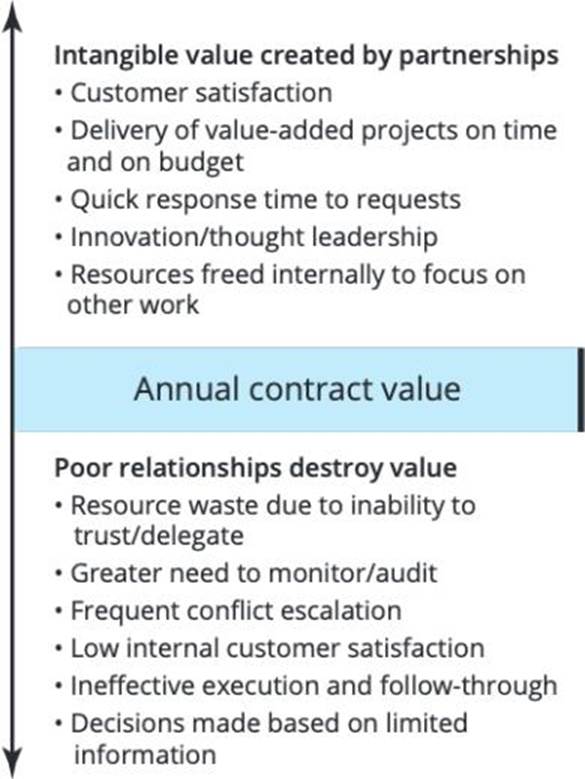
LO 1, AC 1.4