
CIPS L4M5 Practice Exams
Last updated on Oct 23,2026- Exam Code: L4M5
- Exam Name: Commercial Negotiation
- Certification Provider: CIPS
- Latest update: Oct 23,2026
Information generated through Purchase Price Cost Analysis can be useful to the purchaser, by helping to identify which of the following costs relating to the supplier? Select the THREE that apply.
- A . External costs
- B . Profit
- C . Material costs
- D . Market costs
- E . Budgeted costs
- F . Depreciation on equipment
C, F
Explanation:
Below are some examples of cost input that can be analysed in PPCA process:
– Material costs
– Process and labour costs
– Employment costs
– Overhead costs
– Distribution costs
– Depreciation on equipment
– Profit
…
If you want to learn more on PPCA, you can study from OGC document here: https://webarchive.nationalarchives.gov.uk/20100609100650/www.ogc.gov.uk/documents/Cost_Pri ce_analysis(1).pdf
LO 2, AC 2.1
Which of the following should be done when undertaking a reflection activity on negotiation? Select TWO that apply.
- A . Identify areas in your skill set where you need to improve
- B . Gloss over areas where you need to improve your skills or performance
- C . Be overly modest about your contribution to the outcomes of negotiation
- D . Use generalised or ambiguous language when describing your strengths and development areas
- E . Be honest and objective about your skills
A, E
Explanation:
Giving positive group and individual feedback is easy, as is self-congratulation and, in many cases, it is hoped, this will be an accurate reflection on actual performance. When it comes to developmental or difficult feedback, it is only natural to want to move on and not reflect on the negative or developmental points, or why a negotiation did not achieve its objectives. But this is a mistake. The best learning opportunities come from reflection on what could be done better, and this can be achieved without blame, threat or condemnation. Everyone and every team will make mistakes and/or have areas where they could have improved. Clearly, if every reflection session concludes that an individual or team keeps making the same mistake, then there is a case to change roles or consider alternative approaches.
About Dos and Don’ts of reflection, you can refer here: https://offices.depaul.edu/human-resources/employee-relations/Documents/Self%20Assesement.pdf
Which of the following are common forms of collaborating approach in Thomas-Kilmann conflict resolution model? Select THREE that apply.
- A . Exploring a disagreement to learn from each other’s insights
- B . Yielding to another’s point of view
- C . Resolving some conditions that would otherwise have them competing for resources
- D . Trying to win at any cost
- E . Trying to find a creative solution to current problem
- F . Seeking a quick middle-ground position
A, C, E
Explanation:
Collaborating is both assertive and cooperative. When collaborating, an individual attempts to work with the other person to find a solution that fully satisfies the concerns of both. It involves digging into an issue to identify the underlying concerns of the two individuals and to find an alternative that meets both sets of concerns. Collaborating between two persons might take the form of exploring a disagreement to learn from each other’s insights, resolving some condition that would otherwise have them competing for resources, or confronting and trying to find a creative solution to an interpersonal problem.
At the first stage of CIPS Procurement and Supply Cycle (Understand need), which of the following is the most important duty of procurement professional?
- A . Demand management
- B . Evaluating the interests from suppliers
- C . Undertaking ‘reverse marketing’
- D . Deciding whether RFQ or ITT should be used
A
Explanation:
At the first stage of CIPS Procurement and Supply Cycle (Understand need and develop a high-level specification), procurement professional mainly negotiate with internal stakeholders. They have a duty to proportionately and constructively challenge specification if there’s genuine doubt over the need or how the need is expressed. This is called demand management. Their first duty is to the organisation’s treasury, not to functional managers.
Demand management including: negotiation/challenge between procurement and internal stakeholders over the need/requirement/specification. Remember that in any process or product, the greatest opportunity for cost reduction is at the design stage.
Professional buyer is planning for the next negotiation of a simple one-off contract.
This negotiation is typified by which of the following? Select TWO that apply.
- A . Continuous dialogue with supplier
- B . Total cost of ownership is the most important criterion
- C . Vendor ratings will be used
- D . Arm’s-length approach
- E . Pricing is the most important criterion
D, E
Explanation:
Professional buyers, when planning or engaging in negotiation with suppliers, should always be aware of where the intended and actual relationship with this supplier is positioned on the ‘spectrum’ or ‘continuum’ of commercial relationships. The relationship spectrum describes the range of commercial relationships between a buyer and supplier based on richness of communication, longevity and mutual dependence.
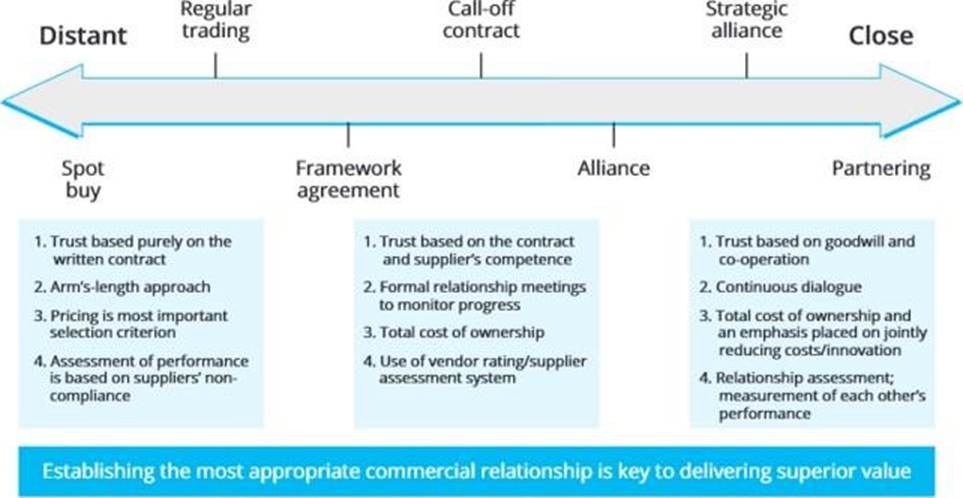
In the question, the contract is simple one-off (or spot buy), which means the relationship will likely to be more transactional. In such relationship, price is the most important criteria and buyer may adopt arm’s-length approach.
Professional buyer is planning for the next negotiation of a simple one-off contract.
This negotiation is typified by which of the following? Select TWO that apply.
- A . Continuous dialogue with supplier
- B . Total cost of ownership is the most important criterion
- C . Vendor ratings will be used
- D . Arm’s-length approach
- E . Pricing is the most important criterion
D, E
Explanation:
Professional buyers, when planning or engaging in negotiation with suppliers, should always be aware of where the intended and actual relationship with this supplier is positioned on the ‘spectrum’ or ‘continuum’ of commercial relationships. The relationship spectrum describes the range of commercial relationships between a buyer and supplier based on richness of communication, longevity and mutual dependence.
In the question, the contract is simple one-off (or spot buy), which means the relationship will likely to be more transactional. In such relationship, price is the most important criteria and buyer may adopt arm’s-length approach.
Chair
- A . 1 and 2
- B . 1 and 3
- C . 2 and 3
- D . 3 and 4
B
Explanation:
A junior team member can effectively contribute as a note taker (1) and observer (3), allowing them to support the meeting without taking on roles that require more experience, like chairing or serving as an expert. This aligns with CIPS’s recommendations for assigning junior roles in negotiations.
Which of the following are examples of push techniques in commercial negotiations? Select TWO that apply.
- A . Threat of punishment, costs and damage
- B . Listening to, involving and supporting others
- C . Argument based on information, logic and reason
- D . Working together to define the problem, the goals and the best solution
- E . Using language and imagery to ‘paint a picture others can see’
A, C
Explanation:
There are two major persuasion methods: ‘push’ and ‘pull’.
Persuasion can be defined as encouraging someone to do something that you want them to do for you. Persuasion is reasoning with someone so that they will believe or do something they might not otherwise do. Persuasion can be considered as ‘pushing’ on TOP so that they can accept the change in attitude or behaviour as a result of your actions.
Influence is the ability to affect the manner of thinking of another. Influence can be considered as pulling on TOP so that you achieve the same result, but TOP feels they have changed their attitude or behaviour as a result of their reflection and thinking, and not your direct actions.
There are 5 options in this question:
‘Threat of punishment, costs and damage’: The influencer tries to ‘push’ the other party to act as he/she wants by using force. This method is effective but short-lived. The influencer also risks to developing reputation for being heavy handed and dictatorial.
‘Argument based on information, logic and reason’: The influencer uses logic and reasons to persuade the other party. This is also known as ‘Persuasive Reasoning’ (Push)
‘Using language and imagery to ‘paint a picture others can see’’: The influencer seeks to influence another by understanding the other’s emotions, and stimulating that party’s imagination to visualise the desired future goal of the influencer. This is also known as ‘visionary (pull)’
‘Working together to define the problem, the goals and the best solution’: In this technique, the person seeking to influence another involves the other party in the decision making process. This is known as ‘collaborative (pull)’
‘Listening to, involving and supporting others’: In this technique, the person seeking to influence another tries to discover the other party’s emotion and aims at mutual understanding. This is also a collaborative approach.
A garden furniture supplier who is currently in negotiations for a high-value contract has offered the procurement manager a visit to their site. The supplier suggests that during this visit, they can undertake the contract negotiation.
What would be an appropriate response from the procurement manager?
- A . Accept the offer as this would be an ideal opportunity to see what the supplier can offer and will provide the supplier with familiarity while negotiating
- B . Accept the offer as this would save time; a supplier visit and negotiation could be done at the same time
- C . Decline the offer as it would take too much time to go and visit the supplier
- D . Decline the offer as negotiating while on a site visit will provide the supplier with an unfair advantage, as they will be in a familiar environment
D
Explanation:
Negotiating at the supplier’s site can give the supplier a psychological advantage due to their familiarity with the setting. To ensure a neutral and balanced negotiation environment, it’s preferable to conduct negotiations in a neutral location or through structured channels, as recommended in CIPS’s guidance on negotiation settings.
Stalemate is more likely to happen if both parties trade more variables in a commercial negotiation.
Is this assumption true?
- A . No, because the party who offers more variables will have lower bargaining power
- B . Yes, because the negotiation will last endlessly if there are too many variables
- C . No, because more variables will facilitate more possible negotiated outcomes
- D . Yes, because more variables will cause more conflicts of interest
C
Explanation:
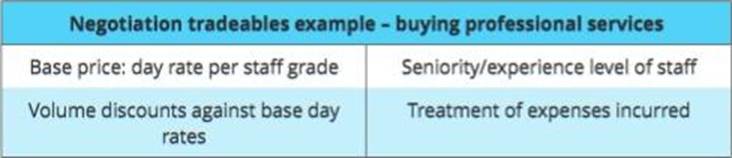
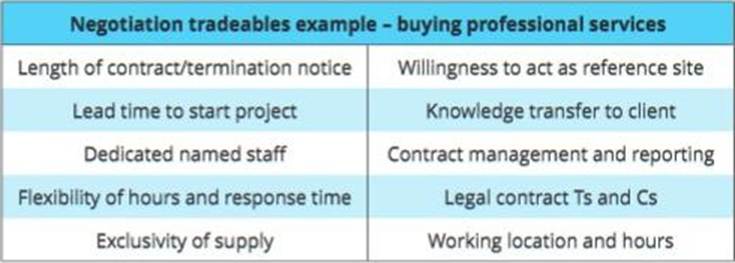
Negotiation variables such as price or contract length, etc are that can be traded with TOP in a negotiation. The more variables you can identify, the better. The more variables you can identify and articulate, the lower the chances of the negotiation reaching deadlock as more possibilities are facilitated regarding more creative solutions.
Below are examples of negotiation tradeables in buying professional services:
LO 2, AC 2.3