
CIPS L4M5 Practice Exams
Last updated on Oct 23,2026- Exam Code: L4M5
- Exam Name: Commercial Negotiation
- Certification Provider: CIPS
- Latest update: Oct 23,2026
Which of the following are most likely to be the potential cultural differences that can make transactions with an international supplier more problematic that with local suppliers? Select TWO that apply.
- A . Incoterms and logistics difficulties
- B . The use and interpretation of body language
- C . Currency exchange fluctuation
- D . The importance of timescales
- E . Payment mechanism
B, D
Explanation:
The question requires student to detect factors of cultural differences. Problems may occur on the international scene with such things as the importance of extending courtesy between cultures, the importance of timescales, the use of negotiating ploys, the sense of ‘fair play’, the use and interpretation of body language, the role of women in negotiations (or indeed, in business in general), the importance of status, the role of conflict, standards of dress and deportment and the readiness to ignore or uphold contract terms and conditions. LO 3, AC 3.3
John Browne, a junior buyer for a corporation, is analyzing the global supply market before undertaking negotiations and is wondering whether foreign exchange rates are important to factor into his research.
Should John consider the foreign exchange rates?
- A . No, as they only affect the bank’s interest rates for loans
- B . Yes, only if the organization can handle foreign currencies in their accounts
- C . Yes, as they can affect profit and turnover
- D . No, exchange rates only apply to the national economy
C
Explanation:
Foreign exchange rates impact import costs, profit margins, and overall turnover when transactions are conducted in foreign currencies. Understanding these fluctuations allows buyers to anticipate changes in purchasing costs, supporting informed decision-making, as highlighted in CIPS guidance on global procurement considerations.
Sally is negotiating with an oversea supplier on the price and payment period. Her company and the supplying organisation are equal in bargaining power. The supplier says that they are investing in new facilities and machinery so the payment period should not be longer than 30 days. Sally knows that her company often pays the suppliers after 45 days from the delivery, but at the moment the company has positive cash flow and it is able to pay immediately.
Which of the following should be Sally’s concession plan?
- A . Contend on the normal payment period
- B . Shorten payment period but ask for a discount
- C . Agree with supplier’s payment period without any further demand
- D . Demand for a discount without any other concessions
B
Explanation:
In the scenario, the length of payment period is particularly important to the supplier as they are investing new facilities. Otherwise, the buyer’s company has a positive cash flow position and budget is available for a shorter payment terms. So this tradeable (payment period) is important to supplier but it is not a significant problem with the buyer.
This tradeable will fall within ‘Easy concession to trade’ quadrant in the following matrix:
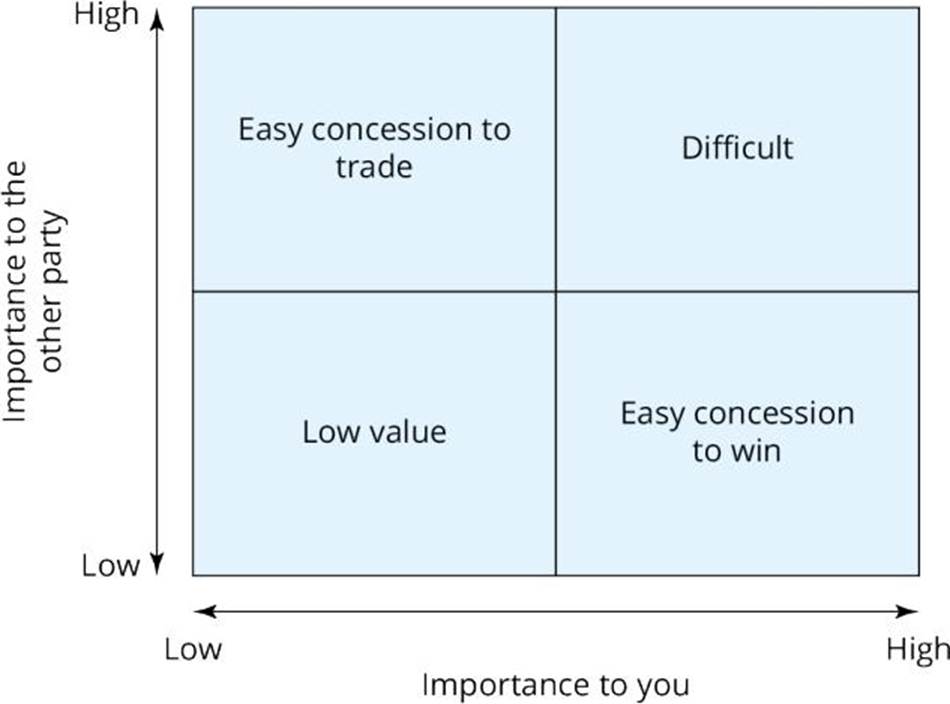
If the tradeable fall within this quadrant, Sally should shorten the payment period in supplier’s favour and try to win as many concessions as possible in return. Asking for a discount may be a reasonable trade-off.
LO 2, AC 2.3
Sally is negotiating with an oversea supplier on the price and payment period. Her company and the supplying organisation are equal in bargaining power. The supplier says that they are investing in new facilities and machinery so the payment period should not be longer than 30 days. Sally knows that her company often pays the suppliers after 45 days from the delivery, but at the moment the company has positive cash flow and it is able to pay immediately.
Which of the following should be Sally’s concession plan?
- A . Contend on the normal payment period
- B . Shorten payment period but ask for a discount
- C . Agree with supplier’s payment period without any further demand
- D . Demand for a discount without any other concessions
B
Explanation:
In the scenario, the length of payment period is particularly important to the supplier as they are investing new facilities. Otherwise, the buyer’s company has a positive cash flow position and budget is available for a shorter payment terms. So this tradeable (payment period) is important to supplier but it is not a significant problem with the buyer.
This tradeable will fall within ‘Easy concession to trade’ quadrant in the following matrix:
If the tradeable fall within this quadrant, Sally should shorten the payment period in supplier’s favour and try to win as many concessions as possible in return. Asking for a discount may be a reasonable trade-off.
LO 2, AC 2.3
Which of the following are most likely to be direct costs of a steel manufacturer? Select THREE that apply.
- A . Cleaning services
- B . Coal
- C . Senior management salary
- D . Insurance for production lines
- E . Scrap metal
- F . Hourly production wages
B, E, F
Explanation:
Direct costs are those costs of a product/service directly attributable/traceable to its production.
Examples of direct costs including the following:
Materials and services bought-in: In steel manufacturer, raw materials are iron ores, scrap metal, coals, etc
Labour or wages: money paid to staff for the work involved in producing the product.
Other expenses: other charges incurred that can be specifically attributed to a particular product, batch or service
Which of these personal power bases stems from the manager’s position in the organisation and the authority that lies in that position?
- A . Coercive power
- B . Legitimate power
- C . Expert power
- D . Reward power
B
Explanation:
Legitimate power comes from the belief that a person has the formal right to make demands, and to expect others to be compliant and obedient. Legitimate power comes from rules, formal authority, organisation rank, staff grade or official position held. In commercial negotiation, legitimate power can be demonstrated by job title and rank.
LO 1, AC 1.3