
CIPS L4M5 Practice Exams
Last updated on Oct 23,2026- Exam Code: L4M5
- Exam Name: Commercial Negotiation
- Certification Provider: CIPS
- Latest update: Oct 23,2026
Representatives from South African Department of Health is negotiating the price of hospital drugs with US pharmaceutical companies.
Which of the following are most likely to be macro factors that influence the outcomes of the negotiation? Select TWO that apply.
- A . Forward integration
- B . Digitalisation of medicine
- C . Order quantity
- D . Regulations on health and safety
Switching costs of buyer
B, D
Explanation:
All one-to-one commercial negotiations between a specific purchaser and a specific supplier take place within an industrial market and a larger business environment characterised by multiple forces which both parties typically have little control over.
STEEPLE framework highlights the 6 main external influences on a business:
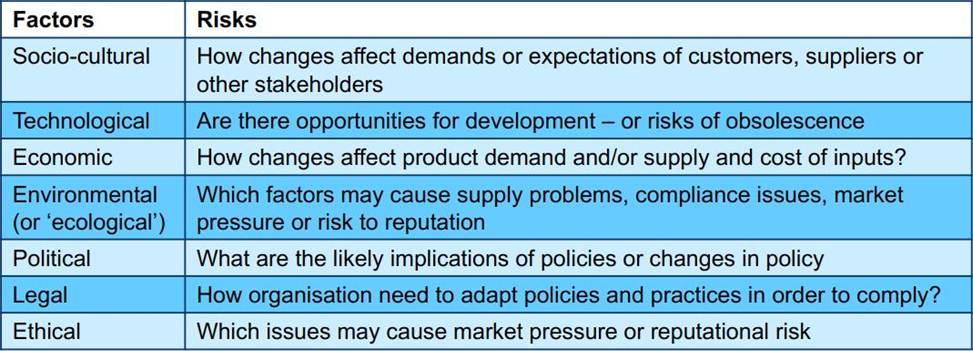
Particularly, pharmaceutical industry is a heavily regulated sector, therefore, legal and regulatory matters in the industry is highly important. Otherwise, technological trends also permeate into pharmaceutical companies, technologies like digitalisation may transform the balance of power in such negotiation.
LO 1, AC 1.3
Representatives from South African Department of Health is negotiating the price of hospital drugs with US pharmaceutical companies.
Which of the following are most likely to be macro factors that influence the outcomes of the negotiation? Select TWO that apply.
- A . Forward integration
- B . Digitalisation of medicine
- C . Order quantity
- D . Regulations on health and safety
Switching costs of buyer
B, D
Explanation:
All one-to-one commercial negotiations between a specific purchaser and a specific supplier take place within an industrial market and a larger business environment characterised by multiple forces which both parties typically have little control over.
STEEPLE framework highlights the 6 main external influences on a business:
Particularly, pharmaceutical industry is a heavily regulated sector, therefore, legal and regulatory matters in the industry is highly important. Otherwise, technological trends also permeate into pharmaceutical companies, technologies like digitalisation may transform the balance of power in such negotiation.
LO 1, AC 1.3
’What specific tests do you carry out to ensure quality is achieved?’ This is an example of which type of negotiation question?
- A . Leading
- B . Probing
- C . Reflective
- D . Closed
B
Explanation:
The question requires more detailed answer, it is an example of probing question.
Probing questions are typically follow-up questions, and aim to elicit more detailed information on the back of the answer elicited from the open questions. Probing question are also useful to check that the supplier fully understand their offering, as well as your needs, can also be used to communicate to the suppliers that you know this category well. LO 3, AC 3.3
There are no commitments in hypothetical questions. Is this statement true?
- A . No, because the party who makes hypothetical questions cannot withdraw their proposals
- B . No, because hypothetical questions are made explicitly to the other party
- C . Yes, because hypothetical questions generate a specific response
- D . Yes, because hypothetical questions only mention possible situations
D
Explanation:
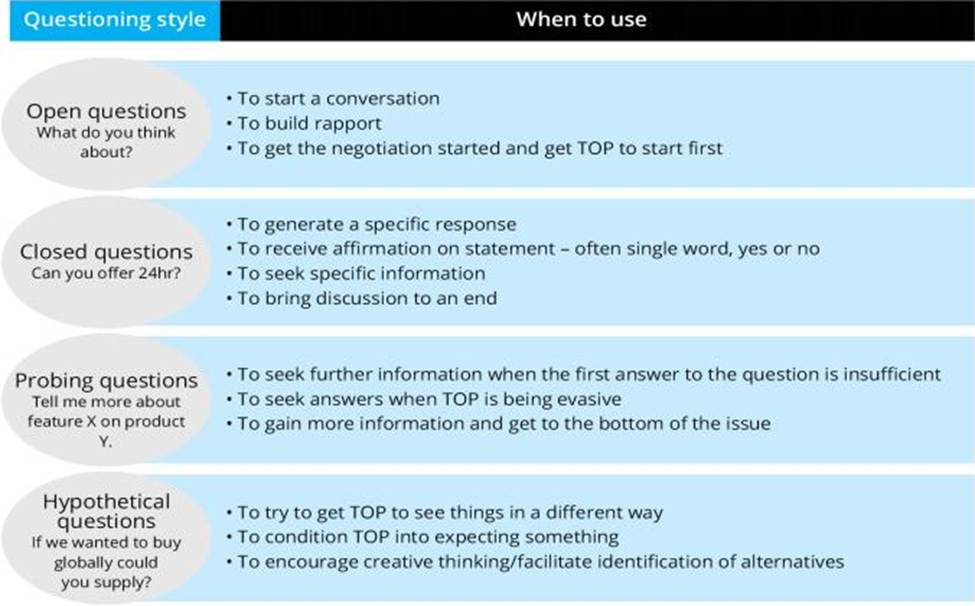
There are four types of questions that can be used in a commercial negotiation:
Hypothetical questions, where you ask about a possible situation or abstract concept, are very useful at the testing and proposal phases. Hypothetical question does not state any commitment as it is only about ‘if something happens, then …’. This type of question can be useful at giving suggestion.
LO 3, AC 3.3
There are no commitments in hypothetical questions. Is this statement true?
- A . No, because the party who makes hypothetical questions cannot withdraw their proposals
- B . No, because hypothetical questions are made explicitly to the other party
- C . Yes, because hypothetical questions generate a specific response
- D . Yes, because hypothetical questions only mention possible situations
D
Explanation:
There are four types of questions that can be used in a commercial negotiation:
Hypothetical questions, where you ask about a possible situation or abstract concept, are very useful at the testing and proposal phases. Hypothetical question does not state any commitment as it is only about ‘if something happens, then …’. This type of question can be useful at giving suggestion.
LO 3, AC 3.3
One difference between perfect competition and monopolistic competition is that…?
- A . In perfect competition, firms produce slightly differentiated products
- B . A perfectly competitive industry has fewer firms.
- C . Monopolistic competition has no barriers to entry
- D . Firms in monopolistic competition face a downward-sloping demand curve
D
Explanation:
Monopolistic competition exists in market where there are many competing producers but they will try to use product differentiation. Although their products may be very similar, their ability to differentiate means that they can act as monopolies in short run, irrespective of the actions of their competitors.
In perfect competition, there are no barriers to entry to the market or exit from the market. In monopolistic competition, there tend to be fewer barriers to entry or exit in these markets than in oligopolistic markets, but it doesn’t mean that there are absolutely no barriers to entry in monopolistic competition.
In perfect competition, the demand curve is perfectly elastic, which means that it will be horizontal. Otherwise, in monopolistic competition market, the demand curve will have normal downward slope.
LO 2, AC 2.2
Which of the following should be done by the procurement team at the closing stage of a negotiation? Select TWO that apply.
- A . Gloat publicly about the deal
- B . Seek agreement in principle if TOP does not have the final authority
- C . Tell TOP that they could have got a better deal
- D . Accept ambiguity or uncertainty
- E . Leave the meeting as soon as possible
B, E
Explanation:
The agreement and closing phase is the phase when it is either clear through explicit language, or strongly suggested through non-verbal signals, that TOP is ready to move to agreement. Judging when to close can be difficult and as with phases of the negotiation, experience, observation, practice and reflection will be the best ways to learn here.
In the closing phase, procurement should:
– Watch for closing/buying signals
– Check to ensure all issues have been resolved
– Consider using visual aids to summarise
– Use ‘summary close’
– Make a decision to conclude/close
– Seek agreement in principle if TOP does not have the final authority
– Make your own private notes on the final agreement
– Shake hands on the agreement
– Leave the meeting as soon as possible thereafter.
LO 3, AC 3.1
Which of the following are recognised techniques in contract negotiation? Select THREE that apply.
- A . Framing and reframing
- B . Ratification
- C . Pacing and leading
- D . Validation
- E . Role ethics
- F . Anchoring
A, C, F
Explanation:
The question asks about negotiation techniques which are not present in the book.
In this question, there are only 3 recognised techniques:
– Framing and reframing: A frame is an assumption, or set of assumptions, that guides our attention and behavior. Reframing is the ability to identify and significantly change assumptions or perspectives. Framing has a significant impact on the effectiveness of negotiation outcomes and negotiator working relationships. You can read more on framing and reframing here.
– Anchoring: Anchoring bias is well-known cognitive bias in negotiation and in other contexts. The anchoring bias describes the common tendency to give too much weight to the first number put forth in a discussion and then inadequately adjust from that starting point, or the “anchor.” We even fixate on anchors when we know they are irrelevant to the discussion at hand. You can read more on anchoring here.
– Pacing and leading: Pacing and leading is a two-step lever of persuasion. First C You “match your pace” to the person you want to influence in as many ways as possible. You can do this by mimicking the way the person talks, stands, their appearance, etc. You can also mimic less tangible aspects like the way they act, or their emotional state. Second C Once you’ve set your pace with someone, lead them to whatever decision or behavior you want them to take! You can read more on pacing and leading here.
Reference: CIPS study guide page 163-165 LO 3, AC 3.2