
CIPS L4M5 Practice Exams
Last updated on Oct 23,2026- Exam Code: L4M5
- Exam Name: Commercial Negotiation
- Certification Provider: CIPS
- Latest update: Oct 23,2026
Broken record
- A . 1 and 3 only
- B . 2 and 4 only
- C . 3 and 4 only
- D . 1 and 2 only
C
Explanation:
In the scenario, the buyer states that permission from senior management is required to shorten payment period and she only has authority to sign off a deal in which the payment period lasts at least 30 days. The buyer is using lack of authority. The buyer also repeats the matter again throughout the negotiation. This is a common tactic known as broken record.
Rose is a senior buyer from a skiing equipment retailer. Rose is concerned about the current ski boot shortage and the number of invoicing problems from a key supplier. She has decided to have a video conference with Victor, CEO of the supplier. Initially, she intends to threaten Victor with contract termination unless he can improve the situation. However, she is a little wary of doing this as the switching costs are high. Eventually, she decides to seek solutions by encouraging the other party to offer their views and ideas. Rose also prepares some ideas to discuss with Victor.
Which of the following is the persuasion method that Rose intends to use in the forthcoming conference?
- A . Directive (push)
- B . Persuasive reasoning (push)
- C . Collaborative (pull)
- D . Visionary (pull)
C
Explanation:
There are two major persuasion methods: ‘push’ and ‘pull’.
Persuasion can be defined as encouraging someone to do something that you want them to do for you. Persuasion is reasoning with someone so that they will believe or do something they might not otherwise do. Persuasion can be considered as ‘pushing’ on TOP so that they can accept the change in attitude or behaviour as a result of your actions.
Influence is the ability to affect the manner of thinking of another. Influence can be considered as pulling on TOP so that you achieve the same result, but TOP feels they have changed their attitude or behaviour as a result of their reflection and thinking, and not your direct actions.
There are multiple variables to consider when choosing between ‘push’ and ‘pull’. Professor Fiona Dent of Ashridge Business School proposes situations when each style might be most appropriate, breaking down push into ‘directive’ and ‘reasoning’ and ‘pull’ into ‘collaborative’ and ‘visionary’:
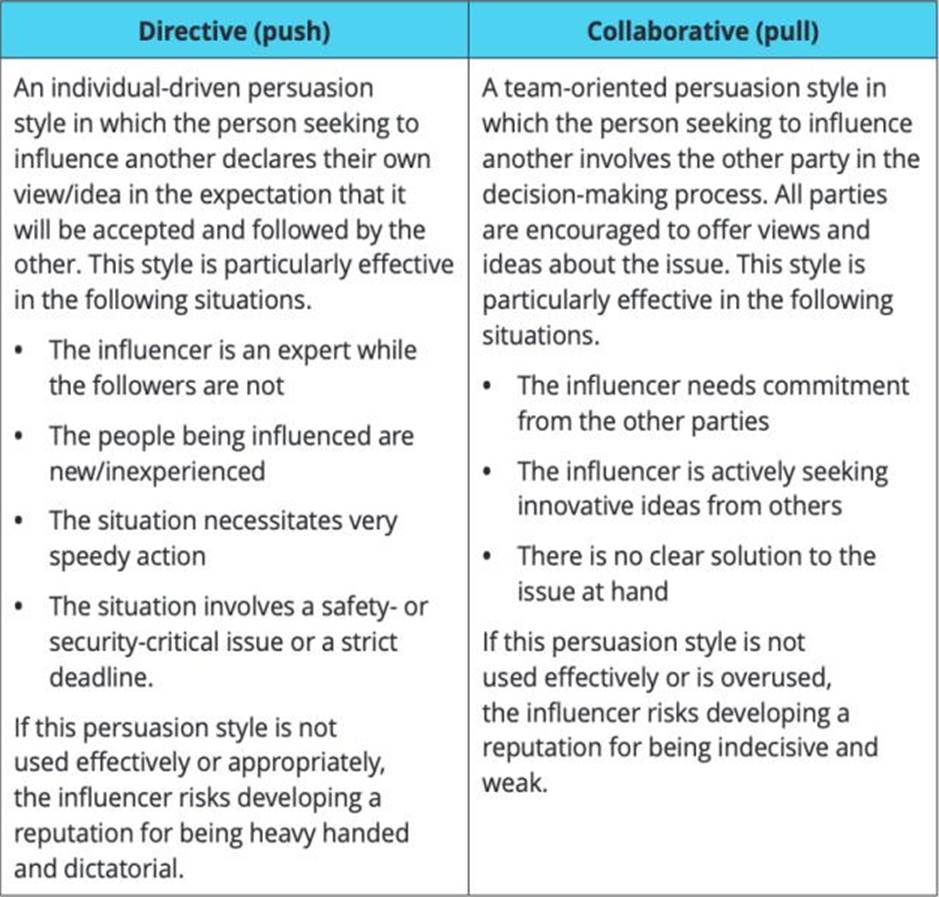
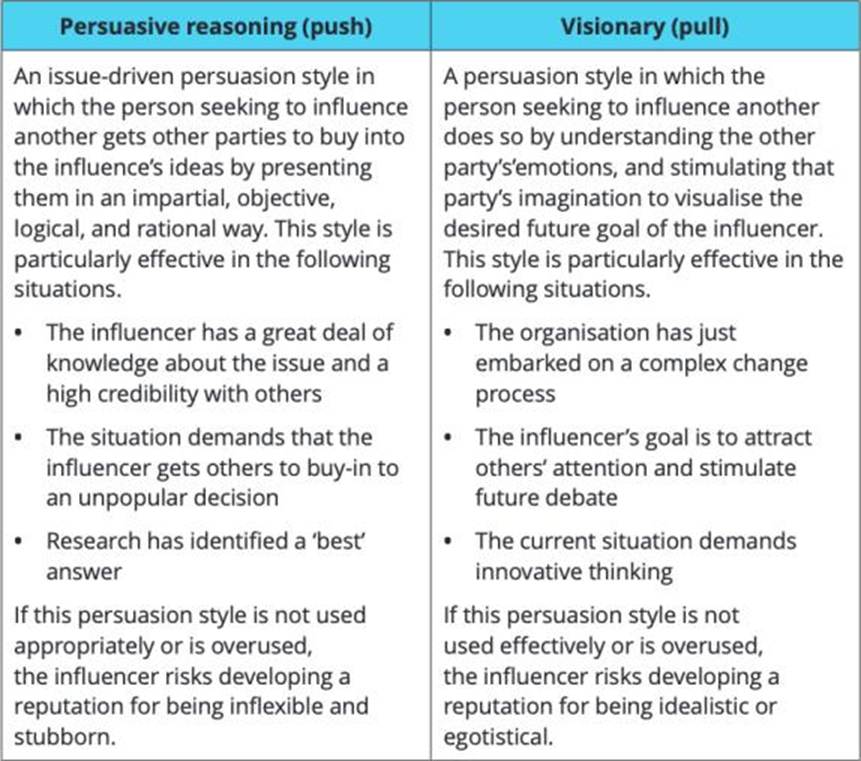
In the scenario, Rose intends to let both parties exchange their views and ideas so that solutions to current problems can be found. This is the typical characteristic of collaborative (pull) method.
A senior buyer analyses the supply market and he realises that his organisation is treated as Exploit according to supplier’s perspective model.
What does he need to do?
- A . Adopt opaque processes
- B . Increase the spend value
- C . Raise the transactional costs to do business
- D . Pay the suppliers on time
D
Explanation:
The supplier’s perspective model has two axes: Spend value and Attractiveness:
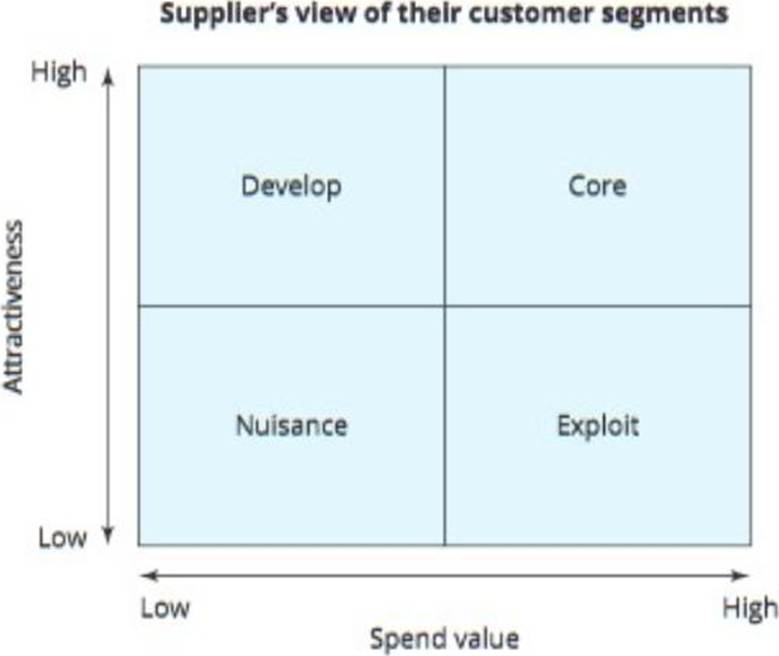
Exploit is the quadrant where the buyer has high spend but low attractiveness. Overarching supplier objective would be: "Milk this customer and charge a high price to compensate for all the pain they put us through".
The buyer should increase its attractiveness to raise the position to Core customer.
To do this, a buyer may:
– Simplify procurement processes
– Simplify contracting processes
– Use clear and concise documentation
– Eliminate onerous supplier terms and conditions
– Make the payment on time
– Use transparent processes
– Promote ethical behaviours
LO 1, AC 1.4
Which of the following best describes Leverage quadrant in Kraljic matrix?
- A . Low risk, high importance
- B . High value, high complex
- C . Low risk, low importance
- D . High complex, low importance
A
Explanation:
In 1983, Peter Kraljic devised a means to segment the supplier base in the article in HBR. In this, he argued that supply items should be mapped against two key dimensions: risk and profitability.
Risk relates to the likelihood for an unexpected event in the supply chains to disrupt operations. For instance, in important areas of spend, such as tire suppliers for an automotive are business critical, and should a disruption occur, the auto company is likely itself to face substantial problems.
Profitability describes the impact of a supply item upon the bottom line. For certain areas of spend, such as stationery, supplies have only a negligible effect on profits. In other categories, a single source of supply can make or break a business.
Putting these two dimensions together yields a classic two-by-two matrix.
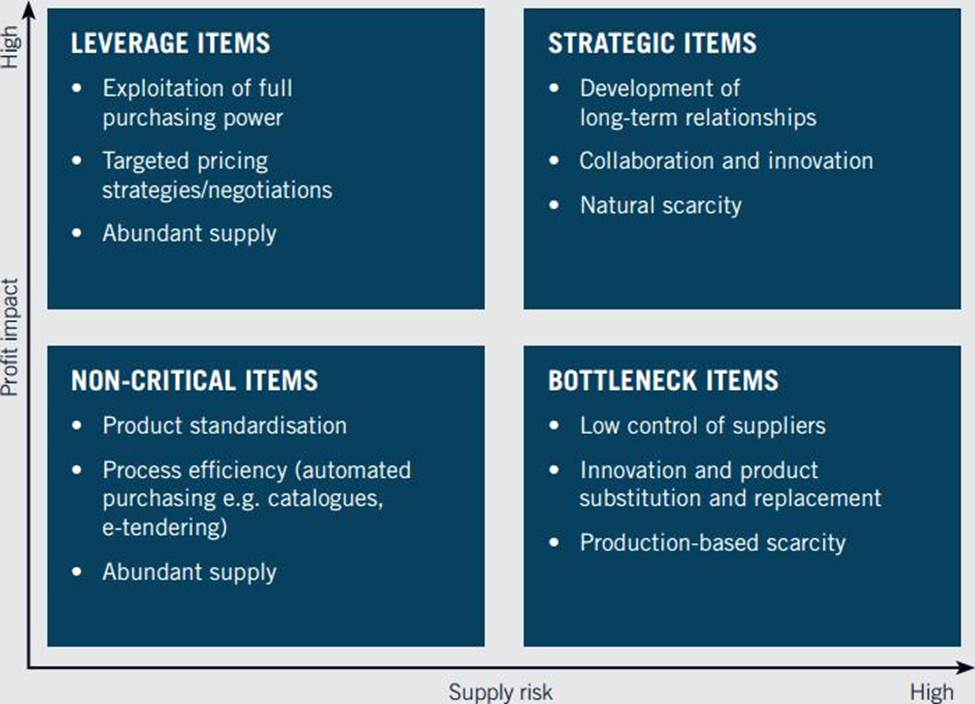
Source: Peter Kraljic, HBR
Reference: – CIPS study guide page 63-73
– What Is The Kraljic Matrix? (forbes.com) LO 1, AC 1.4
According to Dr. Mari Sako, which of the following is potentially the weakest trust to be built?
- A . Competence trust
- B . Goodwill trust
- C . Charitable trust
- D . Contractual trust
D
Explanation:
Trust is the expectation that the other party will behave in a predictable and mutually acceptable way. In inter-firm relationships, the presence and absence of trust can affect the level of cost in a relationship. The existence of trust is taught to lower the transaction cost in a relationship. Dr. Mari Sako identified taxonomy of 3 types of trust in commercial relationship, which is very useful from the perspective of procurement.
Contractual trust: Trust based on the contract with TOP. This is potentially the weakest source of trust if there is nothing else to base the trust on, but it is the quickest to establish.
Competence trust: Trust based on TOP’s professional qualifications or proven or certified technical capability or experience.
Goodwill trust: Trust based on knowing TOP has your interest at heart and will not behave opportunistically. This is potentially the strongest type of trust, but it takes the longest time to build. Otherwise, trust also has legal meaning. A trust is a legal document that can be created during a person’s lifetime and survive the person’s death. A trust can also be created by a will and formed after death. Charitable trusts are trusts which benefit a particular charity or the public in general.
Which of the following is the definition of safety margin?
- A . The difference between current or forecasted sales and sales at the break-even point
- B . The amount of revenue that remains after subtracting costs directly associated with production
- C . The production level at which total revenues for a product equal total expenses
- D . The incremental money generated for each product/unit sold after deducting the variable costs
A
Explanation:
As a financial metric, the margin of safety (safety margin) is equal to the difference between current or forecasted sales and sales at the break-even point. The margin of safety is sometimes reported as a ratio, in which the aforementioned formula is divided by current or forecasted sales to yield a percentage value. The figure is used in both break-even analysis and forecasting to inform a firm’s management of the existing cushion in actual sales or budgeted sales before the firm would incur a loss.
This is a question that a student met in her actual exam. The margin of safety is not even mentioned in the CIPS study guide.