
CIPS L4M5 Practice Exams
Last updated on Oct 23,2026- Exam Code: L4M5
- Exam Name: Commercial Negotiation
- Certification Provider: CIPS
- Latest update: Oct 23,2026
Which of the following statements about oligopoly is incorrect?
- A . A few firms play an important role in the sale of a product
- B . Oligopolistic firms recognize their interdependence
- C . One firm’s behaviour is a function of what its rivals do
- D . Prices in oligopoly are predicted to fluctuate widely and frequently
D
Explanation:
An oligopoly exists when there are small number of producers that exert a significant influence in the market. Oligopoly’s main characteristics are discussed as follows: – Interdependence
The most important feature of oligopoly is the interdependence in decision¬-making of the few firms which comprise the industry. This is because when the number of competi¬tors is few, any change in price, output, product etc. by a firm will have a direct effect on the fortune of its rivals, which will then retaliate in changing their own prices, output or products as the case may be. – Importance of advertising and selling costs
A direct effect of interdependence of oligopolists is that the various firms have to employ various aggressive and defensive marketing weapons to gain a greater share in the market or to prevent a fall in their market share. For this various firms have to incur a good deal of costs on advertising and on other measures of sales promotion. Therefore, there is a great importance of advertising and selling costs under conditions of market situation characterised by oligopoly – Group behaviour
Another important feature of oligopoly is that for the proper solution to the problem of determination of price and output under, it analysis of group behaviour is impor-tant.
– Indeterminateness of demand curve facing an oligopolist
…
In this question, ‘Prices in oligopoly are predicted to fluctuate widely and frequently’ is an incorrect statement as producers in oligopoly often try to set up price. Prices fluctuate more frequently in perfect competition.
LO 2, AC 2.2
Which of the following are hardball tactics in negotiations? Select TWO that apply.
- A . Expand the pie
- B . Snow job
- C . Good cop, bad cop
- D . Sweetening the deal
- E . Bridging
B, C
Explanation:
In difficult negotiations and disputes, hardball tactics like punishment and threats often seem like the only way to win concessions. Some negotiators seem to believe that hardball tactics are the key to success in any negotiation. They resort to extreme demands and even unethical behaviour to try to get the upper hand in a negotiation.
The following are 8 typical hardball tactics:
The sourcing manager has decided to adopt an adversarial style of negotiation to take advantage of the buyer’s greater bargaining power over the suppliers.
In what other circumstances should an adversarial relationship be used?
- A . When the supplier is likely to respond with further concessions to maintain a long-term relationship
- B . In all forms of negotiation as each party is always trying to gain advantage over the other
- C . In a monopoly market as the supplier will respond by conceding quantity discounts
- D . When the issues concerned are non-negotiable, for example, health and safety commitments
D
Explanation:
An adversarial style is appropriate when issues are non-negotiable, such as health and safety commitments (D). In these scenarios, compliance is required without compromise, and a firm stance may be necessary. This aligns with CIPS guidance, where adversarial tactics are used in non-negotiable contexts to enforce strict standards.
From the principled point of view about negotiation environment, which of the following is a true statement?
- A . Advantage gained from uncomfortable negotiation environment is likely to last long after the
negotiation - B . The room layout can be seen as a source of tactical advantage
- C . Home advantage should not be exploited to win a temporary advantage
- D . There is no ideal negotiation environment in real life
C
Explanation:
From a principled point of view, the focus of negotiation is on resolving the issue and not on winning temporary advantage over TOP through exploiting home advantage. From the principled point of view, the location and room layout should not be viewed as a source of tactical advantage and should not be used to try to gain advantage over TOP or unfairly influence them in the meeting room.
From a pragmatic point of view, not all of these elements in the ideal negotiation environment may be feasible, so the host may have to make compromises and explain these to TOP.
From a distributive point of view, the host will seek to create an advantage for themselves either explicitly or more subtly. It is arguable that any advantage gained through intentionally creating an uncomfortable environment to put short-term pressure on TOP is likely to be short-lived as TOP will likely reflect on this later and seek means to get even. LO 2, AC 2.4
Which of the following is the most appropriate approach to investors or shareholders who have high level of influence but low interest in the running of business?
- A . Engage and keep them satisfied
- B . Engage and consult with them regularly
- C . Keep these people inform through general communication media
- D . Manage them closely
A
Explanation:
Investors or shareholders who have high level of influence but low interest belong to ‘Keep satisfied’ quadrant of Mendelow’s Stakeholder Matrix.
You may read 2 versions from L4M1 and L4M5 here:
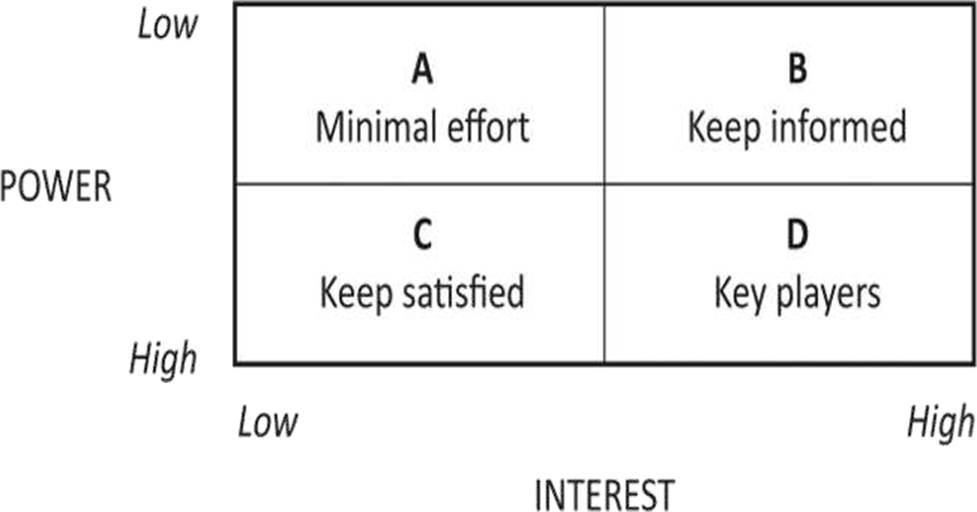
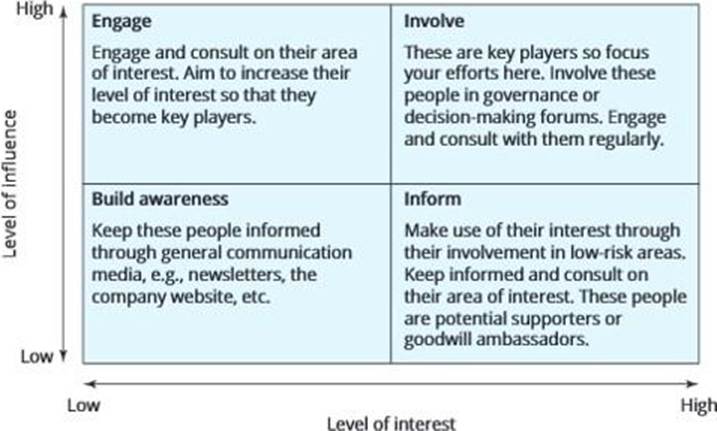
LO 1, AC 1.1
Which of the following are macroeconomic factors that may have influence to the commercial negotiation? Select TWO that apply
- A . Equilibrium price
- B . Supply curve
- C . Unemployment rate
- D . Bargaining power of supplier
- E . Rising import tariffs
C, E
Explanation:
There are many macro economic factors that could influence procurement in general and commercial negotiation in particular.
Below are six factors that are agreed to be fairly significant:
• Economy growth rate
• Inflation rates
• Interest rates
• Currency exchange rate
• Unemployment rate
• Protectionism
LO 2, AC 2.2
Buying organisation may increase its leverage with suppliers by concentrating spend.
Which of the following are most likely to be forms of supplier spend consolidation? Select THREE that apply.
- A . Forming purchasing consortia
- B . Volume consolidation across categories
- C . Volume separation
- D . Paying supplier on time
- E . Volume redistribution
- F . Simplify procurement process
A, B, E
Explanation:
Buying organisation may increase its leverage with suppliers by concentrating spend.
Supplier spend consolidation can take many forms as outlined below:
Vendor base reduction: straightforward reduction of number of suppliers in any category
Volume pooling: pooling cross organisational requirement until your order volume is high enough to attract new bidders/additional discounts
Volume redistribution: making recommendations following spend analysis to move from one supplier to another
Volume consolidation across categories: certain purchase requirements may be common across a number of categories
Standardisation and harmonisation of specifications: analysis of specifications and standards for a high spend purchased input, may show that there is a little difference between them and that the specification can be standardised or at least harmonised across the group or across national, regional or global operations.
Forming purchasing consortia: buyers may decide to come together and combine their purchase volumes to attract better deals.
Which of the following occur within the planning and preparation stage in a negotiation process? Select THREE that apply.
- A . Understanding the other party
- B . Defining the constituents
- C . Making as few concessions as possible
- D . Using questions to elicit information
- E . Narrowing the range of solutions
- F . Analyse the bargaining power
A, B, F
Explanation:
In the planning and preparation stage of negotiation, it is essential to build a strong foundation by understanding various factors that influence the negotiation outcome. According to CIPS resources, critical aspects of preparation include:
Understanding the other party (A): This helps in anticipating their needs, objectives, and potential negotiation styles, leading to more strategic discussions.
Defining the constituents (B): This involves identifying all stakeholders or parties impacted by the negotiation, ensuring their interests are considered when planning the negotiation strategy.
Analyzing the bargaining power (F): Understanding the relative power each party brings to the negotiation helps in setting realistic goals and predicting possible negotiation dynamics.
These elements are foundational in ensuring a well-rounded approach and enabling both parties to enter negotiations with clarity and strategy, enhancing the potential for a positive outcome.
JCB is a large manufacturer of heavy machinery. The CPO is going to a negotiation with a Chinese supplier about procuring some major components. He is wondering about balance of power in the negotiation.
Which of the following micro factors are most likely to shift the balance of power towards the buying organisation in this commercial negotiation? Select TWO that apply
- A . Buyers purchase in small volumes
- B . Suppliers are more concentrated than buyer
- C . Eruption of epidemic in supply market
- D . JCB’s switching costs are low
- E . These components are highly standardised
D, E
Explanation:
There are many factors that can influence the balance of power in a negotiation. These factors are
classified into 3 levels:
– Macro level: STEEPLE framework: social, technological, economic, environment, political, legal and ethical
– Micro level: Porter’s five forces:
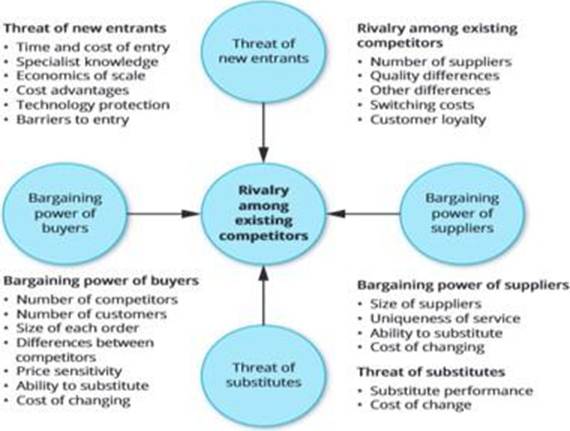
– One-to-one buyer-supplier dynamics.
The question asks about the micro factors that increases buyer’s bargaining power. Among 5 answers, only 2 are likely to increase buyer’s power:
– JCB’s switching costs are low: Buyer may easily switch its suppliers anytime
– These components are highly standardised: The products are not different any more, buyer may choose to buy from any supplier available.
Other answers cannot be correct because:
– Suppliers are more concentrated than buyer: Suppliers are forming oligopoly market, their bargaining power tend to be greater.
– Eruption of epidemic in supply market: this is a macro factor. Eruption of epidemic may cause factories closed and disruptions on supply chain.
– Buyers purchase in small volumes: Buyer will be seen as less potential to suppliers. Buying organisation may have difficulties to deal better price with suppliers.
LO 1, AC 1.3