
CIPS L4M5 Practice Exams
Last updated on Oct 23,2026- Exam Code: L4M5
- Exam Name: Commercial Negotiation
- Certification Provider: CIPS
- Latest update: Oct 23,2026
When prices of input materials increase, supply curve shifts to the left while demand remains stable. The shift of supply will tend to cause which of the following?
- A . An increase in the equilibrium price and quantity
- B . A decrease in the equilibrium price and quantity
- C . A decrease in the equilibrium price and an increase in the equilibrium quantity
- D . An increase in the equilibrium price and a decrease in the equilibrium quantity
D
Explanation:
The case in the question is illustrated as below:
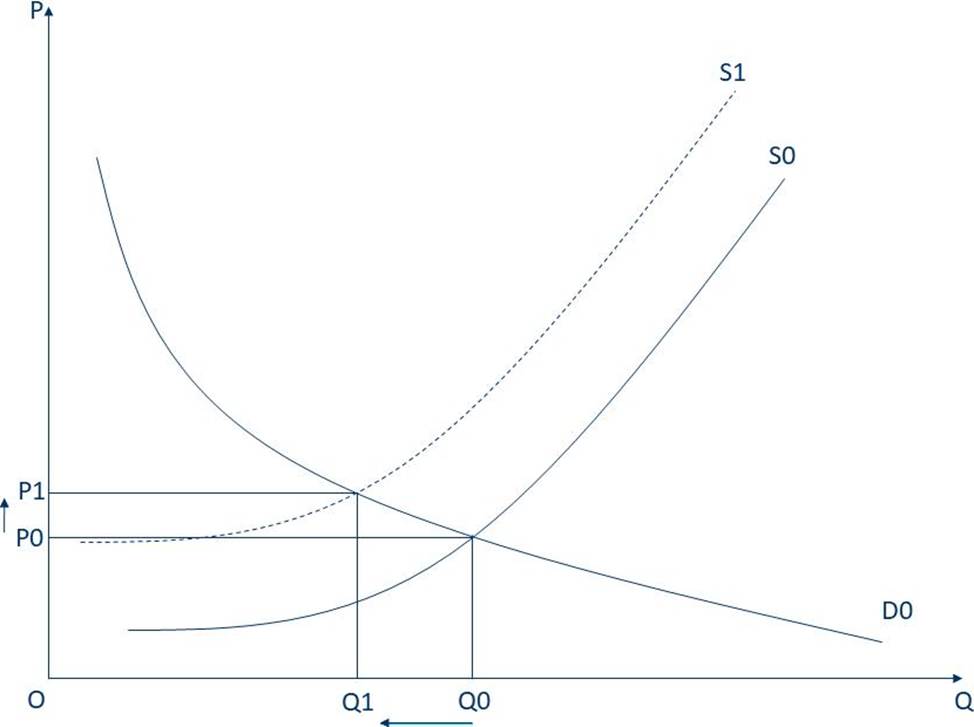
The equilibrium price initially at P0 with quantity Q0, when supply curve shifts to the left, it will converge with demand curve at new equilibrium point with price P1 and quantity Q1. As you can see from the graph, P1 is greater than P0 and Q1 is smaller than Q0.
Distributive approach in negotiation is typified by which of the following?
- A . Distributive approaches are inherently inferior to integrative approaches in commercial negotiation
- B . Both parties understand each other’s goals
- C . Each party attempts to maximise the value obtained at other’s expense
- D . Both parties share 50:50 of the ‘pie’
C
Explanation:
Distributive approach to negotiation used when the interested parties are attempting to divide something up or distribute something of value, also known as zero-sum approach or win-lose. Commercial situations often demand a distributive bargaining approach, if the ‘pie’ is inherently of a fixed size. In this case, any conflicts must be resolved by sharing it.
In win-lose approach, a negotiator wants to maximise the value obtained in a single deal, the relationship with the other party is not important. Therefore, a strong party may win more than 50% of the metaphorical ‘pie’.
It should not be assumed that win-win can be applied to all commercial negotiations, or that win-lose approaches are inherently inferior.
Which of the following will shift the supply curve to the right?
- A . Changes in customer taste
- B . New disruptive technology
- C . Decreased market price of substitute products
- D . Increased customers’ disposable income
B
Explanation:
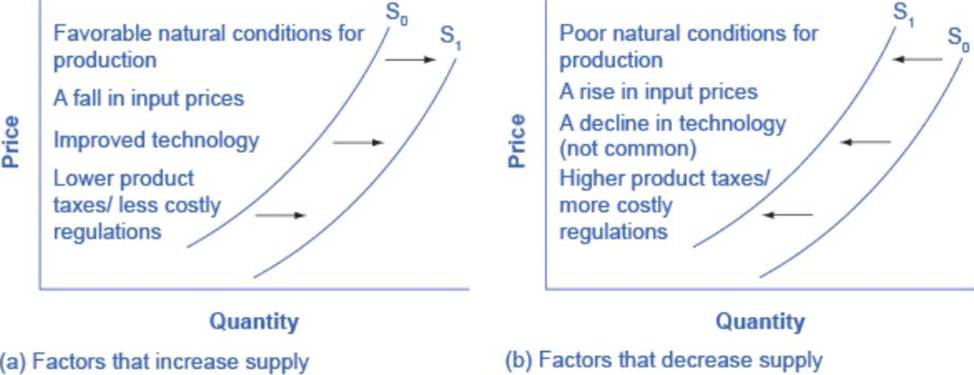
The following graph shows the factors that shift the supply curve to the left and to the right.
Reference: – CIPS study guide page 103
– Principles of Microeconomics 2e, 2017, Open Stax – Rice University. LO 2, AC 2.2
Which of the following will shift the supply curve to the right?
- A . Changes in customer taste
- B . New disruptive technology
- C . Decreased market price of substitute products
- D . Increased customers’ disposable income
B
Explanation:
The following graph shows the factors that shift the supply curve to the left and to the right.
Reference: – CIPS study guide page 103
– Principles of Microeconomics 2e, 2017, Open Stax – Rice University. LO 2, AC 2.2
Before engaging in a negotiation with a supplier of rechargeable lights, procurement team tries to visualise the breakdown of supplier’s costs to calculate its break-even point. They estimate that total fixed expenses related to rechargeable electric light are $270,000 per month and variable expenses involved in manufacturing this product are $126 per unit. The supplier charges its customer $180 per unit.
Within its current capacity, this supplier will make a profit at which of the following?
- A . More than 5,000 units are sold monthly
- B . Exactly 5,000 units are sold per month
- C . Exactly 1,500 units are sold monthly
- D . More than 1,500 units are sold monthly
A
Explanation:
The analysis of cost into fixed and variable enables organisations to determine their break-even point (BE) – the point where total revenue from sales and total cost exactly balance. All costs need to be covered by sale revenue in order for a company to make a profit. If you know your fixed costs and your variable costs then you can work out the minimum quantity of goods or services you need to sell to break even.
Break even point is measured in volume and can be worked out graphically or via formulae:
Price – Variable costs = Contribution
Break even point (volume) = Fixed expenses/Contribution margin per unit In this scenario, the break even point (Q) is: 270,000/(180-126) = 5,000
To make a profit, the supplier needs to sell more than 5,000 units per month.
The BE point is thus an important determinant of flexibility of pricing for suppliers. Before BE is
achieved there will be much greater reluctance to offer price concessions to customers than after BE
is achieved.
LO 2, AC 2.1
The sourcing manager has decided to adopt an adversarial style of negotiation to take advantage of the buyer’s greater bargaining power over the suppliers.
In what other circumstances should an adversarial relationship be used?
- A . When the supplier is likely to respond with further concessions to maintain a long-term relationship
- B . In all forms of negotiation as each party is always trying to gain advantage over the other
- C . In a monopoly market as the supplier will respond by conceding quantity discounts
- D . When the issues concerned are non-negotiable, for example, health and safety commitments
D
Explanation:
This question is a duplicate of Question 17. The answer remains the same: When the issues concerned are non-negotiable, such as health and safety commitments (D). Non-negotiable issues require an assertive approach to ensure adherence to essential standards, as highlighted in CIPS’s framework for negotiation styles.
A skilled negotiator will use a range of questioning techniques in a negotiation.
If they wished to explore options with the other party without making any formal commitment, which type of question style would they use?
- A . Leading
- B . Hypothetic
- C . Reflective
- D . Multiple
B
Explanation:
Hypothetical questions are used to explore options or scenarios without making commitments. This technique allows negotiators to understand the other party’s preferences and limitations by presenting hypothetical situations, as recommended in CIPS guidelines for negotiation questioning techniques.
A buying organisation with a low spend and the reputation for paying late might be viewed by a supplier as which of the following?
- A . Develop
- B . Nuisance
- C . Core
- D . Exploit
B
Explanation:
To answer this question, you should know
The seller’s perspective as in ‘How to Negotiate Professionally’:
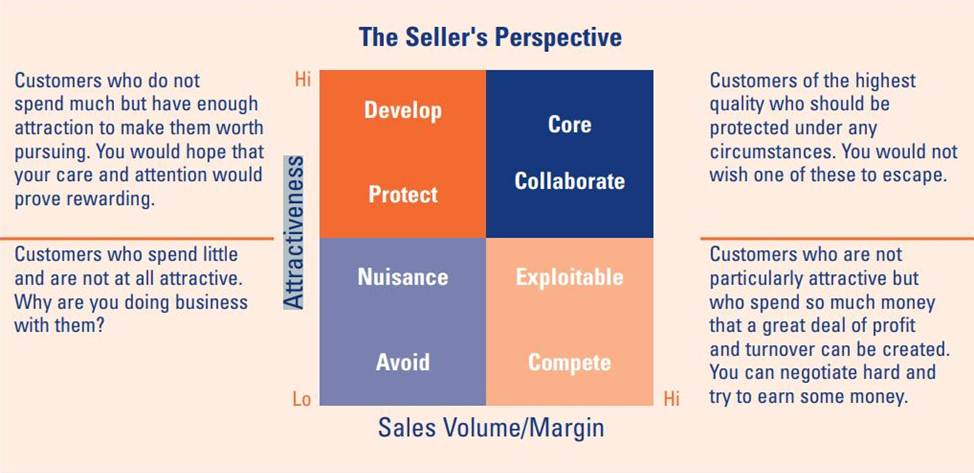
In the scenario, the buyer’s spend is low, while they seem unattractive to seller (as they tend to pay late). So the buyer is classified as Nuisance in seller’s perspective.
Which of the following is an objective of proposing phase?
- A . Check hypothesis and assumptions
- B . Trade concessions
- C . Create atmosphere conducive to agreement
- D . Start making tentative offers
D
Explanation:
In the study guide, CIPS lists 5 stages of an negotiation:
The opening phase: confirm understanding and get the issues on the table. At this stage, both parties should check agenda, authority and create atmosphere conducive to agreement
The testing phase is an information gathering stage where the hypothesis and assumptions you have made in the planning stage can be tested and confirmed or disconfirmed
The proposing phase: Both sides may start making tentative proposals regarding their offering.
The bargaining phase: Both parties trade concessions; the preliminary stages are over and proposals move from being tentative and general to being more definite and specific.
The agreement and closing phase: both parties should seek agreement or if TOP does not have the final authority, some sort of acknowledgement of what key terms are should be sought.
Which of the following are most likely to be indirect costs of a garment manufacturer? Select THREE that apply.
- A . Packaging material
- B . Textile
- C . Zips pads
- D . Maintenance materials
- E . Utilities
- F . Depreciation of machinery
D, E, F
Explanation:
Indirect costs are those cost that are not directly attributable to production.
Examples of indirect costs including the following:
Indirect labour: This covers every person in the factory who does not directly perform a production operation such as managers, supervisors, engineers, store personnel, clerks, maintenance staff, porters, canteen staff, security and cleaners etc.
Expenses: Included in this element is every fixed and variable expenses incurred in operating the factory, such as rent, rates, utilities, insurance, depreciation, maintenance, air conditioning and the various types of energy generation required by a clothing factory.
Indirect materials: Also known as consumables, this element contains all the materials not directly connected to the makeup of a garment. Some of the typical items involved are office materials, spare parts, marker paper, maintenance materials, chalk & pins.
Direct costs are those costs of a product/service directly attributable/traceable to its production.
Examples of direct costs including the following:
Direct Materials: Direct materials are all the materials and trimmings which go into the construction and finish of the garment. Typically, these materials would include cloth, lining, fusible, zips pads, tapes, labels, tickets, hangers and packaging materials.
Direct Labour: This cover the cost of all the labor directly involved in producing the garment and could include cutting, fusing, regular sewing, special machine operations, pressing, finishing, inspection and packing. Labor of all types and grade has a direct overhead which include holiday pay, sick pay, fringe benefits etc and the statutory payments made by the employer for each employee. This is usually expressed as a percentage of salary and when this percentage is added to the employee’s wage, it becomes the basis for calculating direct labor costs.