
CIPS L4M5 Practice Exams
Last updated on Oct 23,2026- Exam Code: L4M5
- Exam Name: Commercial Negotiation
- Certification Provider: CIPS
- Latest update: Oct 23,2026
Which of the following are most likely to be indirect costs of a garment manufacturer? Select THREE that apply.
- A . Packaging material
- B . Textile
- C . Zips pads
- D . Maintenance materials
- E . Utilities
- F . Depreciation of machinery
D, E, F
Explanation:
Indirect costs are those cost that are not directly attributable to production.
Examples of indirect costs including the following:
Indirect labour: This covers every person in the factory who does not directly perform a production operation such as managers, supervisors, engineers, store personnel, clerks, maintenance staff, porters, canteen staff, security and cleaners etc.
Expenses: Included in this element is every fixed and variable expenses incurred in operating the factory, such as rent, rates, utilities, insurance, depreciation, maintenance, air conditioning and the various types of energy generation required by a clothing factory.
Indirect materials: Also known as consumables, this element contains all the materials not directly connected to the makeup of a garment. Some of the typical items involved are office materials, spare parts, marker paper, maintenance materials, chalk & pins.
Direct costs are those costs of a product/service directly attributable/traceable to its production.
Examples of direct costs including the following:
Direct Materials: Direct materials are all the materials and trimmings which go into the construction and finish of the garment. Typically, these materials would include cloth, lining, fusible, zips pads, tapes, labels, tickets, hangers and packaging materials.
Direct Labour: This cover the cost of all the labor directly involved in producing the garment and could include cutting, fusing, regular sewing, special machine operations, pressing, finishing, inspection and packing. Labor of all types and grade has a direct overhead which include holiday pay, sick pay, fringe benefits etc and the statutory payments made by the employer for each employee. This is usually expressed as a percentage of salary and when this percentage is added to the employee’s wage, it becomes the basis for calculating direct labor costs.
Which of the following is the purpose of using stakeholder support level scale?
- A . To identify stakeholder level of influence and interest and plot them on stakeholder map
- B . To identify stakeholder’s needs and expectations
- C . To estimate the gap and the progress towards desired levels of support
- D . To identify key stakeholders
C
Explanation:
In order to estimate the gap and the progress towards desired level of support, a stakeholder support scale can be used by the procurement internally. The support level scale measures stakeholder commitment. Current support level for the procurement/negotiation objectives should be gained from engagement with key stakeholders.
The following is an example of stakeholder support level scale:

LO 1, AC 1.1
SBL provides contract bathroom furniture and fittings for a wide variety of domestic and commercial clients. To some suppliers, SBL spend claims a large portion of their revenue. But SBL is famous for imposing draconian obligations on these suppliers.
Which of the following is most likely to be overarching objective of these suppliers to SBL?
- A . Charge a higher price to compensate for all the pain SBL has put
- B . Win and keep business with SBL at any costs, even without profits
- C . Drop the business with SBL immediately
- D . Hold on and keep SBL happy but make sure that the business is profitable
A
Explanation:
According to Paul Steele’s ‘The Seller’s Perspective’, customer can be classified into 4 categories as below:
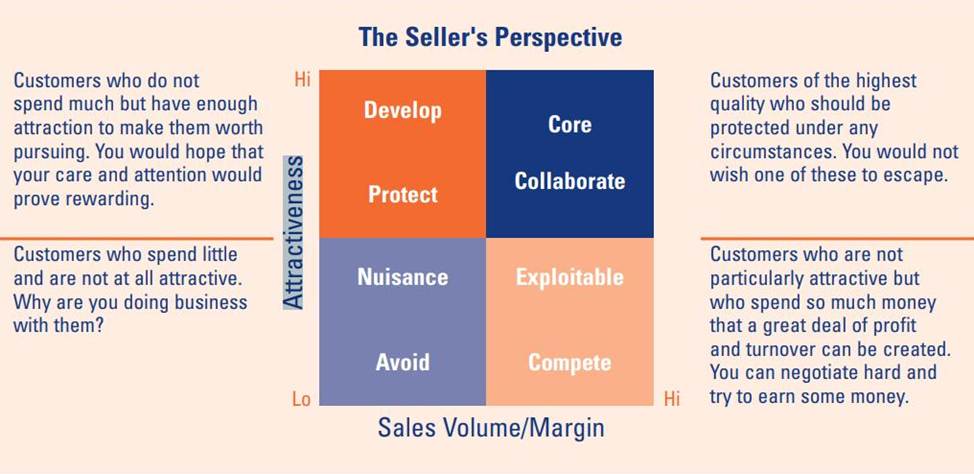
In this scenario, although SBL’s spend claims large portion in suppliers’ revenues, their draconian treatment will reduce SBL’s attractiveness in supplier’s perspective. SBL falls into Exploit quadrant. With exploitable customers, suppliers tend to ‘milk’ the customer and charge a high price to compensate for all the pain customer put on them.
Which of the following is NOT a barrier to entry in a monopolized market?
- A . The costs of production make a single producer more efficient than a large number of producers
- B . A single firm is very large
- C . The government gives a single firm the exclusive right to produce some good
- D . A key resource is owned by a single firm
B
Explanation:
Monopolies exist in many markets in real life for very different reasons:
Ownership of a Key Resource: When one company exerts sole control over a resource that is necessary for the production of a specific product, the market may become a monopoly. For example, the only medication deemed acceptable to treat a disease comes from a particular ingredient X, and knowledge of this ingredient X is owned by a single family owned company. The company can, therefore, be said to have a monopoly over ingredient X that is needed to cure the disease because it is the only company that can produce a product deemed acceptable. Government Franchise: In certain instances, a monopoly may be explicitly created by the government if it grants a single company, whether private or government-owned, the right to conduct business in a particular market. For example, when a national railways transportation service is created by the government, in most cases they are granted a monopoly on the operation of passenger trains in the country. As a result, other firms are only able to offer passenger train services with the cooperation and/or permission of the government-owned provider.
Intellectual Property Protection: Extending intellectual property protection to a company in the form
of patents and copyrights is yet another way in which monopolies are created. When a government does this, it is in fact giving a single company an exclusive right to provide a particular product / service to the market. Patents and copyrights work in providing owners of intellectual property with the right to act as an exclusive provider of a new product for a specific length of time. This creates a temporary monopoly in the market with regards to new products and services.
Natural Monopoly: A market may also become a monopoly simply because it may be more cost-effective for one company to serve the whole market than to have several smaller firms in competition with one another. A company with virtually unlimited economies of scale is referred to as a natural monopoly. Such firms become monopolies due to their position and size, which makes it impossible for new entrants in the market to compete price-wise. Natural monopolies are common in industries with high fixed costs and low marginal costs of operation such as providers of television, telephone, and internet services.
In this question, ‘A single firm is very large’ is not enough to tell whether this market is monopolistic.
A procurement professional is preparing for a negotiation with supplier. She is setting targets for price which her company is seeking to achieve.
Which of the following acronyms can help her identify limits before engaging in the negotiation?
- A . MIL
- B . RAQSCI
- C . TIMWOOD
- D . PPCA
A
Explanation:
MIL criteria indicate 3 limits that negotiator should establish:
M – Must achieve: minimum target/maximum you can concede on this point; the mandatory requirement or fall back position
I – Intend to achieve: realistic target you are aiming for on this point
L C Like to achieve: stretch target to achieve on this point.
PPCA is purchase cost analysis
TIMWOOD indicates 7 types of waste in Lean principles
The RAQSCI model is a mnemonic summary of a business model used to define and structure business requirements
Under EU public procurement directives, which of the following are procedures in which there is no commercial negotiation allowed?
- A . Innovation Partnerships
- B . Open Procedure
- C . Restricted Procedure
- D . Competitive Dialogue
- E . Competitive Procedure with Negotiation
B, C
Explanation:
Under the European Union public procurement directives, all public sector bodies must abide by certain rules when they procure goods and services over a threshold value.
These rules are codified under 5 procurement procedures: