
CIPS L4M5 Practice Exams
Last updated on Oct 22,2026- Exam Code: L4M5
- Exam Name: Commercial Negotiation
- Certification Provider: CIPS
- Latest update: Oct 22,2026
When implementing value analysis or value engineering, which of the following acronyms reminds both buyer and supplier of ideas on removal, substitution and design-out of cost elements?
- A . SMART
- B . STOPS WASTE
- C . OWN-IT
- D . SAMOA
B
Explanation:
Ray Carter coined the mnemonic STOPS WASTE to remind buyers of 10 cost-reduction ideas they can ask for themselves and their suppliers in any situation when considering a key purchase input.
Stop Waste by:
Standardisation – is there a standard specification?
Transportation – is the inbound transport classification appropriate
Over-engineered – is the specification too tight?
Packaging – can packaging be reduced or eliminated?
Substitutes – is there a cheaper substitute material
Weight – is there opportunity to reduce weight of the product?
Any unnecessary processing – is there any unnecessary design or feature?
Supplier’s input – are suppliers able to assist with the cost reduction
To make – is it more economical to make or buy?
Eliminate – if no one uses the feature, can it be eliminated?
SAMOA is a useful acronym for checking and testing the information gathered from the Internet:
Source
Audience
Methodology
Objectivity
Accuracy
OWN-IT is acronym for 5 steps in the process of collecting and analysing the data and information needed in any field:
Outline
Wide search
Narrow search
Increase your stockpile of information
Transform your stockpile into new knowledge
A SMART goal is used to help guide goal setting. SMART is an acronym that stands for Specific, Measurable, Achievable, Realistic, and Time-bound.
Which of the following is considered a strength of a ‘logical’ style negotiator?
- A . Assertive
- B . Methodical
- C . Friendly and accessible
- D . Interrelate issues easily and make quick decisions
B
Explanation:
A useful and simple shorthand for preferred negotiation styles is summarised by four simple descriptor: ‘warm’, ‘tough’, ‘logical’ and ‘dealer’, which can be applied to describe individuals’ dominant preferred style in most circumstances.
Warm – a people person
Tough – a hard-nosed negotiator
Logic – a numbers person
Dealer – a trader who loves bargaining
Strengths, weaknesses of logical style are described below:
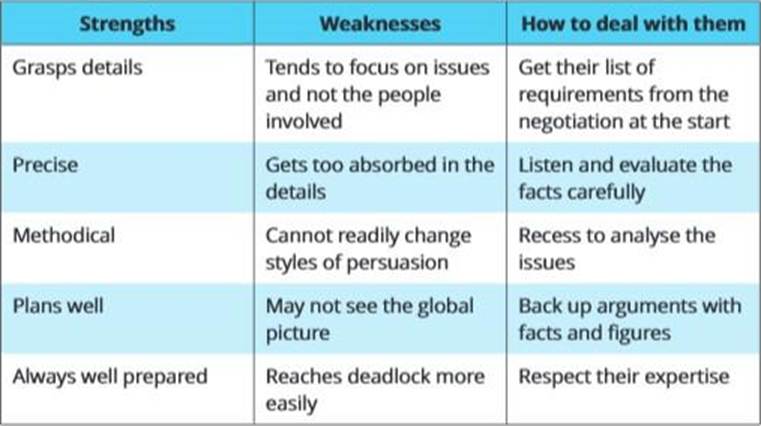
Which of the following is considered a strength of a ‘logical’ style negotiator?
- A . Assertive
- B . Methodical
- C . Friendly and accessible
- D . Interrelate issues easily and make quick decisions
B
Explanation:
A useful and simple shorthand for preferred negotiation styles is summarised by four simple descriptor: ‘warm’, ‘tough’, ‘logical’ and ‘dealer’, which can be applied to describe individuals’ dominant preferred style in most circumstances.
Warm – a people person
Tough – a hard-nosed negotiator
Logic – a numbers person
Dealer – a trader who loves bargaining
Strengths, weaknesses of logical style are described below:
XYZ Ltd needs to purchase a bundle of IT products from suppliers. The procurement manager requests details of costs regarding designing and managing those products. After receiving reports from suppliers, she realises that they have charged up to a 1,095% mark-up on IT products.
In order to ensure value for money, which of the following should be a priority pricing arrangement of the procurement manager in the negotiation with these IT suppliers?
- A . Premium pricing
- B . Cost plus arrangement
- C . Market skimming
- D . Market penetration pricing
B
Explanation:
In the scenario, the main cost driver is suppliers’ mark-up. The priority should be limit the margin to be added. XYZ Ltd can agree “cost plus” contracts with their suppliers to ensure no IT product purchased exceeds an agreed maximum margin level. Procurement teams can use their benchmarking tools to police these contracts. Cost plus contracts are agreements where the contractor’s pricing is based on itemising allowable costs and then adding an agreed margin. Market penetration pricing – pricing low to win a large share of the market
Market skimming – pricing a new product high in order to make a large profit from the purchases by initial customers. This is an effective strategy only in the absence of competition. When competition appears, market skimmers usually drop their prices
Premium pricing – usually pricing high because the market is prepared to pay extra for the kudos associated with the product, thanks to, say, a reputation for quality, or a highly fashionable brand name, and so on
Which of the following is categorised as fixed cost?
- A . Additional pallet hires due to higher demand in year-end season
- B . Land rental paid in advance
- C . Governments taxes
- D . Raw materials for next year production
B
Explanation:
Anorganisation’s expense can be categorised into three groups:
Fixed Costs C costs that do not change with output.
Variable Costs C costs that vary in direct proportion to output.
Semi-variable costs C costs that are a combination of the above, with both a fixed and
variable element.
Among the four options:
"Land rental paid in advance": This is fixed cost. The rental won’t increase when the production increases.
"Additional pallet hires due to higher demand in year-end season": This can be identified as semi-variable cost (or step cost).
"Governments taxes": The taxes are often levied by a percentage of income or revenue. Therefore, it is variable
"Raw materials for next year production": This is obviously variable cost.
Reference:
CIPS study guide page 79-84
Study tips: Fixed variable and semi-variable costs – AAT Comment
When is the best time to adopt accommodating style according to Thomas-Kilmann conflict mode instrument?
- A . When both buyer and supplier want to find an integrative solution as their concerns are too important to be compromised
- B . When buyer needs to gather more information to gain more advantages in later negotiations
- C . When preserving harmony and avoiding disruption with supplier are especially important
- D . When buyer and supplier have equal power but are strongly committed to mutually exclusive
goals
C
Explanation:
According to Thomas-Kilmann conflict model instrument, there are 5 conflict management styles: Accommodating is an unassertive and cooperative approach to resolving the conflict. Accommodating means conceding to the other party with little debate or fight, not challenging or strongly putting forward your own point of view and generally giving and yielding to the other party’s point of view.
Accommodating is best used when: