
Amazon MLS-C01 Practice Exams
Last updated on Oct 22,2026- Exam Code: MLS-C01
- Exam Name: AWS Certified Machine Learning - Specialty
- Certification Provider: Amazon
- Latest update: Oct 22,2026
While reviewing the histogram for residuals on regression evaluation data a Machine Learning Specialist notices that the residuals do not form a zero-centered bell shape as shown.
What does this mean?
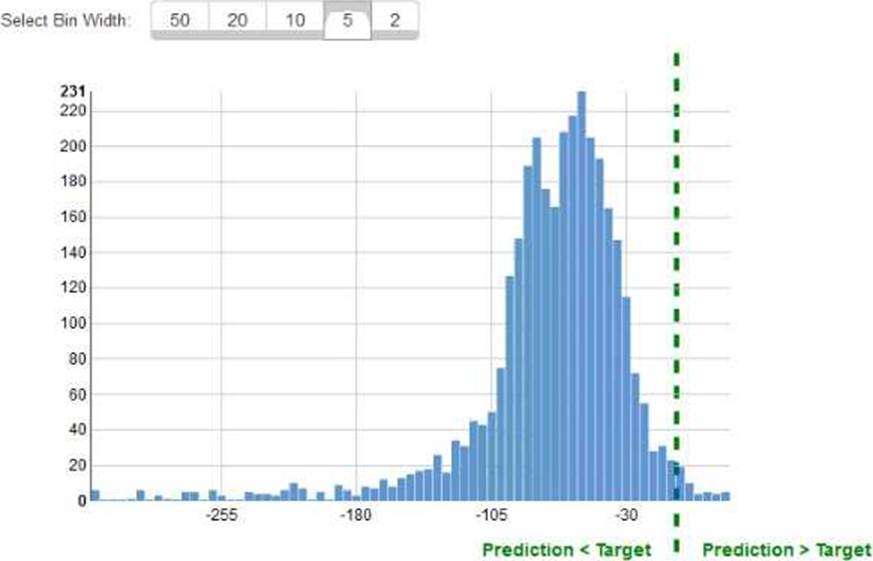
- A . The model might have prediction errors over a range of target values.
- B . The dataset cannot be accurately represented using the regression model
- C . There are too many variables in the model
- D . The model is predicting its target values perfectly.
A
Explanation:
Residuals are the differences between the actual and predicted values of the target variable in a regression model. A histogram of residuals is a graphical tool that can help evaluate the performance and assumptions of the model. Ideally, the histogram of residuals should have a zero-centered bell shape, which indicates that the residuals are normally distributed with a mean of zero and a constant variance. This means that the model has captured the true relationship between the input and output variables, and that the errors are random and unbiased. However, if the histogram of residuals does not have a zero-centered bell shape, as shown in the image, this means that the model might have prediction errors over a range of target values. This is because the residuals do not form a symmetrical and homogeneous distribution around zero, which implies that the model has some systematic bias or heteroscedasticity. This can affect the accuracy and validity of the model, and indicate that the model needs to be improved or modified.
References:
Residual Analysis in Regression – Statistics By Jim
How to Check Residual Plots for Regression Analysis – dummies Histogram of Residuals – Statistics.
How To
A machine learning (ML) developer for an online retailer recently uploaded a sales dataset into Amazon SageMaker Studio. The ML developer wants to obtain importance scores for each feature of the dataset. The ML developer will use the importance scores to feature engineer the dataset.
Which solution will meet this requirement with the LEAST development effort?
- A . Use SageMaker Data Wrangler to perform a Gini importance score analysis.
- B . Use a SageMaker notebook instance to perform principal component analysis (PCA).
- C . Use a SageMaker notebook instance to perform a singular value decomposition analysis.
- D . Use the multicollinearity feature to perform a lasso feature selection to perform an importance scores analysis.
A
Explanation:
SageMaker Data Wrangler is a feature of SageMaker Studio that provides an end-to-end solution for importing, preparing, transforming, featurizing, and analyzing data. Data Wrangler includes built-in analyses that help generate visualizations and data insights in a few clicks. One of the built-in analyses is the Quick Model visualization, which can be used to quickly evaluate the data and produce importance scores for each feature. A feature importance score indicates how useful a feature is at predicting a target label. The feature importance score is between [0, 1] and a higher number indicates that the feature is more important to the whole dataset. The Quick Model visualization uses a random forest model to calculate the feature importance for each feature using the Gini importance method. This method measures the total reduction in node impurity (a measure of how well a node separates the classes) that is attributed to splitting on a particular feature. The ML developer can use the Quick Model visualization to obtain the importance scores for each feature of the dataset and use them to feature engineer the dataset. This solution requires the least development effort compared to the other options.
References:
• Analyze and Visualize
• Detect multicollinearity, target leakage, and feature correlation with Amazon SageMaker Data Wrangler
A retail company stores 100 GB of daily transactional data in Amazon S3 at periodic intervals. The company wants to identify the schema of the transactional data. The company also wants to perform transformations on the transactional data that is in Amazon S3.
The company wants to use a machine learning (ML) approach to detect fraud in the transformed data.
Which combination of solutions will meet these requirements with the LEAST operational overhead? {Select THREE.)
- A . Use Amazon Athena to scan the data and identify the schema.
- B . Use AWS Glue crawlers to scan the data and identify the schema.
- C . Use Amazon Redshift to store procedures to perform data transformations
- D . Use AWS Glue workflows and AWS Glue jobs to perform data transformations.
- E . Use Amazon Redshift ML to train a model to detect fraud.
- F . Use Amazon Fraud Detector to train a model to detect fraud.
BDF
Explanation:
To meet the requirements with the least operational overhead, the company should use AWS Glue crawlers, AWS Glue workflows and jobs, and Amazon Fraud Detector. AWS Glue crawlers can scan the data in Amazon S3 and identify the schema, which is then stored in the AWS Glue Data Catalog. AWS Glue workflows and jobs can perform data transformations on the data in Amazon S3 using serverless Spark or Python scripts. Amazon Fraud Detector can train a model to detect fraud using the transformed data and the company’s historical fraud labels, and then generate fraud predictions using a simple API call.
Option A is incorrect because Amazon Athena is a serverless query service that can analyze data in Amazon S3 using standard SQL, but it does not perform data transformations or fraud detection. Option C is incorrect because Amazon Redshift is a cloud data warehouse that can store and query data using SQL, but it requires provisioning and managing clusters, which adds operational overhead. Moreover, Amazon Redshift does not provide a built-in fraud detection capability.
Option E is incorrect because Amazon Redshift ML is a feature that allows users to create, train, and deploy machine learning models using SQL commands in Amazon Redshift. However, using Amazon Redshift ML would require loading the data from Amazon S3 to Amazon Redshift, which adds complexity and cost. Also, Amazon Redshift ML does not support fraud detection as a use case.
References:
AWS Glue Crawlers
AWS Glue Workflows and Jobs
Amazon Fraud Detector
A company sells thousands of products on a public website and wants to automatically identify products with potential durability problems. The company has 1.000 reviews with date, star rating, review text, review summary, and customer email fields, but many reviews are incomplete and have empty fields. Each review has already been labeled with the correct durability result.
A machine learning specialist must train a model to identify reviews expressing concerns over product durability. The first model needs to be trained and ready to review in 2 days.
What is the MOST direct approach to solve this problem within 2 days?
- A . Train a custom classifier by using Amazon Comprehend.
- B . Build a recurrent neural network (RNN) in Amazon SageMaker by using Gluon and Apache MXNet.
- C . Train a built-in BlazingText model using Word2Vec mode in Amazon SageMaker.
- D . Use a built-in seq2seq model in Amazon SageMaker.
A
Explanation:
The most direct approach to solve this problem within 2 days is to train a custom classifier by using Amazon Comprehend. Amazon Comprehend is a natural language processing (NLP) service that can analyze text and extract insights such as sentiment, entities, topics, and syntax. Amazon Comprehend
also provides a custom classification feature that allows users to create and train a custom text classifier using their own labeled data. The custom classifier can then be used to categorize any text document into one or more custom classes. For this use case, the custom classifier can be trained to identify reviews that express concerns over product durability as a class, and use the star rating, review text, and review summary fields as input features. The custom classifier can be created and trained using the Amazon Comprehend console or API, and does not require any coding or machine learning expertise. The training process is fully managed and scalable, and can handle large and complex datasets. The custom classifier can be trained and ready to review in 2 days or less, depending on the size and quality of the dataset.
The other options are not the most direct approaches because:
Option B: Building a recurrent neural network (RNN) in Amazon SageMaker by using Gluon and Apache MXNet is a more complex and time-consuming approach that requires coding and machine learning skills. RNNs are a type of deep learning models that can process sequential data, such as text, and learn long-term dependencies between tokens. Gluon is a high-level API for MXNet that simplifies the development of deep learning models. Amazon SageMaker is a fully managed service that provides tools and frameworks for building, training, and deploying machine learning models. However, to use this approach, the machine learning specialist would have to write custom code to preprocess the data, define the RNN architecture, train the model, and evaluate the results. This would likely take more than 2 days and involve more administrative overhead.
Option C: Training a built-in BlazingText model using Word2Vec mode in Amazon SageMaker is not a suitable approach for text classification. BlazingText is a built-in algorithm in Amazon SageMaker that provides highly optimized implementations of the Word2Vec and text classification algorithms. The Word2Vec algorithm is useful for generating word embeddings, which are dense vector representations of words that capture their semantic and syntactic similarities. However, word embeddings alone are not sufficient for text classification, as they do not account for the context and structure of the text documents. To use this approach, the machine learning specialist would have to combine the word embeddings with another classifier model, such as a logistic regression or a neural network, which would add more complexity and time to the solution.
Option D: Using a built-in seq2seq model in Amazon SageMaker is not a relevant approach for text classification. Seq2seq is a built-in algorithm in Amazon SageMaker that provides a sequence-to- sequence framework for neural machine translation based on MXNet. Seq2seq is a supervised learning algorithm that can generate an output sequence of tokens given an input sequence of tokens, such as translating a sentence from one language to another. However, seq2seq is not designed for text classification, which requires assigning a label or a category to a text document, not generating another text sequence. To use this approach, the machine learning specialist would have to modify the seq2seq algorithm to fit the text classification task, which would be challenging and inefficient.
Reference: Custom Classification – Amazon Comprehend
Build a Text Classification Model with Amazon Comprehend – AWS Machine Learning Blog
Recurrent Neural Networks – Gluon API
BlazingText Algorithm – Amazon SageMaker
Sequence-to-Sequence Algorithm – Amazon SageMaker
A Machine Learning Specialist is required to build a supervised image-recognition model to identify a cat. The ML Specialist performs some tests and records the following results for a neural network-based image classifier:
Total number of images available = 1,000 Test set images = 100 (constant test set)
The ML Specialist notices that, in over 75% of the misclassified images, the cats were held upside down by their owners.
Which techniques can be used by the ML Specialist to improve this specific test error?
- A . Increase the training data by adding variation in rotation for training images.
- B . Increase the number of epochs for model training.
- C . Increase the number of layers for the neural network.
- D . Increase the dropout rate for the second-to-last layer.
A
Explanation:
To improve the test error for the image classifier, the Machine Learning Specialist should use the technique of increasing the training data by adding variation in rotation for training images. This technique is called data augmentation, which is a way of artificially expanding the size and diversity of the training dataset by applying various transformations to the original images, such as rotation, flipping, cropping, scaling, etc. Data augmentation can help the model learn more robust features that are invariant to the orientation, position, and size of the objects in the images. This can improve the generalization ability of the model and reduce the test error, especially for cases where the images are not well-aligned or have different perspectives1.
References:
1: Image Augmentation – Amazon SageMaker
An engraving company wants to automate its quality control process for plaques. The company performs the process before mailing each customized plaque to a customer. The company has created an Amazon S3 bucket that contains images of defects that should cause a plaque to be rejected. Low-confidence predictions must be sent to an internal team of reviewers who are using Amazon Augmented Al (Amazon A2I).
Which solution will meet these requirements?
- A . Use Amazon Textract for automatic processing. Use Amazon A2I with Amazon Mechanical Turk for manual review.
- B . Use Amazon Rekognition for automatic processing. Use Amazon A2I with a private workforce option for manual review.
- C . Use Amazon Transcribe for automatic processing. Use Amazon A2I with a private workforce option for manual review.
- D . Use AWS Panorama for automatic processing Use Amazon A2I with Amazon Mechanical Turk for manual review
B
Explanation:
Amazon Rekognition is a service that provides computer vision capabilities for image and video analysis, such as object, scene, and activity detection, face and text recognition, and custom label detection. Amazon Rekognition can be used to automate the quality control process for plaques by comparing the images of the plaques with the images of defects in the Amazon S3 bucket and returning a confidence score for each defect. Amazon A2I is a service that enables human review of machine learning predictions, such as low-confidence predictions from Amazon Rekognition. Amazon A2I can be integrated with a private workforce option, which allows the engraving company to use its own internal team of reviewers to manually inspect the plaques that are flagged by Amazon Rekognition. This solution meets the requirements of automating the quality control process, sending low-confidence predictions to an internal team of reviewers, and using Amazon A2I for manual review.
References:
1: Amazon Rekognition documentation
2: Amazon A2I documentation
3: Amazon Rekognition Custom Labels documentation
4: Amazon A2I Private Workforce documentation
A data scientist uses an Amazon SageMaker notebook instance to conduct data exploration and analysis. This requires certain Python packages that are not natively available on Amazon SageMaker to be installed on the notebook instance.
How can a machine learning specialist ensure that required packages are automatically available on the notebook instance for the data scientist to use?
- A . Install AWS Systems Manager Agent on the underlying Amazon EC2 instance and use Systems Manager Automation to execute the package installation commands.
- B . Create a Jupyter notebook file (.ipynb) with cells containing the package installation commands to
execute and place the file under the /etc/init directory of each Amazon SageMaker notebook instance. - C . Use the conda package manager from within the Jupyter notebook console to apply the necessary conda packages to the default kernel of the notebook.
- D . Create an Amazon SageMaker lifecycle configuration with package installation commands and assign the lifecycle configuration to the notebook instance.
D
Explanation:
The best way to ensure that required packages are automatically available on the notebook instance for the data scientist to use is to create an Amazon SageMaker lifecycle configuration with package installation commands and assign the lifecycle configuration to the notebook instance. A lifecycle configuration is a shell script that runs when you create or start a notebook instance. You can use a lifecycle configuration to customize the notebook instance by installing libraries, changing environment variables, or downloading datasets. You can also use a lifecycle configuration to automate the installation of custom Python packages that are not natively available on Amazon SageMaker.
Option A is incorrect because installing AWS Systems Manager Agent on the underlying Amazon EC2 instance and using Systems Manager Automation to execute the package installation commands is not a recommended way to customize the notebook instance. Systems Manager Automation is a feature that lets you safely automate common and repetitive IT operations and tasks across AWS resources. However, using Systems Manager Automation would require additional permissions and configurations, and it would not guarantee that the packages are installed before the notebook instance is ready to use.
Option B is incorrect because creating a Jupyter notebook file (.ipynb) with cells containing the package installation commands to execute and placing the file under the /etc/init directory of each Amazon SageMaker notebook instance is not a valid way to customize the notebook instance. The /etc/init directory is used to store scripts that are executed during the boot process of the operating system, not the Jupyter notebook application. Moreover, a Jupyter notebook file is not a shell script that can be executed by the operating system.
Option C is incorrect because using the conda package manager from within the Jupyter notebook console to apply the necessary conda packages to the default kernel of the notebook is not an automatic way to customize the notebook instance. This option would require the data scientist to manually run the conda commands every time they create or start a new notebook instance. This would not be efficient or convenient for the data scientist.
References:
Customize a notebook instance using a lifecycle configuration script – Amazon SageMaker AWS Systems Manager Automation – AWS Systems Manager Conda environments – Amazon SageMaker
A retail company intends to use machine learning to categorize new products A labeled dataset of current products was provided to the Data Science team. The dataset includes 1 200 products. The labeled dataset has 15 features for each product such as title dimensions, weight, and price Each product is labeled as belonging to one of six categories such as books, games, electronics, and movies.
Which model should be used for categorizing new products using the provided dataset for training?
- A . An XGBoost model where the objective parameter is set to multi: softmax
- B . A deep convolutional neural network (CNN) with a softmax activation function for the last layer
- C . A regression forest where the number of trees is set equal to the number of product categories
- D . A DeepAR forecasting model based on a recurrent neural network (RNN)
A
Explanation:
XGBoost is a machine learning framework that can be used for classification, regression, ranking, and other tasks. It is based on the gradient boosting algorithm, which builds an ensemble of weak learners (usually decision trees) to produce a strong learner. XGBoost has several advantages over other algorithms, such as scalability, parallelization, regularization, and sparsity handling. For categorizing new products using the provided dataset, an XGBoost model would be a suitable choice, because it can handle multiple features and multiple classes efficiently and accurately. To train an XGBoost model for multi-class classification, the objective parameter should be set to multi: softmax, which means that the model will output a probability distribution over the classes and predict the class with the highest probability. Alternatively, the objective parameter can be set to multi: softprob, which means that the model will output the raw probability of each class instead of the predicted class label. This can be useful for evaluating the model performance or for post-processing the predictions.
References:
XGBoost: A tutorial on how to use XGBoost with Amazon SageMaker.
XGBoost Parameters: A reference guide for the parameters of XGBoost.
A real-estate company is launching a new product that predicts the prices of new houses. The historical data for the properties and prices is stored in .csv format in an Amazon S3 bucket. The data has a header, some categorical fields, and some missing values. The company’s data scientists have used Python with a common open-source library to fill the missing values with zeros. The data scientists have dropped all of the categorical fields and have trained a model by using the open-source linear regression algorithm with the default parameters.
The accuracy of the predictions with the current model is below 50%. The company wants to improve the model performance and launch the new product as soon as possible.
Which solution will meet these requirements with the LEAST operational overhead?
- A . Create a service-linked role for Amazon Elastic Container Service (Amazon ECS) with access to the S3 bucket. Create an ECS cluster that is based on an AWS Deep Learning Containers image. Write the code to perform the feature engineering. Train a logistic regression model for predicting the price, pointing to the bucket with the dataset. Wait for the training job to complete. Perform the inferences.
- B . Create an Amazon SageMaker notebook with a new IAM role that is associated with the notebook. Pull the dataset from the S3 bucket. Explore different combinations of feature engineering transformations, regression algorithms, and hyperparameters. Compare all the results in the notebook, and deploy the most accurate configuration in an endpoint for predictions.
- C . Create an IAM role with access to Amazon S3, Amazon SageMaker, and AWS Lambda. Create a training job with the SageMaker built-in XGBoost model pointing to the bucket with the dataset. Specify the price as the target feature. Wait for the job to complete. Load the model artifact to a Lambda function for inference on prices of new houses.
- D . Create an IAM role for Amazon SageMaker with access to the S3 bucket. Create a SageMaker AutoML job with SageMaker Autopilot pointing to the bucket with the dataset. Specify the price as the target attribute. Wait for the job to complete. Deploy the best model for predictions.
D
Explanation:
The solution D meets the requirements with the least operational overhead because it uses Amazon SageMaker Autopilot, which is a fully managed service that automates the end-to-end process of building, training, and deploying machine learning models. Amazon SageMaker Autopilot can handle data preprocessing, feature engineering, algorithm selection, hyperparameter tuning, and model deployment. The company only needs to create an IAM role for Amazon SageMaker with access to the S3 bucket, create a SageMaker AutoML job pointing to the bucket with the dataset, specify the price as the target attribute, and wait for the job to complete. Amazon SageMaker Autopilot will generate a list of candidate models with different configurations and performance metrics, and the company can deploy the best model for predictions1. The other options are not suitable because:
Option A: Creating a service-linked role for Amazon Elastic Container Service (Amazon ECS) with access to the S3 bucket, creating an ECS cluster based on an AWS Deep Learning Containers image, writing the code to perform the feature engineering, training a logistic regression model for predicting the price, and performing the inferences will incur more operational overhead than using Amazon SageMaker Autopilot. The company will have to manage the ECS cluster, the container image, the code, the model, and the inference endpoint. Moreover, logistic regression may not be the best algorithm for predicting the price, as it is more suitable for binary classification tasks2. Option B: Creating an Amazon SageMaker notebook with a new IAM role that is associated with the notebook, pulling the dataset from the S3 bucket, exploring different combinations of feature engineering transformations, regression algorithms, and hyperparameters, comparing all the results in the notebook, and deploying the most accurate configuration in an endpoint for predictions will incur more operational overhead than using Amazon SageMaker Autopilot. The company will have to write the code for the feature engineering, the model training, the model evaluation, and the model deployment. The company will also have to manually compare the results and select the best configuration3.
Option C: Creating an IAM role with access to Amazon S3, Amazon SageMaker, and AWS Lambda, creating a training job with the SageMaker built-in XGBoost model pointing to the bucket with the dataset, specifying the price as the target feature, loading the model artifact to a Lambda function for inference on prices of new houses will incur more operational overhead than using Amazon SageMaker Autopilot. The company will have to create and manage the Lambda function, the model artifact, and the inference endpoint. Moreover, XGBoost may not be the best algorithm for predicting the price, as it is more suitable for classification and ranking tasks4.
References:
1: Amazon SageMaker Autopilot
2: Amazon Elastic Container Service
3: Amazon SageMaker Notebook Instances
4: Amazon SageMaker XGBoost Algorithm
A Data Scientist is working on an application that performs sentiment analysis. The validation accuracy is poor and the Data Scientist thinks that the cause may be a rich vocabulary and a low average frequency of words in the dataset
Which tool should be used to improve the validation accuracy?
- A . Amazon Comprehend syntax analysts and entity detection
- B . Amazon SageMaker BlazingText allow mode
- C . Natural Language Toolkit (NLTK) stemming and stop word removal
- D . Scikit-learn term frequency-inverse document frequency (TF-IDF) vectorizers
D
Explanation:
Term frequency-inverse document frequency (TF-IDF) is a technique that assigns a weight to each word in a document based on how important it is to the meaning of the document. The term frequency (TF) measures how often a word appears in a document, while the inverse document frequency (IDF) measures how rare a word is across a collection of documents. The TF-IDF weight is the product of the TF and IDF values, and it is high for words that are frequent in a specific document but rare in the overall corpus. TF-IDF can help improve the validation accuracy of a sentiment analysis model by reducing the impact of common words that have little or no sentiment value, such as “the”, “a”, “and”, etc. Scikit-learn is a popular Python library for machine learning that provides a TF-IDF vectorizer class that can transform a collection of text documents into a matrix of TF-IDF features. By using this tool, the Data Scientist can create a more informative and discriminative feature representation for the sentiment analysis task.
References:
TfidfVectorizer – scikit-learn
Text feature extraction – scikit-learn TF-IDF for Beginners | by Jana Schmidt | Towards Data Science
Sentiment Analysis: Concept, Analysis and Applications | by Susan Li | Towards Data Science