
Amazon MLS-C01 Practice Exams
Last updated on Oct 22,2026- Exam Code: MLS-C01
- Exam Name: AWS Certified Machine Learning - Specialty
- Certification Provider: Amazon
- Latest update: Oct 22,2026
A machine learning engineer is building a bird classification model. The engineer randomly separates a dataset into a training dataset and a validation dataset. During the training phase, the model achieves very high accuracy. However, the model did not generalize well during validation of the validation dataset. The engineer realizes that the original dataset was imbalanced.
What should the engineer do to improve the validation accuracy of the model?
- A . Perform stratified sampling on the original dataset.
- B . Acquire additional data about the majority classes in the original dataset.
- C . Use a smaller, randomly sampled version of the training dataset.
- D . Perform systematic sampling on the original dataset.
A
Explanation:
Stratified sampling is a technique that preserves the class distribution of the original dataset when creating a smaller or split dataset. This means that the proportion of examples from each class in the original dataset is maintained in the smaller or split dataset. Stratified sampling can help improve the validation accuracy of the model by ensuring that the validation dataset is representative of the original dataset and not biased towards any class. This can reduce the variance and overfitting of the model and increase its generalization ability. Stratified sampling can be applied to both oversampling and undersampling methods, depending on whether the goal is to increase or decrease the size of the dataset.
The other options are not effective ways to improve the validation accuracy of the model. Acquiring additional data about the majority classes in the original dataset will only increase the imbalance and make the model more biased towards the majority classes. Using a smaller, randomly sampled version of the training dataset will not guarantee that the class distribution is preserved and may result in losing important information from the minority classes. Performing systematic sampling on the original dataset will also not ensure that the class distribution is preserved and may introduce sampling bias if the original dataset is ordered or grouped by class.
References:
• Stratified Sampling for Imbalanced Datasets
• Imbalanced Data
• Tour of Data Sampling Methods for Imbalanced Classification
A company is running a machine learning prediction service that generates 100 TB of predictions every day A Machine Learning Specialist must generate a visualization of the daily precision-recall curve from the predictions, and forward a read-only version to the Business team.
Which solution requires the LEAST coding effort?
- A . Run a daily Amazon EMR workflow to generate precision-recall data, and save the results in Amazon S3 Give the Business team read-only access to S3
- B . Generate daily precision-recall data in Amazon QuickSight, and publish the results in a dashboard
shared with the Business team - C . Run a daily Amazon EMR workflow to generate precision-recall data, and save the results in Amazon S3 Visualize the arrays in Amazon QuickSight, and publish them in a dashboard shared with the Business team
- D . Generate daily precision-recall data in Amazon ES, and publish the results in a dashboard shared with the Business team.
C
Explanation:
A precision-recall curve is a plot that shows the trade-off between the precision and recall of a binary classifier as the decision threshold is varied. It is a useful tool for evaluating and comparing the performance of different models. To generate a precision-recall curve, the following steps are needed:
Calculate the precision and recall values for different threshold values using the predictions and the true labels of the data.
Plot the precision values on the y-axis and the recall values on the x-axis for each threshold value. Optionally, calculate the area under the curve (AUC) as a summary metric of the model performance. Among the four options, option C requires the least coding effort to generate and share a visualization of the daily precision-recall curve from the predictions. This option involves the following steps:
Run a daily Amazon EMR workflow to generate precision-recall data: Amazon EMR is a service that allows running big data frameworks, such as Apache Spark, on a managed cluster of EC2 instances. Amazon EMR can handle large-scale data processing and analysis, such as calculating the precision and recall values for different threshold values from 100 TB of predictions. Amazon EMR supports various languages, such as Python, Scala, and R, for writing the code to perform the calculations.
Amazon EMR also supports scheduling workflows using Apache Airflow or AWS Step Functions, which can automate the daily execution of the code.
Save the results in Amazon S3: Amazon S3 is a service that provides scalable, durable, and secure object storage. Amazon S3 can store the precision-recall data generated by Amazon EMR in a cost-effective and accessible way. Amazon S3 supports various data formats, such as CSV, JSON, or Parquet, for storing the data. Amazon S3 also integrates with other AWS services, such as Amazon QuickSight, for further processing and visualization of the data.
Visualize the arrays in Amazon QuickSight: Amazon QuickSight is a service that provides fast, easy-to-use, and interactive business intelligence and data visualization. Amazon QuickSight can connect to Amazon S3 as a data source and import the precision-recall data into a dataset. Amazon QuickSight can then create a line chart to plot the precision-recall curve from the dataset. Amazon QuickSight also supports calculating the AUC and adding it as an annotation to the chart.
Publish them in a dashboard shared with the Business team: Amazon QuickSight allows creating and publishing dashboards that contain one or more visualizations from the datasets. Amazon QuickSight also allows sharing the dashboards with other users or groups within the same AWS account or across different AWS accounts. The Business team can access the dashboard with read-only permissions and view the daily precision-recall curve from the predictions.
The other options require more coding effort than option C for the following reasons:
Option A: This option requires writing code to plot the precision-recall curve from the data stored in Amazon S3, as well as creating a mechanism to share the plot with the Business team. This can involve using additional libraries or tools, such as matplotlib, seaborn, or plotly, for creating the plot, and using email, web, or cloud services, such as AWS Lambda or Amazon SNS, for sharing the plot.
Option B: This option requires transforming the predictions into a format that Amazon QuickSight can recognize and import as a data source, such as CSV, JSON, or Parquet. This can involve writing code to process and convert the predictions, as well as uploading them to a storage service, such as Amazon S3 or Amazon Redshift, that Amazon QuickSight can connect to.
Option D: This option requires writing code to generate precision-recall data in Amazon ES, as well as creating a dashboard to visualize the data. Amazon ES is a service that provides a fully managed Elasticsearch cluster, which is mainly used for search and analytics purposes. Amazon ES is not designed for generating precision-recall data, and it requires using a specific data format, such as JSON, for storing the data. Amazon ES also requires using a tool, such as Kibana, for creating and sharing the dashboard, which can involve additional configuration and customization steps.
References:
Precision-Recall
What Is Amazon EMR?
What Is Amazon S3?
[What Is Amazon QuickSight?]
[What Is Amazon Elasticsearch Service?]
A Machine Learning Specialist is building a model that will perform time series forecasting using Amazon SageMaker. The Specialist has finished training the model and is now planning to perform load testing on the endpoint so they can configure Auto Scaling for the model variant
Which approach will allow the Specialist to review the latency, memory utilization, and CPU utilization during the load test"?
- A . Review SageMaker logs that have been written to Amazon S3 by leveraging Amazon Athena and Amazon OuickSight to visualize logs as they are being produced
- B . Generate an Amazon CloudWatch dashboard to create a single view for the latency, memory utilization, and CPU utilization metrics that are outputted by Amazon SageMaker
- C . Build custom Amazon CloudWatch Logs and then leverage Amazon ES and Kibana to query and visualize the data as it is generated by Amazon SageMaker
- D . Send Amazon CloudWatch Logs that were generated by Amazon SageMaker lo Amazon ES and use Kibana to query and visualize the log data.
B
Explanation:
Amazon CloudWatch is a service that can monitor and collect various metrics and logs from AWS resources, such as Amazon SageMaker. Amazon CloudWatch can also generate dashboards to create a single view for the metrics and logs that are of interest. By using Amazon CloudWatch, the Machine Learning Specialist can review the latency, memory utilization, and CPU utilization during the load test, as these are some of the metrics that are outputted by Amazon SageMaker. The Specialist can create a custom dashboard that displays these metrics in different widgets, such as graphs, tables, or text. The dashboard can also be configured to refresh automatically and show the latest data as the load test is running. This approach will allow the Specialist to monitor the performance and resource utilization of the model variant and adjust the Auto Scaling configuration accordingly.
References:
[Monitoring Amazon SageMaker with Amazon CloudWatch – Amazon SageMaker] [Using Amazon CloudWatch Dashboards – Amazon CloudWatch] [Create a CloudWatch Dashboard – Amazon CloudWatch]
A retail company is selling products through a global online marketplace. The company wants to use machine learning (ML) to analyze customer feedback and identify specific areas for improvement. A developer has built a tool that collects customer reviews from the online marketplace and stores them in an Amazon S3 bucket. This process yields a dataset of 40 reviews. A data scientist building the ML models must identify additional sources of data to increase the size of the dataset.
Which data sources should the data scientist use to augment the dataset of reviews? (Choose three.)
- A . Emails exchanged by customers and the company’s customer service agents
- B . Social media posts containing the name of the company or its products
- C . A publicly available collection of news articles
- D . A publicly available collection of customer reviews
- E . Product sales revenue figures for the company
- F . Instruction manuals for the company’s products
A, B, D
Explanation:
The data sources that the data scientist should use to augment the dataset of reviews are those that contain relevant and diverse customer feedback about the company or its products. Emails exchanged by customers and the company’s customer service agents can provide valuable insights into the issues and complaints that customers have, as well as the solutions and responses that the company offers. Social media posts containing the name of the company or its products can capture the opinions and sentiments of customers and potential customers, as well as their reactions to marketing campaigns and product launches. A publicly available collection of customer reviews can provide a large and varied sample of feedback from different online platforms and marketplaces, which can help to generalize the ML models and avoid bias.
References:
Detect sentiment from customer reviews using Amazon Comprehend | AWS Machine Learning Blog.
How to Apply Machine Learning to Customer Feedback
When submitting Amazon SageMaker training jobs using one of the built-in algorithms, which common parameters MUST be specified? (Select THREE.)
- A . The training channel identifying the location of training data on an Amazon S3 bucket.
- B . The validation channel identifying the location of validation data on an Amazon S3 bucket.
- C . The 1AM role that Amazon SageMaker can assume to perform tasks on behalf of the users.
- D . Hyperparameters in a JSON array as documented for the algorithm used.
- E . The Amazon EC2 instance class specifying whether training will be run using CPU or GPU.
- F . The output path specifying where on an Amazon S3 bucket the trained model will persist.
A, C, F
Explanation:
When submitting Amazon SageMaker training jobs using one of the built-in algorithms, the common parameters that must be specified are:
The training channel identifying the location of training data on an Amazon S3 bucket. This parameter tells SageMaker where to find the input data for the algorithm and what format it is in. For example, TrainingInputMode: File means that the input data is in files stored in S3.
The IAM role that Amazon SageMaker can assume to perform tasks on behalf of the users. This parameter grants SageMaker the necessary permissions to access the S3 buckets, ECR repositories, and other AWS resources needed for the training job. For example, RoleArn: arn:aws:iam::123456789012:role/service-role/AmazonSageMaker-ExecutionRole-20200303T150948 means that SageMaker will use the specified role to run the training job. The output path specifying where on an Amazon S3 bucket the trained model will persist. This parameter tells SageMaker where to save the model artifacts, such as the model weights and parameters, after the training job is completed. For example, OutputDataConfig: {S3OutputPath:
s3://my-bucket/my-training-job} means that SageMaker will store the model artifacts in the specified
S3 location.
The validation channel identifying the location of validation data on an Amazon S3 bucket is an optional parameter that can be used to provide a separate dataset for evaluating the model performance during the training process. This parameter is not required for all algorithms and can be omitted if the validation data is not available or not needed.
The hyperparameters in a JSON array as documented for the algorithm used is another optional parameter that can be used to customize the behavior and performance of the algorithm. This parameter is specific to each algorithm and can be used to tune the model accuracy, speed, complexity, and other aspects. For example, HyperParameters: {num_round: "10", objective: "binary:logistic"} means that the XGBoost algorithm will use 10 boosting rounds and the logistic loss function for binary classification.
The Amazon EC2 instance class specifying whether training will be run using CPU or GPU is not a
parameter that is specified when submitting a training job using a built-in algorithm. Instead, this
parameter is specified when creating a training instance, which is a containerized environment that
runs the training code and algorithm. For example, ResourceConfig: {InstanceType: ml.m5.xlarge,
InstanceCount: 1, VolumeSizeInGB: 10} means that SageMaker will use one m5.xlarge instance with
10 GB of storage for the training instance.
References:
Train a Model with Amazon SageMaker
Use Amazon SageMaker Built-in Algorithms or Pre-trained Models CreateTrainingJob – Amazon SageMaker Service
A data scientist is working on a forecast problem by using a dataset that consists of .csv files that are stored in Amazon S3.
The files contain a timestamp variable in the following format:
March 1st, 2020, 08:14pm –
There is a hypothesis about seasonal differences in the dependent variable. This number could be higher or lower for weekdays because some days and hours present varying values, so the day of the week, month, or hour could be an important factor. As a result, the data scientist needs to transform the timestamp into weekdays, month, and day as three separate variables to conduct an analysis.
Which solution requires the LEAST operational overhead to create a new dataset with the added features?
- A . Create an Amazon EMR cluster. Develop PySpark code that can read the timestamp variable as a string, transform and create the new variables, and save the dataset as a new file in Amazon S3.
- B . Create a processing job in Amazon SageMaker. Develop Python code that can read the timestamp variable as a string, transform and create the new variables, and save the dataset as a new file in Amazon S3.
- C . Create a new flow in Amazon SageMaker Data Wrangler. Import the S3 file, use the Featurize date/time transform to generate the new variables, and save the dataset as a new file in Amazon S3.
- D . Create an AWS Glue job. Develop code that can read the timestamp variable as a string, transform and create the new variables, and save the dataset as a new file in Amazon S3.
C
Explanation:
The solution C will create a new dataset with the added features with the least operational overhead because it uses Amazon SageMaker Data Wrangler, which is a service that simplifies the process of data preparation and feature engineering for machine learning. The solution C involves the following steps:
Create a new flow in Amazon SageMaker Data Wrangler. A flow is a visual representation of the data preparation steps that can be applied to one or more datasets. The data scientist can create a new flow in the Amazon SageMaker Studio interface and import the S3 file as a data source1.
Use the Featurize date/time transform to generate the new variables. Amazon SageMaker Data Wrangler provides a set of preconfigured transformations that can be applied to the data with a few clicks. The Featurize date/time transform can parse a date/time column and generate new columns for the year, month, day, hour, minute, second, day of week, and day of year. The data scientist can use this transform to create the new variables from the timestamp variable2.
Save the dataset as a new file in Amazon S3. Amazon SageMaker Data Wrangler can export the transformed dataset as a new file in Amazon S3, or as a feature store in Amazon SageMaker Feature Store. The data scientist can choose the output format and location of the new file3. The other options are not suitable because:
Option A: Creating an Amazon EMR cluster and developing PySpark code that can read the timestamp variable as a string, transform and create the new variables, and save the dataset as a new file in Amazon S3 will incur more operational overhead than using Amazon SageMaker Data Wrangler. The data scientist will have to manage the Amazon EMR cluster, the PySpark application, and the data storage. Moreover, the data scientist will have to write custom code for the date/time parsing and feature generation, which may require more development effort and testing4.
Option B: Creating a processing job in Amazon SageMaker and developing Python code that can read the timestamp variable as a string, transform and create the new variables, and save the dataset as a new file in Amazon S3 will incur more operational overhead than using Amazon SageMaker Data Wrangler. The data scientist will have to manage the processing job, the Python code, and the data storage. Moreover, the data scientist will have to write custom code for the date/time parsing and feature generation, which may require more development effort and testing5.
Option D: Creating an AWS Glue job and developing code that can read the timestamp variable as a string, transform and create the new variables, and save the dataset as a new file in Amazon S3 will incur more operational overhead than using Amazon SageMaker Data Wrangler. The data scientist will have to manage the AWS Glue job, the code, and the data storage. Moreover, the data scientist will have to write custom code for the date/time parsing and feature generation, which may require more development effort and testing6.
References:
1: Amazon SageMaker Data Wrangler
2: Featurize Date/Time – Amazon SageMaker Data Wrangler
3: Exporting Data – Amazon SageMaker Data Wrangler
4: Amazon EMR
5: Processing Jobs – Amazon SageMaker
6: AWS Glue
A company wants to classify user behavior as either fraudulent or normal. Based on internal research, a Machine Learning Specialist would like to build a binary classifier based on two features: age of account and transaction month. The class distribution for these features is illustrated in the figure provided.
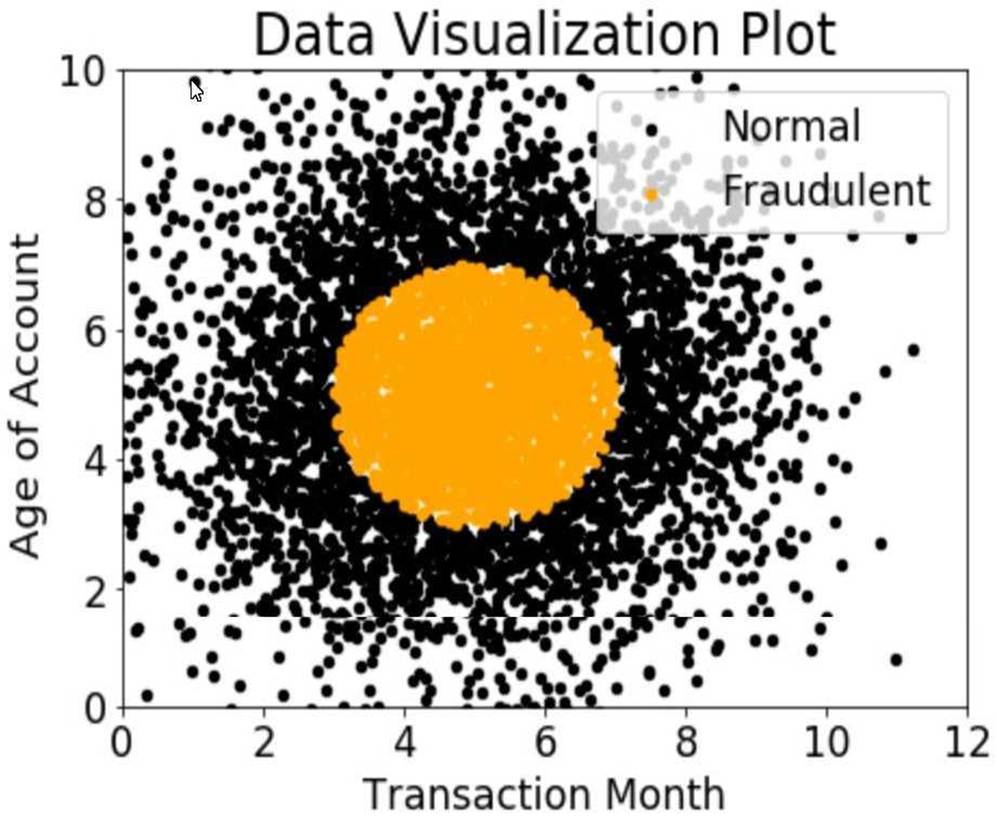
Based on this information, which model would have the HIGHEST recall with respect to the fraudulent class?
- A . Decision tree
- B . Linear support vector machine (SVM)
- C . Naive Bayesian classifier
- D . Single Perceptron with sigmoidal activation function
A
Explanation:
Based on the figure provided, a decision tree would have the highest recall with respect to the fraudulent class. Recall is a model evaluation metric that measures the proportion of actual positive instances that are correctly classified by the model. Recall is calculated as follows: Recall = True Positives / (True Positives + False Negatives)
A decision tree is a type of machine learning model that can perform classification tasks by splitting the data into smaller and purer subsets based on a series of rules or conditions. A decision tree can handle both linear and non-linear data, and can capture complex patterns and interactions among the features. A decision tree can also be easily visualized and interpreted1
In this case, the data is not linearly separable, and has a clear pattern of seasonality. The fraudulent class forms a large circle in the center of the plot, while the normal class is scattered around the edges. A decision tree can use the transaction month and the age of account as the splitting criteria, and create a circular boundary that separates the fraudulent class from the normal class. A decision tree can achieve a high recall for the fraudulent class, as it can correctly identify most of the black dots as positive instances, and minimize the number of false negatives. A decision tree can also adjust the depth and complexity of the tree to balance the trade-off between recall and precision23. The other options are not valid or suitable for achieving a high recall for the fraudulent class. A linear support vector machine (SVM) is a type of machine learning model that can perform classification tasks by finding a linear hyperplane that maximizes the margin between the classes. A linear SVM can handle linearly separable data, but not non-linear data. A linear SVM cannot capture the circular pattern of the fraudulent class, and may misclassify many of the black dots as negative instances, resulting in a low recall4 A naive Bayesian classifier is a type of machine learning model that can perform classification tasks by applying the Bayes’ theorem and assuming conditional independence among the features. A naive Bayesian classifier can handle both linear and non-linear data, and can incorporate prior knowledge and probabilities into the model. However, a naive Bayesian classifier may not perform well when the features are correlated or dependent, as in this case. A naive Bayesian classifier may not capture the circular pattern of the fraudulent class, and may misclassify many of the black dots as negative instances, resulting in a low recall5 A single perceptron with sigmoidal activation function is a type of machine learning model that can perform classification tasks by applying a weighted linear combination of the features and a non-linear activation function. A single perceptron with sigmoidal activation function can handle linearly separable data, but not non-linear data. A single perceptron with sigmoidal activation function cannot capture the circular pattern of the fraudulent class, and may misclassify many of the black dots as negative instances, resulting in a low recall.
A company is using Amazon Textract to extract textual data from thousands of scanned text-heavy legal documents daily. The company uses this information to process loan applications automatically. Some of the documents fail business validation and are returned to human reviewers, who investigate the errors. This activity increases the time to process the loan applications.
What should the company do to reduce the processing time of loan applications?
- A . Configure Amazon Textract to route low-confidence predictions to Amazon SageMaker Ground Truth. Perform a manual review on those words before performing a business validation.
- B . Use an Amazon Textract synchronous operation instead of an asynchronous operation.
- C . Configure Amazon Textract to route low-confidence predictions to Amazon Augmented AI (Amazon A2I). Perform a manual review on those words before performing a business validation.
- D . Use Amazon Rekognition’s feature to detect text in an image to extract the data from scanned images. Use this information to process the loan applications.
C
Explanation:
The company should configure Amazon Textract to route low-confidence predictions to Amazon Augmented AI (Amazon A2I). Amazon A2I is a service that allows you to implement human review of machine learning (ML) predictions. It also comes integrated with some of the Artificial Intelligence (AI) services such as Amazon Textract. By using Amazon A2I, the company can perform a manual review on those words that have low confidence scores before performing a business validation. This will help reduce the processing time of loan applications by avoiding errors and rework.
Option A is incorrect because Amazon SageMaker Ground Truth is not a suitable service for human review of Amazon Textract predictions. Amazon SageMaker Ground Truth is a service that helps you build highly accurate training datasets for machine learning. It allows you to label your own data or use a workforce of human labelers. However, it does not provide an easy way to integrate with Amazon Textract and route low-confidence predictions for human review.
Option B is incorrect because using an Amazon Textract synchronous operation instead of an asynchronous operation will not reduce the processing time of loan applications. A synchronous operation is a request-response operation that returns the results immediately. An asynchronous operation is a start-and-check operation that returns a job identifier that you can use to check the status and results later. The choice of operation depends on the size and complexity of the document, not on the confidence of the predictions.
Option D is incorrect because using Amazon Rekognition’s feature to detect text in an image to extract the data from scanned images is not a better alternative than using Amazon Textract. Amazon Rekognition is a service that provides computer vision capabilities, such as face recognition, object detection, and scene analysis. It can also detect text in an image, but it does not provide the same level of accuracy and functionality as Amazon Textract. Amazon Textract can not only detect text, but also extract data from tables and forms, and understand the layout and structure of the document.
References:
Amazon Augmented AI
Amazon SageMaker Ground Truth
Amazon Textract Operations
Amazon Rekognition
A company is building a line-counting application for use in a quick-service restaurant. The company wants to use video cameras pointed at the line of customers at a given register to measure how many people are in line and deliver notifications to managers if the line grows too long. The restaurant locations have limited bandwidth for connections to external services and cannot accommodate multiple video streams without impacting other operations.
Which solution should a machine learning specialist implement to meet these requirements?
- A . Install cameras compatible with Amazon Kinesis Video Streams to stream the data to AWS over the restaurant’s existing internet connection. Write an AWS Lambda function to take an image and send it to Amazon Rekognition to count the number of faces in the image. Send an Amazon Simple Notification Service (Amazon SNS) notification if the line is too long.
- B . Deploy AWS DeepLens cameras in the restaurant to capture video. Enable Amazon Rekognition on the AWS DeepLens device, and use it to trigger a local AWS Lambda function when a person is recognized. Use the Lambda function to send an Amazon Simple Notification Service (Amazon SNS)
notification if the line is too long. - C . Build a custom model in Amazon SageMaker to recognize the number of people in an image. Install cameras compatible with Amazon Kinesis Video Streams in the restaurant. Write an AWS Lambda function to take an image. Use the SageMaker endpoint to call the model to count people. Send an Amazon Simple Notification Service (Amazon SNS) notification if the line is too long.
- D . Build a custom model in Amazon SageMaker to recognize the number of people in an image. Deploy AWS DeepLens cameras in the restaurant. Deploy the model to the cameras. Deploy an AWS Lambda function to the cameras to use the model to count people and send an Amazon Simple Notification Service (Amazon SNS) notification if the line is too long.
D
Explanation:
The best solution for building a line-counting application for use in a quick-service restaurant is to use the following steps:
Build a custom model in Amazon SageMaker to recognize the number of people in an image. Amazon SageMaker is a fully managed service that provides tools and workflows for building, training, and deploying machine learning models. A custom model can be tailored to the specific use case of line-counting and achieve higher accuracy than a generic model1
Deploy AWS DeepLens cameras in the restaurant to capture video. AWS DeepLens is a wireless video camera that integrates with Amazon SageMaker and AWS Lambda. It can run machine learning inference locally on the device without requiring internet connectivity or streaming video to the cloud. This reduces the bandwidth consumption and latency of the application2
Deploy the model to the cameras. AWS DeepLens allows users to deploy trained models from Amazon SageMaker to the cameras with a few clicks. The cameras can then use the model to process the video frames and count the number of people in each frame2
Deploy an AWS Lambda function to the cameras to use the model to count people and send an Amazon Simple Notification Service (Amazon SNS) notification if the line is too long. AWS Lambda is a serverless computing service that lets users run code without provisioning or managing servers. AWS DeepLens supports running Lambda functions on the device to perform actions based on the inference results. Amazon SNS is a service that enables users to send notifications to subscribers via email, SMS, or mobile push23
The other options are incorrect because they either require internet connectivity or streaming video to the cloud, which may impact the bandwidth and performance of the application.
For example:
Option A uses Amazon Kinesis Video Streams to stream the data to AWS over the restaurant’s existing internet connection. Amazon Kinesis Video Streams is a service that enables users to capture, process, and store video streams for analytics and machine learning. However, this option requires streaming multiple video streams to the cloud, which may consume a lot of bandwidth and cause network congestion. It also requires internet connectivity, which may not be reliable or available in some locations4
Option B uses Amazon Rekognition on the AWS DeepLens device. Amazon Rekognition is a service that provides computer vision capabilities, such as face detection, face recognition, and object detection. However, this option requires calling the Amazon Rekognition API over the internet, which may introduce latency and require bandwidth. It also uses a generic face detection model, which may not be optimized for the line-counting use case.
Option C uses Amazon SageMaker to build a custom model and an Amazon SageMaker endpoint to call the model. Amazon SageMaker endpoints are hosted web services that allow users to perform inference on their models. However, this option requires sending the images to the endpoint over the internet, which may consume bandwidth and introduce latency. It also requires internet connectivity, which may not be reliable or available in some locations.
References:
1: Amazon SageMaker C Machine Learning Service – AWS
2: AWS DeepLens – Deep learning enabled video camera – AWS
3: Amazon Simple Notification Service (SNS) – AWS
4: Amazon Kinesis Video Streams – Amazon Web Services
: Amazon Rekognition C Video and Image – AWS
: Deploy a Model – Amazon SageMaker
A company wants to predict the sale prices of houses based on available historical sales data. The target variable in the company’s dataset is the sale price. The features include parameters such as the lot size, living area measurements, non-living area measurements, number of bedrooms, number of bathrooms, year built, and postal code. The company wants to use multi-variable linear regression to predict house sale prices.
Which step should a machine learning specialist take to remove features that are irrelevant for the analysis and reduce the model’s complexity?
- A . Plot a histogram of the features and compute their standard deviation. Remove features with high variance.
- B . Plot a histogram of the features and compute their standard deviation. Remove features with low variance.
- C . Build a heatmap showing the correlation of the dataset against itself. Remove features with low mutual correlation scores.
- D . Run a correlation check of all features against the target variable. Remove features with low target variable correlation scores.
D
Explanation:
Feature selection is the process of reducing the number of input variables to those that are most relevant for predicting the target variable. One way to do this is to run a correlation check of all features against the target variable and remove features with low target variable correlation scores. This means that these features have little or no linear relationship with the target variable and are not useful for the prediction. This can reduce the model’s complexity and improve its performance.
References:
Feature engineering – Machine Learning Lens
Feature Selection For Machine Learning in Python