
Amazon MLS-C01 Practice Exams
Last updated on Oct 23,2026- Exam Code: MLS-C01
- Exam Name: AWS Certified Machine Learning - Specialty
- Certification Provider: Amazon
- Latest update: Oct 23,2026
A company provisions Amazon SageMaker notebook instances for its data science team and creates Amazon VPC interface endpoints to ensure communication between the VPC and the notebook instances. All connections to the Amazon SageMaker API are contained entirely and securely using the AWS network. However, the data science team realizes that individuals outside the VPC can still connect to the notebook instances across the internet.
Which set of actions should the data science team take to fix the issue?
- A . Modify the notebook instances’ security group to allow traffic only from the CIDR ranges of the VPC. Apply this security group to all of the notebook instances’ VPC interfaces.
- B . Create an IAM policy that allows the sagemaker:CreatePresignedNotebooklnstanceUrl and sagemaker:DescribeNotebooklnstance actions from only the VPC endpoints. Apply this policy to all IAM users, groups, and roles used to access the notebook instances.
- C . Add a NAT gateway to the VPC. Convert all of the subnets where the Amazon SageMaker notebook instances are hosted to private subnets. Stop and start all of the notebook instances to reassign only private IP addresses.
- D . Change the network ACL of the subnet the notebook is hosted in to restrict access to anyone outside the VPC.
A
Explanation:
The issue is that the notebook instances’ security group allows inbound traffic from any source IP address, which means that anyone with the authorized URL can access the notebook instances over the internet. To fix this issue, the data science team should modify the security group to allow traffic only from the CIDR ranges of the VPC, which are the IP addresses assigned to the resources within the VPC. This way, only the VPC interface endpoints and the resources within the VPC can communicate with the notebook instances. The data science team should apply this security group to all of the notebook instances’ VPC interfaces, which are the network interfaces that connect the notebook instances to the VPC.
The other options are not correct because:
Option B: Creating an IAM policy that allows the sagemaker:CreatePresignedNotebookInstanceUrl and sagemaker:DescribeNotebookInstance actions from only the VPC endpoints does not prevent individuals outside the VPC from accessing the notebook instances. These actions are used to generate and retrieve the authorized URL for the notebook instances, but they do not control who can use the URL to access the notebook instances. The URL can still be shared or leaked to unauthorized users, who can then access the notebook instances over the internet.
Option C: Adding a NAT gateway to the VPC and converting the subnets where the notebook instances are hosted to private subnets does not solve the issue either. A NAT gateway is used to enable outbound internet access from a private subnet, but it does not affect inbound internet access. The notebook instances can still be accessed over the internet if their security group allows inbound traffic from any source IP address. Moreover, stopping and starting the notebook instances to reassign only private IP addresses is not necessary, because the notebook instances already have private IP addresses assigned by the VPC interface endpoints.
Option D: Changing the network ACL of the subnet the notebook is hosted in to restrict access to anyone outside the VPC is not a good practice, because network ACLs are stateless and apply to the entire subnet. This means that the data science team would have to specify both the inbound and outbound rules for each IP address range that they want to allow or deny. This can be cumbersome and error-prone, especially if the VPC has multiple subnets and resources. It is better to use security groups, which are stateful and apply to individual resources, to control the access to the notebook instances.
References:
Connect to SageMaker Within your VPC – Amazon SageMaker Security Groups for Your VPC – Amazon Virtual Private Cloud VPC Interface Endpoints – Amazon Virtual Private Cloud
While working on a neural network project, a Machine Learning Specialist discovers that some features in the data have very high magnitude resulting in this data being weighted more in the cost function.
What should the Specialist do to ensure better convergence during backpropagation?
- A . Dimensionality reduction
- B . Data normalization
- C . Model regulanzation
- D . Data augmentation for the minority class
B
Explanation:
Data normalization is a data preprocessing technique that scales the features to a common range, such as [0, 1] or [-1, 1]. This helps reduce the impact of features with high magnitude on the cost function and improves the convergence during backpropagation. Data normalization can be done using different methods, such as min-max scaling, z-score standardization, or unit vector normalization. Data normalization is different from dimensionality reduction, which reduces the number of features; model regularization, which adds a penalty term to the cost function to prevent overfitting; and data augmentation, which increases the amount of data by creating synthetic samples.
References:
Data processing options for AI/ML | AWS Machine Learning Blog Data preprocessing – Machine Learning Lens
How to Normalize Data Using scikit-learn in Python Normalization | Machine Learning | Google for Developers
A music streaming company is building a pipeline to extract features. The company wants to store the features for offline model training and online inference. The company wants to track feature history and to give the company’s data science teams access to the features.
Which solution will meet these requirements with the MOST operational efficiency?
- A . Use Amazon SageMaker Feature Store to store features for model training and inference. Create
an online store for online inference. Create an offline store for model training. Create an 1AM role for data scientists to access and search through feature groups. - B . Use Amazon SageMaker Feature Store to store features for model training and inference. Create an online store for both online inference and model training. Create an 1AM role for data scientists to access and search through feature groups.
- C . Create one Amazon S3 bucket to store online inference features. Create a second S3 bucket to store offline model training features. Turn on
versioning for the S3 buckets and use tags to specify which tags are for online inference features and which are for offline model training features. Use Amazon Athena to query the S3 bucket for online inference. Connect the S3 bucket for offline model training to a SageMaker training job. Create an 1AM policy that allows data scientists to access both buckets. - D . Create two separate Amazon DynamoDB tables to store online inference features and offline model training features. Use time-based versioning on both tables. Query the DynamoDB table for online inference. Move the data from DynamoDB to Amazon S3 when a new SageMaker training job is launched. Create an 1AM policy that allows data scientists to access both tables.
A
Explanation:
Amazon SageMaker Feature Store is a fully managed, purpose-built repository for storing, updating, and sharing machine learning features. It supports both online and offline stores for features, allowing real-time access for online inference and batch access for offline model training. It also tracks feature history, making it easier for data scientists to work with and access relevant feature sets.
This solution provides the necessary storage and access capabilities with high operational efficiency by managing feature history and enabling controlled access through IAM roles, making it a comprehensive choice for the company’s requirements.
A Machine Learning Specialist is creating a new natural language processing application that processes a dataset comprised of 1 million sentences. The aim is to then run Word2Vec to generate embeddings of the sentences and enable different types of predictions –
Here is an example from the dataset
"The quck BROWN FOX jumps over the lazy dog"
Which of the following are the operations the Specialist needs to perform to correctly sanitize and prepare the data in a repeatable manner? (Select THREE)
- A . Perform part-of-speech tagging and keep the action verb and the nouns only
- B . Normalize all words by making the sentence lowercase
- C . Remove stop words using an English stopword dictionary.
- D . Correct the typography on "quck" to "quick."
- E . One-hot encode all words in the sentence
- F . Tokenize the sentence into words.
B, C, F
Explanation:
To prepare the data for Word2Vec, the Specialist needs to perform some preprocessing steps that can help reduce the noise and complexity of the data, as well as improve the quality of the embeddings.
Some of the common preprocessing steps for Word2Vec are:
Normalizing all words by making the sentence lowercase: This can help reduce the vocabulary size and treat words with different capitalizations as the same word. For example, “Fox” and “fox” should be considered as the same word, not two different words.
Removing stop words using an English stopword dictionary: Stop words are words that are very common and do not carry much semantic meaning, such as “the”, “a”, “and”, etc. Removing them can help focus on the words that are more relevant and informative for the task.
Tokenizing the sentence into words: Tokenization is the process of splitting a sentence into smaller units, such as words or subwords. This is necessary for Word2Vec, as it operates on the word level and requires a list of words as input.
The other options are not necessary or appropriate for Word2Vec:
Performing part-of-speech tagging and keeping the action verb and the nouns only: Part-of-speech tagging is the process of assigning a grammatical category to each word, such as noun, verb, adjective, etc. This can be useful for some natural language processing tasks, but not for Word2Vec, as it can lose some important information and context by discarding other words.
Correcting the typography on “quck” to “quick”: Typo correction can be helpful for some tasks, but not for Word2Vec, as it can introduce errors and inconsistencies in the data. For example, if the typo is intentional or part of a dialect, correcting it can change the meaning or style of the sentence. Moreover, Word2Vec can learn to handle typos and variations in spelling by learning similar embeddings for them.
One-hot encoding all words in the sentence: One-hot encoding is a way of representing words as vectors of 0s and 1s, where only one element is 1 and the rest are 0. The index of the 1 element corresponds to the word’s position in the vocabulary. For example, if the vocabulary is [“cat”, “dog”, “fox”], then “cat” can be encoded as [1, 0, 0], “dog” as [0, 1, 0], and “fox” as [0, 0, 1]. This can be useful for some machine learning models, but not for Word2Vec, as it does not capture the semantic similarity and relationship between words. Word2Vec aims to learn dense and low-dimensional embeddings for words, where similar words have similar vectors.
A Machine Learning Specialist is configuring Amazon SageMaker so multiple Data Scientists can access notebooks, train models, and deploy endpoints. To ensure the best operational performance, the Specialist needs to be able to track how often the Scientists are deploying models, GPU and CPU utilization on the deployed SageMaker endpoints, and all errors that are generated when an endpoint is invoked.
Which services are integrated with Amazon SageMaker to track this information? (Select TWO.)
- A . AWS CloudTrail
- B . AWS Health
- C . AWS Trusted Advisor
- D . Amazon CloudWatch
- E . AWS Config
A, D
Explanation:
The services that are integrated with Amazon SageMaker to track the information that the Machine Learning Specialist needs are AWS CloudTrail and Amazon CloudWatch. AWS CloudTrail is a service that records the API calls and events for AWS services, including Amazon SageMaker. AWS CloudTrail can track the actions performed by the Data Scientists, such as creating notebooks, training models, and deploying endpoints. AWS CloudTrail can also provide information such as the identity of the user, the time of the action, the parameters used, and the response elements returned. AWS CloudTrail can help the Machine Learning Specialist to monitor the usage and activity of Amazon SageMaker, as well as to audit and troubleshoot any issues1 Amazon CloudWatch is a service that collects and analyzes the metrics and logs for AWS services, including Amazon SageMaker. Amazon CloudWatch can track the performance and utilization of the Amazon SageMaker endpoints, such as the CPU and GPU utilization, the inference latency, the number of invocations, etc. Amazon CloudWatch can also track the errors and alarms that are generated when an endpoint is invoked, such as the model errors, the throttling errors, the HTTP errors, etc. Amazon CloudWatch can help the Machine Learning Specialist to optimize the operational performance and reliability of Amazon SageMaker, as well as to set up notifications and actions based on the metrics and logs
A machine learning (ML) specialist needs to extract embedding vectors from a text series. The goal is to provide a ready-to-ingest feature space for a data scientist to develop downstream ML predictive models. The text consists of curated sentences in English. Many sentences use similar words but in different contexts. There are questions and answers among the sentences, and the embedding space must differentiate between them.
Which options can produce the required embedding vectors that capture word context and sequential QA information? (Choose two.)
- A . Amazon SageMaker seq2seq algorithm
- B . Amazon SageMaker BlazingText algorithm in Skip-gram mode
- C . Amazon SageMaker Object2Vec algorithm
- D . Amazon SageMaker BlazingText algorithm in continuous bag-of-words (CBOW) mode
- E . Combination of the Amazon SageMaker BlazingText algorithm in Batch Skip-gram mode with a custom recurrent neural network (RNN)
B, E
Explanation:
To capture word context and sequential QA information, the embedding vectors need to consider
both the order and the meaning of the words in the text.
Option B, Amazon SageMaker BlazingText algorithm in Skip-gram mode, is a valid option because it can learn word embeddings that capture the semantic similarity and syntactic relations between words based on their co-occurrence in a window of words. Skip-gram mode can also handle rare words better than continuous bag-of-words (CBOW) mode1.
Option E, combination of the Amazon SageMaker BlazingText algorithm in Batch Skip-gram mode with a custom recurrent neural network (RNN), is another valid option because it can leverage the advantages of Skip-gram mode and also use an RNN to model the sequential nature of the text. An RNN can capture the temporal dependencies and long-term dependencies between words, which are important for QA tasks2.
Option A, Amazon SageMaker seq2seq algorithm, is not a valid option because it is designed for sequence-to-sequence tasks such as machine translation, summarization, or chatbots. It does not produce embedding vectors for text series, but rather generates an output sequence given an input sequence3.
Option C, Amazon SageMaker Object2Vec algorithm, is not a valid option because it is designed for learning embeddings for pairs of objects, such as text-image, text-text, or image-image. It does not produce embedding vectors for text series, but rather learns a similarity function between pairs of objects4.
Option D, Amazon SageMaker BlazingText algorithm in continuous bag-of-words (CBOW) mode, is not a valid option because it does not capture word context as well as Skip-gram mode. CBOW mode predicts a word given its surrounding words, while Skip-gram mode predicts the surrounding words given a word. CBOW mode is faster and more suitable for frequent words, but Skip-gram mode can learn more meaningful embeddings for rare words1.
References:
1: Amazon SageMaker BlazingText
2: Recurrent Neural Networks (RNNs)
3: Amazon SageMaker Seq2Seq
4: Amazon SageMaker Object2Vec
A retail company is ingesting purchasing records from its network of 20,000 stores to Amazon S3 by using Amazon Kinesis Data Firehose. The company uses a small, server-based application in each store to send the data to AWS over the internet. The company uses this data to train a machine learning model that is retrained each day. The company’s data science team has identified existing attributes on these records that could be combined to create an improved model.
Which change will create the required transformed records with the LEAST operational overhead?
- A . Create an AWS Lambda function that can transform the incoming records. Enable data transformation on the ingestion Kinesis Data Firehose delivery stream. Use the Lambda function as the invocation target.
- B . Deploy an Amazon EMR cluster that runs Apache Spark and includes the transformation logic. Use Amazon EventBridge (Amazon CloudWatch Events) to schedule an AWS Lambda function to launch the cluster each day and transform the records that accumulate in Amazon S3. Deliver the transformed records to Amazon S3.
- C . Deploy an Amazon S3 File Gateway in the stores. Update the in-store software to deliver data to the S3 File Gateway. Use a scheduled daily AWS Glue job to transform the data that the S3 File Gateway delivers to Amazon S3.
- D . Launch a fleet of Amazon EC2 instances that include the transformation logic. Configure the EC2 instances with a daily cron job to transform the records that accumulate in Amazon S3. Deliver the transformed records to Amazon S3.
A
Explanation:
The solution A will create the required transformed records with the least operational overhead because it uses AWS Lambda and Amazon Kinesis Data Firehose, which are fully managed services that can provide the desired functionality.
The solution A involves the following steps:
Create an AWS Lambda function that can transform the incoming records. AWS Lambda is a service that can run code without provisioning or managing servers. AWS Lambda can execute the transformation logic on the purchasing records and add the new attributes to the records1.
Enable data transformation on the ingestion Kinesis Data Firehose delivery stream. Use the Lambda function as the invocation target. Amazon Kinesis Data Firehose is a service that can capture, transform, and load streaming data into AWS data stores. Amazon Kinesis Data Firehose can enable data transformation and invoke the Lambda function to process the incoming records before delivering them to Amazon S3. This can reduce the operational overhead of managing the transformation process and the data storage2.
The other options are not suitable because:
Option B: Deploying an Amazon EMR cluster that runs Apache Spark and includes the transformation logic, using Amazon EventBridge (Amazon CloudWatch Events) to schedule an AWS Lambda function to launch the cluster each day and transform the records that accumulate in Amazon S3, and delivering the transformed records to Amazon S3 will incur more operational overhead than using AWS Lambda and Amazon Kinesis Data Firehose. The company will have to manage the Amazon EMR cluster, the Apache Spark application, the AWS Lambda function, and the Amazon EventBridge rule. Moreover, this solution will introduce a delay in the transformation process, as it will run only once a day3.
Option C: Deploying an Amazon S3 File Gateway in the stores, updating the in-store software to deliver data to the S3 File Gateway, and using a scheduled daily AWS Glue job to transform the data that the S3 File Gateway delivers to Amazon S3 will incur more operational overhead than using AWS Lambda and Amazon Kinesis Data Firehose. The company will have to manage the S3 File Gateway, the in-store software, and the AWS Glue job. Moreover, this solution will introduce a delay in the transformation process, as it will run only once a day4.
Option D: Launching a fleet of Amazon EC2 instances that include the transformation logic, configuring the EC2 instances with a daily cron job to transform the records that accumulate in Amazon S3, and delivering the transformed records to Amazon S3 will incur more operational overhead than using AWS Lambda and Amazon Kinesis Data Firehose. The company will have to manage the EC2 instances, the transformation code, and the cron job. Moreover, this solution will introduce a delay in the transformation process, as it will run only once a day5.
References:
1: AWS Lambda
2: Amazon Kinesis Data Firehose
3: Amazon EMR
4: Amazon S3 File Gateway
5: Amazon EC2
A Data Scientist is building a linear regression model and will use resulting p-values to evaluate the statistical significance of each coefficient. Upon inspection of the dataset, the Data Scientist discovers that most of the features are normally distributed. The plot of one feature in the dataset is shown in the graphic.
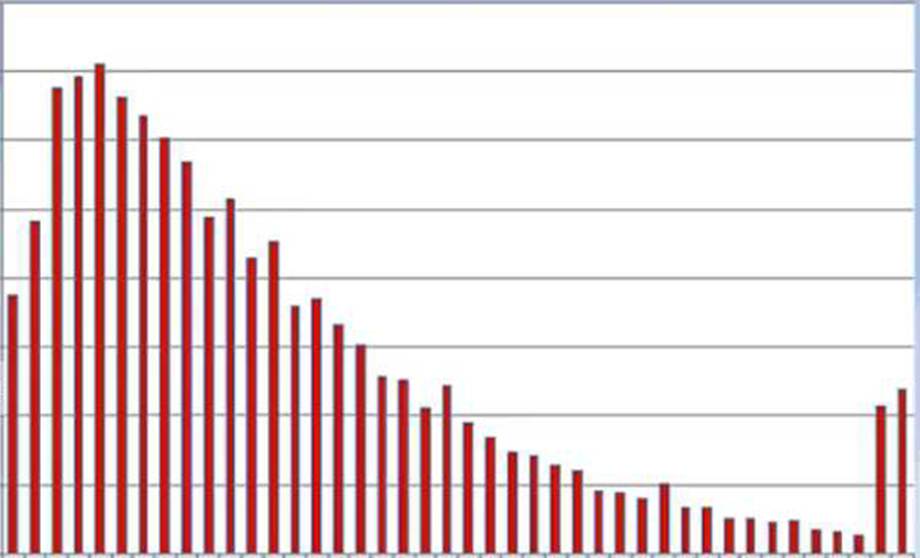
What transformation should the Data Scientist apply to satisfy the statistical assumptions of the linear
regression model?
- A . Exponential transformation
- B . Logarithmic transformation
- C . Polynomial transformation
- D . Sinusoidal transformation
B
Explanation:
The plot in the graphic shows a right-skewed distribution, which violates the assumption of normality for linear regression. To correct this, the Data Scientist should apply a logarithmic transformation to the feature. This will help to make the distribution more symmetric and closer to a normal distribution, which is a key assumption for linear regression.
References:
Linear Regression
Linear Regression with Amazon Machine Learning
Machine Learning on AWS
A company that runs an online library is implementing a chatbot using Amazon Lex to provide book recommendations based on category. This intent is fulfilled by an AWS Lambda function that queries an Amazon DynamoDB table for a list of book titles, given a particular category. For testing, there are only three categories implemented as the custom slot types: "comedy," "adventure,” and "documentary.”
A machine learning (ML) specialist notices that sometimes the request cannot be fulfilled because Amazon Lex cannot understand the category spoken by users with utterances such as "funny," "fun," and "humor.". The ML specialist needs to fix the problem without changing the Lambda code or data in DynamoDB.
How should the ML specialist fix the problem?
- A . Add the unrecognized words in the enumeration values list as new values in the slot type.
- B . Create a new custom slot type, add the unrecognized words to this slot type as enumeration values, and use this slot type for the slot.
- C . Use the AMAZON.SearchQuery built-in slot types for custom searches in the database.
- D . Add the unrecognized words as synonyms in the custom slot type.
D
Explanation:
The best way to fix the problem without changing the Lambda code or data in DynamoDB is to add the unrecognized words as synonyms in the custom slot type. This way, Amazon Lex can resolve the synonyms to the corresponding slot values and pass them to the Lambda function. For example, if the slot type has a value “comedy” with synonyms “funny”, “fun”, and “humor”, then any of these words entered by the user will be resolved to “comedy” and the Lambda function can query the DynamoDB table for the book titles in that category. Adding synonyms to the custom slot type can be done easily using the Amazon Lex console or API, and does not require any code changes. The other options are not correct because:
Option A: Adding the unrecognized words in the enumeration values list as new values in the slot type would not fix the problem, because the Lambda function and the DynamoDB table are not aware of these new values. The Lambda function would not be able to query the DynamoDB table for the book titles in the new categories, and the request would still fail. Moreover, adding new values to the slot type would increase the complexity and maintenance of the chatbot, as the Lambda function and the DynamoDB table would have to be updated accordingly.
Option B: Creating a new custom slot type, adding the unrecognized words to this slot type as enumeration values, and using this slot type for the slot would also not fix the problem, for the same reasons as option
A Machine Learning Specialist is working for an online retailer that wants to run analytics on every customer visit, processed through a machine learning pipeline. The data needs to be ingested by Amazon Kinesis Data Streams at up to 100 transactions per second, and the JSON data blob is 100 KB in size.
What is the MINIMUM number of shards in Kinesis Data Streams the Specialist should use to successfully ingest this data?
- A . 1 shards
- B . 10 shards
- C . 100 shards
- D . 1,000 shards
A
Explanation:
According to the Amazon Kinesis Data Streams documentation, the maximum size of data blob (the data payload before Base64-encoding) per record is 1 MB. The maximum number of records that can be sent to a shard per second is 1,000. Therefore, the maximum throughput of a shard is 1 MB/sec for input and 2 MB/sec for output. In this case, the input throughput is 100 transactions per second * 100 KB per transaction = 10 MB/sec. Therefore, the minimum number of shards required is 10 MB/sec / 1 MB/sec = 10 shards. However, the question asks for the minimum number of shards in Kinesis Data Streams, not the minimum number of shards per stream. A Kinesis Data Streams account can have multiple streams, each with its own number of shards. Therefore, the minimum number of shards in Kinesis Data Streams is 1, which is the minimum number of shards per stream.
References:
Amazon Kinesis Data Streams Terminology and Concepts
Amazon Kinesis Data Streams Limits