
Amazon MLS-C01 Practice Exams
Last updated on Oct 23,2026- Exam Code: MLS-C01
- Exam Name: AWS Certified Machine Learning - Specialty
- Certification Provider: Amazon
- Latest update: Oct 23,2026
A data scientist obtains a tabular dataset that contains 150 correlated features with different ranges to build a regression model. The data scientist needs to achieve more efficient model training by implementing a solution that minimizes impact on the model’s performance. The data scientist decides to perform a principal component analysis (PCA) preprocessing step to reduce the number of features to a smaller set of independent features before the data scientist uses the new features in the regression model.
Which preprocessing step will meet these requirements?
- A . Use the Amazon SageMaker built-in algorithm for PCA on the dataset to transform the data
- B . Load the data into Amazon SageMaker Data Wrangler. Scale the data with a Min Max Scaler transformation step Use the SageMaker built-in algorithm for PCA on the scaled dataset to transform the data.
- C . Reduce the dimensionality of the dataset by removing the features that have the highest correlation Load the data into Amazon SageMaker Data Wrangler Perform a Standard Scaler transformation step to scale the data Use the SageMaker built-in algorithm for PCA on the scaled dataset to transform the data
- D . Reduce the dimensionality of the dataset by removing the features that have the lowest correlation. Load the data into Amazon SageMaker Data Wrangler. Perform a Min Max Scaler transformation step to scale the data. Use the SageMaker built-in algorithm for PCA on the scaled dataset to transform the data.
B
Explanation:
Principal component analysis (PCA) is a technique for reducing the dimensionality of datasets, increasing interpretability but at the same time minimizing information loss. It does so by creating new uncorrelated variables that successively maximize variance. PCA is useful when dealing with datasets that have a large number of correlated features. However, PCA is sensitive to the scale of the features, so it is important to standardize or normalize the data before applying PCA. Amazon SageMaker provides a built-in algorithm for PCA that can be used to transform the data into a lower-dimensional representation. Amazon SageMaker Data Wrangler is a tool that allows data scientists to visually explore, clean, and prepare data for machine learning. Data Wrangler provides various transformation steps that can be applied to the data, such as scaling, encoding, imputing, etc. Data Wrangler also integrates with SageMaker built-in algorithms, such as PCA, to enable feature engineering and dimensionality reduction. Therefore, option B is the correct answer, as it involves scaling the data with a Min Max Scaler transformation step, which rescales the data to a range of [0, 1], and then using the SageMaker built-in algorithm for PCA on the scaled dataset to transform the data. Option A is incorrect, as it does not involve scaling the data before applying PCA, which can affect the results of the dimensionality reduction. Option C is incorrect, as it involves removing the features that have the highest correlation, which can lead to information loss and reduce the performance of the regression model. Option D is incorrect, as it involves removing the features that have the lowest correlation, which can also lead to information loss and reduce the performance of the regression model.
References:
Principal Component Analysis (PCA) – Amazon SageMaker
Scale data with a Min Max Scaler – Amazon SageMaker Data Wrangler
Use Amazon SageMaker built-in algorithms – Amazon SageMaker Data Wrangler
The displayed graph is from a foresting model for testing a time series.
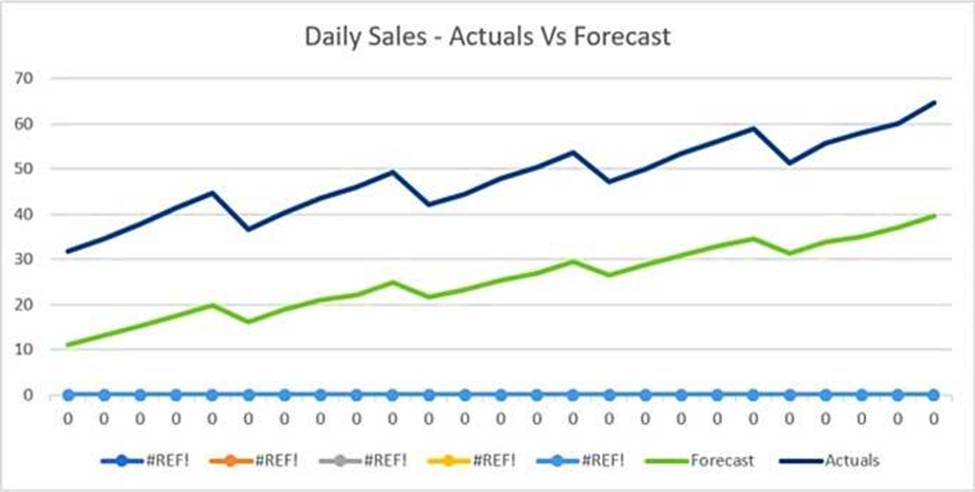
Considering the graph only, which conclusion should a Machine Learning Specialist make about the behavior of the model?
- A . The model predicts both the trend and the seasonality well.
- B . The model predicts the trend well, but not the seasonality.
- C . The model predicts the seasonality well, but not the trend.
- D . The model does not predict the trend or the seasonality well.
D
Explanation:
A machine learning (ML) specialist is using Amazon SageMaker hyperparameter optimization (HPO) to improve a model’s accuracy.
The learning rate parameter is specified in the following HPO configuration:
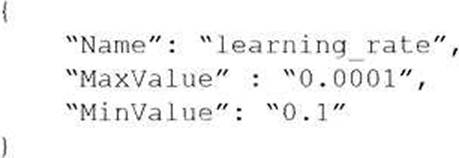
During the results analysis, the ML specialist determines that most of the training jobs had a learning rate between 0.01 and 0.1. The best result had a learning rate of less than 0.01. Training jobs need to run regularly over a changing dataset. The ML specialist needs to find a tuning mechanism that uses different learning rates more evenly from the provided range between MinValue and MaxValue.
Which solution provides the MOST accurate result?
- A . Modify the HPO configuration as follows:
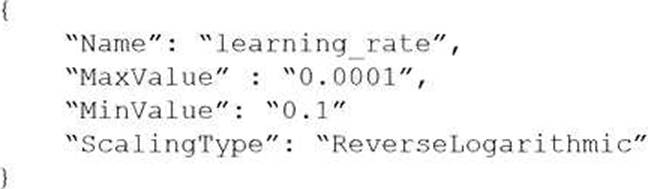
Select the most accurate hyperparameter configuration form this HPO job. - B . Run three different HPO jobs that use different learning rates form the following intervals for MinValue and MaxValue while using the same number of training jobs for each HPO job:
[0.01, 0.1]
[0.001, 0.01]
[0.0001, 0.001]
Select the most accurate hyperparameter configuration form these three HPO jobs. - C . Modify the HPO configuration as follows:
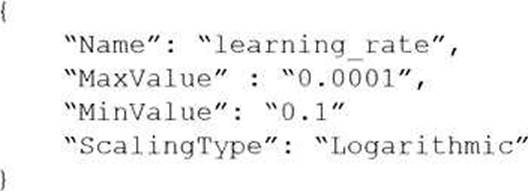
Select the most accurate hyperparameter configuration form this training job. - D . Run three different HPO jobs that use different learning rates form the following intervals for MinValue and MaxValue.
Divide the number of training jobs for each HPO job by three:
[0.01, 0.1]
[0.001, 0.01]
[0.0001, 0.001]
Select the most accurate hyperparameter configuration form these three HPO jobs.
C
Explanation:
The solution C modifies the HPO configuration to use a logarithmic scale for the learning rate parameter. This means that the values of the learning rate are sampled from a log-uniform distribution, which gives more weight to smaller values. This can help to explore the lower end of the range more evenly and find the optimal learning rate more efficiently. The other solutions either use a linear scale, which may not sample enough values from the lower end, or divide the range into sub-intervals, which may miss some combinations of hyperparameters.
References: How Hyperparameter Tuning Works – Amazon SageMaker Tuning Hyperparameters – Amazon SageMaker
A company has an ecommerce website with a product recommendation engine built in TensorFlow. The recommendation engine endpoint is hosted by Amazon SageMaker. Three compute-optimized instances support the expected peak load of the website.
Response times on the product recommendation page are increasing at the beginning of each month. Some users are encountering errors. The website receives the majority of its traffic between 8 AM and 6 PM on weekdays in a single time zone.
Which of the following options are the MOST effective in solving the issue while keeping costs to a minimum? (Choose two.)
- A . Configure the endpoint to use Amazon Elastic Inference (EI) accelerators.
- B . Create a new endpoint configuration with two production variants.
- C . Configure the endpoint to automatically scale with the Invocations Per Instance metric.
- D . Deploy a second instance pool to support a blue/green deployment of models.
- E . Reconfigure the endpoint to use burstable instances.
A, C
Explanation:
The solution A and C are the most effective in solving the issue while keeping costs to a minimum.
The solution A and C involve the following steps:
Configure the endpoint to use Amazon Elastic Inference (EI) accelerators. This will enable the company to reduce the cost and latency of running TensorFlow inference on SageMaker. Amazon EI provides GPU-powered acceleration for deep learning models without requiring the use of GPU instances. Amazon EI can attach to any SageMaker instance type and provide the right amount of acceleration based on the workload1.
Configure the endpoint to automatically scale with the Invocations Per Instance metric. This will enable the company to adjust the number of instances based on the demand and traffic patterns of the website. The Invocations Per Instance metric measures the average number of requests that each instance processes over a period of time. By using this metric, the company can scale out the endpoint when the load increases and scale in when the load decreases. This can improve the response time and availability of the product recommendation engine2.
The other options are not suitable because:
Option B: Creating a new endpoint configuration with two production variants will not solve the issue of increasing response time and errors. Production variants are used to split the traffic between different models or versions of the same model. They can be useful for testing, updating, or A/B testing models. However, they do not provide any scaling or acceleration benefits for the inference workload3.
Option D: Deploying a second instance pool to support a blue/green deployment of models will not solve the issue of increasing response time and errors. Blue/green deployment is a technique for updating models without downtime or disruption. It involves creating a new endpoint configuration with a different instance pool and model version, and then shifting the traffic from the old endpoint to the new endpoint gradually. However, this technique does not provide any scaling or acceleration benefits for the inference workload4.
Option E: Reconfiguring the endpoint to use burstable instances will not solve the issue of increasing response time and errors. Burstable instances are instances that provide a baseline level of CPU performance with the ability to burst above the baseline when needed. They can be useful for workloads that have moderate CPU utilization and occasional spikes. However, they are not suitable for workloads that have high and consistent CPU utilization, such as the product recommendation engine. Moreover, burstable instances may incur additional charges when they exceed their CPU credits5.
References:
1: Amazon Elastic Inference
2: How to Scale Amazon SageMaker Endpoints
3: Deploying Models to Amazon SageMaker Hosting Services
4: Updating Models in Amazon SageMaker Hosting Services
5: Burstable Performance Instances
A company is launching a new product and needs to build a mechanism to monitor comments about the company and its new product on social media. The company needs to be able to evaluate the sentiment expressed in social media posts, and visualize trends and configure alarms based on various thresholds.
The company needs to implement this solution quickly, and wants to minimize the infrastructure and data science resources needed to evaluate the messages. The company already has a solution in place to collect posts and store them within an Amazon S3 bucket.
What services should the data science team use to deliver this solution?
- A . Train a model in Amazon SageMaker by using the BlazingText algorithm to detect sentiment in the corpus of social media posts. Expose an endpoint that can be called by AWS Lambda. Trigger a Lambda function when posts are added to the S3 bucket to invoke the endpoint and record the sentiment in an Amazon DynamoDB table and in a custom Amazon CloudWatch metric. Use CloudWatch alarms to notify analysts of trends.
- B . Train a model in Amazon SageMaker by using the semantic segmentation algorithm to model the semantic content in the corpus of social media posts. Expose an endpoint that can be called by AWS Lambda. Trigger a Lambda function when objects are added to the S3 bucket to invoke the endpoint and record the sentiment in an Amazon DynamoDB table. Schedule a second Lambda function to query recently added records and send an Amazon Simple Notification Service (Amazon SNS) notification to notify analysts of trends.
- C . Trigger an AWS Lambda function when social media posts are added to the S3 bucket. Call Amazon Comprehend for each post to capture the sentiment in the message and record the sentiment in an Amazon DynamoDB table. Schedule a second Lambda function to query recently added records and send an Amazon Simple Notification Service (Amazon SNS) notification to notify analysts of trends.
- D . Trigger an AWS Lambda function when social media posts are added to the S3 bucket. Call Amazon Comprehend for each post to capture the sentiment in the message and record the sentiment in a custom Amazon CloudWatch metric and in S3. Use CloudWatch alarms to notify analysts of trends.
D
Explanation:
The solution that uses Amazon Comprehend and Amazon CloudWatch is the most suitable for the given scenario. Amazon Comprehend is a natural language processing (NLP) service that can analyze text and extract insights such as sentiment, entities, topics, and syntax. Amazon CloudWatch is a monitoring and observability service that can collect and track metrics, create dashboards, and set alarms based on various thresholds. By using these services, the data science team can quickly and easily implement a solution to monitor the sentiment of social media posts without requiring much infrastructure or data science resources. The solution also meets the requirements of storing the sentiment in both S3 and CloudWatch, and using CloudWatch alarms to notify analysts of trends.
References:
Amazon Comprehend
Amazon CloudWatch
A media company wants to create a solution that identifies celebrities in pictures that users upload. The company also wants to identify the IP address and the timestamp details from the users so the company can prevent users from uploading pictures from unauthorized locations.
Which solution will meet these requirements with LEAST development effort?
- A . Use AWS Panorama to identify celebrities in the pictures. Use AWS CloudTrail to capture IP address and timestamp details.
- B . Use AWS Panorama to identify celebrities in the pictures. Make calls to the AWS Panorama Device SDK to capture IP address and timestamp details.
- C . Use Amazon Rekognition to identify celebrities in the pictures. Use AWS CloudTrail to capture IP address and timestamp details.
- D . Use Amazon Rekognition to identify celebrities in the pictures. Use the text detection feature to capture IP address and timestamp details.
C
Explanation:
The solution C will meet the requirements with the least development effort because it uses Amazon Rekognition and AWS CloudTrail, which are fully managed services that can provide the desired functionality.
The solution C involves the following steps:
Use Amazon Rekognition to identify celebrities in the pictures. Amazon Rekognition is a service that can analyze images and videos and extract insights such as faces, objects, scenes, emotions, and more. Amazon Rekognition also provides a feature called Celebrity Recognition, which can recognize thousands of celebrities across a number of categories, such as politics, sports, entertainment, and medi
a. Amazon Rekognition can return the name, face, and confidence score of the recognized celebrities, as well as additional information such as URLs and biographies1.
Use AWS CloudTrail to capture IP address and timestamp details. AWS CloudTrail is a service that can record the API calls and events made by or on behalf of AWS accounts. AWS CloudTrail can provide information such as the source IP address, the user identity, the request parameters, and the response elements of the API calls. AWS CloudTrail can also deliver the event records to an Amazon S3 bucket or an Amazon CloudWatch Logs group for further analysis and auditing2. The other options are not suitable because:
Option A: Using AWS Panorama to identify celebrities in the pictures and using AWS CloudTrail to capture IP address and timestamp details will not meet the requirements effectively. AWS Panorama is a service that can extend computer vision to the edge, where it can run inference on video streams from cameras and other devices. AWS Panorama is not designed for identifying celebrities in pictures, and it may not provide accurate or relevant results. Moreover, AWS Panorama requires the use of an AWS Panorama Appliance or a compatible device, which may incur additional costs and complexity3.
Option B: Using AWS Panorama to identify celebrities in the pictures and making calls to the AWS Panorama Device SDK to capture IP address and timestamp details will not meet the requirements effectively, for the same reasons as option
A company needs to quickly make sense of a large amount of data and gain insight from it. The data is in different formats, the schemas change frequently, and new data sources are added regularly. The company wants to use AWS services to explore multiple data sources, suggest schemas, and enrich and transform the data. The solution should require the least possible coding effort for the data flows and the least possible infrastructure management.
Which combination of AWS services will meet these requirements?
- A . Amazon EMR for data discovery, enrichment, and transformation
Amazon Athena for querying and analyzing the results in Amazon S3 using standard SQL Amazon QuickSight for reporting and getting insights - B . Amazon Kinesis Data Analytics for data ingestion
Amazon EMR for data discovery, enrichment, and transformation Amazon Redshift for querying and analyzing the results in Amazon S3 - C . AWS Glue for data discovery, enrichment, and transformation
Amazon Athena for querying and analyzing the results in Amazon S3 using standard SQL Amazon QuickSight for reporting and getting insights - D . AWS Data Pipeline for data transfer
AWS Step Functions for orchestrating AWS Lambda jobs for data discovery, enrichment, and transformation
Amazon Athena for querying and analyzing the results in Amazon S3 using standard SQL Amazon QuickSight for reporting and getting insights
C
Explanation:
The best combination of AWS services to meet the requirements of data discovery, enrichment, transformation, querying, analysis, and reporting with the least coding and infrastructure management is AWS Glue, Amazon Athena, and Amazon QuickSight.
These services are:
AWS Glue for data discovery, enrichment, and transformation. AWS Glue is a serverless data integration service that automatically crawls, catalogs, and prepares data from various sources and formats. It also provides a visual interface called AWS Glue DataBrew that allows users to apply over 250 transformations to clean, normalize, and enrich data without writing code1
Amazon Athena for querying and analyzing the results in Amazon S3 using standard SQL. Amazon Athena is a serverless interactive query service that allows users to analyze data in Amazon S3 using standard SQL. It supports a variety of data formats, such as CSV, JSON, ORC, Parquet, and Avro. It also integrates with AWS Glue Data Catalog to provide a unified view of the data sources and schemas2 Amazon QuickSight for reporting and getting insights. Amazon QuickSight is a serverless business intelligence service that allows users to create and share interactive dashboards and reports. It also provides ML-powered features, such as anomaly detection, forecasting, and natural language queries, to help users discover hidden insights from their data3
The other options are not suitable because they either require more coding effort, more infrastructure management, or do not support the desired use cases. For example:
Option A uses Amazon EMR for data discovery, enrichment, and transformation. Amazon EMR is a managed cluster platform that runs Apache Spark, Apache Hive, and other open-source frameworks for big data processing. It requires users to write code in languages such as Python, Scala, or SQL to perform data integration tasks. It also requires users to provision, configure, and scale the clusters according to their needs4
Option B uses Amazon Kinesis Data Analytics for data ingestion. Amazon Kinesis Data Analytics is a service that allows users to process streaming data in real time using SQL or Apache Flink. It is not suitable for data discovery, enrichment, and transformation, which are typically batch-oriented tasks. It also requires users to write code to define the data processing logic and the output destination5
Option D uses AWS Data Pipeline for data transfer and AWS Step Functions for orchestrating AWS Lambda jobs for data discovery, enrichment, and transformation. AWS Data Pipeline is a service that helps users move data between AWS services and on-premises data sources. AWS Step Functions is a service that helps users coordinate multiple AWS services into workflows. AWS Lambda is a service that lets users run code without provisioning or managing servers. These services require users to write code to define the data sources, destinations, transformations, and workflows. They also require users to manage the scalability, performance, and reliability of the data pipelines.
Reference:
1: AWS Glue – Data Integration Service – Amazon Web Services
2: Amazon Athena C Interactive SQL Query Service – AWS
3: Amazon QuickSight – Business Intelligence Service – AWS
4: Amazon EMR – Amazon Web Services
5: Amazon Kinesis Data Analytics – Amazon Web Services
: AWS Data Pipeline – Amazon Web Services
: AWS Step Functions – Amazon Web Services
: AWS Lambda – Amazon Web Services
Amazon Connect has recently been tolled out across a company as a contact call center. The solution has been configured to store voice call recordings on Amazon S3
The content of the voice calls are being analyzed for the incidents being discussed by the call operators Amazon Transcribe is being used to convert the audio to text, and the output is stored on Amazon S3
Which approach will provide the information required for further analysis?
- A . Use Amazon Comprehend with the transcribed files to build the key topics
- B . Use Amazon Translate with the transcribed files to train and build a model for the key topics
- C . Use the AWS Deep Learning AMI with Gluon Semantic Segmentation on the transcribed files to
train and build a model for the key topics - D . Use the Amazon SageMaker k-Nearest-Neighbors (kNN) algorithm on the transcribed files to generate a word embeddings dictionary for the key topics
A
Explanation:
Amazon Comprehend is a natural language processing (NLP) service that uses machine learning to find insights and relationships in text. It can analyze text documents and identify the key topics, entities, sentiments, languages, and more. In this case, Amazon Comprehend can be used with the transcribed files from Amazon Transcribe to extract the main topics that are being discussed by the call operators. This can help to understand the common issues and concerns of the customers, and provide insights for further analysis and improvement.
References:
Amazon Comprehend – Amazon Web Services
AWS Certified Machine Learning – Specialty Sample Questions
A Machine Learning Specialist at a company sensitive to security is preparing a dataset for model training. The dataset is stored in Amazon S3 and contains Personally Identifiable Information (Pll).
The dataset:
* Must be accessible from a VPC only.
* Must not traverse the public internet.
How can these requirements be satisfied?
- A . Create a VPC endpoint and apply a bucket access policy that restricts access to the given VPC endpoint and the VPC.
- B . Create a VPC endpoint and apply a bucket access policy that allows access from the given VPC endpoint and an Amazon EC2 instance.
- C . Create a VPC endpoint and use Network Access Control Lists (NACLs) to allow traffic between only the given VPC endpoint and an Amazon EC2 instance.
- D . Create a VPC endpoint and use security groups to restrict access to the given VPC endpoint and an Amazon EC2 instance.
A
Explanation:
A VPC endpoint is a logical device that enables private connections between a VPC and supported AWS services. A VPC endpoint can be either a gateway endpoint or an interface endpoint. A gateway endpoint is a gateway that is a target for a specified route in the route table, used for traffic destined to a supported AWS service. An interface endpoint is an elastic network interface with a private IP address that serves as an entry point for traffic destined to a supported service1
In this case, the Machine Learning Specialist can create a gateway endpoint for Amazon S3, which is a supported service for gateway endpoints. A gateway endpoint for Amazon S3 enables the VPC to access Amazon S3 privately, without requiring an internet gateway, NAT device, VPN connection, or AWS Direct Connect connection. The traffic between the VPC and Amazon S3 does not leave the Amazon network2
To restrict access to the dataset stored in Amazon S3, the Machine Learning Specialist can apply a bucket access policy that allows access only from the given VPC endpoint and the VPC. A bucket access policy is a resource-based policy that defines who can access a bucket and what actions they can perform. A bucket access policy can use various conditions to control access, such as the source IP address, the source VPC, the source VPC endpoint, etc. In this case, the Machine Learning Specialist can use the aws:sourceVpce condition to specify the ID of the VPC endpoint, and the aws:sourceVpc condition to specify the ID of the VPC. This way, only the requests that originate from the VPC endpoint or the VPC can access the bucket that contains the dataset34
The other options are not valid or secure ways to satisfy the requirements. Creating a VPC endpoint and applying a bucket access policy that allows access from the given VPC endpoint and an Amazon EC2 instance is not a good option, as it does not restrict access to the VPC. An Amazon EC2 instance is a virtual server that runs in the AWS cloud. An Amazon EC2 instance can have a public IP address or a private IP address, depending on the network configuration. Allowing access from an Amazon EC2 instance does not guarantee that the instance is in the same VPC as the VPC endpoint, and may expose the dataset to unauthorized access. Creating a VPC endpoint and using Network Access Control Lists (NACLs) to allow traffic between only the given VPC endpoint and an Amazon EC2 instance is not a good option, as it does not restrict access to the VPC. NACLs are stateless firewalls that can control inbound and outbound traffic at the subnet level. NACLs can use rules to allow or deny traffic based on the protocol, port, and source or destination IP address. However, NACLs do not support VPC endpoints as a source or destination, and cannot filter traffic based on the VPC
endpoint ID or the VPC ID. Therefore, using NACLs does not guarantee that the traffic is from the VPC endpoint or the VPC, and may expose the dataset to unauthorized access. Creating a VPC endpoint and using security groups to restrict access to the given VPC endpoint and an Amazon EC2 instance is not a good option, as it does not restrict access to the VPC. Security groups are stateful firewalls that can control inbound and outbound traffic at the instance level. Security groups can use rules to allow or deny traffic based on the protocol, port, and source or destination. However, security groups do not support VPC endpoints as a source or destination, and cannot filter traffic based on the VPC endpoint ID or the VPC ID. Therefore, using security groups does not guarantee that the traffic is from the VPC endpoint or the VPC, and may expose the dataset to unauthorized access.
A company wants to conduct targeted marketing to sell solar panels to homeowners. The company wants to use machine learning (ML) technologies to identify which houses already have solar panels. The company has collected 8,000 satellite images as training data and will use Amazon SageMaker Ground Truth to label the data.
The company has a small internal team that is working on the project. The internal team has no ML expertise and no ML experience.
Which solution will meet these requirements with the LEAST amount of effort from the internal team?
- A . Set up a private workforce that consists of the internal team. Use the private workforce and the SageMaker Ground Truth active learning feature to label the data. Use Amazon Rekognition Custom Labels for model training and hosting.
- B . Set up a private workforce that consists of the internal team. Use the private workforce to label the data. Use Amazon Rekognition Custom Labels for model training and hosting.
- C . Set up a private workforce that consists of the internal team. Use the private workforce and the SageMaker Ground Truth active learning feature to label the data. Use the SageMaker Object Detection algorithm to train a model. Use SageMaker batch transform for inference.
- D . Set up a public workforce. Use the public workforce to label the data. Use the SageMaker Object Detection algorithm to train a model. Use SageMaker batch transform for inference.
A
Explanation:
The solution A will meet the requirements with the least amount of effort from the internal team because it uses Amazon SageMaker Ground Truth and Amazon Rekognition Custom Labels, which are fully managed services that can provide the desired functionality. The solution A involves the following steps:
Set up a private workforce that consists of the internal team. Use the private workforce and the SageMaker Ground Truth active learning feature to label the data. Amazon SageMaker Ground Truth is a service that can create high-quality training datasets for machine learning by using human labelers. A private workforce is a group of labelers that the company can manage and control. The internal team can use the private workforce to label the satellite images as having solar panels or not. The SageMaker Ground Truth active learning feature can reduce the labeling effort by using a machine learning model to automatically label the easy examples and only send the difficult ones to the human labelers1.
Use Amazon Rekognition Custom Labels for model training and hosting. Amazon Rekognition Custom Labels is a service that can train and deploy custom machine learning models for image analysis. Amazon Rekognition Custom Labels can use the labeled data from SageMaker Ground Truth to train a model that can detect solar panels in satellite images. Amazon Rekognition Custom Labels can also host the model and provide an API endpoint for inference2. The other options are not suitable because:
Option B: Setting up a private workforce that consists of the internal team, using the private workforce to label the data, and using Amazon Rekognition Custom Labels for model training and hosting will incur more effort from the internal team than using SageMaker Ground Truth active learning feature. The internal team will have to label all the images manually, without the assistance of the machine learning model that can automate some of the labeling tasks1.
Option C: Setting up a private workforce that consists of the internal team, using the private workforce and the SageMaker Ground Truth active learning feature to label the data, using the SageMaker Object Detection algorithm to train a model, and using SageMaker batch transform for inference will incur more operational overhead than using Amazon Rekognition Custom Labels. The company will have to manage the SageMaker training job, the model artifact, and the batch transform job. Moreover, SageMaker batch transform is not suitable for real-time inference, as it processes the data in batches and stores the results in Amazon S33.
Option D: Setting up a public workforce, using the public workforce to label the data, using the SageMaker Object Detection algorithm to train a model, and using SageMaker batch transform for inference will incur more operational overhead and cost than using a private workforce and Amazon Rekognition Custom Labels. A public workforce is a group of labelers from Amazon Mechanical Turk, a crowdsourcing marketplace. The company will have to pay the public workforce for each labeling task, and it may not have full control over the quality and security of the labeled data. The company will also have to manage the SageMaker training job, the model artifact, and the batch transform job, as explained in option C4.
References:
1: Amazon SageMaker Ground Truth
2: Amazon Rekognition Custom Labels
3: Amazon SageMaker Object Detection
4: Amazon Mechanical Turk