
Amazon MLS-C01 Practice Exams
Last updated on Oct 23,2026- Exam Code: MLS-C01
- Exam Name: AWS Certified Machine Learning - Specialty
- Certification Provider: Amazon
- Latest update: Oct 23,2026
A Machine Learning Specialist is preparing data for training on Amazon SageMaker. The Specialist is transformed into a numpy .array, which appears to be negatively affecting the speed of the training.
What should the Specialist do to optimize the data for training on SageMaker?
- A . Use the SageMaker batch transform feature to transform the training data into a DataFrame
- B . Use AWS Glue to compress the data into the Apache Parquet format
- C . Transform the dataset into the Recordio protobuf format
- D . Use the SageMaker hyperparameter optimization feature to automatically optimize the data
C
Explanation:
The Recordio protobuf format is a binary data format that is optimized for training on SageMaker. It allows faster data loading and lower memory usage compared to other formats such as CSV or numpy arrays. The Recordio protobuf format also supports features such as sparse input, variable-length input, and label embedding. To use the Recordio protobuf format, the data needs to be serialized and deserialized using the appropriate libraries. Some of the built-in algorithms in SageMaker support the Recordio protobuf format as a content type for training and inference.
References:
Common Data Formats for Training
Using RecordIO Format
Content Types Supported by Built-in Algorithms
A company wants to use automatic speech recognition (ASR) to transcribe messages that are less than 60 seconds long from a voicemail-style application. The company requires the correct identification of 200 unique product names, some of which have unique spellings or pronunciations. The company has 4,000 words of Amazon SageMaker Ground Truth voicemail transcripts it can use to customize the chosen ASR model. The company needs to ensure that everyone can update their customizations multiple times each hour.
Which approach will maximize transcription accuracy during the development phase?
- A . Use a voice-driven Amazon Lex bot to perform the ASR customization. Create customer slots within the bot that specifically identify each of the required product names. Use the Amazon Lex synonym mechanism to provide additional variations of each product name as mis-transcriptions are identified in development.
- B . Use Amazon Transcribe to perform the ASR customization. Analyze the word confidence scores in the transcript, and automatically create or update a custom vocabulary file with any word that has a confidence score below an acceptable threshold value. Use this updated custom vocabulary file in all future transcription tasks.
- C . Create a custom vocabulary file containing each product name with phonetic pronunciations, and use it with Amazon Transcribe to perform the ASR customization. Analyze the transcripts and manually update the custom vocabulary file to include updated or additional entries for those names that are not being correctly identified.
- D . Use the audio transcripts to create a training dataset and build an Amazon Transcribe custom language model. Analyze the transcripts and update the training dataset with a manually corrected version of transcripts where product names are not being transcribed correctly. Create an updated custom language model.
C
Explanation:
The best approach to maximize transcription accuracy during the development phase is to create a custom vocabulary file containing each product name with phonetic pronunciations, and use it with Amazon Transcribe to perform the ASR customization. A custom vocabulary is a list of words and phrases that are likely to appear in your audio input, along with optional information about how to pronounce them. By using a custom vocabulary, you can improve the transcription accuracy of domain-specific terms, such as product names, that may not be recognized by the general vocabulary of Amazon Transcribe. You can also analyze the transcripts and manually update the custom vocabulary file to include updated or additional entries for those names that are not being correctly identified.
The other options are not as effective as option C for the following reasons:
Option A is not suitable because Amazon Lex is a service for building conversational interfaces, not for transcribing voicemail messages. Amazon Lex also has a limit of 100 slots per bot, which is not enough to accommodate the 200 unique product names required by the company.
Option B is not optimal because it relies on the word confidence scores in the transcript, which may not be accurate enough to identify all the mis-transcribed product names. Moreover, automatically creating or updating a custom vocabulary file may introduce errors or inconsistencies in the pronunciation or display of the words.
Option D is not feasible because it requires a large amount of training data to build a custom language model. The company only has 4,000 words of Amazon SageMaker Ground Truth voicemail transcripts, which is not enough to train a robust and reliable custom language model. Additionally, creating and updating a custom language model is a time-consuming and resource-intensive process, which may not be suitable for the development phase where frequent changes are expected.
References:
Amazon Transcribe C Custom Vocabulary
Amazon Transcribe C Custom Language Models
[Amazon Lex C Limits]
A Machine Learning Specialist is building a convolutional neural network (CNN) that will classify 10 types of animals. The Specialist has built a series of layers in a neural network that will take an input image of an animal, pass it through a series of convolutional and pooling layers, and then finally pass it through a dense and fully connected layer with 10 nodes. The Specialist would like to get an output from the neural network that is a probability distribution of how likely it is that the input image belongs to each of the 10 classes
Which function will produce the desired output?
- A . Dropout
- B . Smooth L1 loss
- C . Softmax
- D . Rectified linear units (ReLU)
C
Explanation:
The softmax function is a function that can transform a vector of arbitrary real values into a vector of real values in the range (0,1) that sum to 1. This means that the softmax function can produce a valid probability distribution over multiple classes. The softmax function is often used as the activation function of the output layer in a neural network, especially for multi-class classification problems. The softmax function can assign higher probabilities to the classes with higher scores, which allows the network to make predictions based on the most likely class. In this case, the Machine Learning Specialist wants to get an output from the neural network that is a probability distribution of how likely it is that the input image belongs to each of the 10 classes of animals. Therefore, the softmax function is the most suitable function to produce the desired output.
References:
Softmax Activation Function for Deep Learning: A Complete Guide.
What is Softmax in Machine Learning? – reason.town
machine learning – Why is the softmax function often used as activation … Multi-Class Neural Networks: Softmax | Machine Learning | Google for …
A machine learning specialist is developing a proof of concept for government users whose primary concern is security. The specialist is using Amazon SageMaker to train a convolutional neural network (CNN) model for a photo classifier application. The specialist wants to protect the data so that it cannot be accessed and transferred to a remote host by malicious code accidentally installed on the training container.
Which action will provide the MOST secure protection?
- A . Remove Amazon S3 access permissions from the SageMaker execution role.
- B . Encrypt the weights of the CNN model.
- C . Encrypt the training and validation dataset.
- D . Enable network isolation for training jobs.
D
Explanation:
The most secure action to protect the data from being accessed and transferred to a remote host by malicious code accidentally installed on the training container is to enable network isolation for training jobs. Network isolation is a feature that allows you to run training and inference containers in internet-free mode, which blocks any outbound network calls from the containers, even to other AWS services such as Amazon S3. Additionally, no AWS credentials are made available to the container runtime environment. This way, you can prevent unauthorized access to your data and resources by malicious code or users. You can enable network isolation by setting the EnableNetworkIsolation parameter to True when you call CreateTrainingJob, CreateHyperParameterTuningJob, or CreateModel.
References:
Run Training and Inference Containers in Internet-Free Mode – Amazon SageMaker
A health care company is planning to use neural networks to classify their X-ray images into normal and abnormal classes. The labeled data is divided into a training set of 1,000 images and a test set of 200 images. The initial training of a neural network model with 50 hidden layers yielded 99% accuracy on the training set, but only 55% accuracy on the test set.
What changes should the Specialist consider to solve this issue? (Choose three.)
- A . Choose a higher number of layers
- B . Choose a lower number of layers
- C . Choose a smaller learning rate
- D . Enable dropout
- E . Include all the images from the test set in the training set
- F . Enable early stopping
B, D, F
Explanation:
The problem described in the question is a case of overfitting, where the neural network model performs well on the training data but poorly on the test data. This means that the model has learned the noise and specific patterns of the training data, but cannot generalize to new and unseen data. To solve this issue, the Specialist should consider the following changes:
Choose a lower number of layers: Reducing the number of layers can reduce the complexity and capacity of the neural network model, making it less prone to overfitting. A model with 50 hidden layers is likely too deep for the given data size and task. A simpler model with fewer layers can learn the essential features of the data without memorizing the noise.
Enable dropout: Dropout is a regularization technique that randomly drops out some units in the neural network during training. This prevents the units from co-adapting too much and forces the model to learn more robust features. Dropout can improve the generalization and test performance of the model by reducing overfitting.
Enable early stopping: Early stopping is another regularization technique that monitors the validation error during training and stops the training process when the validation error stops decreasing or starts increasing. This prevents the model from overtraining on the training data and reduces overfitting.
References:
Deep Learning – Machine Learning Lens
How to Avoid Overfitting in Deep Learning Neural Networks
How to Identify Overfitting Machine Learning Models in Scikit-Learn
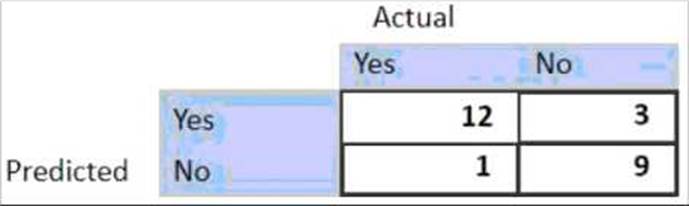
For the given confusion matrix, what is the recall and precision of the model?
- A . Recall = 0.92 Precision = 0.84
- B . Recall = 0.84 Precision = 0.8
- C . Recall = 0.92 Precision = 0.8
- D . Recall = 0.8 Precision = 0.92
C
Explanation:
Recall and precision are two metrics that can be used to evaluate the performance of a classification model. Recall is the ratio of true positives to the total number of actual positives, which measures how well the model can identify all the relevant cases. Precision is the ratio of true positives to the total number of predicted positives, which measures how accurate the model is when it makes a positive prediction. Based on the confusion matrix in the image, we can calculate the recall and precision as follows:
Recall = TP / (TP + FN) = 12 / (12 + 1) = 0.92
Precision = TP / (TP + FP) = 12 / (12 + 3) = 0.8
Where TP is the number of true positives, FN is the number of false negatives, and FP is the number of false positives. Therefore, the recall and precision of the model are 0.92 and 0.8, respectively.
A data scientist is developing a pipeline to ingest streaming web traffic data. The data scientist needs to implement a process to identify unusual web traffic patterns as part of the pipeline. The patterns will be used downstream for alerting and incident response. The data scientist has access to unlabeled historic data to use, if needed.
The solution needs to do the following:
Calculate an anomaly score for each web traffic entry.
Adapt unusual event identification to changing web patterns over time.
Which approach should the data scientist implement to meet these requirements?
- A . Use historic web traffic data to train an anomaly detection model using the Amazon SageMaker Random Cut Forest (RCF) built-in model. Use an Amazon Kinesis Data Stream to process the incoming web traffic data. Attach a preprocessing AWS Lambda function to perform data enrichment by calling the RCF model to calculate the anomaly score for each record.
- B . Use historic web traffic data to train an anomaly detection model using the Amazon SageMaker built-in XGBoost model. Use an Amazon Kinesis Data Stream to process the incoming web traffic data. Attach a preprocessing AWS Lambda function to perform data enrichment by calling the XGBoost model to calculate the anomaly score for each record.
- C . Collect the streaming data using Amazon Kinesis Data Firehose. Map the delivery stream as an input source for Amazon Kinesis Data Analytics. Write a SQL query to run in real time against the streaming data with the k-Nearest Neighbors (kNN) SQL extension to calculate anomaly scores for each record using a tumbling window.
- D . Collect the streaming data using Amazon Kinesis Data Firehose. Map the delivery stream as an input source for Amazon Kinesis Data Analytics. Write a SQL query to run in real time against the streaming data with the Amazon Random Cut Forest (RCF) SQL extension to calculate anomaly scores for each record using a sliding window.
D
Explanation:
Amazon Kinesis Data Analytics is a service that allows users to analyze streaming data in real time using SQL queries. Amazon Random Cut Forest (RCF) is a SQL extension that enables anomaly detection on streaming data. RCF is an unsupervised machine learning algorithm that assigns an anomaly score to each data point based on how different it is from the rest of the data. A sliding window is a type of window that moves along with the data stream, so that the anomaly detection model can adapt to changing patterns over time. A tumbling window is a type of window that has a fixed size and does not overlap with other windows, so that the anomaly detection model is based on a fixed period of time. Therefore, option D is the best approach to meet the requirements of the question, as it uses RCF to calculate anomaly scores for each web traffic entry and uses a sliding window to adapt to changing web patterns over time.
Option A is incorrect because Amazon SageMaker Random Cut Forest (RCF) is a built-in model that can be used to train and deploy anomaly detection models on batch or streaming data, but it requires more steps and resources than using the RCF SQL extension in Amazon Kinesis Data Analytics. Option B is incorrect because Amazon SageMaker XGBoost is a built-in model that can be used for supervised learning tasks such as classification and regression, but not for unsupervised learning tasks such as anomaly detection. Option C is incorrect because k-Nearest Neighbors (kNN) is a SQL extension that can be used for classification and regression tasks on streaming data, but not for anomaly detection. Moreover, using a tumbling window would not allow the anomaly detection model to adapt to changing web patterns over time.
References:
Using CloudWatch anomaly detection
Anomaly Detection With CloudWatch
Performing Real-time Anomaly Detection using AWS
What Is AWS Anomaly Detection? (And Is There A Better Option?)
A company has set up and deployed its machine learning (ML) model into production with an endpoint using Amazon SageMaker hosting services. The ML team has configured automatic scaling for its SageMaker instances to support workload changes. During testing, the team notices that additional instances are being launched before the new instances are ready. This behavior needs to change as soon as possible.
How can the ML team solve this issue?
- A . Decrease the cooldown period for the scale-in activity. Increase the configured maximum capacity of instances.
- B . Replace the current endpoint with a multi-model endpoint using SageMaker.
- C . Set up Amazon API Gateway and AWS Lambda to trigger the SageMaker inference endpoint.
- D . Increase the cooldown period for the scale-out activity.
D
Explanation:
: The correct solution for changing the scaling behavior of the SageMaker instances is to increase the cooldown period for the scale-out activity. The cooldown period is the amount of time, in seconds, after a scaling activity completes before another scaling activity can start. By increasing the cooldown period for the scale-out activity, the ML team can ensure that the new instances are ready before launching additional instances. This will prevent over-scaling and reduce costs1
The other options are incorrect because they either do not solve the issue or require unnecessary steps. For example:
Option A decreases the cooldown period for the scale-in activity and increases the configured maximum capacity of instances. This option does not address the issue of launching additional instances before the new instances are ready. It may also cause under-scaling and performance degradation.
Option B replaces the current endpoint with a multi-model endpoint using SageMaker. A multi-model endpoint is an endpoint that can host multiple models using a single endpoint. It does not affect the scaling behavior of the SageMaker instances. It also requires creating a new endpoint and updating the application code to use it2
Option C sets up Amazon API Gateway and AWS Lambda to trigger the SageMaker inference endpoint. Amazon API Gateway is a service that allows users to create, publish, maintain, monitor, and secure APIs. AWS Lambda is a service that lets users run code without provisioning or managing servers. These services do not affect the scaling behavior of the SageMaker instances. They also require creating and configuring additional resources and services34
References:
1: Automatic Scaling – Amazon SageMaker
2: Create a Multi-Model Endpoint – Amazon SageMaker
3: Amazon API Gateway – Amazon Web Services
4: AWS Lambda – Amazon Web Services
A manufacturing company stores production volume data in a PostgreSQL database.
The company needs an end-to-end solution that will give business analysts the ability to prepare data for processing and to predict future production volume based the previous year’s production volume. The solution must not require the company to have coding knowledge.
Which solution will meet these requirements with the LEAST effort?
- A . Use AWS Database Migration Service (AWS DMS) to transfer the data from the PostgreSQL database to an Amazon S3 bucket. Create an Amazon EMR cluster to read the S3 bucket and perform the data preparation. Use Amazon SageMaker Studio for the prediction modeling.
- B . Use AWS Glue DataBrew to read the data that is in the PostgreSQL database and to perform the data preparation. Use Amazon SageMaker Canvas for the prediction modeling.
- C . Use AWS Database Migration Service (AWS DMS) to transfer the data from the PostgreSQL database to an Amazon S3 bucket. Use AWS Glue to read the data in the S3 bucket and to perform the data preparation. Use Amazon SageMaker Canvas for the prediction modeling.
- D . Use AWS Glue DataBrew to read the data that is in the PostgreSQL database and to perform the data preparation. Use Amazon SageMaker Studio for the prediction modeling.
B
Explanation:
AWS Glue DataBrew provides a no-code data preparation interface that enables business analysts to clean and transform data from various sources, including PostgreSQL databases, without needing programming skills. Amazon SageMaker Canvas offers a no-code interface for machine learning model training and predictions, allowing users to predict future production volume without coding expertise.
This solution meets the requirements efficiently by providing end-to-end data preparation and prediction modeling without requiring coding.
An e commerce company wants to launch a new cloud-based product recommendation feature for its web application. Due to data localization regulations, any sensitive data must not leave its on-premises data center, and the product recommendation model must be trained and tested using nonsensitive data only. Data transfer to the cloud must use IPsec. The web application is hosted on premises with a PostgreSQL database that contains all the data. The company wants the data to be uploaded securely to Amazon S3 each day for model retraining.
How should a machine learning specialist meet these requirements?
- A . Create an AWS Glue job to connect to the PostgreSQL DB instance. Ingest tables without sensitive data through an AWS Site-to-Site VPN connection directly into Amazon S3.
- B . Create an AWS Glue job to connect to the PostgreSQL DB instance. Ingest all data through an AWS Site- to-Site VPN connection into Amazon S3 while removing sensitive data using a PySpark job.
- C . Use AWS Database Migration Service (AWS DMS) with table mapping to select PostgreSQL tables with no sensitive data through an SSL connection. Replicate data directly into Amazon S3.
- D . Use PostgreSQL logical replication to replicate all data to PostgreSQL in Amazon EC2 through AWS Direct Connect with a VPN connection. Use AWS Glue to move data from Amazon EC2 to Amazon S3.
C
Explanation:
The best option is to use AWS Database Migration Service (AWS DMS) with table mapping to select PostgreSQL tables with no sensitive data through an SSL connection. Replicate data directly into Amazon S3.
This option meets the following requirements:
It ensures that only nonsensitive data is transferred to the cloud by using table mapping to filter out the tables that contain sensitive data1.
It uses IPsec to secure the data transfer by enabling SSL encryption for the AWS DMS endpoint2. It uploads the data to Amazon S3 each day for model retraining by using the ongoing replication feature of AWS DMS3.
The other options are not as effective or feasible as the option above. Creating an AWS Glue job to connect to the PostgreSQL DB instance and ingest data through an AWS Site-to-Site VPN connection directly into Amazon S3 is possible, but it requires more steps and resources than using AWS DMS.
Also, it does not specify how to filter out the sensitive data from the tables. Creating an AWS Glue job to connect to the PostgreSQL DB instance and ingest all data through an AWS Site-to-Site VPN connection into Amazon S3 while removing sensitive data using a PySpark job is also possible, but it is more complex and error-prone than using AWS DMS. Also, it does not use IPsec as required. Using PostgreSQL logical replication to replicate all data to PostgreSQL in Amazon EC2 through AWS Direct Connect with a VPN connection, and then using AWS Glue to move data from Amazon EC2 to Amazon S3 is not feasible, because PostgreSQL logical replication does not support replicating only a subset of data4. Also, it involves unnecessary data movement and additional costs.
References:
Table mapping – AWS Database Migration Service
Using SSL to encrypt a connection to a DB instance – AWS Database Migration Service Ongoing replication – AWS Database Migration Service Logical replication – PostgreSQL