
Amazon MLS-C01 Practice Exams
Last updated on Oct 23,2026- Exam Code: MLS-C01
- Exam Name: AWS Certified Machine Learning - Specialty
- Certification Provider: Amazon
- Latest update: Oct 23,2026
A Data Scientist is developing a machine learning model to classify whether a financial transaction is fraudulent. The labeled data available for training consists of 100,000 non-fraudulent observations and 1,000 fraudulent observations.
The Data Scientist applies the XGBoost algorithm to the data, resulting in the following confusion matrix when the trained model is applied to a previously unseen validation dataset.
The accuracy of the model is 99.1%, but the Data Scientist has been asked to reduce the number of false negatives.
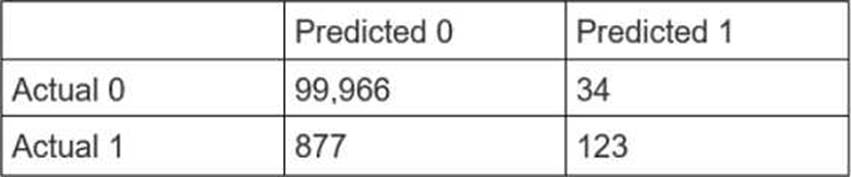
Which combination of steps should the Data Scientist take to reduce the number of false positive predictions by the model? (Select TWO.)
- A . Change the XGBoost eval_metric parameter to optimize based on rmse instead of error.
- B . Increase the XGBoost scale_pos_weight parameter to adjust the balance of positive and negative weights.
- C . Increase the XGBoost max_depth parameter because the model is currently underfitting the data.
- D . Change the XGBoost evaljnetric parameter to optimize based on AUC instead of error.
- E . Decrease the XGBoost max_depth parameter because the model is currently overfitting the data.
B, D
Explanation:
The XGBoost algorithm is a popular machine learning technique for classification problems. It is based on the idea of boosting, which is to combine many weak learners (decision trees) into a strong learner (ensemble model).
The XGBoost algorithm can handle imbalanced data by using the scale_pos_weight parameter, which controls the balance of positive and negative weights in the objective function. A typical value to consider is the ratio of negative cases to positive cases in the data. By increasing this parameter, the algorithm will pay more attention to the minority class (positive) and reduce the number of false negatives.
The XGBoost algorithm can also use different evaluation metrics to optimize the model performance. The default metric is error, which is the misclassification rate. However, this metric can be misleading for imbalanced data, as it does not account for the different costs of false positives and false negatives. A better metric to use is AUC, which is the area under the receiver operating characteristic (ROC) curve. The ROC curve plots the true positive rate against the false positive rate for different threshold values. The AUC measures how well the model can distinguish between the two classes, regardless of the threshold. By changing the eval_metric parameter to AUC, the algorithm will try to maximize the AUC score and reduce the number of false negatives.
Therefore, the combination of steps that should be taken to reduce the number of false negatives are to increase the scale_pos_weight parameter and change the eval_metric parameter to AUC.
References:
XGBoost Parameters
XGBoost for Imbalanced Classification
A Data Scientist received a set of insurance records, each consisting of a record ID, the final outcome among 200 categories, and the date of the final outcome. Some partial information on claim contents is also provided, but only for a few of the 200 categories. For each outcome category, there are hundreds of records distributed over the past 3 years. The Data Scientist wants to predict how many claims to expect in each category from month to month, a few months in advance.
What type of machine learning model should be used?
- A . Classification month-to-month using supervised learning of the 200 categories based on claim contents.
- B . Reinforcement learning using claim IDs and timestamps where the agent will identify how many claims in each category to expect from month to month.
- C . Forecasting using claim IDs and timestamps to identify how many claims in each category to expect from month to month.
- D . Classification with supervised learning of the categories for which partial information on claim contents is provided, and forecasting using claim IDs and timestamps for all other categories.
C
Explanation:
: Forecasting is a type of machine learning model that predicts future values of a target variable based on historical data and other features. Forecasting is suitable for problems that involve time-series data, such as the number of claims in each category from month to month. Forecasting can handle multiple categories of the target variable, as well as missing or partial information on some features. Therefore, option C is the best choice for the given problem.
Option A is incorrect because classification is a type of machine learning model that assigns a label to an input based on predefined categories. Classification is not suitable for predicting continuous or numerical values, such as the number of claims in each category from month to month. Moreover, classification requires sufficient and complete information on the features that are relevant to the target variable, which is not the case for the given problem. Option B is incorrect because reinforcement learning is a type of machine learning model that learns from its own actions and rewards in an interactive environment. Reinforcement learning is not suitable for problems that involve historical data and do not require an agent to take actions. Option D is incorrect because it combines two different types of machine learning models, which is unnecessary and inefficient. Moreover, classification is not suitable for predicting the number of claims in some categories, as explained in option A.
References:
Forecasting | AWS Solutions for Machine Learning (AI/ML) | AWS Solutions Library Time Series Forecasting Service C Amazon Forecast C Amazon Web Services
Amazon Forecast: Guide to Predicting Future Outcomes – Onica Amazon Launches What-If Analyses for Machine Learning Forecasting …
A Marketing Manager at a pet insurance company plans to launch a targeted marketing campaign on social media to acquire new customers Currently, the company has the following data in Amazon Aurora
• Profiles for all past and existing customers
• Profiles for all past and existing insured pets
• Policy-level information
• Premiums received
• Claims paid
What steps should be taken to implement a machine learning model to identify potential new customers on social media?
- A . Use regression on customer profile data to understand key characteristics of consumer segments Find similar profiles on social media.
- B . Use clustering on customer profile data to understand key characteristics of consumer segments
Find similar profiles on social media. - C . Use a recommendation engine on customer profile data to understand key characteristics of consumer segments. Find similar profiles on social media
- D . Use a decision tree classifier engine on customer profile data to understand key characteristics of consumer segments. Find similar profiles on social media
B
Explanation:
Clustering is a machine learning technique that can group data points into clusters based on their similarity or proximity. Clustering can help discover the underlying structure and patterns in the data, as well as identify outliers or anomalies. Clustering can also be used for customer segmentation, which is the process of dividing customers into groups based on their characteristics, behaviors, preferences, or needs. Customer segmentation can help understand the key features and needs of different customer segments, as well as design and implement targeted marketing campaigns for each segment. In this case, the Marketing Manager at a pet insurance company plans to launch a targeted marketing campaign on social media to acquire new customers. To do this, the Manager can use clustering on customer profile data to understand the key characteristics of consumer segments, such as their demographics, pet types, policy preferences, premiums paid, claims made, etc. The Manager can then find similar profiles on social media, such as Facebook, Twitter, Instagram, etc., by using the cluster features as filters or keywords. The Manager can then target these potential new customers with personalized and relevant ads or offers that match their segment’s needs and interests. This way, the Manager can implement a machine learning model to identify potential new customers on social media.
This graph shows the training and validation loss against the epochs for a neural network.
The network being trained is as follows
• Two dense layers one output neuron
• 100 neurons in each layer
• 100 epochs
• Random initialization of weights
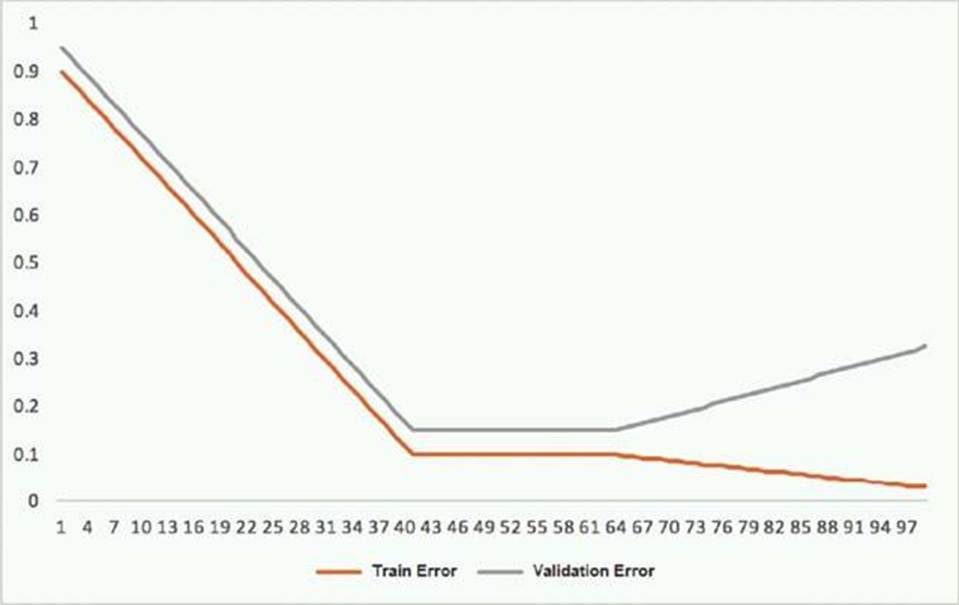
Which technique can be used to improve model performance in terms of accuracy in the validation set?
- A . Early stopping
- B . Random initialization of weights with appropriate seed
- C . Increasing the number of epochs
- D . Adding another layer with the 100 neurons
A
Explanation:
Early stopping is a technique that can be used to prevent overfitting and improve model performance on the validation set. Overfitting occurs when the model learns the training data too well and fails to generalize to new and unseen data. This can be seen in the graph, where the training loss keeps decreasing, but the validation loss starts to increase after some point. This means that the model is fitting the noise and patterns in the training data that are not relevant for the validation data. Early stopping is a way of stopping the training process before the model overfits the training data. It works by monitoring the validation loss and stopping the training when the validation loss stops decreasing or starts increasing. This way, the model is saved at the point where it has the best performance on the validation set. Early stopping can also save time and resources by reducing the number of epochs needed for training.
References:
Early Stopping
How to Stop Training Deep Neural Networks At the Right Time Using Early Stopping
A machine learning specialist needs to analyze comments on a news website with users across the globe. The specialist must find the most discussed topics in the comments that are in either English or Spanish.
What steps could be used to accomplish this task? (Choose two.)
- A . Use an Amazon SageMaker BlazingText algorithm to find the topics independently from language.
Proceed with the analysis. - B . Use an Amazon SageMaker seq2seq algorithm to translate from Spanish to English, if necessary.
Use a SageMaker Latent Dirichlet Allocation (LDA) algorithm to find the topics. - C . Use Amazon Translate to translate from Spanish to English, if necessary. Use Amazon Comprehend topic modeling to find the topics.
- D . Use Amazon Translate to translate from Spanish to English, if necessary. Use Amazon Lex to extract topics form the content.
- E . Use Amazon Translate to translate from Spanish to English, if necessary. Use Amazon SageMaker Neural Topic Model (NTM) to find the topics.
C, E
Explanation:
To find the most discussed topics in the comments that are in either English or Spanish, the machine learning specialist needs to perform two steps: first, translate the comments from Spanish to English if necessary, and second, apply a topic modeling algorithm to the comments.
The following options are valid ways to accomplish these steps using AWS services:
Option C: Use Amazon Translate to translate from Spanish to English, if necessary. Use Amazon Comprehend topic modeling to find the topics. Amazon Translate is a neural machine translation service that delivers fast, high-quality, and affordable language translation. Amazon Comprehend is a natural language processing (NLP) service that uses machine learning to find insights and relationships in text. Amazon Comprehend topic modeling is a feature that automatically organizes a collection of text documents into topics that contain commonly used words and phrases.
Option E: Use Amazon Translate to translate from Spanish to English, if necessary. Use Amazon SageMaker Neural Topic Model (NTM) to find the topics. Amazon SageMaker is a fully managed service that provides every developer and data scientist with the ability to build, train, and deploy machine learning (ML) models quickly. Amazon SageMaker Neural Topic Model (NTM) is an unsupervised learning algorithm that is used to organize a corpus of documents into topics that contain word groupings based on their statistical distribution.
The other options are not valid because:
Option A: Amazon SageMaker BlazingText algorithm is not a topic modeling algorithm, but a text classification and word embedding algorithm. It cannot find the topics independently from language, as different languages have different word distributions and semantics.
Option B: Amazon SageMaker seq2seq algorithm is not a translation algorithm, but a sequence-to-sequence learning algorithm that can be used for tasks such as summarization, chatbot, and question answering. Amazon SageMaker Latent Dirichlet Allocation (LDA) algorithm is a topic modeling algorithm, but it requires the input documents to be in the same language and preprocessed into a bag-of-words format.
Option D: Amazon Lex is not a topic modeling algorithm, but a service for building conversational
interfaces into any application using voice and text. It cannot extract topics from the content, but only intents and slots based on a predefined bot configuration.
References: Amazon Translate
Amazon Comprehend
Amazon SageMaker
Amazon SageMaker Neural Topic Model (NTM) Algorithm Amazon SageMaker BlazingText Amazon SageMaker Seq2Seq
Amazon SageMaker Latent Dirichlet Allocation (LDA) Algorithm Amazon Lex
Which of the following metrics should a Machine Learning Specialist generally use to compare/evaluate machine learning classification models against each other?
- A . Recall
- B . Misclassification rate
- C . Mean absolute percentage error (MAPE)
- D . Area Under the ROC Curve (AUC)
D
Explanation:
Area Under the ROC Curve (AUC) is a metric that measures the performance of a binary classifier across all possible thresholds. It is also known as the probability that a randomly chosen positive example will be ranked higher than a randomly chosen negative example by the classifier. AUC is a good metric to compare different classification models because it is independent of the class distribution and the decision threshold. It also captures both the sensitivity (true positive rate) and the specificity (true negative rate) of the model.
References:
AWS Machine Learning Specialty Exam Guide
AWS Machine Learning Specialty Sample Questions
A machine learning (ML) specialist uploads a dataset to an Amazon S3 bucket that is protected by server-side encryption with AWS KMS keys (SSE-KMS). The ML specialist needs to ensure that an Amazon SageMaker notebook instance can read the dataset that is in Amazon S3.
Which solution will meet these requirements?
- A . Define security groups to allow all HTTP inbound and outbound traffic. Assign the security groups to the SageMaker notebook instance.
- B . Configure the SageMaker notebook instance to have access to the VPC. Grant permission in the AWS Key Management Service (AWS KMS) key policy to the notebook’s VPC.
- C . Assign an IAM role that provides S3 read access for the dataset to the SageMaker notebook. Grant permission in the KMS key policy to the 1AM role.
- D . Assign the same KMS key that encrypts the data in Amazon S3 to the SageMaker notebook instance.
C
Explanation:
When an Amazon SageMaker notebook instance needs to access encrypted data in Amazon S3, the ML specialist must ensure that both Amazon S3 access permissions and AWS Key Management Service (KMS) decryption permissions are properly configured. The dataset in this scenario is stored with server-side encryption using an AWS KMS key (SSE-KMS), so the following steps are necessary: S3 Read Permissions: Attach an IAM role to the SageMaker notebook instance with permissions that allow the s3:GetObject action for the specific S3 bucket storing the data. This will allow the notebook instance to read data from Amazon S3.
KMS Key Policy Permissions: Grant permissions in the KMS key policy to the IAM role assigned to the SageMaker notebook instance. This allows SageMaker to use the KMS key to decrypt data in the S3 bucket.
These steps ensure the SageMaker notebook instance can access the encrypted data stored in S3. The AWS documentation emphasizes that to access SSE-KMS encrypted data, the SageMaker notebook requires appropriate permissions in both the S3 bucket policy and the KMS key policy, making Option C the correct and secure approach.
A company is building a new supervised classification model in an AWS environment. The company’s data science team notices that the dataset has a large quantity of variables Ail the variables are numeric. The model accuracy for training and validation is low. The model’s processing time is affected by high latency. The data science team needs to increase the accuracy of the model and decrease the processing.
How it should the data science team do to meet these requirements?
- A . Create new features and interaction variables.
- B . Use a principal component analysis (PCA) model.
- C . Apply normalization on the feature set.
- D . Use a multiple correspondence analysis (MCA) model
B
Explanation:
The best way to meet the requirements is to use a principal component analysis (PCA) model, which is a technique that reduces the dimensionality of the dataset by transforming the original variables into a smaller set of new variables, called principal components, that capture most of the variance and information in the data1. This technique has the following advantages:
It can increase the accuracy of the model by removing noise, redundancy, and multicollinearity from the data, and by enhancing the interpretability and generalization of the model23.
It can decrease the processing time of the model by reducing the number of features and the computational complexity of the model, and by improving the convergence and stability of the model45.
It is suitable for numeric variables, as it relies on the covariance or correlation matrix of the data, and it can handle a large quantity of variables, as it can extract the most relevant ones16.
The other options are not effective or appropriate, because they have the following drawbacks:
A: Creating new features and interaction variables can increase the accuracy of the model by capturing more complex and nonlinear relationships in the data, but it can also increase the processing time of the model by adding more features and increasing the computational complexity of the model7. Moreover, it can introduce more noise, redundancy, and multicollinearity in the data, which can degrade the performance and interpretability of the model8.
C: Applying normalization on the feature set can increase the accuracy of the model by scaling the features to a common range and avoiding the dominance of some features over others, but it can also decrease the processing time of the model by reducing the numerical instability and improving the convergence of the model. However, normalization alone is not enough to address the high dimensionality and high latency issues of the dataset, as it does not reduce the number of features or the variance in the data.
D: Using a multiple correspondence analysis (MCA) model is not suitable for numeric variables, as it is a technique that reduces the dimensionality of the dataset by transforming the original categorical variables into a smaller set of new variables, called factors, that capture most of the inertia and information in the data. MCA is similar to PCA, but it is designed for nominal or ordinal variables, not for continuous or interval variables.
References:
1: Principal Component Analysis – Amazon SageMaker
2: How to Use PCA for Data Visualization and Improved Performance in Machine Learning | by Pratik Shukla | Towards Data Science
3: Principal Component Analysis (PCA) for Feature Selection and some of its Pitfalls | by Nagesh Singh Chauhan | Towards Data Science
4: How to Reduce Dimensionality with PCA and Train a Support Vector Machine in Python | by James Briggs | Towards Data Science
5: Dimensionality Reduction and Its Applications | by Aniruddha Bhandari | Towards Data Science
6: Principal Component Analysis (PCA) in Python | by Susan Li | Towards Data Science
7: Feature Engineering for Machine Learning | by Dipanjan (DJ) Sarkar | Towards Data Science
8: Feature Engineering ―.
How to Engineer Features and.
How to Get Good at It | by Parul Pandey | Towards Data Science
: [Feature Scaling for Machine Learning: Understanding the Difference Between Normalization vs. Standardization | by Benjamin Obi Tayo Ph.D. | Towards Data Science]
: [Why,.
How and When to Scale your Features | by George Seif | Towards Data Science]
: [Normalization vs Dimensionality Reduction | by Saurabh Annadate | Towards Data Science]
: [Multiple Correspondence Analysis – Amazon SageMaker]
: [Multiple Correspondence Analysis (MCA) | by Raul Eulogio | Towards Data Science]
A business to business (B2B) ecommerce company wants to develop a fair and equitable risk mitigation strategy to reject potentially fraudulent transactions. The company wants to reject fraudulent transactions despite the possibility of losing some profitable transactions or customers.
Which solution will meet these requirements with the LEAST operational effort?
- A . Use Amazon SageMaker to approve transactions only for products the company has sold in the past.
- B . Use Amazon SageMaker to train a custom fraud detection model based on customer data.
- C . Use the Amazon Fraud Detector prediction API to approve or deny any activities that Fraud Detector identifies as fraudulent.
- D . Use the Amazon Fraud Detector prediction API to identify potentially fraudulent activities so the company can review the activities and reject fraudulent transactions.
C
Explanation:
Amazon Fraud Detector is a managed service designed to detect potentially fraudulent online activities, such as transactions. It uses machine learning and business rules to classify activities as fraudulent or legitimate, minimizing the need for custom model training. By using the Amazon Fraud Detector prediction API, the company can automatically approve or reject transactions flagged as fraudulent, implementing an efficient risk mitigation strategy without extensive operational effort. This approach requires minimal setup and effectively allows the company to block fraudulent transactions with high confidence, addressing the business’s need to balance risk mitigation and customer impact.
A large consumer goods manufacturer has the following products on sale
• 34 different toothpaste variants
• 48 different toothbrush variants
• 43 different mouthwash variants
The entire sales history of all these products is available in Amazon S3 Currently, the company is using custom-built autoregressive integrated moving average (ARIMA) models to forecast demand for these products. The company wants to predict the demand for a new product that will soon be launched
Which solution should a Machine Learning Specialist apply?
- A . Train a custom ARIMA model to forecast demand for the new product.
- B . Train an Amazon SageMaker DeepAR algorithm to forecast demand for the new product
- C . Train an Amazon SageMaker k-means clustering algorithm to forecast demand for the new product.
- D . Train a custom XGBoost model to forecast demand for the new product
B
Explanation:
The company wants to predict the demand for a new product that will soon be launched, based on the sales history of similar products. This is a time series forecasting problem, which requires a machine learning algorithm that can learn from historical data and generate future predictions. One of the most suitable solutions for this problem is to use the Amazon SageMaker DeepAR algorithm, which is a supervised learning algorithm for forecasting scalar time series using recurrent neural networks (RNN). DeepAR can handle multiple related time series, such as the sales of different products, and learn a global model that captures the common patterns and trends across the time series. DeepAR can also generate probabilistic forecasts that provide confidence intervals and quantify the uncertainty of the predictions.
DeepAR can outperform traditional forecasting methods, such as ARIMA, especially when the dataset contains hundreds or thousands of related time series. DeepAR can also use the trained model to forecast the demand for new products that are similar to the ones it has been trained on, by using the categorical features that encode the product attributes. For example, the company can use the product type, brand, flavor, size, and price as categorical features to group the products and learn the typical behavior for each group.
Therefore, the Machine Learning Specialist should apply the Amazon SageMaker DeepAR algorithm to forecast the demand for the new product, by using the sales history of the existing products as the training dataset, and the product attributes as the categorical features.
References:
DeepAR Forecasting Algorithm – Amazon SageMaker
Now available in Amazon SageMaker: DeepAR algorithm for more accurate time series forecasting