
UiPath UiPath-STEPv1 Practice Exams
Last updated on Oct 21,2026- Exam Code: UiPath-STEPv1
- Exam Name: UiPath Software Testing Engineer Professional Exam
- Certification Provider: UiPath
- Latest update: Oct 21,2026
What factors influence the calculation of coverage in the Descriptor Coverage feature in UiPath?
- A . The total number of selectors in a test case execution.
- B . The number of selectors that have been manually verified.
- C . The number of times a selector has been successfully executed.
- D . The total number of selectors available in the Object Repository.
C
Explanation:
In Descriptor Coverage, the calculation is influenced by the number of times a selector has been successfully executed during test case runs. It helps evaluate how thoroughly the UI elements defined in the Object Repository are being tested.
What does the Timezone configuration in the Add Test Schedule section do?
- A . It adjusts the test execution time according to the tenant’s timezone.
- B . It allows to specify the timezone according to which the schedule is launched.
- C . It allows to set up a default timezone for all test schedules.
- D . It determines the timezone of your Orchestrator instance.
B
Explanation:
The Timezone configuration in the Add Test Schedule section allows you to specify the timezone according to which the test schedule is launched. This ensures that the test execution aligns with the correct time zone, especially when working with teams across different geographical locations.
How can a Serverless Robot be added to an Orchestrator tenant?
- A . Go to Tenant > Machines. Click Add Machine and select Cloud Robot – Serverless. Fill in the Name and optionally the Description. Add tags if necessary, but don’t configure other settings. Finally, click Save.
- B . Go to Tenant > Robots. Click Add Robot and select Serverless. Fill in the Name and optionally the Description. Add tags if necessary and configure other settings. Finally, click Provision.
- C . Go to Tenant > Robots. Click Add Robot and select Serverless Robot. Fill in the Name and optionally the Description. Add tags if necessary and configure other settings. Finally, click Add Robot.
- D . Go to Tenant > Machines. Click Add Machine and select Cloud Robot – Serverless. Fill in the Name and optionally the Description. Add tags if necessary and configure other settings. Finally, click Provision.
A
Explanation:
To add a Serverless Robot in Orchestrator, navigate to Tenant > Machines, click Add Machine, and select Cloud Robot C Serverless. Then, fill in the Name (and optionally Description), add any necessary tags, and click Save. No additional configuration is required.
How can manual steps be marked in a Test Case as passed or failed in the Manual Execution Assistant?
- A . Use the "Execute Manually" button.
- B . Click "Set Failed" or "Set Passed" at the end of the test.
- C . Click "Set Failed" or "Set Passed" for each step.
- D . Only automated steps can be marked; manual steps are automatically passed.
B
Explanation:
In the Manual Execution Assistant of UiPath Test Manager, manual steps can be marked as passed or failed by clicking "Set Failed" or "Set Passed" at the end of the test. This allows the tester to indicate the outcome of the manual step after execution.
In which of the following cases is the Self-Hosted agent needed when creating a pipeline using the UiPath Integration for Azure DevOps?
- A . In cases where UiPath Orchestrator is not available.
- B . In cases where an External Application cannot be created in order to connect to UiPath Orchestrator.
- C . In cases where Cross-Platform projects are built and deployed.
- D . In cases where the Orchestrator is not accessible from the public internet.
D
Explanation:
A Self-Hosted agent is required when creating a pipeline using the UiPath Integration for Azure DevOps in cases where Orchestrator is not accessible from the public internet. This agent acts as an intermediary to facilitate communication between the DevOps pipeline and Orchestrator when direct internet access is not available.
Consider the following snippet:
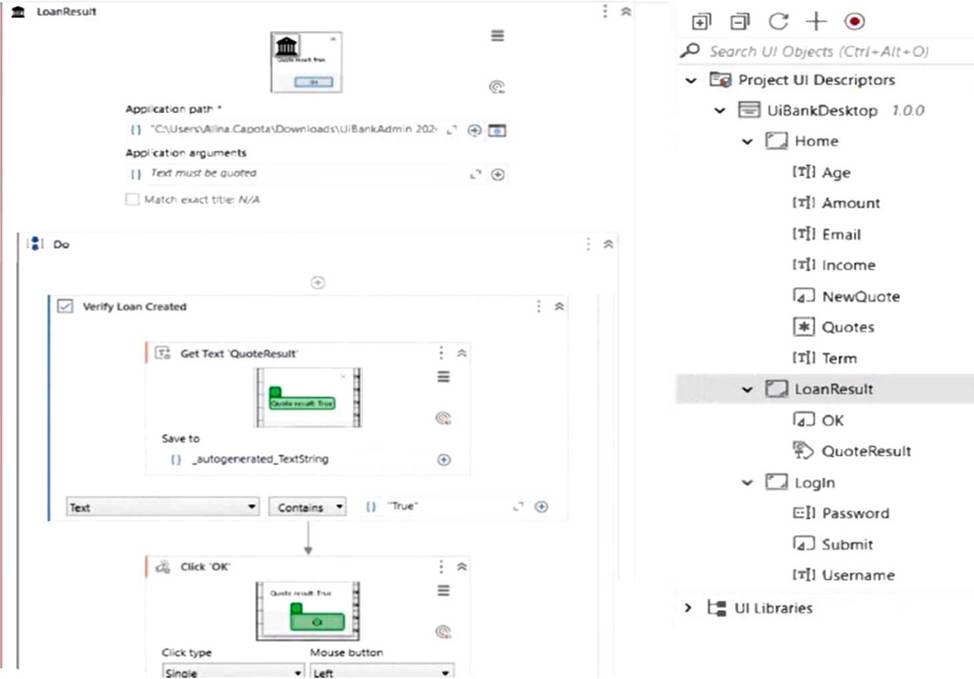
What should be improved to ensure the Test Case will not fail with exception?
- A . In the Verification point ‘_autogenerated_TextString’ should be removed.
- B . The ObjectRepository should be changed so all the elements fall into Home screen.
- C . The ApplicationPath should be provided dynamically.
- D . Click ‘OK’ should be removed.
C
Explanation:
The ApplicationPath in the "Launch Application" activity is hardcoded, which can lead to failures if the file path changes or differs across environments. To avoid exceptions and improve flexibility, the ApplicationPath should be provided dynamically (e.g., through a project argument or configuration file).
A developer needs to design a coded automation that approves or denies a loan application based on the loan rate.
How should the Execute() entry point method be declared if it needs to return the value for (IsLoanApproved), based on the loan rate (LoanRate)?
- A . public (int LoanRate) Execute(bool IsLoanApproved)
- B . public int Execute (bool IsLoanApproved)
- C . public bool Execute (bool IsLoanApproved, int loanRate)
- D . public (bool IsLoanApproved) Execute(int LoanRate)
C
Explanation:
The correct method signature for a coded automation in UiPath that needs to process input (loanRate) and return a value (IsLoanApproved) is:
**public bool Execute(bool IsLoanApproved, int loanRate)**
This follows the standard format where input parameters are passed to the method, and the result is returned via the method’s return type.
What is the main purpose of conducting Regression Testing in application development?
- A . Regression Testing is conducted to validate whether the software application is secure from threats.
- B . Regression Testing is conducted to ensure that changes in the code have not affected existing functionalities.
- C . Regression Testing is conducted to ensure the application’s performance under high load conditions.
- D . Regression Testing is conducted to ensure the application’s compatibility with different environments.
B
Explanation:
The main purpose of Regression Testing is to ensure that recent changes or additions to the code have not negatively impacted existing functionality. It helps maintain application stability after updates.
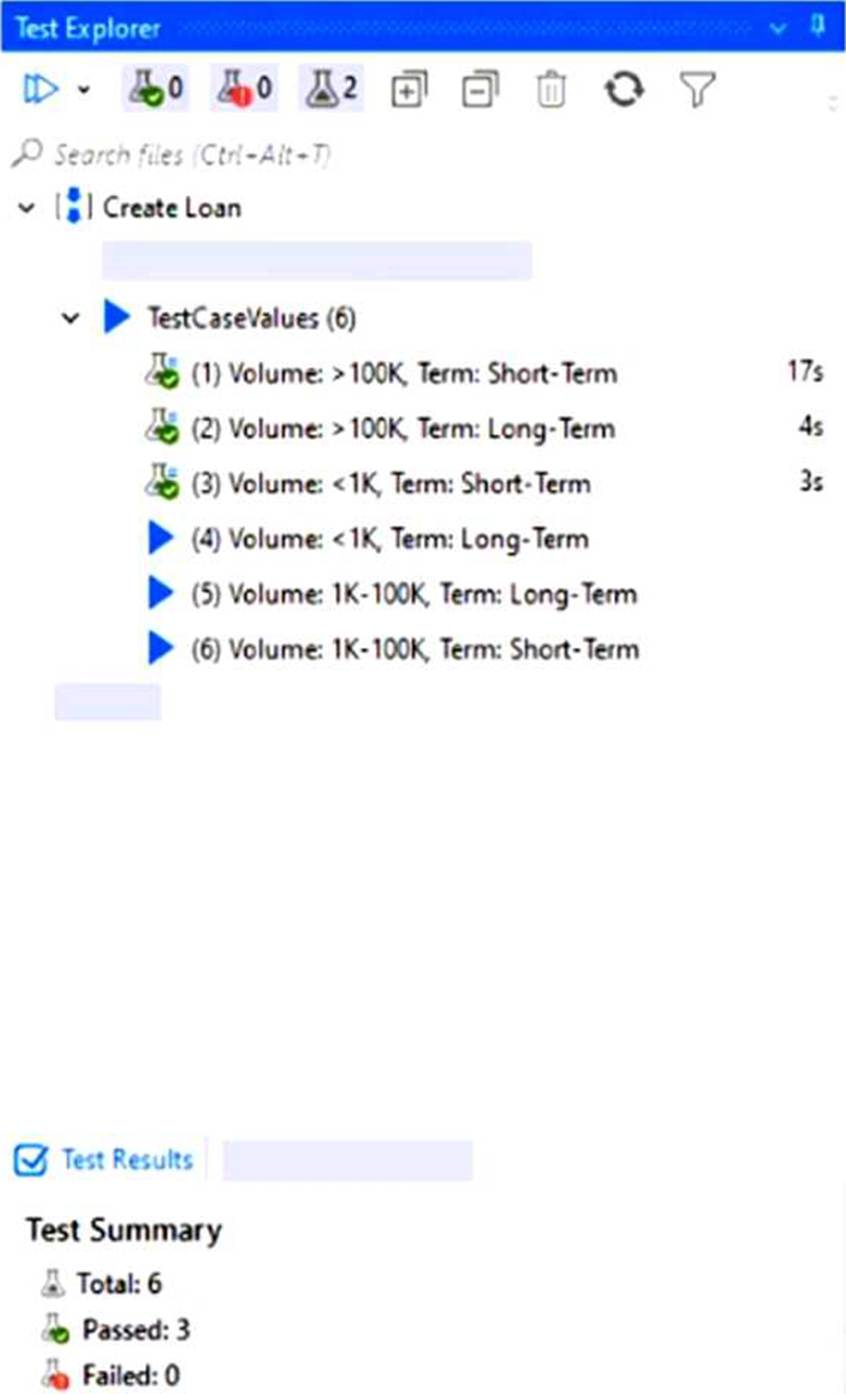
What conclusions can be drawn from the exhibit?
- A . It’s a data-driven test case with 2 variations, 2 variations were run and 2 not yet run.
- B . It’s a data-driven test case with 3 variations, 3 variations were run and 3 not yet run.
- C . It’s a data-driven test case with 6 variations, 3 variations were run and 3 not yet run.
- D . It’s an automated test case with 8 variations.
C
Explanation:
The Test Explorer shows a data-driven test case named "Create Loan" with 6 variations under TestCaseValues. Out of these, 3 have green flask icons (indicating they were run and passed), while 3 have blue play icons (indicating they have not yet been executed).