
Snowflake ARA-C01 Practice Exams
Last updated on Oct 21,2026- Exam Code: ARA-C01
- Exam Name: SnowPro Advanced Architect Certification
- Certification Provider: Snowflake
- Latest update: Oct 21,2026
Based on the Snowflake object hierarchy, what securable objects belong directly to a Snowflake account? (Select THREE).
- A . Database
- B . Schema
- C . Table
- D . Stage
- E . Role
- F . Warehouse
A, E, F
Explanation:
A securable object is an entity to which access can be granted in Snowflake. Securable objects include databases, schemas, tables, views, stages, pipes, functions, procedures, sequences, tasks, streams, roles, warehouses, and shares1.
The Snowflake object hierarchy is a logical structure that organizes the securable objects in a nested manner. The top-most container is the account, which contains all the databases, roles, and warehouses for the customer organization. Each database contains schemas, which in turn contain tables, views, stages, pipes, functions, procedures, sequences, tasks, and streams. Each role can be granted privileges on other roles or securable objects. Each warehouse can be used to execute queries on securable objects2.
Based on the Snowflake object hierarchy, the securable objects that belong directly to a Snowflake account are databases, roles, and warehouses. These objects are created and managed at the account level, and do not depend on any other securable object. The other options are not correct because:
Schemas belong to databases, not to accounts. A schema must be created within an existing database3.
Tables belong to schemas, not to accounts. A table must be created within an existing schema4.
Stages belong to schemas or tables, not to accounts. A stage must be created within an existing
schema or table.
Reference: 1: Overview of Access Control | Snowflake Documentation
2: Securable Objects | Snowflake Documentation
3: CREATE SCHEMA | Snowflake Documentation
4: CREATE TABLE | Snowflake Documentation
[5]: CREATE STAGE | Snowflake Documentation
When loading data into a table that captures the load time in a column with a default value of either CURRENT_TIME () or CURRENT_TIMESTAMP () what will occur?
- A . All rows loaded using a specific COPY statement will have varying timestamps based on when the rows were inserted.
- B . Any rows loaded using a specific COPY statement will have varying timestamps based on when the rows were read from the source.
- C . Any rows loaded using a specific COPY statement will have varying timestamps based on when the rows were created in the source.
- D . All rows loaded using a specific COPY statement will have the same timestamp value.
D
Explanation:
When using the COPY command to load data into Snowflake, if a column has a default value set to CURRENT_TIME() or CURRENT_TIMESTAMP(), all rows loaded by that specific COPY command will have the same timestamp. This is because the default value for the timestamp is evaluated at the start of the COPY operation, and that same value is applied to all rows loaded by that operation.
Reference: This behavior is consistent with Snowflake’s documentation on the CURRENT_TIMESTAMP function, which specifies that the timestamp is captured at the time the statement is executed1.
How do Snowflake databases that are created from shares differ from standard databases that are not created from shares? (Choose three.)
- A . Shared databases are read-only.
- B . Shared databases must be refreshed in order for new data to be visible.
- C . Shared databases cannot be cloned.
- D . Shared databases are not supported by Time Travel.
- E . Shared databases will have the PUBLIC or INFORMATION_SCHEMA schemas without explicitly granting these schemas to the share.
- F . Shared databases can also be created as transient databases.
A, C, D
Explanation:
According to the SnowPro Advanced: Architect documents and learning resources, the ways that Snowflake databases that are created from shares differ from standard databases that are not created from shares are:
Shared databases are read-only. This means that the data consumers who access the shared databases cannot modify or delete the data or the objects in the databases. The data providers who share the databases have full control over the data and the objects, and can grant or revoke privileges on them1.
Shared databases cannot be cloned. This means that the data consumers who access the shared databases cannot create a copy of the databases or the objects in the databases. The data providers who share the databases can clone the databases or the objects, but the clones are not automatically shared2.
Shared databases are not supported by Time Travel. This means that the data consumers who access the shared databases cannot use the AS OF clause to query historical data or restore deleted
data. The data providers who share the databases can use Time Travel on the databases or the objects, but the historical data is not visible to the data consumers3.
The other options are incorrect because they are not ways that Snowflake databases that are created from shares differ from standard databases that are not created from shares. Option B is incorrect because shared databases do not need to be refreshed in order for new data to be visible. The data consumers who access the shared databases can see the latest data as soon as the data providers update the data1. Option E is incorrect because shared databases will not have the PUBLIC or INFORMATION_SCHEMA schemas without explicitly granting these schemas to the share. The data consumers who access the shared databases can only see the objects that the data providers grant to the share, and the PUBLIC and INFORMATION_SCHEMA schemas are not granted by default4. Option F is incorrect because shared databases cannot be created as transient databases. Transient databases are databases that do not support Time Travel or Fail-safe, and can be dropped without affecting the retention period of the data. Shared databases are always created as permanent databases, regardless of the type of the source database5.
Reference: Introduction to Secure Data Sharing | Snowflake Documentation, Cloning Objects | Snowflake Documentation, Time Travel | Snowflake Documentation, Working with Shares | Snowflake Documentation, CREATE DATABASE | Snowflake Documentation
Which Snowflake data modeling approach is designed for BI queries?
- A . 3NF
- B . Star schema
- C . Data Vault
- D . Snowflake schema
B
Explanation:
In the context of business intelligence (BI) queries, which are typically focused on data analysis and reporting, the star schema is the most suitable data modeling approach.
Option B: Star Schema – The star schema is a type of relational database schema that is widely used for developing data warehouses and data marts for BI purposes. It consists of a central fact table surrounded by dimension tables. The fact table contains the core data metrics, and the dimension tables contain descriptive attributes related to the fact data. The simplicity of the star schema allows for efficient querying and aggregation, which are common operations in BI reporting.
A Snowflake Architect is designing a multiple-account design strategy.
This strategy will be MOST cost-effective with which scenarios? (Select TWO).
- A . The company wants to clone a production database that resides on AWS to a development database that resides on Azure.
- B . The company needs to share data between two databases, where one must support Payment Card Industry Data Security Standard (PCI DSS) compliance but the other one does not.
- C . The company needs to support different role-based access control features for the development, test, and production environments.
- D . The company security policy mandates the use of different Active Directory instances for the development, test, and production environments.
- E . The company must use a specific network policy for certain users to allow and block given IP addresses.
B, D
Explanation:
B. When dealing with PCI DSS compliance, having separate accounts can be beneficial because it enables strong isolation of environments that handle sensitive data from those that do not. By segregating the compliant from non-compliant resources, an organization can limit the scope of compliance, thus making it a cost-effective strategy.
D. Different Active Directory instances can be managed more effectively and securely when separated into different accounts. This approach allows for distinct identity and access management policies, which can enforce security requirements and minimize the risk of access policy errors between environments.
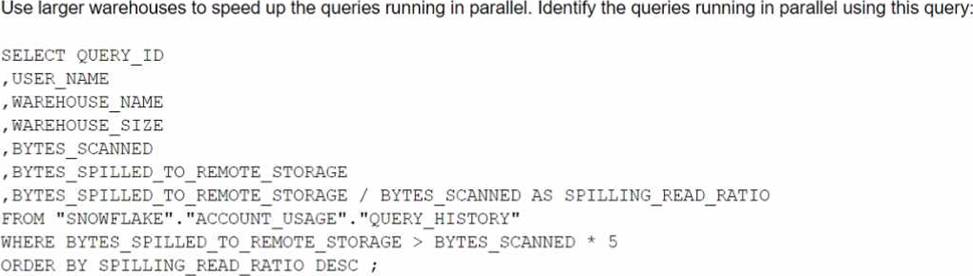
The Business Intelligence team reports that when some team members run queries for their dashboards in parallel with others, the query response time is getting significantly slower.
What can a Snowflake Architect do to identify what is occurring and troubleshoot this issue?
A)
B)

C)

D)
- A . Option A
- B . Option B
- C . Option C
- D . Option D
A
Explanation:
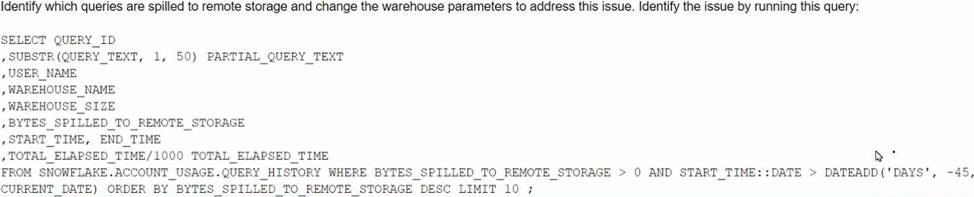
The image shows a SQL query that can be used to identify which queries are spilled to remote storage and suggests changing the warehouse parameters to address this issue. Spilling to remote storage occurs when the memory allocated to a warehouse is insufficient to process a query, and Snowflake uses disk or cloud storage as a temporary cache. This can significantly slow down the query performance and increase the cost. To troubleshoot this issue, a Snowflake Architect can run the query shown in the image to find out which queries are spilling, how much data they are spilling, and which warehouses they are using. Then, the architect can adjust the warehouse size, type, or scaling policy to provide enough memory for the queries and avoid spilling12.
Reference: Recognizing Disk Spilling
Managing the Kafka Connector
The Business Intelligence team reports that when some team members run queries for their dashboards in parallel with others, the query response time is getting significantly slower.
What can a Snowflake Architect do to identify what is occurring and troubleshoot this issue?
A)
B)
C)
D)
- A . Option A
- B . Option B
- C . Option C
- D . Option D
A
Explanation:
The image shows a SQL query that can be used to identify which queries are spilled to remote storage and suggests changing the warehouse parameters to address this issue. Spilling to remote storage occurs when the memory allocated to a warehouse is insufficient to process a query, and Snowflake uses disk or cloud storage as a temporary cache. This can significantly slow down the query performance and increase the cost. To troubleshoot this issue, a Snowflake Architect can run the query shown in the image to find out which queries are spilling, how much data they are spilling, and which warehouses they are using. Then, the architect can adjust the warehouse size, type, or scaling policy to provide enough memory for the queries and avoid spilling12.
Reference: Recognizing Disk Spilling
Managing the Kafka Connector
Role A has the following permissions:
. USAGE on db1
. USAGE and CREATE VIEW on schemal in db1
. SELECT on tablel in schemal
Role B has the following permissions:
. USAGE on db2
. USAGE and CREATE VIEW on schema2 in db2
. SELECT on table2 in schema2
A user has Role A set as the primary role and Role B as a secondary role.
What command will fail for this user?
- A . use database db1;
use schema schemal;
create view v1 as select * from db2.schema2.table2; - B . use database db2;
use schema schema2;
create view v2 as select * from dbl.schemal. tablel; - C . use database db2;
use schema schema2;
select * from db1.schemal.tablel union select * from table2; - D . use database db1;
use schema schemal;
select * from db2.schema2.table2;
B
Explanation:
This command will fail because while the user has USAGE permission on db2 and schema2 through Role B, and can create a view in schema2, they do not have SELECT permission on db1.schemal.table1 with Role
B. Since Role A, which has SELECT permission on db1.schemal.table1, is not the currently active role when the view v2 is being created in db2.schema2, the user does not have the necessary permissions to read from db1.schemal.table1 to create the view. Snowflake’s security model requires that the active role have all necessary permissions to execute the command.