
Salesforce MuleSoft Integration Architect I Practice Exams
Last updated on Nov 16,2026- Exam Code: MuleSoft Integration Architect I
- Exam Name: Salesforce Certified MuleSoft Integration Architect I
- Certification Provider: Salesforce
- Latest update: Nov 16,2026
49 of A popular retailer is designing a public API for its numerous business partners. Each business partner will invoke the API at the URL 58. https://api.acme.com/partnefs/vl. The API implementation is estimated to require deployment to 5 CloudHub workers.
The retailer has obtained a public X.509 certificate for the name apl.acme.com, signed by a reputable CA, to be used as the server certificate.
Where and how should the X.509 certificate and Mule applications be used to configure load balancing among the 5 CloudHub workers, and what DNS entries should be configured in order for the retailer to support its numerous business partners?
- A . Add the X.509 certificate to the Mule application’s deployable archive, then configure a CloudHub Dedicated Load Balancer (DLB) for each of the Mule application’s CloudHub workers Create a CNAME for api.acme.com pointing to the DLB’s A record
- B . Add the X.509 certificate to the CloudHub Shared Load Balancer (SLB), not to the Mule application Create a CNAME for api.acme.com pointing to the SLB’s A record
- C . Add the X.509 certificate to a CloudHub Dedicated Load Balancer (DLB), not to the Mule application
Create a CNAME for api.acme.com pointing to the DLB’s A record - D . Add the x.509 certificate to the Mule application’s deployable archive, then configure the CloudHub Shared Load Balancer (SLB)
for each of the Mule application’s CloudHub workers
Create a CNAME for api.acme.com pointing to the SLB’s A record
C
Explanation:
* An X.509 certificate is a vital safeguard against malicious network impersonators. Without x.509 server authentication, man-in-the-middle attacks can be initiated by malicious access points, compromised routers, etc.
* X.509 is most used for SSL/TLS connections to ensure that the client (e.g., a web browser) is not fooled by a malicious impersonator pretending to be a known, trustworthy website.
* Coming to the question, we can not use SLB here as SLB does not allow to define vanity domain names. * Hence we need to use DLB and add certificate in there
Hence correct answer is Add the X 509 certificate to the cloudhub Dedicated Load Balancer (DLB), not the Mule application. Create the CNAME for api.acme.com pointing to the DLB’s record
A stock broking company makes use of CloudHub VPC to deploy Mule applications. Mule application needs to connect to a database application in the customers on-premises corporate data center and also to a Kafka cluster running in AWS VPC.
How is access enabled for the API to connect to the database application and Kafka cluster securely?
- A . Set up a transit gateway to the customers on-premises corporate datacenter to AWS VPC
- B . Setup AnyPoint VPN to the customer’s on-premise corporate data
center and VPC peering with AWS VPC - C . Setup VPC peering with AWS VPC and the customers devices corporate data center
- D . Setup VPC peering with the customers onto my service corporate data center and Anypoint VPN to AWS VPC
A global organization operates datacenters in many countries. There are private network links between these datacenters because all business data (but NOT metadata) must be exchanged over these private network connections.
The organization does not currently use AWS in any way.
The strategic decision has Just been made to rigorously minimize IT operations effort and investment going forward.
What combination of deployment options of the Anypoint Platform control plane and runtime plane(s) best serves this organization at the start of this strategic journey?
- A . MuleSoft-hosted Anypoint Platform control plane CloudHub Shared Worker Cloud in multiple AWS regions
- B . Anypoint Platform – Private Cloud Edition Customer-hosted runtime plane in each datacenter
- C . MuleSoft-hosted Anypoint Platform control plane Customer-hosted runtime plane in multiple AWS regions
- D . MuleSoft-hosted Anypoint Platform control plane Customer-hosted runtime plane in each datacenter
D
Explanation:
Correct answer is MuleSoft-hosted Anypoint Platform control plane Customer-hosted runtime plane in each datacenter There are two things to note about the question which can help us figure out correct answer.
* Business data must be exchanged over these private network connections which means we can not use MuleSoft provided Cloudhub option. So we are left with either customer hosted runtime in external cloud provider or customer hosted runtime in their own premises. As customer does not use AWS at the moment. Hence that don’t have the immediate option of using Customer-hosted runtime plane in multiple AWS regions. hence the most suitable option for runtime plane is Customer-hosted runtime plane in each datacenter
* Metadata has no limitation to reside in organization premises. Hence for control plane MuleSoft hosted Anypoint platform can be used as a strategic solution.
Hybrid is the best choice to start. Mule hosted Control plane and Customer hosted Runtime to start with.
Once they mature in cloud migration, everything can be in Mule hosted.
Refer to the exhibit.
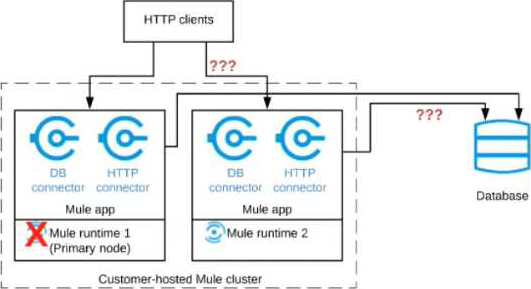
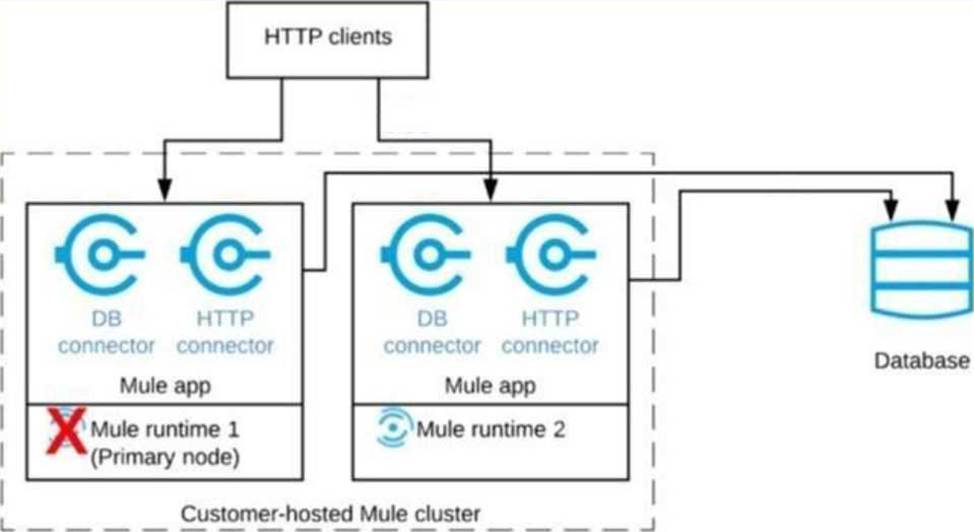
A Mule application is deployed to a cluster of two customer-hosted Mute runtimes. The Mute application has a flow that polls a database and another flow with an HTTP Listener. HTTP clients send HTTP requests directly to individual cluster nodes.
What happens to database polling and HTTP request handling in the time after the primary (master) node of the cluster has railed, but before that node is restarted?
- A . Database polling continues Only HTTP requests sent to the remaining node continue to be accepted
- B . Database polling stops All HTTP requests continue to be accepted
- C . Database polling continues All HTTP requests continue to be accepted, but requests to the failed node Incur increased latency
- D . Database polling stops All HTTP requests are rejected
A
Explanation:
Correct answer is Database polling continues Only HTTP requests sent to the remaining node continue to be accepted: Architecture descripted in the question could be described as follows. When node 1 is down, DB polling will still continue via node 2. Also requests which are coming directly to node 2 will also be accepted and processed in BAU fashion. Only thing that wont work is when requests are sent to Node 1 HTTP connector. The flaw with this architecture is HTTP clients are sending HTTP requests directly to individual cluster nodes. By default, clustering Mule runtime engines ensures high system availability. If a Mule runtime engine node becomes unavailable due to failure or planned downtime, another node in the cluster can assume the workload and continue to process existing events and messages
Refer to the exhibit.
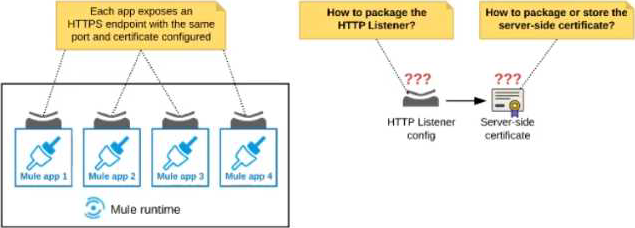
An organization deploys multiple Mule applications to the same customer -hosted Mule runtime. Many of these Mule applications must expose an HTTPS endpoint on the same port using a server-side certificate that rotates often.
What is the most effective way to package the HTTP Listener and package or store the server-side certificate when deploying these Mule applications, so the disruption caused by certificate rotation is minimized?
- A . Package the HTTPS Listener configuration in a Mule DOMAIN project, referencing it from all Mule applications that need to expose an HTTPS endpoint Package the server-side certificate in ALL Mule
APPLICATIONS that need to expose an HTTPS endpoint - B . Package the HTTPS Listener configuration in a Mule DOMAIN project, referencing it from all Mule applications that need to expose an HTTPS endpoint. Store the server-side certificate in a shared filesystem location in the Mule runtime’s classpath, OUTSIDE the Mule DOMAIN or any Mule APPLICATION
- C . Package an HTTPS Listener configuration In all Mule APPLICATIONS that need to expose an HTTPS endpoint Package the server-side certificate in a NEW Mule DOMAIN project
- D . Package the HTTPS Listener configuration in a Mule DOMAIN project, referencing It from all Mule applications that need to expose an HTTPS endpoint. Package the server-side certificate in the SAME Mule DOMAIN project Go to Set
B
Explanation:
In this scenario, both A & C will work, but A is better as it does not require repackage to the domain project at all.
Correct answer is Package the HTTPS Listener configuration in a Mule DOMAIN project, referencing it from all Mule applications that need to expose an HTTPS endpoint. Store the server-side certificate in a shared filesystem location in the Mule runtime’s classpath, OUTSIDE the Mule DOMAIN or any Mule APPLICATION.
What is Mule Domain Project?
* A Mule Domain Project is implemented to configure the resources that are shared among different projects. These resources can be used by all the projects associated with this domain. Mule applications can be associated with only one domain, but a domain can be associated with multiple projects. Shared resources allow multiple development teams to work in parallel using the same set of reusable connectors. Defining these connectors as shared resources at the domain level allows the team to: – Expose multiple services within the domain through the same port. – Share the connection to persistent storage. – Share services between apps through a well-defined interface. – Ensure consistency between apps upon any changes because the configuration is only set in one place.
* Use domains Project to share the same host and port among multiple projects. You can declare the http connector within a domain project and associate the domain project with other projects. Doing this also allows to control thread settings, keystore configurations, time outs for all the requests made within multiple applications. You may think that one can also achieve this by duplicating the http connector configuration across all the applications. But, doing this may pose a nightmare if you have to make a change and redeploy all the applications.
* If you use connector configuration in the domain and let all the applications use the new domain instead of a default domain, you will maintain only one copy of the http connector configuration. Any changes will require only the domain to the redeployed instead of all the applications.
You can start using domains in only three steps:
1) Create a Mule Domain project
2) Create the global connector configurations which needs to be shared across the applications inside the Mule Domain project
3) Modify the value of domain in mule-deploy.properties file of the applications
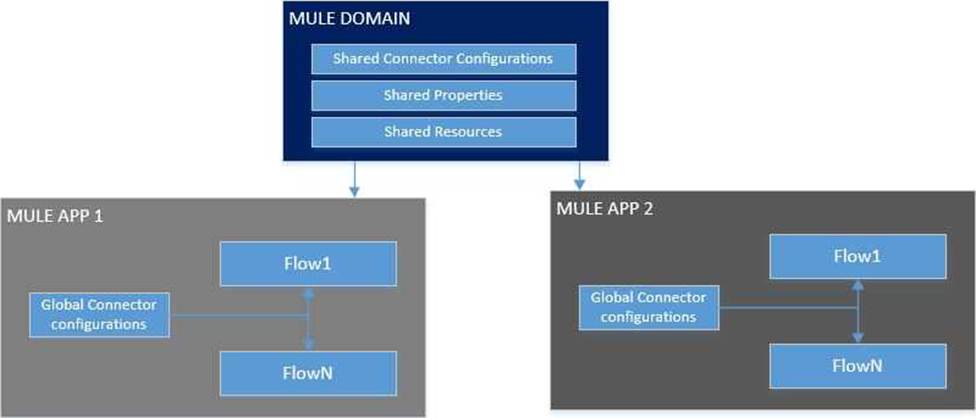
Use a certificate defined in already deployed Mule domain Configure the certificate in the domain so that the API proxy HTTPS Listener references it, and then deploy the secure API proxy to the target Runtime Fabric, or on-premises target. (CloudHub is not supported with this approach because it does not support Mule domains.)
Which of the below requirements prevent the usage of Anypoint MQ in a company’s network? (Choose two answers)
- A . single message payload can be up to 15 MB
- B . payloads must be encrypted
- C . the message broker must be hosted on premises
- D . support for point-to-point messaging
- E . ability for a third party outside the company’s network to consume events from the queue
A Mule application is built to support a local transaction for a series of operations on a single database. The mule application has a Scatter-Gather scope that participates in the local transaction.
What is the behavior of the Scatter-Gather when running within this local transaction?
- A . Execution of all routes within Scatter-Gather occurs in parallel Any error that occurs inside Scatter-Gather will result in a roll back of all the database operations
- B . Execution of all routes within Scatter-Gather occurs sequentially Any error that occurs inside Scatter-Gather will be handled by error handler and will not result in roll back
- C . Execution of all routes within Scatter-Gather occurs sequentially Any error that occurs inside Scatter-Gather will result in a roll back of all the database operations
- D . Execution of all routes within Scatter-Gather occurs in parallel Any error that occurs inside Scatter-Gather will be handled by error handler and will not result in roll back
When designing an upstream API and its implementation, the development team has been advised to not set timeouts when invoking downstream API. Because the downstream API has no SLA that can be relied upon. This is the only donwstream API dependency of that upstream API. Assume the downstream API runs uninterrupted without crashing.
What is the impact of this advice?
- A . The invocation of the downstream API will run to completion without timing out.
- B . An SLA for the upstream API CANNOT be provided.
- C . A default timeout of 500 ms will automatically be applied by the Mule runtime in which the upstream API implementation executes.
- D . A load-dependent timeout of less than 1000 ms will be applied by the Mule runtime in which the downstream API implementation executes.
B
Explanation:
An SLA for the upstream API CANNOT be provided.
An insurance company is using a CIoudHub runtime plane. As a part of requirement, email alert should be sent to internal operations team every time of policy applied to an API instance is deleted.
As an integration architect suggest on how this requirement be met?
- A . Use audit logs in Anypoint platform to detect a policy deletion and configure the Audit logs alert feature to send an email to the operations team
- B . Use Anypoint monitoring to configure an alert that sends an email to the operations team every time a policy is deleted in API manager
- C . Create a custom connector to be triggered every time of policy is deleted in API manager
- D . Implement a new application that uses the Audit log REST API to
detect the policy deletion and send an email to operations team the SMTP connector
An organization if struggling frequent plugin version upgrades and external plugin project dependencies. The team wants to minimize the impact on applications by creating best practices that will define a set of default dependencies across all new and in progress projects.
How can these best practices be achieved with the applications having the least amount of responsibility?
- A . Create a Mule plugin project with all the dependencies and add it as a dependency in each application’s POM.xml file
- B . Create a mule domain project with all the dependencies define in its POM.xml file and add each application to the domain Project
- C . Add all dependencies in each application’s POM.xml file
- D . Create a parent POM of all the required dependencies and reference each in each application’s POM.xml file