
Salesforce MuleSoft Integration Architect I Practice Exams
Last updated on Nov 16,2026- Exam Code: MuleSoft Integration Architect I
- Exam Name: Salesforce Certified MuleSoft Integration Architect I
- Certification Provider: Salesforce
- Latest update: Nov 16,2026
A manufacturing company is planning to deploy Mule applications to its own Azure Kubernetes Service infrastructure.
The organization wants to make the Mule applications more available and robust by deploying each Mule application to an isolated Mule runtime in a Docker container while managing all the Mule applications from the MuleSoft-hosted control plane.
What is the most idiomatic (used for its intended purpose) choice of runtime plane to meet these organizational requirements?
- A . Anypoint Platform Private Cloud Edition
- B . Anypoint Runtime Fabric
- C . CloudHub
- D . Anypoint Service Mesh
B
Explanation:
Reference: https://blogs.mulesoft.com/dev-guides/how-to-tutorials/anypoint-runtime-fabric/
An API client makes an HTTP request to an API gateway with an Accept header containing the value’’ application’’.
What is a valid HTTP response payload for this request in the client requested data format?
- A . <status>healthy</status>
- B . {"status" "healthy"}
- C . status(‘healthy")
- D . status: healthy
What is an example of data confidentiality?
- A . Signing a file digitally and sending it using a file transfer mechanism
- B . Encrypting a file containing personally identifiable information (PV)
- C . Providing a server’s private key to a client for secure decryption of data during a two-way SSL handshake
- D . De-masking a person’s Social Security number while inserting it into a database
What metrics about API invocations are available for visualization in custom charts using Anypoint Analytics?
- A . Request size, request HTTP verbs, response time
- B . Request size, number of requests, JDBC Select operation result set size
- C . Request size, number of requests, response size, response time
- D . Request size, number of requests, JDBC Select operation response time
C
Explanation:
Correct answer is Request size, number of requests, response size, response time Analytics API Analytics can provide insight into how your APIs are being used and how they are performing. From API Manager, you can access the Analytics dashboard, create a custom dashboard, create and manage charts, and create reports. From API Manager, you can get following types of analytics: – API viewing analytics – API events analytics – Charted metrics in API Manager It can be accessed using: http://anypoint.mulesoft.com/analytics
API Analytics provides a summary in chart form of requests, top apps, and latency for a particular duration.
The custom dashboard in Anypoint Analytics contains a set of charts for a single API or for all APIs Each chart displays various API characteristics
C Requests size: Line chart representing size of requests in KBs
C Requests: Line chart representing number of requests over a period
C Response size: Line chart representing size of response in KBs
C Response time: Line chart representing response time in ms
* To check this, You can go to API Manager > Analytics > Custom Dashboard > Edit Dashboard > Create Chart > Metric
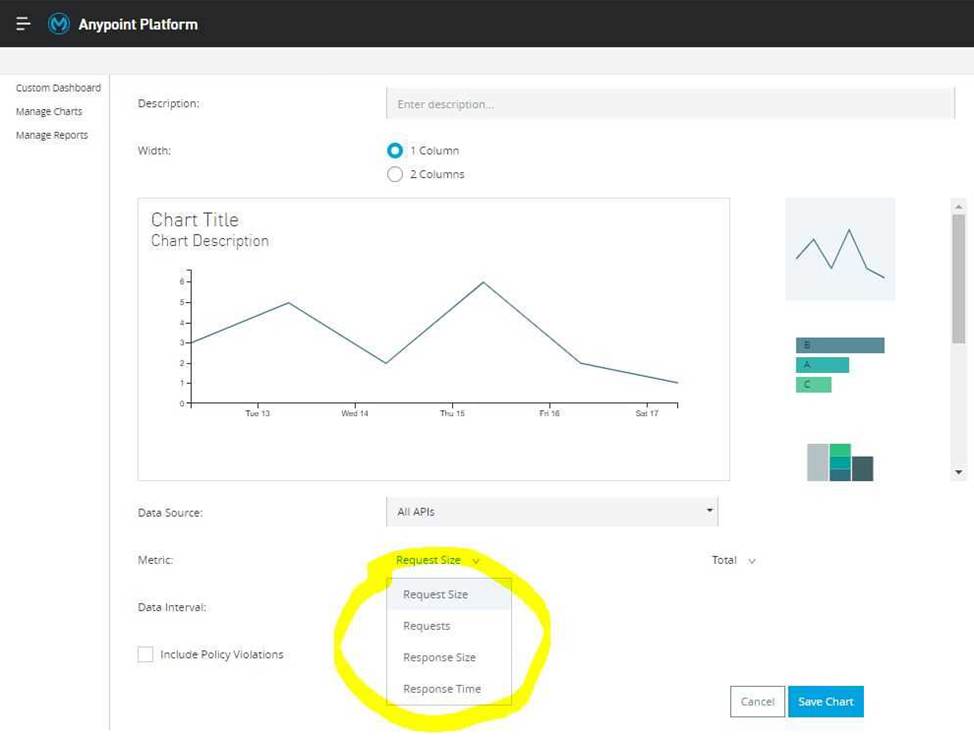
Reference: https://docs.mulesoft.com/monitoring/api-analytics-dashboard
Additional Information:
The default dashboard contains a set of charts
C Requests by date: Line chart representing number of requests
C Requests by location: Map chart showing the number of requests for each country of origin
C Requests by application: Bar chart showing the number of requests from each of the top five registered applications
C Requests by platform: Ring chart showing the number of requests broken down by platform
A customer wants to use the mapped diagnostic context (MDC) and logging variables to enrich its logging and improve tracking by providing more context in the logs.
The customer also wants to improve the throughput and lower the latency of message processing.
As an Mulesoft integration architect can you advise, what should the customer implement to meet these requirements?
- A . Use synchronous logging and use pattern layout with [%MDC] in the log4j2.xml configuration file and then configure the logging variables
- B . Useasync logger at the level greater than INFO and use pattern layout with [%MDC] in the log4j2,xml configuration file and then configure the logging variables
- C . Useasync logger at the level equal to DEBUG orTRACEand use pattern
layout with [%MDC] in the log4j2.xml configuration file and then configure the logging variables - D . Use synchronous logging at the INFO DEBUG or Trace level and use pattern layout with [%MDC] in the log4j2.xml configuration file and then configure the logging variables
An organization plans to migrate all its Mule applications to Runtime Fabric (RTF). Currently, all Mule applications have been deployed to CloudHub using automated CI/CD scripts.
What steps should be taken to properly migrate the applications from CloudHub to RTF, while keeping the same automated CI/CD deployment strategy?
- A . A runtimefabric dependency should be added as a mule-plugin to the pom.xml file in all the Mule applications.
- B . runtimeFabric command-line parameter should be added to the CI/CD deployment scripts.
- C . A runtimefFabricDeployment profile should be added to Mule configuration properties YAML files in all the Mule applications.
CI/CD scripts must be modified to use the new configuration properties. - D . runtimefabricDeployment profile should be added to the pom.xml file in all the Mule applications.
CI/CD scripts must be modified to use the new RTF profile. - E . – The pom.xml and Mule configuration YAML files can remain unchanged in each Mule application.
A –runtimeFabric command-line parameter should be added to the CI/CD deployment scripts
Refer to the exhibit.
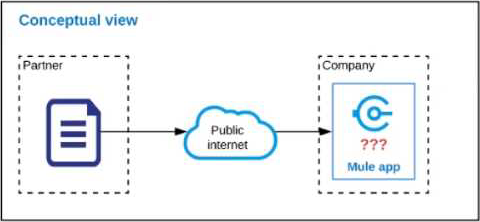
An organization is designing a Mule application to receive data from one external business partner.
The two companies currently have no shared IT infrastructure and do not want to establish one.
Instead, all communication should be over the public internet (with no VPN).
What Anypoint Connector can be used in the organization’s Mule application to securely receive data from this external business partner?
- A . File connector
- B . VM connector
- C . SFTP connector
- D . Object Store connector
C
Explanation:
* Object Store and VM Store is used for sharing data inter or intra mule applications in same setup. Can’t be used with external Business Partner
* Also File connector will not be useful as the two companies currently have no shared IT infrastructure. It’s specific for local use.
* Correct answer is SFTP connector. The SFTP Connector implements a secure file transport channel so that your Mule application can exchange files with external resources. SFTP uses the SSH security protocol to transfer messages. You can implement the SFTP endpoint as an inbound endpoint with a one-way exchange pattern, or as an outbound endpoint configured for either a one-way or request-response exchange pattern.
Refer to the exhibit.
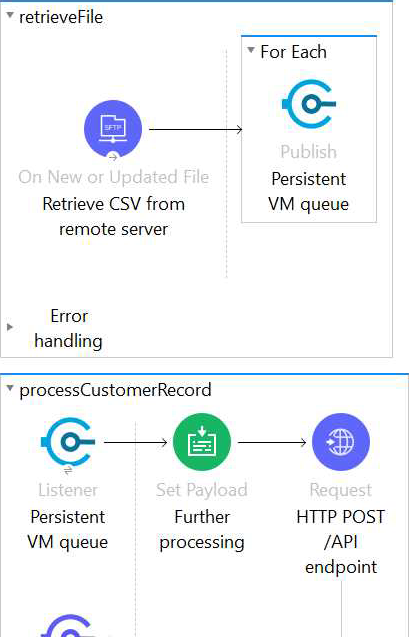
This Mule application is deployed to multiple Cloudhub workers with persistent queue enabled. The retrievefile flow event source reads a CSV file from a remote SFTP server and then publishes each record in the CSV file to a VM queue. The processCustomerRecords flow’s VM Listner receives messages from the same VM queue and then processes each message separately.
How are messages routed to the cloudhub workers as messages are received by the VM Listener?
- A . Each message is routed to ONE of the Cloudhub workers in a DETERMINSTIC round robin fashion thereby EXACTLY BALANCING messages among the cloudhub workers
- B . Each messages routes to ONE of the available Clouhub workers in a NON-DETERMINSTIC non round-robin fashion thereby APPROXIMATELY BALANCING messages among the cloudhub workers
- C . Each message is routed to the SAME Cloudhub worker that retrieved the file, thereby BINDING ALL messages to ONLY that ONE Cloudhub worker
- D . Each message is duplicated to ALL of the Cloudhub workers, thereby SHARING EACH message with ALL the Cloudhub workers.
An organization has implemented the cluster with two customer hosted Mule runtimes is hosting an application.
This application has a flow with a JMS listener configured to consume messages from a queue destination.
As an integration architect can you advise which JMS listener configuration must be used to receive messages in all the nodes of the cluster?
- A . Use the parameter primaryNodeOnly= "false" on the JMS listener
- B . Use the parameter primaryNodeOnly= "false" on the JMS listener with a shared subscription
- C . Use the parameter primaryNodeOnly= "true" on the JMS listener with a nonshared subscription
- D . Use the parameter primaryNodeOnly= "true" on the JMS listener