
Salesforce MuleSoft Integration Architect I Practice Exams
Last updated on Oct 01,2026- Exam Code: MuleSoft Integration Architect I
- Exam Name: Salesforce Certified MuleSoft Integration Architect I
- Certification Provider: Salesforce
- Latest update: Oct 01,2026
Refer to the exhibit.
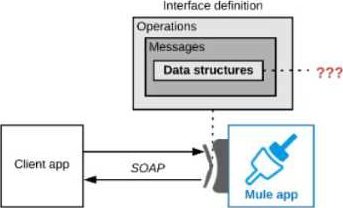
A Mule application is being designed to expose a SOAP web service to its clients.
What language is typically used inside the web service’s interface definition to define the data structures that the web service Is expected to exchange with its clients?
- A . WSDL
- B . XSD
- C . JSON Schema
- D . RAMI
B
Explanation:
Correct Answer. XSD In this approach to developing a web service, you begin with an XML schema (XSD file) that defines XML data structures to be used as parameters and return types in the web service operations.
Reference: https://www.w3schools.com/xml/schema_intro.asp
A developer needs to discover which API specifications have been created within the organization before starting a new project.
Which Anypoint Platform component can the developer use to find and try out the currently released API specifications?
- A . Anypoint Exchange
- B . Runtime Manager
- C . API Manager
- D . Object Store
A high-volume eCommerce retailer receives thousands of orders per hour and requires notification of its order management, warehouse, and billing system for subsequent processing within 15 minutes of order submission through its website.
Which integration technology, when used for its typical and intended purpose, meets the retailer’s requirements for this use case?
- A . Managed File Transfer (MFT)
- B . Publish/Subscriber Messaging Bus (Pub/Sub)
- C . Enterprise Data Warehouse (EDW)
- D . Extract Transform Load (ETL)
In Anypoint Platform, a company wants to configure multiple identity providers (Idps) for various lines of business (LOBs) Multiple business groups and environments have been defined for the these LOBs.
What Anypoint Platform feature can use multiple Idps access the company’s business groups and environment?
- A . User management
- B . Roles and permissions
- C . Dedicated load balancers
- D . Client Management
D
Explanation:
Correct answer is Client Management
* Anypoint Platform acts as a client provider by default, but you can also configure external client providers to authorize client applications.
* As an API owner, you can apply an OAuth 2.0 policy to authorize client applications that try to access your API. You need an OAuth 2.0 provider to use an OAuth 2.0 policy.
* You can configure more than one client provider and associate the client providers with different environments. If you configure multiple client providers after you have already created environments, you can associate the new client providers with the environment.
* You should review the existing client configuration before reassigning client providers to avoid any downtime with existing assets or APIs.
* When you delete a client provider from your master organization, the client provider is no longer available in environments that used it.
* Also, assets or APIs that used the client provider can no longer authorize users who want to access them.
MuleSoft
Reference: https://docs.mulesoft.com/access-management/managing-api-clients https://www.folkstalk.com/2019/11/mulesoft-integration-and-platform.html
What is a core pillar of the MuleSoft Catalyst delivery approach?
- A . Business outcomes
- B . Technology centralization
- C . Process thinking
- D . Scope reduction
To implement predictive maintenance on its machinery equipment, ACME Tractors has installed thousands of IoT sensors that will send data for each machinery asset as sequences of JMS messages, in near real-time, to a JMS queue named SENSOR_DATA on a JMS server. The Mule application contains a JMS Listener operation configured to receive incoming messages from the JMS servers SENSOR_DATA JMS queue. The Mule application persists each received JMS message, then sends a transformed version of the corresponding Mule event to the machinery equipment back-end systems.
The Mule application will be deployed to a multi-node, customer-hosted Mule runtime cluster.
Under normal conditions, each JMS message should be processed exactly once.
How should the JMS Listener be configured to maximize performance and concurrent message processing of the JMS queue?
- A . Set numberOfConsumers = 1
Set primaryNodeOnly = false - B . Set numberOfConsumers = 1
Set primaryNodeOnly = true - C . Set numberOfConsumers to a value greater than one
Set primaryNodeOnly = true - D . Set numberOfConsumers to a value greater than one
Set primaryNodeOnly = false
D
Explanation:
Reference: https://docs.mulesoft.com/jms-connector/1.8/jms-performance
A travel company wants to publish a well-defined booking service API to be shared with its business partners. These business partners have agreed to ONLY consume SOAP services and they want to get the service contracts in an easily consumable way before they start any development. The travel company will publish the initial design documents to Anypoint Exchange, then share those documents with the business partners.
When using an API-led approach, what is the first design document the travel company should deliver to its business partners?
- A . Create a WSDL specification using any XML editor
- B . Create a RAML API specification using any text editor
- C . Create an OAS API specification in Design Center
- D . Create a SOAP API specification in Design Center
A
Explanation:
SOAP API specifications are provided as WSDL. Design center doesn’t provide the functionality to create WSDL file. Hence WSDL needs to be created using XML editor
As a part of project requirement, Java Invoke static connector in a mule 4 application needs to invoke
a static method in a dependency jar file.
What are two ways to add the dependency to be visible by the connectors class loader? (Choose two answers)
- A . In the Java Invoke static connector configuration, configure a path and name of the dependency jar file
- B . Add the dependency jar file to the java classpath by setting the JVM parameters
- C . Use Maven command to include the dependency jar file when packaging the application
- D . Configure the dependency as a shared library in the project POM
- E . Update mule-artefact.json to export the Java package
Customer has deployed mule applications to different customer hosted mule run times. Mule applications are managed from Anypoint platform.
What needs to be configured to monitor these Mule applications from Anypoint monitoring and what sends monitoring data to Anypoint monitoring?
- A . Enable monitoring of individual applications from runtime manager application settings Runtime manager agent sends monitoring data from the mule applications to Anypoint monitoring
- B . Install runtime manager agent on each mule runtime
Runtime manager agent since monitoring data from the mule applications to Anypoint monitoring - C . Anypoint monitoring agent on each mule runtime
Anypoint monitoring agent sends monitoring data from the mule applications to Anypoint monitoring - D . By default, Anypoint monitoring agent will be installed on each Mule run time
Anypoint Monitoring agent automatically sends monitoring data from the Mule applications to Anypoint monitoring
An insurance company has an existing API which is currently used by customers. API is deployed to customer hosted Mule runtime cluster. The load balancer that is used to access any APIs on the mule cluster is only configured to point to applications hosted on the server at port 443.
Mule application team of a company attempted to deploy a second API using port 443 but the application will not start and checking logs shows an error indicating the address is already in use.
Which steps must the organization take to resolve this error and allow customers to access both the API’s?
- A . Change the base path of the HTTP listener configuration in the second API to a different one from the first API
- B . Set HTTP listener configuration in both API’s to allow for connections from multiple ports
- C . Move the HTTP listener configurations from the API’s and package them in a mule domain project using port 443
- D . Set the HTTP listener of the second API to use different port than the one used in the first API