
Salesforce MuleSoft Integration Architect I Practice Exams
Last updated on Nov 16,2026- Exam Code: MuleSoft Integration Architect I
- Exam Name: Salesforce Certified MuleSoft Integration Architect I
- Certification Provider: Salesforce
- Latest update: Nov 16,2026
A leading eCommerce giant will use MuleSoft APIs on Runtime Fabric (RTF) to process customer orders. Some customer-sensitive information, such as credit card information, is required in request payloads or is included in response payloads in some of the APIs. Other API requests and responses are not authorized to access some of this customer-sensitive information but have been implemented to validate and transform based on the structure and format of this customer-sensitive information (such as account IDs, phone numbers, and postal codes).
What approach configures an API gateway to hide sensitive data exchanged between API consumers and API implementations, but can convert tokenized fields back to their original value for other API requests or responses, without having to recode the API implementations?
Later, the project team requires all API specifications to be augmented with an additional non-functional requirement (NFR) to protect the backend services from a high rate of requests, according to defined service-level agreements (SLAs). The NFR’s SLAs are based on a new tiered subscription level "Gold", "Silver", or "Platinum" that must be tied to a new parameter that is being added to the Accounts object in their enterprise data model.
Following MuleSoft’s recommended best practices, how should the project team now convey the necessary non-functional requirement to stakeholders?
- A . Create and deploy API proxies in API Manager for the NFR, change the baseurl in each API specification to the corresponding API proxy implementation endpoint, and publish each modified API specification to Exchange
- B . Update each API specification with comments about the NFR’s SLAs and publish each modified API specification to Exchange
- C . Update each API specification with a shared RAML fragment required to implement the NFR and publish the RAML fragment and each modified API specification to Exchange
- D . Create a shared RAML fragment required to implement the NFR, list each API implementation endpoint in the RAML fragment, and publish the RAML fragment to Exchange
An organization is designing multiple new applications to run on CloudHub in a single Anypoint VPC and that must share data using a common persistent Anypoint object store V2 (OSv2).
Which design gives these mule applications access to the same object store instance?
- A . AVM connector configured to directly access the persistence queue of the persistent object store
- B . An Anypoint MQ connector configured to directly access the persistent object store
- C . Object store V2 can be shared across cloudhub applications with the configured osv2 connector
- D . The object store V2 rest API configured to access the persistent object store
What is the MuleSoft-recommended best practice to share the connector and configuration information among the APIs?
- A . Build a Mule domain project, add the Database connector and configuration to it, and reference this one domain project from each System API
- B . Build a separate Mule domain project for each API, and configure each of them to use a file on a shared file store to load the configuration information dynamically
- C . Build another System API that connects to the database, and refactor all the other APIs to make requests through the new System API to access the database
- D . Create an API proxy for each System API and share the Database connector configuration with all the API proxies via an automated policy
An organization has decided on a cloudhub migration strategy that aims to minimize the organizations own IT resources. Currently, the organizational has all of its Mule applications running on its own premises and uses an premises load balancer that exposes all APIs under the base URL https://api.acme.com
As part of the migration strategy, the organization plans to migrate all of its Mule applications and load balancer to cloudhub
What is the most straight-forward and cost effective approach to the Mule applications deployment and load balancing that preserves the public URLs?
- A . Deploy the Mule applications to Cloudhub
Update the CNAME record for an api.acme.com in the organizations DNS server pointing to the A record of a cloudhub dedicated load balancer (DLB)
Apply mapping rules in the DLB to map URLs to their corresponding Mule applications - B . For each migrated Mule application, deploy an API proxy Mule application to Cloudhub with all applications under the control of a dedicated load balancer (CLB)
Update the CNAME record for api.acme.com in the organization DNS server pointing to the A record of a cloudhub dedicated load balancer (DLB)
Apply mapping rules in the DLB to map each API proxy application to its corresponding Mule applications - C . Deploy the Mule applications to Cloudhub
Create CNAME record for api.acme.com in the Cloudhub Shared load balancer (SLB) pointing to the A record of the on-premise load balancer
Apply mapping rules in the SLB to map URLs to their corresponding Mule applications - D . Deploy the Mule applications to Cloudhub
Update the CNAME record for api.acme.com in the organization DNS server pointing to the A record of the cloudhub shared load balancer (SLB)
Apply mapping rules in the SLB to map URLs to their corresponding Mule applications.
A
Explanation:
https://help.mulesoft.com/s/feed/0D52T000055pzgsSAA.
A trading company handles millions of requests a day. Due to nature of its business, it requires excellent performance and reliability within its application.
For this purpose, company uses a number of event-based API’s hosted on various mule clusters that communicate across a shared message queue sitting within its network.
Which method should be used to meet the company’s requirement for its system?
- A . XA transactions and XA connected components
- B . JMS transactions
- C . JMS manual acknowledgements with a reliability pattern
- D . VM queues with reliability pattern
An organization will deploy Mule applications to Cloudhub, Business requirements mandate that all application logs be stored ONLY in an external splunk consolidated logging service and NOT in Cloudhub.
In order to most easily store Mule application logs ONLY in Splunk, how must Mule application logging be configured in Runtime Manager, and where should the log4j2 splunk appender be defined?
- A . Keep the default logging configuration in RuntimeManager
Define the splunk appender in ONE global log4j.xml file that is uploaded once to Runtime Manager to support at Mule application deployments. - B . Disable Cloudhub logging in Runtime Manager
Define the splunk appender in EACH Mule application’s log4j2.xml file - C . Disable Cloudhub logging in Runtime Manager
Define the splunk appender in ONE global log4j.xml file that is uploaded once to Runtime Manger to support at Mule application deployments. - D . Keep the default logging configuration in Runtime Manager Define the Splunk appender in EACH Mule application log4j2.xml file
B
Explanation:
By default, CloudHub replaces a Mule application’s log4j2.xml file with a CloudHub log4j2.xml file. In CloudHub, you can disable the CloudHub provided Mule application log4j2 file. This allows integrating Mule application logs with custom or third-party log management systems
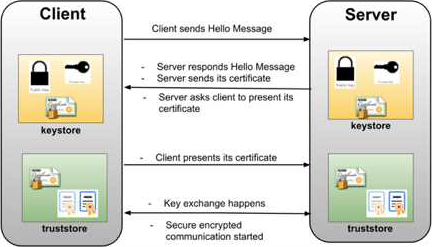
What requires configuration of both a key store and a trust store for an HTTP Listener?
- A . Support for TLS mutual (two-way) authentication with HTTP clients
- B . Encryption of requests to both subdomains and API resource endpoints fhttPs://aDi.customer.com/ and https://customer.com/api)
- C . Encryption of both HTTP request and HTTP response bodies for all HTTP clients
- D . Encryption of both HTTP request header and HTTP request body for all HTTP clients
A
Explanation:
1 way SSL: The server presents its certificate to the client and the client adds it to its list of trusted certificate. And so, the client can talk to the server.
2-way SSL: The same principle but both ways. i.e. both the client and the server has to establish trust between themselves using a trusted certificate. In this way of a digital handshake, the server needs to present a certificate to authenticate itself to client and client has to present its certificate to server.
* TLS is a cryptographic protocol that provides communications security for your Mule app.
* TLS offers many different ways of exchanging keys for authentication, encrypting data, and guaranteeing message integrity Keystores and Truststores Truststore and keystore contents differ depending on whether they are used for clients or servers:
For servers: the truststore contains certificates of the trusted clients, the keystore contains the
private and public key of the server. For clients: the truststore contains certificates of the trusted servers, the keystore contains the private and public key of the client.
Adding both a keystore and a truststore to the configuration implements two-way TLS authentication also known as mutual authentication.
* in this case, correct answer is Support for TLS mutual (two-way) authentication with HTTP clients.
An organization is building a test suite for their applications using m-unit. The integration architect has recommended using test recorder in studio to record the processing flows and then configure unit tests based on the capture events
What are the two considerations that must be kept in mind while using test recorder (Choose two answers)
- A . Tests for flows cannot be created with Mule errors raised inside the flow or already existing in the incoming event
- B . Recorder supports smoking a message before or inside a ForEach processor
- C . The recorder support loops where the structure of the data been tested changes inside the iteration
- D . A recorded flow execution ends successfully but the result does not reach its destination because the application is killed
- E . Mocking values resulting from parallel processes are possible and will not affect the execution of the processes that follow in the test
A developer is examining the responses from a RESTful web service that is compliant with the Mypertext Transfer Protocol (HTTP/1.1) a8 defined by the Internet Engineering Task Force (IETF).
In this HTTP/1.1-compliant web service, which class of HTTP response status codes should be specified to indicate when client requests are successfully received, understood, and accepted by the web service?
- A . 3xx
- B . 2xx
- C . 4xx
- D . 5xx
What is maximum vCores can be allocated to application deployed to CloudHub?
- A . 1 vCores
- B . 2 vCores
- C . 4 vCores
- D . 16 vCores