
Salesforce MuleSoft Integration Architect I Practice Exams
Last updated on Nov 16,2026- Exam Code: MuleSoft Integration Architect I
- Exam Name: Salesforce Certified MuleSoft Integration Architect I
- Certification Provider: Salesforce
- Latest update: Nov 16,2026
As an enterprise architect, what are the two reasons for which you would use a canonical data model in the new integration project using MuleSoft Anypoint platform (choose two answers)
- A . To have consistent data structure aligned in processes
- B . To isolate areas within a bounded context
- C . To incorporate industry standard data formats
- D . There are multiple canonical definitions of each data type
- E . Because the model isolates the back and systems and support mule applications from change
A mule application designed to fulfil two requirements
a) Processing files are synchronously from an FTPS server to a back-end database using VM intermediary queues for load balancing VM events
b) Processing a medium rate of records from a source to a target system using batch job scope Considering the processing reliability requirements for FTPS files, how should VM queues be configured for processing files as well as for the batch job scope if the application is deployed to Cloudhub workers?
- A . Use Cloud hub persistent queues for FTPS files processing
There is no need to configure VM queues for the batch jobs scope as it uses by default the worker’s disc for VM queueing - B . Use Cloud hub persistent VM queue for FTPS file processing
There is no need to configure VM queues for the batch jobs scope as it uses by default the worker’s JVM memory for VM queueing - C . Use Cloud hub persistent VM queues for FTPS file processing Disable VM queue for the batch job scope
- D . Use VM connector persistent queues for FTPS file processing Disable VM queue for the batch job scope
What is an advantage that Anypoint Platform offers by providing universal API management and Integration-Platform-as-a-Service (iPaaS) capabilities in a unified platform?
- A . Ability to use a single iPaaS to manage and integrate all API gateways
- B . Ability to use a single connector to manage and integrate all APis
- C . Ability to use a single control plane for both full-lifecycle AP] management and integration
- D . Ability to use a single iPaaS to manage all API developer portals
C
Explanation:
Anypoint Platform offers universal API management and Integration-Platform-as-a-Service (iPaaS) capabilities in a unified platform, meaning that it provides a single control plane to manage both full-lifecycle API management and integration. This allows organizations to easily manage their APIs and integrations, as well as deploy APIs and integrations quickly and efficiently. According to the MuleSoft Certified Integration Architect – Level 1 Course Book, “Anypoint Platform provides a unified platform for managing, deploying, and monitoring both API and integration solutions, allowing organizations to quickly and easily build and manage their APIs and integrations.”
An IT integration tram followed an API-led connectivity approach to implement an order-fulfillment business process. It created an order processing AP that coordinates stateful interactions with a variety of microservices that validate, create, and fulfill new product orders
Which interaction composition pattern did the integration architect who designed this order processing AP| use?
- A . Orchestration
- B . Streaming
- C . Aggregation
- D . Multicasting
Cloud Hub is an example of which cloud computing service model?
- A . Platform as a Service (PaaS)
- B . Software as a Service (SaaS)
- C . Monitoring as a Service (MaaS)
- D . Infrastructure as a Service (laaS)
What is a key difference between synchronous and asynchronous logging from Mule applications?
- A . Synchronous logging writes log messages in a single logging thread but does not block the Mule event being processed by the next event processor
- B . Asynchronous logging can improve Mule event processing throughput while also reducing the processing time for each Mule event
- C . Asynchronous logging produces more reliable audit trails with more accurate timestamps
- D . Synchronous logging within an ongoing transaction writes log messages in the same thread that processes the current Mule event
B
Explanation:
Types of logging:
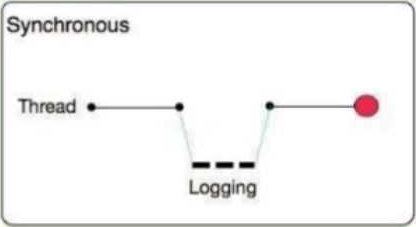
A) Synchronous: The execution of thread that is processing messages is interrupted to wait for the log message to be fully handled before it can continue.
● The execution of the thread that is processing your message is interrupted to wait for the log message to be fully output before it can continue
● Performance degrades because of synchronous logging
● Used when the log is used as an audit trail or when logging ERROR/CRITICAL messages
● If the logger fails to write to disk, the exception would raise on the same thread that’s currently processing the Mule event. If logging is critical for you, then you can rollback the transaction.
B) Asynchronous:
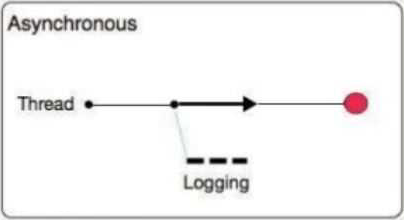
● The logging operation occurs in a separate thread, so the actual processing of your message won’t be delayed to wait for the logging to complete
● Substantial improvement in throughput and latency of message processing
● Mule runtime engine (Mule) 4 uses Log4j 2 asynchronous logging by default
● The disadvantage of asynchronous logging is error handling.
● If the logger fails to write to disk, the thread doing the processing won’t be aware of any issues writing to the disk, so you won’t be able to rollback anything. Because the actual writing of the log gets differed, there’s a chance that log messages might never make it to disk and get lost, if Mule were to crash before the buffers are flushed.
So Correct answer is: Asynchronous logging can improve Mule event processing throughput while also reducing the processing time for each Mule event
A company is using Mulesoft to develop API’s and deploy them to Cloudhub and on premises targets. Recently it has decided to enable Runtime Fabric deployment option as well and infrastructure is set up for this option.
What can be used to deploy Runtime Fabric?
- A . AnypointCLI
- B . Anypoint platform REST API’s
- C . Directly uploading ajar file from the Runtime manager
- D . Mule maven plug-in
A mule application must periodically process a large dataset which varies from 6 GB lo 8 GB from a back-end database and write transform data lo an FTPS server using a properly configured bad job scope.
The performance requirements of an application are approved to run in the cloud hub 0.2 vCore with 8 GB storage capacity and currency requirements are met.
How can the high rate of records be effectively managed in this application?
- A . Use streaming with a file storage repeatable strategy for reading records from the database and batch aggregator with streaming to write to FTPS
- B . Use streaming with an in-memory reputable store strategy for reading records from the database and batch aggregator with streaming to write to FTPS
- C . Use streaming with a file store repeatable strategy for reading records from the database and batch aggregator with an optimal size
- D . Use streaming with a file store repeatable strategy reading records from the database and batch aggregator without any required configuration
Refer to the exhibit.
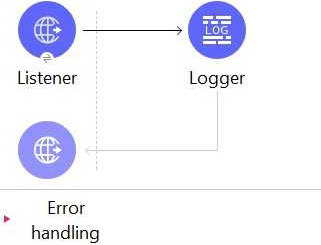
The HTTP Listener and the Logger are being handled from which thread pools respectively?
- A . CPU_INTENSIVE and Dedicated Selector pool
- B . UBER and NONBLOCKING
- C . Shared Selector Pool and CPU LITE
- D . BLOCKING _IO and UBER
An application deployed to a runtime fabric environment with two cluster replicas is designed to periodically trigger of flow for processing a high-volume set of records from the source system and synchronize with the SaaS system using the Batch job scope
After processing 1000 records in a periodic synchronization of 1 lakh records, the replicas in which batch job instance was started went down due to unexpected failure in the runtime fabric environment
What is the consequence of losing the replicas that run the Batch job instance?
- A . The remaining 99000 records will be lost and left and processed
- B . The second replicas will take over processing the remaining 99000 records
- C . A new replacement replica will be available and will be process all 1,00,000 records from scratch leading to duplicate record processing
- D . A new placement replica will be available and will take or processing the remaining 99,000 records