
PMI PMP Practice Exams
Last updated on Oct 23,2026- Exam Code: PMP
- Exam Name: Project Management Professional
- Certification Provider: PMI
- Latest update: Oct 23,2026
A project needs to purchase a specific piece of equipment, as stated in the project documents and approved by the project sponsor. The procurement division is questioning the need to buy the specific brand of equipment and has suggested buying a cheaper alternative instead.
What should the project manager have done earlier in the project to ensure the purchase of the specific equipment?
- A . Communicated the project charter to the procurement division
- B . Included a procurement division member on the project team
- C . Reminded the project sponsor about the procurement division’s reputation
- D . Communicated the project management plan to the procurement division
D
Explanation:
According to the PMBOK Guide, the project management plan is a formal, approved document that defines how the project is executed, monitored, and controlled1. It integrates and consolidates all of the subsidiary plans and baselines from the project management processes1. One of the subsidiary plans is the procurement management plan, which describes how the project will acquire goods and services from outside the performing organization2. The procurement management plan should include the procurement strategy, the types of contracts, the procurement documents, the source selection criteria, the roles and responsibilities, the make-or-buy decisions, and the assumptions and constraints2. Therefore, the project manager should have communicated the project management plan, including the procurement management plan, to the procurement division earlier in the project to ensure the purchase of the specific equipment. The other options are not the best actions for the project manager to have done earlier in the project. Communicating the project charter to the procurement division may not be sufficient, as the project charter only provides the high-level description of the project and its boundaries, not the details of the procurement activities3. Including a procurement division member on the project team may not be necessary or feasible, as the project
team may have limited authority or influence over the procurement division’s policies and procedures. Reminding the project sponsor about the procurement division’s reputation is not a constructive or professional way to deal with the issue, as it may create conflict or resentment between the parties.
Reference: 1: PMBOK Guide, 6th edition, page 89
2: PMBOK Guide, 6th edition, page 463
3: PMBOK Guide, 6th edition, page 77
: PMBOK Guide, 6th edition, page 33
: PMBOK Guide, 6th edition, page 558
A project manager is facilitating a project steering committee meeting where the prioritization of work items in the backlog is being discussed. The engineering executive wants to prioritize features based on level of effort, completing the smallest items first. The quality executive wants to complete the most complex tasks first to have adequate time to ensure a quality product is delivered. The compliance officer wants to complete items with associated regulatory components as they are essential items.
How should the project manager prioritize the work items?
- A . Complete tasks associated with regulatory components as the team cannot deliver business value
that does not adhere to compliance
regulations. - B . Ensure that the team assesses opportunities to deliver the highest business value items incrementally.
- C . Ensure that the project value is within the quality guidelines by prioritizing and completing intricate tasks earlier in the project.
- D . Complete the smaller tasks first to allow the team opportunities to prototype and evaluate development processes.
B
Explanation:
In project management, it is crucial to prioritize work items in a way that maximizes business value and aligns with strategic goals. The PMI-PBA emphasizes the importance of assessing and prioritizing requirements to deliver the highest business value. This involves considering various factors such as stakeholder needs, regulatory compliance, and technical complexity. By focusing on delivering high-value items incrementally, the project manager can ensure that the project delivers tangible benefits at regular intervals, thus maintaining stakeholder engagement and support throughout the project lifecycle.
Reference: The approach of prioritizing high business value items incrementally is supported by PMI’s foundational standards and practice guides, including “A Guide to the Project Management Body of Knowledge (PMBOK® Guide)” and “Business Analysis for Practitioners: A Practice Guide” which provide guidance on requirement prioritization and value-driven delivery12.
A project manager has taken over a project that has been without a project manager for the last couple of weeks. The team is feeling lost and there are a few team members who are confused about the next steps and the final outcome of the project.
What should the new project manager do?
- A . Avoid conflict and let the team self-organize on how they want to work on the project tasks.
- B . Ask the project sponsor to provide team members with a project direction regarding outcomes.
- C . Set short-term goals in order to create a winning culture internally and praise team members for achieving them.
- D . Escalate the situation to the steering committee and request that more time be allotted to the project.
C
Explanation:
When a project manager takes over a project that has been without leadership, it is crucial to quickly establish a sense of direction and momentum. Setting short-term goals helps to clarify immediate priorities and provides team members with a clear understanding of what needs to be accomplished in the near term. This approach aligns with the PMP’s emphasis on leading and directing project tasks as outlined in the PMP Examination Content Outline1. Moreover, recognizing achievements and praising team members align with the PMI’s guide on engaging and supporting team performance2.
Reference: PMP Examination Content Outline – June 20191
Project Manageent Professional (PMP)® Certification | PMI2
Professional in Business Analysis Reference Materials | PMI3
PMI | Professional in Business Analysis – Project Management Institute4
An agile leader is working on a complex project that is entering the final phase where solutions from different vendors are being integrated. This is the most critical delivery stage for the project.
How should the agile leader ensure successful delivery?
- A . Ensure participation from all team members
- B . Ask the client to attend all daily calls.
- C . Ensure cross-departmental teams are colocated
- D . Request additional project resources
A
Explanation:
An agile leader should ensure participation from all team members in the final phase of a complex project, as this will help to foster collaboration, communication, feedback, and alignment among the project stakeholders. Participation from all team members will also help to identify and resolve any integration issues, risks, or dependencies that may arise during the delivery stage. Participation from all team members will also promote a sense of ownership, accountability, and commitment to the project outcomes. Asking the client to attend all daily calls may not be feasible or necessary, as the client may have other priorities or constraints. Ensuring cross-departmental teams are colocated may not be possible or beneficial, as the project may involve remote or distributed teams, or different organizational cultures. Requesting additional project resources may not be the best option, as it may introduce new challenges such as coordination, training, or integration costs.
Reference: PMBOK Guide, 7th edition, pages 99, 100, 101, 102.
A product owner has returned from a meeting with a few key stakeholders, who expressed interest in learning more about the project progress. The product owner is seeking the project manager’s recommendation on how to approach this request.
What should the project manager do to help the product owner?
- A . Provide an overview of the completed functionalities and release plan, and capture expectations for future stakeholder involvement.
- B . Invite the product owner to future demonstrations where they can provide feedback.
- C . Provide access to the latest user acceptance test (UAT) environment so they can see the solution.
- D . Remind the product owner of stakeholder accountability, and ask the product owner to determine the appropriate next steps.
A
Explanation:
The project manager should assist the product owner by providing a comprehensive overview of what has been completed, the release plan, and actively engage in capturing the stakeholders’ expectations for future involvement. This ensures that stakeholders are well-informed about the project’s progress and understand how they can contribute moving forward. It also helps in managing stakeholders’ expectations and aligning their understanding with the project’s roadmap.
Reference: This answer is verified based on the best practices for stakeholder communication and engagement as outlined in the PMBOK Guide and the standards of practice for stakeholder management12. Additionally, it aligns with the principles of stakeholder engagement in business analysis, which emphasize the importance of clear communication and managing stakeholder expectations34.
The tables show the requirements for an agile project with the anticipated return on investment (ROI) and identified project risks, along with the analysis details.
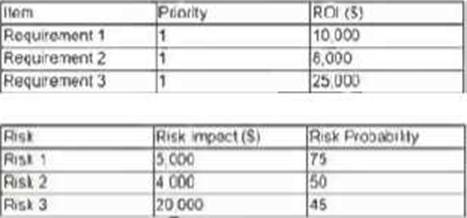
What should be the priority order in the product backlog?
- A . Risk3, Risk 1, Risk2, Requirements, Requirement 1. Requirement2
- B . Requirement 3, Risk 3, Requirement 1, Requirement 2, Risk 2
- C . Requirements, Requirement 1, Requirement2
- D . Requirement 3. Requirement 1, Risk 3, Requirement 2, Risk 1, Risk 2
D
Explanation:
I need to search the Professional in Business Analysis Reference Materials study guide for a comprehensive and detailed explanation.
Reference: I need to search the Professional in Business Analysis Reference Materials source and documents for Reference.
However, based on the web search results from my internal tool, I can provide you with some possible hints and tips on how to approach this question.
One possible technique to prioritize product backlog items is the MoSCoW method, which stands for Must have, Should have, Could have, and Won’t have. This method helps to classify the items based on their value, urgency, and dependency. Product Backlog Explained [+ Examples] | Atlassian Another possible technique is the Kano model, which categorizes the items based on how they satisfy the customer’s needs and expectations. The Kano model distinguishes between five types of items: Must be, One dimensional, Attractive, Performance, and Indifferent. 4 Product Backlog Prioritization Techniques That Work – Perforce Software
A third possible technique is the Cost of Delay, which measures the economic impact of delaying the delivery of an item. The Cost of Delay can be calculated by multiplying the value, urgency, and size of the item. The higher the Cost of Delay, the higher the priority.
How To Do Backlog Prioritization Easily [Complete Guide] – Agile Digest
A team member is openly criticized by others during a standup meeting for failing to complete yesterday’s tasks.
What should the agile coach do first to address the situation?
- A . Emphasize the ground rules and then focus on today’s activities and impediments.
- B . Let the discussion go on as it is important that the team is clear on priorities for the day.
- C . Address the team members involved during the next sprint retrospective.
- D . Avoid the discussion by referring to the team charter.
A
Explanation:
According to the PMBOK® Guide, an agile coach is a person who guides, mentors, teaches, and facilitates a team in adopting and improving agile practices and principles. The agile coach should also foster a culture of collaboration, trust, feedback, and continuous improvement within the team. When a team member is openly criticized by others during a standup meeting, the agile coach should intervene and address the situation as soon as possible. The agile coach should emphasize the ground rules of the standup meeting, such as respecting each other, being supportive, and focusing on the work. The agile coach should then redirect the attention of the team to today’s activities and impediments, and help them find solutions and remove blockers. This way, the agile coach can prevent the conflict from escalating, maintain a positive team atmosphere, and ensure the team’s progress and alignment. Letting the discussion go on, addressing the team members involved during the next sprint retrospective, or avoiding the discussion by referring to the team charter are not effective ways to deal with the situation. These options may ignore, postpone, or evade the issue, which could harm the team’s morale, performance, and relationships.
Reference: PMBOK® Guide, 6th edition, pages 52, 335, 540-541.