
PMI PMP Practice Exams
Last updated on Oct 23,2026- Exam Code: PMP
- Exam Name: Project Management Professional
- Certification Provider: PMI
- Latest update: Oct 23,2026
A project team member informs the project manager that a stakeholder is contacting the team member to request status updates. The team member is being distracted by these repeated requests, which are interfering with the completion of assigned tasks.
What should the project manager do?
- A . Increase the frequency of updates given to this stakeholder.
- B . Inform the team member to stop sending any further updates to the stakeholder.
- C . Raise this issue to the project sponsor in the next project status review meeting.
- D . Review this stakeholder’s communication requirements.
D
Explanation:
The best course of action for the project manager in this situation is to review the stakeholder’s communication requirements. This aligns with the principles of stakeholder engagement and communication management in project management. By reviewing the communication requirements, the project manager can ensure that the information needs of the stakeholder are being met without causing undue disruption to the team’s work. This may involve adjusting the communication plan to provide the stakeholder with the necessary updates in a manner that is less intrusive to the team member’s workflow.
Reference: The answer is verified by the principles found in the PMBOK® Guide, which emphasizes the importance of managing stakeholder expectations through effective communication strategies1. Additionally, the Professional in Business Analysis Reference Materials supports the approach of tailoring communication to meet the needs of stakeholders2.
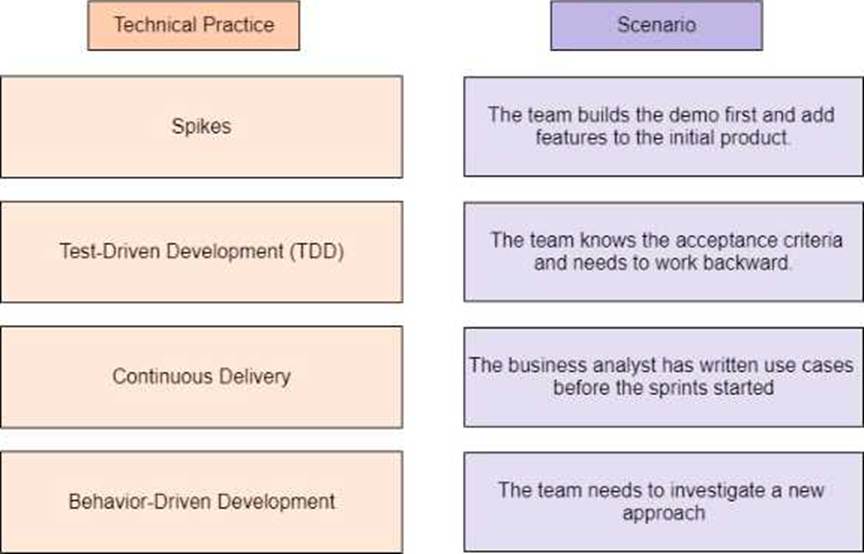
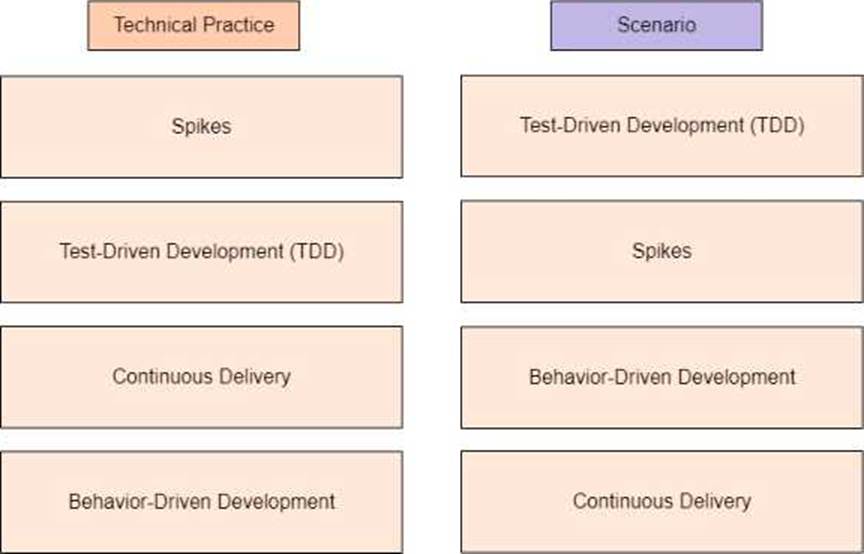
DRAG DROP
Drag the technical practices on the left to the scenario on the right.
A multimillion-dollar project has started and is in the execution phase. A local regulatory authority has just announced changes to the requirements that will need to be implemented in 6 months, prior to completing the project execution phase.
What should the project manager do next?
- A . Add the new requirements to the project scope immediately since they are mandatory changes.
- B . Review the new requirements with the compliance department to determine if a change request is needed.
- C . Ignore the new requirements as the current budget and schedule do not allow for any changes.
- D . Proceed with the defined project requirements and delay implementing the new requirements.
B
Explanation:
When a regulatory authority announces changes that affect a project, it is essential for the project manager to review these new requirements with the compliance department. This is to understand the implications of the changes and to determine if a change request is necessary. The project manager must ensure that the project remains compliant with all relevant regulations, and this often requires adapting the project scope and plan to accommodate new regulatory requirements.
Ignoring such changes or delaying their implementation could result in non-compliance and potential
legal and financial repercussions for the project.
Reference: Project Management Institute. (2024). A Guide to the Project Management Body of Knowledge
(PMBOK® Guide) C Seventh Edition.
Project Management Institute. (2024). Project Management Professional (PMP)® Certification Handbook.
Epicflow. (2024). Changing Requirements in Project Management:
How to Stay on Track1.
Project Management Institute. (2024). An overview of the regulatory process2.
The Digital Project Manager. (2024). Project Manager’s Guide To Implementing A Compliance Program3.
A project manager is responsible for providing a budget estimate for a long-term project that will be executed over several years.
Which essential task should the project manager implement at this phase?
- A . Include key risks in the cost baseline.
- B . Perform an analogous estimate.
- C . Perform a bottom-up estimate.
- D . Include projected inflation rates.
D
Explanation:
According to the PMBOK® Guide, the project manager should include projected inflation rates in the budget estimate for a long-term project that will be executed over several years. This is because inflation rates affect the purchasing power of the project funds and the cost of resources over time. By including projected inflation rates, the project manager can account for the changes in the value of money and the cost of goods and services, and adjust the budget accordingly. This is part of the Estimate Costs process, which involves developing an approximation of the monetary resources needed to complete the project activities.
Reference: (Professional in Business Analysis Reference Materials source and documents)
PMBOK® Guide, 6th edition, Chapter 7, Section 7.2, Estimate Costs PMP Exam Prep, 10th edition, Rita Mulcahy, Page 223, Estimate Costs
A project manager is beginning a new project with very diverse team members. The project manager chose to use consensus building so the team can agree on and be engaged in how the project will be executed.
How should the project manager proceed?
- A . Create an environment where the agreement is reached by a majority vote.
- B . Create an environment where the agreement is reached through discussion.
- C . Establish recurring brainstorming sessions to discuss project issues.
- D . Allow team members to contribute ideas in a stream-of-consciousness mode.
B
Explanation:
Consensus building in project management, especially with diverse team members, involves creating an environment where agreement is reached through open and inclusive discussion. This approach encourages participation from all team members, ensuring that each voice is heard and considered. It helps in identifying common ground and facilitates the integration of various perspectives into a cohesive plan. The process is respectful, efficient, and productive, leading to decisions that are accepted by all and fostering commitment to the project’s execution.
Reference:
How to Build Consensus in Project Management – LinkedIn1, Creating Collaboration in Diverse Teams – LinkedIn2, How to Build Consensus in a Diverse Team – LinkedIn3, How to Build Consensus Among Diverse Team Members – LinkedIn4.
A company has rolled out the latest retail management system, and the project has been handed over to operations. The operations team finds that many of the day-to-day requirements are not covered in the system, and support for the project has limited hours,. The project team has dissolved and the contract resources are no longer working on the project. As a result, the operations team has been facing numerous customer issues.
What should the project lead have done initially to avoid this situation?
- A . Reviewed the project management plan
- B . Created a detailed operations manual
- C . Increased support hours for the hours of operation
- D . Involved operations stakeholders during planning
D
Explanation:
The project lead should have involved the operations stakeholders during the planning phase of the project. This would have ensured that the system was designed to meet the day-to-day requirements of the operations team. Additionally, it would have allowed for the identification of necessary support hours and resources. By involving operations stakeholders early in the project, the project lead could have avoided the issues that arose after the project was handed over to operations.
Reference: Project Management Professional (PMP)® Examination Content Outline, June 2015, PMI; A Guide to the Project Management Body of Knowledge (PMBOK® Guide) C Sixth Edition, Project Management Institute, Inc., 2017.
A complex project is m its execution phase. The project is set up to produce both predictive and incremental deliverables. The agile team is running late on their tasks There is a resource on the agile team who is responsible for producing progress reports for the project manager This resource has the required skills to help other team members with their workload
What should the project manager do to optimize the time of the resource who produces the progress reports?
- A . Work more closely with the agile team to eliminate the need for progress reports
- B . Record this in the issue log and find a resource to produce the reports
- C . Produce the progress reports on their own
- D . Engage a new resource to produce the progress reports
A
Explanation:
In the context of project management, particularly in an agile environment, the project manager should work more closely with the agile team to eliminate the need for progress reports1. This approach allows the resource who was previously responsible for producing progress reports to utilize their skills to assist other team members with their workload1. This strategy not only optimizes the time of the resource but also enhances the productivity and performance of the entire team1. It is important to note that effective time management and resource optimization are critical for the success of a project23.
Reference:
What Is Resource Optimization? Techniques & Best Practices – ProjectManager 10 Time Management Strategies for Project Managers – Atlassian Community. The project manager role ― responsibilities, skills, and more – Adobe
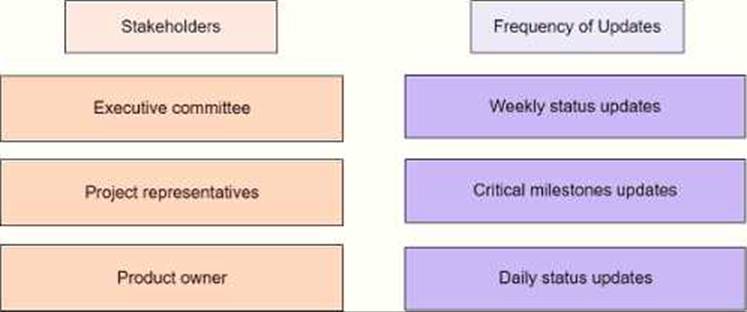
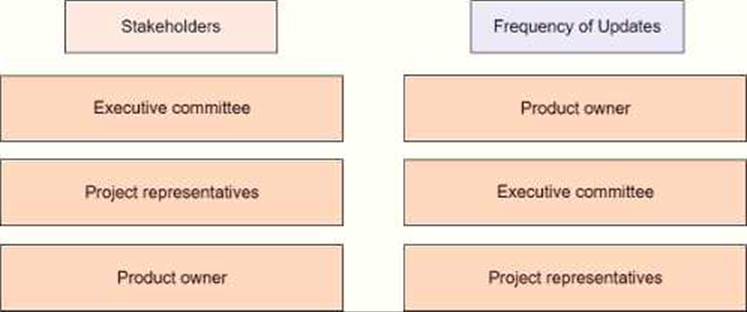
DRAG DROP
A project manager is assigned to a hybrid project involving multiple sectors. The sectors collaborated in the joint venture delivery facility.
The chief executive officer (CEQ) from each participating sector is a sponsor of the project. Each sector nominated project representatives, who in turn appointed a product owner who was the most experienced in delivering such projects.
Match the stakeholders on the left with the appropriate frequency for updates.
Explanation:
Explanation.
Answer steps as below
A project is starting its sixth iteration out seven. During the daily meeting, a team member explains that a key function will take longer to complete than originally anticipated.
What should the project manager do?
- A . Update the issue log and escalate the problem to the project sponsor.
- B . Ask for a project extension to deliver the committed scope.
- C . Review the options and possible solutions with the project team.
- D . Ask for help to increase the team capacity to deliver on time.
C
Explanation:
In the context of Project Management Professional (PMP) practices, when a key function is anticipated to take longer to complete, the project manager should engage with the project team to review options and possible solutions. This approach aligns with the principles of iterative planning and agile methodologies, which emphasize collaboration, team engagement, and adaptive planning to address changes and challenges that arise during project execution. It is essential to work with the team to understand the issue’s impact on the project’s schedule and scope and to explore all possible avenues to mitigate delays while maintaining quality and meeting project objectives.
Reference: The answer is verified by the principles found in the PMI’s guide to the Project Management Body of Knowledge (PMBOK® Guide) and the Disciplined Agile (DA) toolkit, which advocate for a collaborative approach to problem-solving within the team and adapting plans as necessary based on the team’s velocity and iteration goals12.
The city has decided to build a new tram station. The project will include various approaches. The construction and infrastructure work will be accomplished using a predictive life cycle while software will be developed using an iterative life cycle Some neighbors are resisting the project have been asking the mayor to stop the project, and are threatening legal action
What two actions should the project manager take’? (Choose two)
- A . Discuss with the construction team alternatives on moving the new train station to another location.
- B . Publish information on the city’s website about the benefits that the new tram station will bring
- C . Have a meeting with the mayor and explain the importance of the new train station to the city.
- D . Conduct regular meetings with the neighbors to get their buy-in for the project
- E . Register this situation as a risk and develop a mitigation plan
BE
Explanation:
The project manager should take two actions to deal with the situation of the neighbors resisting the project and threatening legal action. One action is to publish information on the city’s website about the benefits that the new tram station will bring, such as improved transportation, reduced traffic, increased safety, and enhanced economic development. This action can help to inform and educate the public about the project’s value proposition and address any misconceptions or concerns that the neighbors may have. The project manager can also use other communication channels, such as social media, newsletters, or press releases, to reach a wider audience and increase awareness and support for the project12.
Another action is to register this situation as a risk and develop a mitigation plan. A risk is an uncertain event or condition that can have a positive or negative effect on the project’s objectives. The situation of the neighbors opposing the project and threatening legal action is a negative risk that can potentially cause delays, cost overruns, reputation damage, or even project cancellation. The project manager should identify and document this risk in the risk register, along with its probability, impact, and priority. The project manager should also develop a mitigation plan to reduce the likelihood or severity of the risk. The mitigation plan may include actions such as engaging with the neighbors, negotiating with them, offering them compensation, or seeking legal advice34.
Reference: PMBOK® Guide, Sixth Edition, pages 376-377, 414-415; 8 Steps for Better Issue Management, Step 5: Communicate with the team; PMBOK® Guide, Sixth Edition, pages 395-396, 443-444; Project Risk Management – A Quick Guide, Step 3: Plan Risk Responses.