
PMI PMP Practice Exams
Last updated on Oct 23,2026- Exam Code: PMP
- Exam Name: Project Management Professional
- Certification Provider: PMI
- Latest update: Oct 23,2026
In the past year, a company paid US$60,000 to an external subcontractor for an ongoing project. The project manager has been asked to evaluate if the project can be delivered more cost effectively this year by using internal labor.
The project manager used an optimistic term of 4 months, a pessimistic term of 6 months, and a most expected term of 5 months, and has concluded that the service can be delivered with the following resources:
* Two engineers (monthly salary of US$700 each)
* One project manager (monthly salary of US$1,600)
* Additional estimated monthly expenses of US$2,000
The project manager used the program evaluation and review technique (PERT) to calculate the savings if the project is delivered with in-house resources.
How much money will the project manager estimate the company can save?
- A . US$35,000
- B . US$20,000
- C . US$40,000
- D . US$30,000
C
Explanation:
To estimate the savings using in-house resources, the project manager would apply the PERT formula to calculate the expected duration of the project. The PERT formula is ( TE frac{(O + 4M + P)}{6} ), where TE is the expected time, O is the optimistic time, M is the most likely time, and P is the pessimistic time1.
Given the optimistic term of 4 months, the most expected term of 5 months, and the pessimistic term of 6 months, the expected duration (TE) would be ( TE frac{(4 + (4 times 5) + 6)}{6} frac{(4 + 20 + 6)}{6} frac{30}{6} 5 ) months.
The total cost for in-house resources for 5 months would be:
Two engineers: ( 2 times US$700 times 5 US$7,000 )
One project manager: ( US$1,600 times 5 US$8,000 )
Additional expenses: ( US$2,000 times 5 US$10,000 )
Total in-house cost: ( US$7,000 + US$8,000 + US$10,000 US$25,000 )
The company paid US$60,000 to an external subcontractor last year. Therefore, the estimated savings would be: ( US$60,000 – US$25,000 US$35,000 )
However, since the options provided do not include US$35,000, and the closest option to the calculated savings is US$40,000, the answer would be C. US$40,000. This discrepancy might be due to additional factors not accounted for in the question’s details, such as indirect costs or a margin of error in the estimates.
Reference: Program Evaluation and Review Technique (PERT) Formula1 PERT Example Calculation2
Professional in Business Analysis (PMI-PBA)® Examination Content Outline3
DRAG DROP
Drag the communication event on the left to the mam subject discussed during the event on the right.
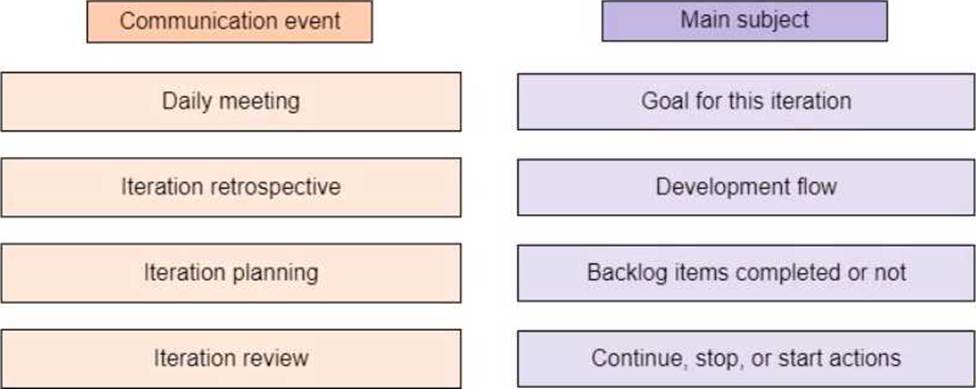
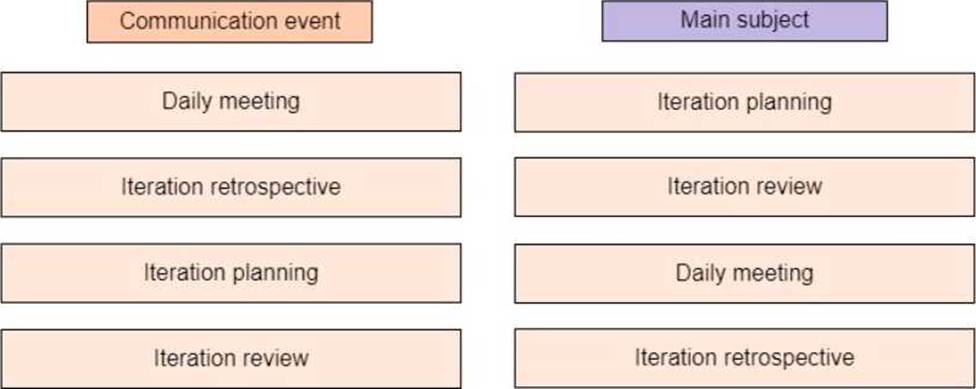
DRAG DROP
Drag the communication event on the left to the mam subject discussed during the event on the right.
A project manager is starting a project using a hybrid approach and notices some team members only have knowledge of predictive approaches.
What does the project manager need to do first in order to have good project performance?
- A . Coach those team members lacking hybrid knowledge to learn on the job.
- B . Change the team to include hybrid experts
- C . Assess the required training per team member.
- D . Deliver hybrid training to all team members
C
Explanation:
According to the PMBOK Guide, the project manager should assess the required training per team member as part of the plan resource management process. This process involves identifying and documenting the project roles, responsibilities, skills, and competencies, as well as the training needs of the project team members. The project manager should also consider the project life cycle approach, whether it is predictive, adaptive, or hybrid, and the implications for the team’s knowledge and skills. The project manager should not coach, change, or deliver training to the team members without first assessing their training needs and gaps, as this may not be effective or efficient.
Reference: PMBOK Guide, 7th edition, pages 307-308, 311-312.
One of the main inputs required for a deliverable is missing due to a miscommunication between the vendor and project manager Because of the missed deliverable, the critical path of the project is extended
What should the project manager do next?
- A . Start an audit of the vendor’s processes and procedures
- B . Review lessons learned from previous projects with this vendor
- C . Make a detailed analysis on vendor issues during the project
- D . Execute a contingency plan to address the issue with the vendor
D
Explanation:
According to the PMBOK Guide, 7th edition, one of the key activities of the project manager is to implement risk responses to address the issues and opportunities that may affect the project objectives and outcomes. This includes executing contingency plans, which are predefined actions or strategies that are triggered by the occurrence of a risk event. In this scenario, the missing input from the vendor is a risk event that has extended the critical path of the project, which means that the project schedule is at risk of being delayed. Therefore, the project manager should execute a contingency plan to address the issue with the vendor and recover the lost time.
Option D is the best answer for this question.
Option A is not the best answer because starting an audit of the vendor’s processes and procedures is not the next thing that the project manager should do. It is a possible action that the project manager may take to identify the root cause of the miscommunication and prevent it from happening again, but it is not a timely or effective action to resolve the current issue. Moreover, starting an audit may not always be feasible or desirable, as it may increase the project costs and risks, and may damage the relationship with the vendor.
Option B is not the best answer because reviewing lessons learned from previous projects with this vendor is not the next thing that the project manager should do. It is a good practice to learn from past experiences and apply them to current projects, but it is not a relevant or helpful action to deal with the current issue. Reviewing lessons learned may not always be accurate or reliable, as the vendor may have changed their processes or procedures since the previous projects.
Option C is not the best answer because making a detailed analysis on vendor issues during the project is not the next thing that the project manager should do. It is a possible action that the project manager may take to monitor and evaluate the vendor’s performance and identify any gaps or improvements, but it is not a proactive or adaptive action to address the current issue. Making a detailed analysis may not always be necessary or appropriate, as it may delay the project delivery and may not reflect the current or future state of the vendor’s situation.
Reference: PMBOK Guide, 7th edition, pages 9-10, 15-16, 25-26, 35-36, 49-50, 59-60.
A project team is globally distributed with team members living and working in different time zones.
The project manager is trying to get the team to collaborate effectively.
Which three actions should the project manager take to accomplish this goal? (Choose three)
- A . Require the team to have daily mandatory meetings with the project management office (PMO).
- B . Recommend the use of formal written documentation in all project communications.
- C . Review the communications strategy with the team regularly with a view for continuous improvement.
- D . Send out a survey to review the preferred method, time frequency for communications.
- E . Compile a communications management plan with input from all stakeholders and distribute for review and approval.
C, D, E
Explanation:
For a globally distributed project team, effective collaboration is crucial. The project manager should: C. Review the communications strategy with the team regularly with a view for continuous improvement. This ensures that the communication approach remains effective and adapts to the changing needs of the project and its stakeholders. Regular reviews can lead to enhancements in the communication process, making it more inclusive and efficient1.
D. Send out a survey to review the preferred method, time frequency for communications. By understanding the pReference and constraints of the global team regarding communication methods and timing, the project manager can tailor the communication plan to suit everyone’s needs, thus fostering better collaboration2.
E. Compile a communications management plan with input from all stakeholders and distribute for review and approval. A comprehensive communications management plan that considers the input from all stakeholders ensures that everyone is on the same page and that the communication needs of the project are met. This plan should detail the information needs of the project’s stakeholders, including what information will be communicated, how it will be communicated, when it will be communicated, and by whom3.
Reference: PMBOK® Guide C Sixth Edition, Project Management Institute, and additional resources on global team collaboration and communications management from PMI.
A project manager is leading a project when a key stakeholder requests additional work that is not in
the scope. The stakeholder is also concerned that the project sponsors may not approve and fund the additional change in scope.
What should the project manager do first?
- A . Evaluate the cost of the additional requested work.
- B . Evaluate the impact and submit a change request.
- C . Discuss the requested change with the sponsor.
- D . Discuss the requested change with the team.
B
Explanation:
When a key stakeholder requests additional work that is not in the scope, the first action a project manager should take is to evaluate the impact of the requested change. This involves assessing how the change will affect the project’s scope, schedule, budget, quality, risk, and benefits. After a thorough evaluation, the project manager should submit a change request. This formalizes the process and ensures that the requested change is documented, evaluated, and approved (or rejected) systematically within the project’s change control procedures.
Reference: The PMBOK® Guide outlines the importance of evaluating the impact of scope changes and the process for submitting change requests. It emphasizes that changes should be formally documented and processed through the project’s change control system12. This approach is aligned with best practices in project management for handling out-of-scope requests3.
The project manager’s firm is executing a construction project. The project is stalled due to reemerging conflicts and misunderstandings among stakeholders.
What should the project manager do to ensure a smooth start and completion of the project?
- A . Conduct an on-site survey, start the project to avoid any undue delays, and ensure costs are under control
- B . Invite all the stakeholders to a change control board (CCB) meeting, share feedback and facts, and come to a consensus.
- C . Advise the firm to cancel the project due to misunderstandings among the stakeholders and the associated risks.
- D . Determine the root cause of the misunderstandings, get all parties to reach a consensus, and help to implement the outcome.
D
Explanation:
In the context of project management, particularly within the PMBOK® Guide’s framework, it is crucial for a project manager to address conflicts by identifying and addressing the root causes. This approach aligns with the conflict resolution techniques outlined in the PMBOK, which include problem-solving and collaboration as effective methods for resolving disputes. By engaging stakeholders to understand their perspectives and reach a consensus, the project manager can facilitate a collaborative environment that fosters mutual understanding and agreement on how to move forward.
Reference: (PMBOK® Guide – Sixth Edition, Chapter 13: Project Stakeholder Management)