
PECB ISO-IEC-27001 Lead Auditor Practice Exams
Last updated on Oct 22,2026- Exam Code: ISO-IEC-27001 Lead Auditor
- Exam Name: PECB Certified ISO/IEC 27001 Lead Auditor exam
- Certification Provider: PECB
- Latest update: Oct 22,2026
Who are allowed to access highly confidential files?
- A . Employees with a business need-to-know
- B . Contractors with a business need-to-know
- C . Employees with signed NDA have a business need-to-know
- D . Non-employees designated with approved access and have signed NDA
A
Explanation:
According to ISO/IEC 27001:2022, clause 8.2.1, the organization shall ensure that access to information and information processing facilities is limited to authorized users based on the access control policy and in accordance with the business requirements of access control2. Therefore, only employees with a business need-to-know are allowed to access highly confidential files, and not contractors, non-employees or employees with signed NDA.
Reference: ISO/IEC 27001:2022 Lead Auditor (Information Security Management Systems) | CQI | IRCA
You are the person responsible for managing the audit programme and deciding the size and composition of the audit team for a specific audit. Select the two factors that should be considered.
- A . The audit scope and criteria
- B . Customer relationships
- C . The overall competence of the audit team needed to achieve audit objectives
- D . Seniority of the audit team leader
- E . The cost of the audit
- F . The duration preferred by the auditee
AC
Explanation:
The overall competence of the12:
The audit scope and criteria: The audit scope defines the extent and boundaries of the audit, such as the locations, processes, functions, and time period to be audited. The audit criteria are the set of policies, procedures, standards, or requirements used as a reference against which the audit evidence is compared. The audit scope and criteria determine the complexity and extent of the audit, and thus influence the number and expertise of the auditors needed to cover all the relevant aspects of the audit.
The overall competence of the audit team needed to achieve audit objectives: The audit team should have the appropriate knowledge, skills, and experience to conduct the audit effectively and efficiently, and to provide credible and reliable audit results. The audit team competence should include the following elements12:
Generic competence: The ability to apply the principles and methods of auditing, such as planning, conducting, reporting, and following up the audit, as well as the personal behaviour and attributes of the auditors, such as ethical conduct, fair presentation, professional care, independence, and impartiality.
Discipline and sector-specific competence: The ability to understand and apply the audit criteria and the relevant technical or industry aspects of the audited organization, such as the information security management system (ISMS) requirements, the information security risks and controls, the legal and regulatory obligations, the organizational context and culture, the processes and activities, the products and services, etc.
Audit team leader competence: The ability to manage the audit team and the audit process, such as coordinating the audit activities, communicating with the audit programme manager and the auditee, resolving any audit-related problems, ensuring the quality and consistency of the audit work and the audit report, etc.
The person responsible for managing the audit programme should not consider the following factors when deciding the size and composition of the audit team for a specific audit, as they are either irrelevant or inappropriate for the audit process12:
Customer relationships: The audit team should not be influenced by any personal or professional relationships with the auditee or other interested parties, as this may compromise the objectivity and impartiality of the audit. The audit team should avoid any conflicts of interest or self-interest that may affect the audit results or the audit decisions.
Seniority of the audit team leader: The audit team leader should be selected based on their competence and experience, not on their seniority or rank within the organization or the audit programme. The audit team leader should have the authority and responsibility to manage the audit team and the audit process, regardless of their seniority or position.
The cost of the audit: The cost of the audit should not be the primary factor for determining the size and composition of the audit team, as this may compromise the quality and effectiveness of the audit. The audit team should have sufficient resources and time to conduct the audit in accordance with the audit objectives, scope, and criteria, and to provide accurate and reliable audit results and recommendations.
The duration preferred by the auditee: The duration of the audit should be based on the audit objectives, scope, and criteria, and the availability and cooperation of the auditee, not on the preference or convenience of the auditee. The audit team should have enough time to conduct the audit in a thorough and systematic manner, and to collect and evaluate sufficient and relevant audit evidence.
Reference: ISO 19011:2018 – Guidelines for auditing management systems PECB Candidate Handbook ISO 27001 Lead Auditor, pages 19-20
DRAG DROP
You are an experienced ISMS internal auditor.
You have just completed a scheduled information security audit of your organisation when the IT Manager approaches you and asks for your assistance in the revision of the company’s Statement of Applicability.
The IT Manager is attempting to update the ISO/IEC 27001:2013 based Statement of Applicability to a Statement aligned to the 4 control themes present in ISO/IEC 27001:2022 (Organizational controls, People Controls, Physical Controls, Technical Controls).
The IT Manager is happy with their reassignment of controls, with the following exceptions. He asks you which of the four control categories each of the following should appear under.
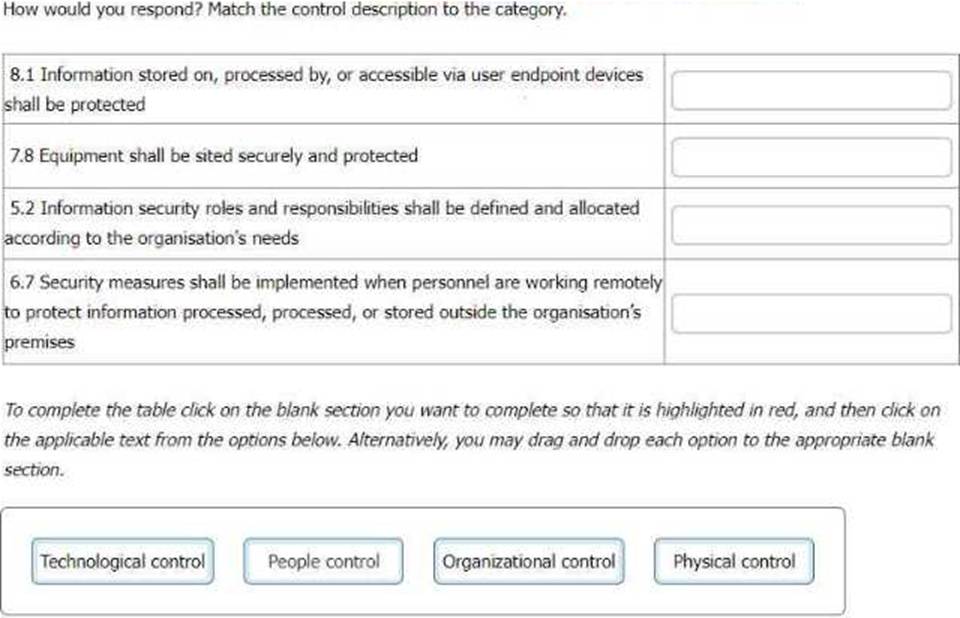
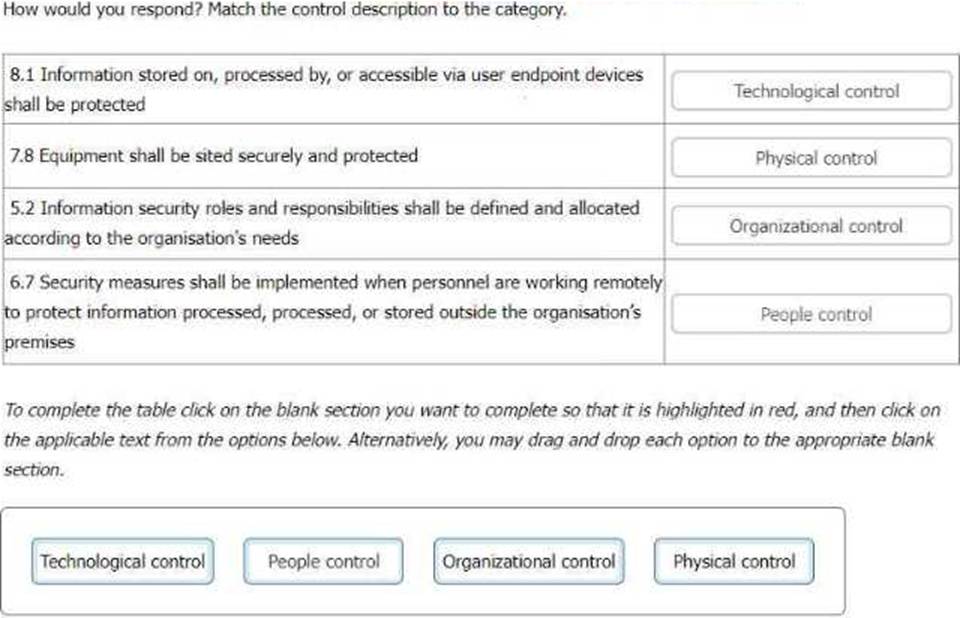
Explanation:
You are an ISMS audit team leader who has been assigned by your certification body to carry out a follow-up audit of a client. You are preparing your audit plan for this audit.
Which two of the following statements are true?
- A . Verification should focus on whether any action undertaken taken has been undertaken efficiently
- B . Corrections should be verified first, followed by corrective actions and finally opportunities for improvement
- C . Verification should focus on whether any action undertaken is complete
- D . Opportunities for improvement should be verified first, followed by corrections and finally corrective actions
- E . Corrective actions should be reviewed first, followed by corrections and finally opportunities for improvement
- F . Verification should focus on whether any action undertaken has been undertaken effectively
C, F
Explanation:
According to ISO 27001:2022 clause 9.1.2, the organisation shall conduct internal audits at planned intervals to provide information on whether the information security management system conforms to the organisation’s own requirements, the requirements of ISO 27001:2022, and is effectively implemented and maintained12
According to ISO 27001:2022 clause 10.1, the organisation shall react to the nonconformities and take action, as applicable, to control and correct them and deal with the consequences. The organisation shall also evaluate the need for action to eliminate the causes of nonconformities, in order to prevent recurrence or occurrence. The organisation shall implement any action needed, review the effectiveness of any corrective action taken, and make changes to the information security management system, if necessary12
A follow-up audit is a type of internal audit that is conducted after a previous audit to verify whether the nonconformities and corrective actions have been addressed and resolved, and whether the information security management system has been improved12
Therefore, the following statements are true for preparing a follow-up audit plan:
Verification should focus on whether any action undertaken is complete. This means that the auditor should check whether the organisation has implemented all the planned actions to correct and prevent the nonconformities, and whether the actions have been documented and communicated as required12
Verification should focus on whether any action undertaken has been undertaken effectively. This means that the auditor should check whether the organisation has achieved the intended results and objectives of the actions, and whether the actions have eliminated or reduced the nonconformities and their causes and consequences12
The following statements are false for preparing a follow-up audit plan:
Verification should focus on whether any action undertaken has been undertaken efficiently. This is false because efficiency is not a criterion for verifying the actions taken to address the nonconformities and corrective actions. Efficiency refers to the optimal use of resources to achieve the desired outcomes, but it is not a requirement of ISO 27001:2022. The auditor should focus on the effectiveness and completeness of the actions, not on the efficiency12
Corrections should be verified first, followed by corrective actions and finally opportunities for improvement. This is false because there is no prescribed order for verifying the corrections, corrective actions, and opportunities for improvement. The auditor should verify all the actions taken by the organisation, regardless of their sequence or priority. The auditor may choose to verify the actions based on their relevance, significance, or impact, but this is not a mandatory requirement12
Opportunities for improvement should be verified first, followed by corrections and finally corrective actions. This is false because there is no prescribed order for verifying the opportunities for improvement, corrections, and corrective actions. The auditor should verify all the actions taken by the organisation, regardless of their sequence or priority. The auditor may choose to verify the actions based on their relevance, significance, or impact, but this is not a mandatory requirement12 Corrective actions should be reviewed first, followed by corrections and finally opportunities for improvement. This is false because there is no prescribed order for reviewing the corrective actions, corrections, and opportunities for improvement. The auditor should review all the actions taken by the organisation, regardless of their sequence or priority. The auditor may choose to review the actions based on their relevance, significance, or impact, but this is not a mandatory requirement12
Reference: 1: ISO/IEC 27001:2022 Lead Auditor (Information Security Management Systems) Course by CQI and IRCA Certified Training 1 2: ISO/IEC 27001 Lead Auditor Training Course by PECB 2
DRAG DROP
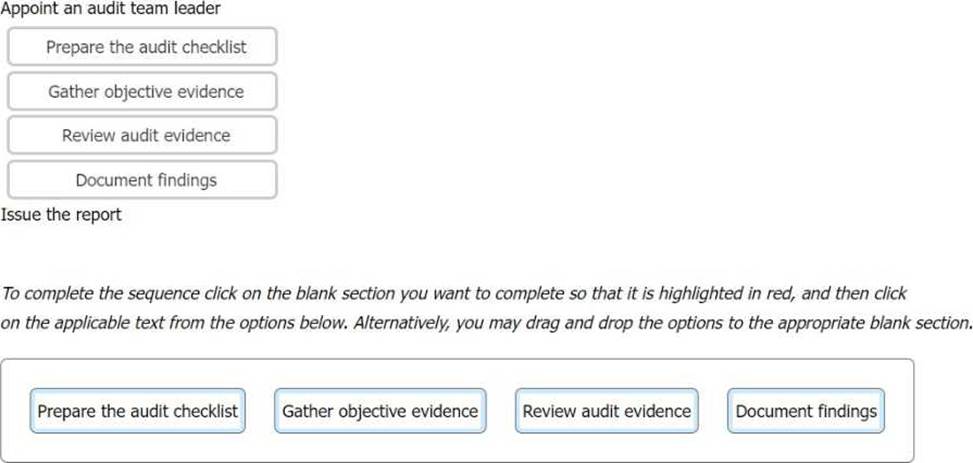
The following options are key actions involved in a first-party audit.
Order the stages to show the sequence in which the actions should take place.
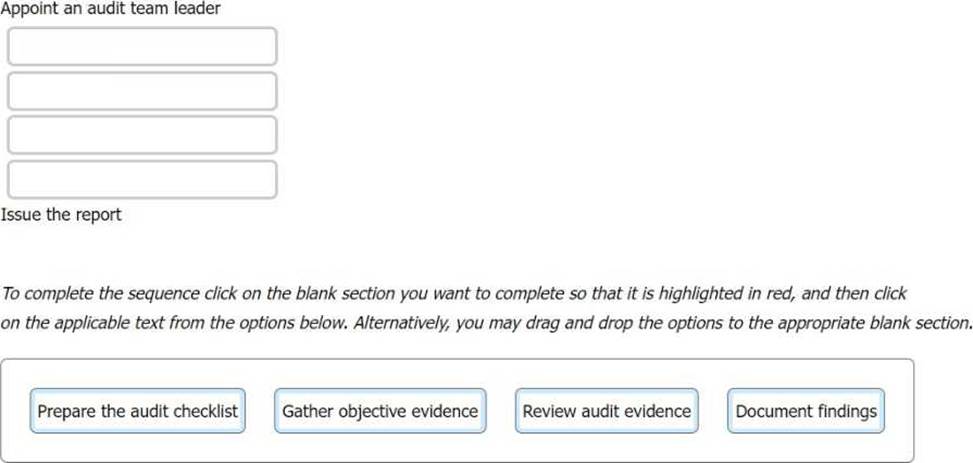
Explanation:
The correct order of the stages is:
Prepare the audit checklist
Gather objective evidence
Review audit evidence
Document findings
Audit preparation: This stage involves defining the audit objectives, scope, criteria, and plan. The auditor also prepares the audit checklist, which is a list of questions or topics that will be covered during the audit. The audit checklist helps the auditor to ensure that all relevant aspects of the ISMS are addressed and that the audit evidence is collected in a systematic and consistent manner12. Audit execution: This stage involves conducting the audit activities, such as opening meeting, interviews, observations, document review, and closing meeting. The auditor gathers objective evidence, which is any information that supports the audit findings and conclusions. Objective evidence can be qualitative or quantitative, and can be obtained from various sources, such as records, statements, physical objects, or observations123.
Audit reporting: This stage involves reviewing the audit evidence, evaluating the audit findings, and documenting the audit results. The auditor reviews the audit evidence to determine whether it is sufficient, reliable, and relevant to support the audit findings. The auditor evaluates the audit findings to determine the degree of conformity or nonconformity of the ISMS with the audit criteria. The auditor documents the audit results in an audit report, which is a formal record of the audit process and outcomes. The audit report typically includes the following elements123:
An introduction clarifying the scope, objectives, timing and extent of the work performed An executive summary indicating the key findings, a brief analysis and a conclusion
The intended report recipients and, where appropriate, guidelines on classification and circulation Detailed findings and analysis
Recommendations for improvement, where applicable
A statement of conformity or nonconformity with the audit criteria
Any limitations or exclusions of the audit scope or evidence
Any deviations from the audit plan or procedures
Any unresolved issues or disagreements between the auditor and the auditee A list of references, abbreviations, and definitions used in the report
A list of appendices, such as audit plan, audit checklist, audit evidence, audit team members, etc. Audit follow-up: This stage involves verifying the implementation and effectiveness of the corrective actions taken by the auditee to address the audit findings. The auditor monitors the progress and completion of the corrective actions, and evaluates their impact on the ISMS performance and conformity. The auditor may conduct a follow-up audit to verify the corrective actions on-site, or may rely on other methods, such as document review, remote interviews, or self-assessment by the auditee. The auditor documents the follow-up results and updates the audit report accordingly123.
Reference: PECB Candidate Handbook ISO 27001 Lead Auditor, pages 19-25 ISO 19011:2018 – Guidelines for auditing management systems The ISO 27001 audit process | ISMS.online
You are an experienced audit team leader guiding an auditor in training.
Your team is currently conducting a third-party surveillance audit of an organisation that stores data on behalf of external clients. The auditor in training has been tasked with reviewing the PHYSICAL controls listed in the Statement of Applicability (SoA) and implemented at the site.
Select four controls from the following that would you expect the auditor in training to review.
- A . Access to and from the loading bay
- B . How power and data cables enter the building
- C . Information security awareness, education, and training
- D . The conducting of verification checks on personnel
- E . The development and maintenance of an information asset inventory
- F . The operation of the site CCTV and door control systems
- G . The organisation’s arrangements for maintaining equipment
- H . The organisation’s business continuity arrangements
ABFG
Explanation:
The four controls from the list that are related to PHYSICAL aspects of the ISMS are:
• Access to and from the loading bay
• How power and data cables enter the building
• The operation of the site CCTV and door control systems
• The organisation’s arrangements for maintaining equipment
These controls are derived from the ISO 27001 Annex A, which provides a comprehensive list of information security controls that can be applied to an ISMS1. The other controls in the list are more related to ORGANIZATIONAL, LEGAL, or HUMAN aspects of the ISMS, which are also important, but not the focus of this question.
According to the ISMS Auditing Guideline2, the auditor in training should review the PHYSICAL controls by:
• Checking the SoA to identify the applicable controls and their implementation status
• Interviewing the relevant staff and management to verify their understanding and involvement in the controls
• Observing the physical and environmental conditions to confirm the existence and effectiveness of the controls
• Examining the relevant documents and records to validate the compliance and performance of the controls
I hope this helps you prepare for the exam.
Reference: 1: What Are ISO 27001 Controls? A Guide to Annex A | Secureframe; 2: ISMS Auditing Guideline – ISO27000
Stages of Information
- A . creation, evolution, maintenance, use, disposition
- B . creation, use, disposition, maintenance, evolution
- C . creation, distribution, use, maintenance, disposition
- D . creation, distribution, maintenance, disposition, use
C
Explanation:
The stages of information are creation, distribution, use, maintenance, and disposition. These are the phases that information goes through during its lifecycle, from the moment it is generated to the moment it is destroyed or archived. Each stage of information has different security requirements and risks, and should be managed accordingly. Creation, evolution, maintenance, use, and disposition are not the correct stages of information, as evolution is not a distinct stage, but a process that can occur in any stage. Creation, use, disposition, maintenance, and evolution are not the correct stages of information, as they are not in the right order. Creation, distribution, maintenance, disposition, and use are not the correct stages of information, as they are not in the right order.
Reference: CQI & IRCA ISO 27001:2022 Lead Auditor Course Handbook, page 32. : [ISO/IEC 27001 LEAD AUDITOR – PECB], page 12.
You are performing an ISO 27001 ISMS surveillance audit at a residential nursing home, ABC Healthcare Services. ABC uses a healthcare mobile app designed and maintained by a supplier, WeCare, to monitor residents’ well-being. During the audit, you learn that 90% erf the residents’ family members regularly receive medical device advertisements from WeCare, by email and SMS once a week. The service agreement between ABC and WeCare prohibits the supplier from using residents’ personal data. ABC has received many complaints from residents and their family members.
The Service Manager says that the complaints were investigated as an information security incident which found that they were justified. Corrective actions have been planned and implemented according to the nonconformity and corrective action management procedure.
You write a nonconformity "ABC failed to comply with information security control A.5.34 (Privacy and protection of PII) relating to the personal data of residents’ and their family members. A supplier, WeCare, used residents’ personal information to send advertisements to family members"
Select three options of the corrections and corrective actions listed that you would expect ABC to make in response to the nonconformity
- A . ABC confirms that information security control A.5.34 is contained in the Statement of Applicability (SoA)
- B . The Service Manager provides evidence of analysis of the cause of nonconformity and how the
ABC evaluates the effectiveness of implemented corrective actions - C . ABC instructs all staff to follow the signed healthcare service agreement with residents’ family members
- D . ABC conducts a management review to take the feedback from residents’ family members into consideration
- E . ABC needs to collect more evidence on how the organisation defines the management system scope and find out if they covered WeCare the medical device manufacturer
- F . ABC identifies and checks compliance with all applicable legislation and contractual requirements involving third parties
- G . The Service Manager implements the corrective actions and Customer Service Representatives evaluate the effectiveness of implemented corrective actions
- H . ABC needs to collect more evidence on how information security risk assessment relates to the identified nonconformities before concluding actions on the nonconformity
B, F, G
Explanation:
According to the ISO/IEC 27001:2022 Lead Auditor (Information Security Management Systems) course, the following corrections and corrective actions are expected from ABC in response to the nonconformity:
B. The Service Manager provides evidence of analysis of the cause of nonconformity and how the ABC evaluates the effectiveness of implemented corrective actions. This is part of the requirement of clause 10.1 of ISO/IEC 27001:2022, which states that the organization shall determine the causes of nonconformities and evaluate the need for action to ensure that they do not recur or occur elsewhere12. The organization shall also evaluate the effectiveness of any corrective actions taken12.
F. ABC identifies and checks compliance with all applicable legislation and contractual requirements involving third parties. This is part of the requirement of clause 4.2 of ISO/IEC 27001:2022, which states that the organization shall determine the external and internal issues that are relevant to its purpose and that affect its ability to achieve the intended outcome(s) of its information security management system12. This includes the legal and contractual requirements related to the information security aspects of the organization’s activities, products and services12.
G. The Service Manager implements the corrective actions and Customer Service Representatives evaluate the effectiveness of implemented corrective actions. This is part of the requirement of clause 10.1 of ISO/IEC 27001:2022, which states that the organization shall implement any action needed and retain documented information as evidence of the results of any action taken12. The organization shall also monitor, measure, analyze and evaluate the information security performance and the effectiveness of the information security management system12.
Reference: 1: ISO/IEC 27001:2022 Lead Auditor (Information Security Management Systems) course, CQI and IRCA Certified Training, 1
2: ISO/IEC 27001 Lead Auditor Training Course, PECB, 2
Which two of the following phrases would apply to "audit objectives"?
- A . Audit duration
- B . Determining conformity
- C . Checking legal compliance
- D . Auditor competence
- E . Revising management policy
- F . Identifying opportunities for improvement, if required
BF
Explanation:
The audit objectives are the purpose and scope of an audit, as defined by the audit client and the auditor. According to the ISO/IEC 27001 standard, the audit objectives for an ISMS audit may include determining the extent of conformity of the ISMS with the audit criteria, evaluating the ability of the ISMS to ensure the organization meets its information security objectives, and identifying potential areas for improvement of the ISMS12.
Reference: = 1: PECB Candidate Handbook – ISO/IEC 27001 Lead Auditor, page 192: ISO/IEC 27007:2011 Information technology ― Security techniques ― Guidelines for information security management systems auditing, clause 4.2.1.
A telecommunications company uses the AES method for ensuring that confidential information is protected. This means that they use a single key to encrypt and decrypt the information.
What kind of control does the company use?
- A . Detective
- B . Corrective
- C . Preventive
C
Explanation:
The AES (Advanced Encryption Standard) method is a symmetric-key algorithm, meaning the same key is used for both encrypting and decrypting data1. This type of control is considered preventive because it is implemented to prevent unauthorized access to confidential information by ensuring that the data is unreadable to anyone who does not have the key.
Reference: = The explanation is based on the general understanding of encryption as a security control within the field of information security, particularly as it pertains to the ISO/IEC 27001 standard for information security management systems (ISMS), which includes encryption as a preventive control measure.