
PECB ISO-9001 Lead Auditor Practice Exams
Last updated on Oct 21,2026- Exam Code: ISO-9001 Lead Auditor
- Exam Name: QMS ISO 9001:2015 Lead Auditor
- Certification Provider: PECB
- Latest update: Oct 21,2026
XYZ Corporation is an organisation that employs 100 people. As the audit team leader, you are conducting a certification audit at Stage 1. When reviewing the quality management system (QMS) documentation, you find that quality objectives have been set for every employee in the organisation except top management. The Quality Manager complains that this has created a lot of resistance
to the QMS, and the Chief Executive is asking questions about how much it will cost. He asks for your opinion on whether this is the correct method of setting objectives.
How would you respond with the following options? Select three.
- A . Suggest asking the certification body for guidance on this matter.
- B . Advise the Quality Manager to read the ISO 9001 standard and interpret in relation to the organisation’s requirements.
- C . Advise the Quality Manager that you will raise an opportunity for improvement if the quality objectives are not addressed properly.
- D . Inform the Quality Manager that you will comment on the subject in your audit report.
- E . Indicate that ISO 9001 requires a minimum of two quality objectives.
- F . Suggest that all employees undertake a training course on ISO 9001.
- G . Advise the Quality Manager that, as an auditor, you cannot provide advice to the organisation on how it should operate its QMS.
- H . Suggest that the Quality Manager obtains external consultancy on the use of quality objectives.
You are a member of the audit team of a second-party audit of an organisation with 625 employees. The audit procedure recommends using sampling criteria which requires the review of the documented competence for 25 personnel. The audit team leader developed an audit plan allocating one hour to audit the Human Resources department (from 11:30 am to 12:30 pm). She told you that she could not allocate any additional time.
What would you do?
- A . Extend the audit until 1.00pm and ask for a quick lunch later.
- B . Plan to review less than 25 cases.
- C . Plan to review as many as possible and see if you can extend the audit duration by one day.
- D . Plan to miss lunch and review as many as possible.
During a third-party audit of a pharmaceutical organisation (CD9000) site of seven COVID-19 testing laboratories in various terminals at a major international airport, you interview the CD 9000’s General Manager (GM), who was accompanied by Jack, the legal compliance expert. Jack is acting as the guide in the absence of the Technical Manager due to him contracting COVID-19.
You: "What external and internal issues have been identified that could affect CD9000 and its quality management system?"
GM: "Jack guided us on this. We identified issues like probable competition of another laboratory organisation in the airport, legal requirements on COVID-19 continuously changing, the shortage of competent laboratory analysists, the epidemic declining soon, shortage of chemicals for the analysis. It was quite a good experience."
You: "Did you document these issues?"
GM: "No. Jack said that ISO 9001 does not require us to document these issues."
You: "How did you determine the risks associated with the issues and did you plan actions to address them?"
GM: "I am not sure. The Technical Manager is responsible for this process. Jack may be able to answer this question in his absence."
Select two options for how you would respond to the General Manager’s suggestion:
- A . I would ask to audit the Technical Manager by phone.
- B . I would ask for a different guide instead of the legal compliance expert.
- C . I would look for evidence that the actions resulting from the risk assessment had been taken.
- D . I would ask the consultant to leave the meeting since he is not an employee of the organisation.
- E . I would delay the audit until the return of the technical manager
- F . I would not accept the legal compliance expert answering the question.
In the context of a third-party certification audit, how can the auditor demonstrate confidentiality? Select two.
- A . Adhere to the CQI Professional Code of Conduct.
- B . Confirm the confidentiality arrangements with the auditee regarding the use of mobile devices/cameras.
- C . Discuss sensitive personal information with the guides appointed by the auditee.
- D . Remove audit evidence without the permission of the auditee.
- E . Share audit conclusions with competitor organisations.
DRAG DROP
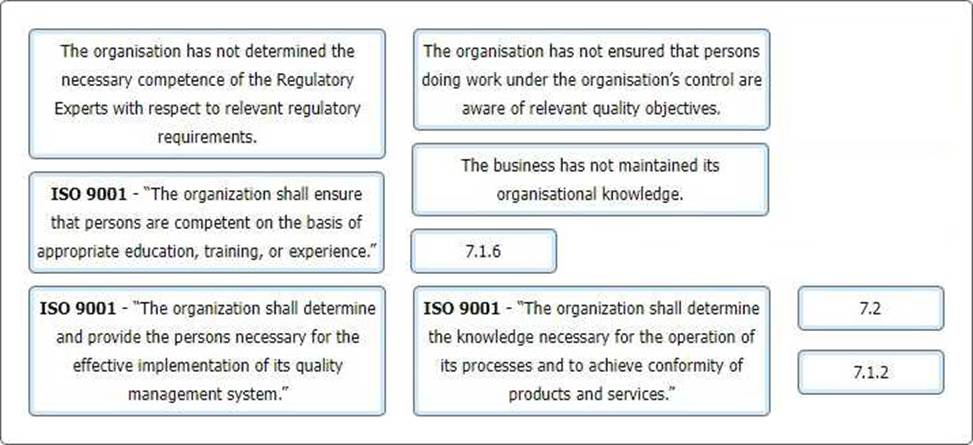
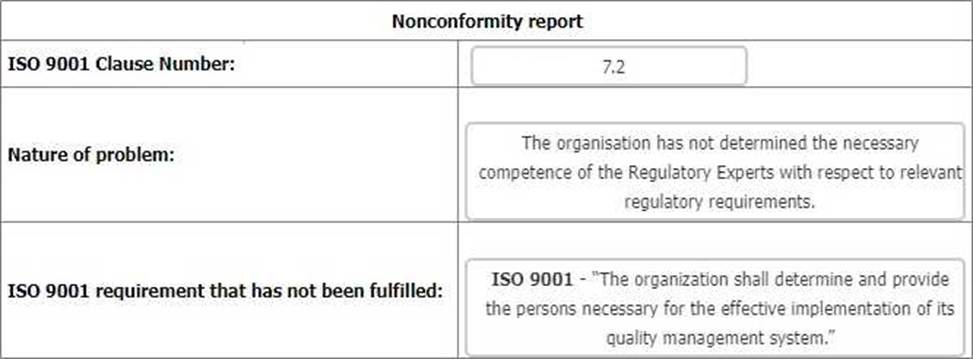
You are carrying out an audit to ISO 9001 at an organisation which offers regulatory consultancy services to manufacturers of cosmetics.
You are interviewing the Technical Director (TD), who manages a team of regulatory experts responsible for providing regulatory services to customers.
You: "How do you ensure your regulatory team’s competence concerning regulatory requirements is maintained?"
TD: "The two Regulatory Experts we employ full-time have years of experience of working in the cosmetics industry."
You: "How is their regulatory competence maintained?"
TD: "They are dedicated individuals with lots of contacts in the sector."
You: "How does the business enable them to maintain their understanding of current regulatory requirements?"
TD: "We leave that up to them."
You decide to raise a nonconformity.

To complete the nonconformity report click on the blank section you want to complete so itis highlighted in red and then did on the applicable text from the options below. Alternatively, drag and drop the options to the appropriate blank section.
Which one of the following options best describes the purpose of a Stage 1 third-party audit?
- A . To determine the auditees understanding of ISO 9001.
- B . To get to know the organisation’s customers.
- C . To learn about the organisation’s procurement processes.
- D . To introduce the audit team to the client.
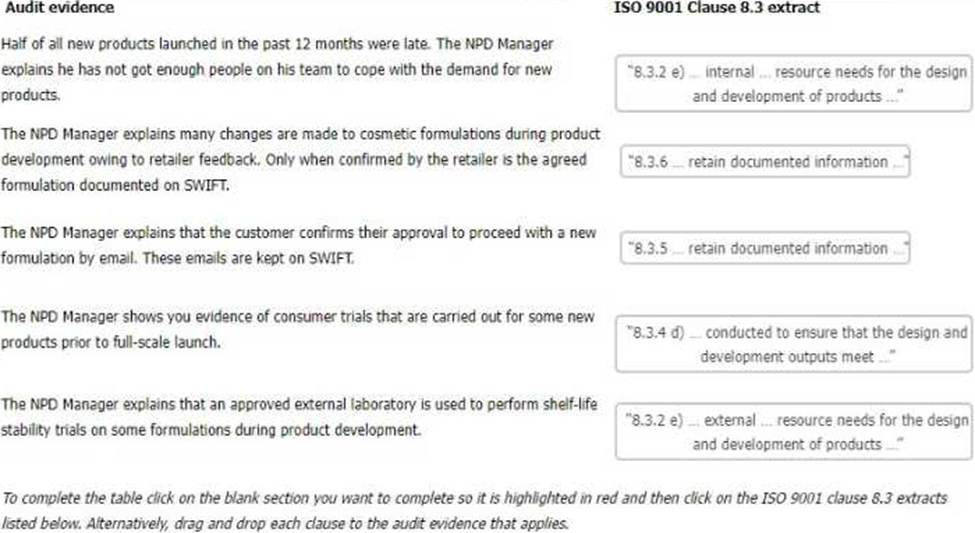
DRAG DROP
You are carrying out an audit at a single-site organisation seeking certification to ISO 9001 for the first time. The organization manufactures cosmetics for major retailers and the name of the retailer supplied appears on the product packaging. Sales turnover has increased significantly over the past five years.
You are interviewing the new Product Development Manager. You note that a software application called SWIFT is used to help control the product development process.
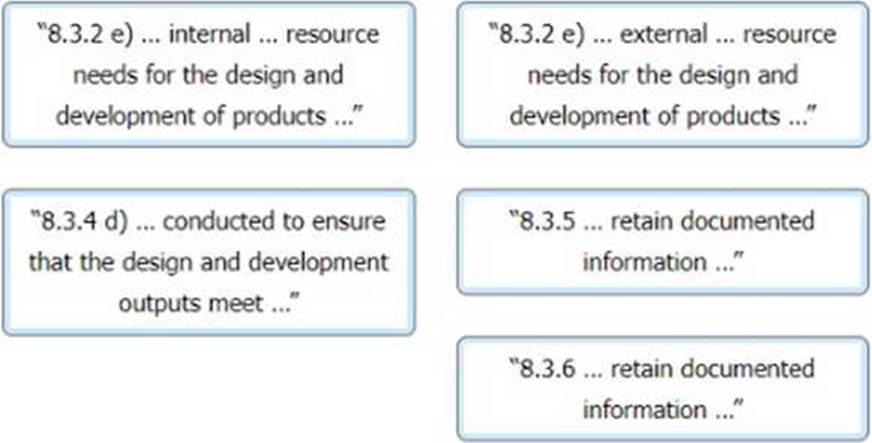
You have gathered audit evidence as outlined in the table. Match the ISO 9001 clause 8.3 extracts to the audit evidence.
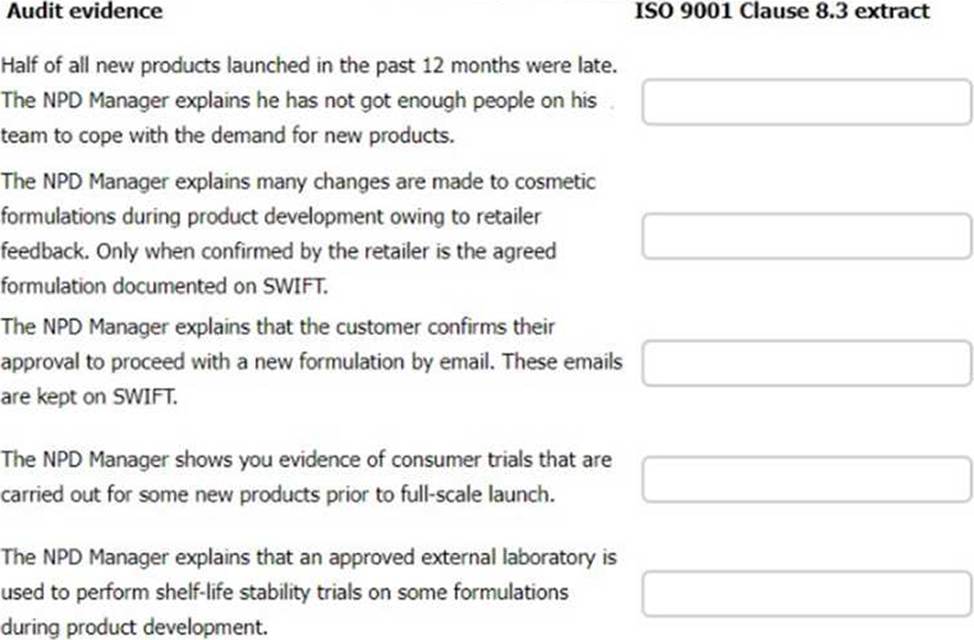
To complete the table click on the blank section you want to complete so it is highlighted in red and then click on the Iso 9001 cause 8.3 extracts listed below. Alternatively, drag and drop each clause to the audit evidence that applies.
Which two of the following roles do not contribute to the audit outcomes?
- A . Individual(s) managing the audit programme
- B . Auditee
- C . Guide
- D . Consultant
- E . Observer
- F . Technical expert
The following actions need to be carried out during a third-party audit planning stage.
Which two actions correspond to the individual(s) managing the audit program before the involvement of the audit team leader?
- A . Prepare the audit plan
- B . Assign responsibilities within the audit team
- C . Prepare the checklists
- D . Provide the resources needed
- E . Review the reports of previous audits
- F . Select the audit team members
Audit criteria are a set of requirements used as a reference against which objective evidence is compared.
Which two of the following are not potential audit criteria?
- A . ISO management system standards
- B . Verbal statements by the general manager
- C . Verbal agreements with interested parties
- D . Health and safety notices
- E . Written agreements with interested parties
- F . Commercial advertisements
- G . Organisation’s documented information
- H . Claims made on the organisation’s website
- I . Commitment to follow principles issued by an NGO
- J . Environmental aspects register