
PECB ISO-9001 Lead Auditor Practice Exams
Last updated on Oct 21,2026- Exam Code: ISO-9001 Lead Auditor
- Exam Name: QMS ISO 9001:2015 Lead Auditor
- Certification Provider: PECB
- Latest update: Oct 21,2026
During an internal audit, it was discovered that the calibration of a spectrometer used daily for production had expired, causing a nonconformance under Clause 7.1.5.2 of ISO 9001:2015. The root cause was the organization not considering the risk of the calibration provider leaving the country.
Which corrective action is the best one?
- A . We will select one sample, which we will send to an external laboratory and will use it as our internal standard.
- B . We will look for a local company to provide this service.
- C . We will have the results on one out of ten of our routine production samples double-checked by an external local laboratory.
- D . We will add this to our external issue register, assess its associated risk, and plan action to address that risk.
DRAG DROP
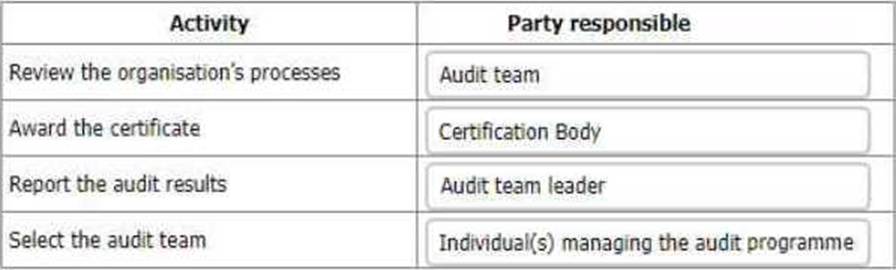
In the context of a third-party audit, match the activity with the party responsible in relation to the audit process.
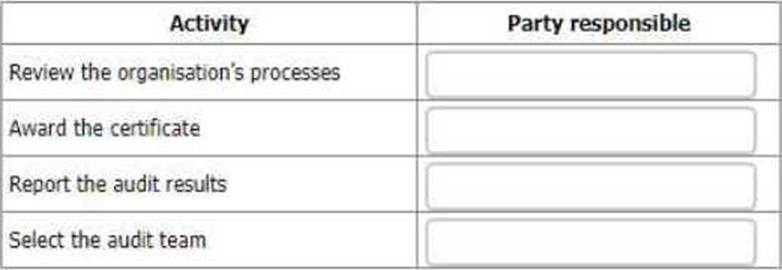
To complete the table, click on the blank section you want to compete so that it is highlighted in red, and then did on the applicable text from the options below. Alternatively, drag and drop each option to the appropriate blank section.

ABC is a service organisation that cleans and irons bed and table linen for four large hospitals in the city centre. It claims to meet ISO 9001:2015 requirements. During an internal audit, an auditor observes that machine No. 4 is being operated with the three variables outside the limits established in the applicable documented procedure SP-701. The auditor has decided to raise a nonconformity.
Which six elements should be included in the nonconformity report?
- A . Condition of the table linens upon receipt from the hospital
- B . Applicable procedure: SP-701
- C . Competence record of the machine operator
- D . Identification number of the washing machine
- E . Manufacturer of the washing machine
- F . Name of the Quality Manager
- G . Number of the production order
- H . The concentration of the cleaning liquid used vs the concentration fixed in SP-701
- I . The planned duration of the process vs the minimum time required in SP-701
- J . Weight of linen being washed vs the maximum weight required in SP-701
A small deaning services organisation is about to start work on a hospital dleaning contract for the local Health Trust. You, as auditor, are conducting a Stage 2 audit to ISO 9001 and review the contract with the Service Manager. The contract requires that a cleaning plan is produced. You: "How was the cleaning plan for the contract developed?" Service Manager: "We have a basic template that covers the materials, labour requirements and cleaning methods to be employed. Some of that is specified by the customer." You: "How does the plan deal with locations like the intensive care wards and the operating theatres, which are included in the contract?" Service Manager: "The basic plan covers general wards, but we will do more frequent cleaning in those areas if the hospital requests it." You: "Are you aware of the regulatory requirements for cleaning standards in hospitals?" Service Manager: "No. We depend on the hospital to look after that side of things in the contract." You decide to raise a non-conformity against section 8.2.2.a.1 of ISO 9001. You decide to raise another non-conformity against section 8.2.4 of ISO 9001 when finding that the cleaning plan was amended without the agreement of the Health Trust. A different cleaning chemical was substituted to that specified in the contract. At the follow- up audit, the corrective action proposed was to "obtain a concession from the Health Trust for use of the new chemical."
Which one of the following options is the reason why you did not accept this action taken?
- A . The substitute chemical has not been used before in the Health Trust.
- B . The action assumes that the Health Trust will agree to the change.
- C . Staff have not been trained in the use of the new chemical.
- D . The process for making changes to the contract has not been addressed.
- E . The substitute chemical may not be as effective as the original.
DRAG DROP
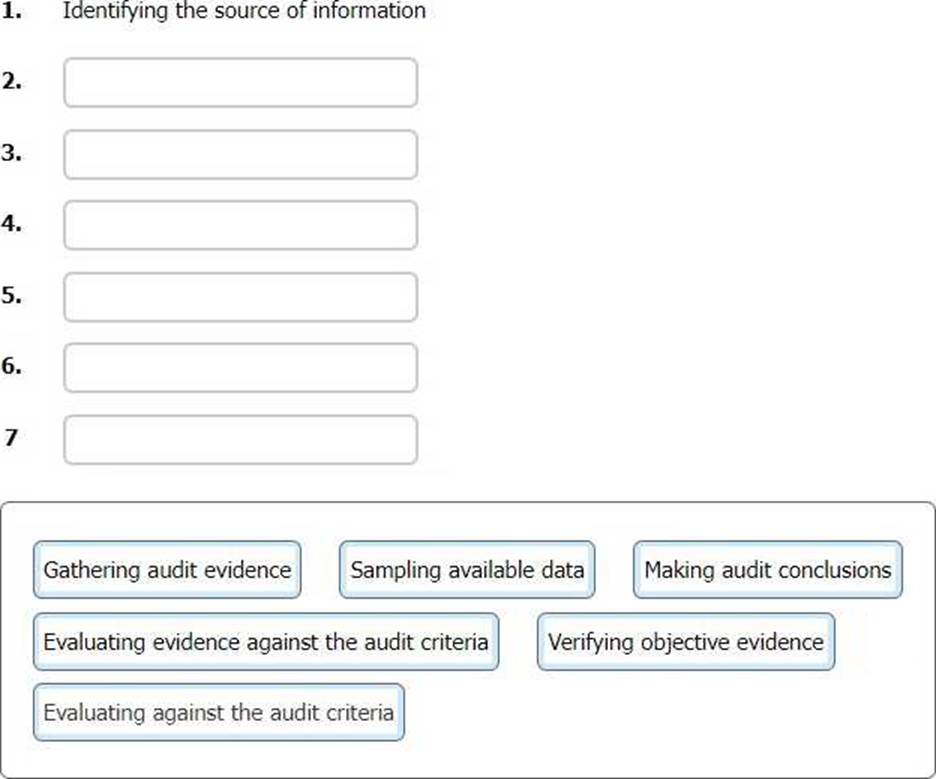
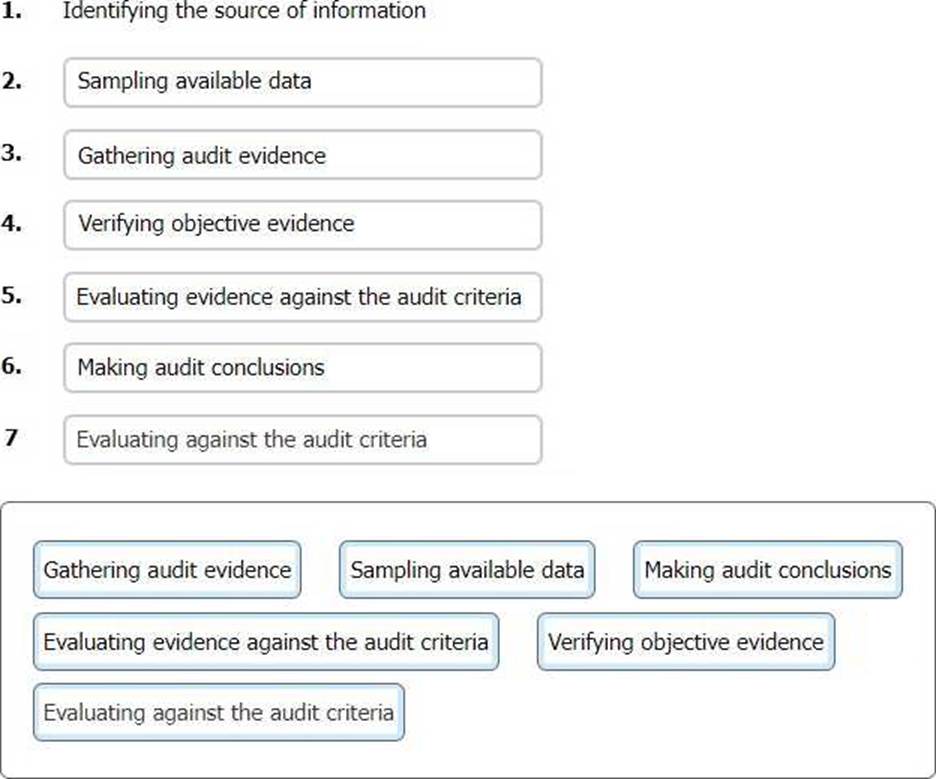
In the context of a management system audit, identify the sequence of a typical process for collecting and verifying information. The first one has been done for you.
To complete the sequence click on the blank section you want to complete so it is highlighted in red and then click on the applicable text from the options below. Alternatively, drag and drop the options to the appropriate blank section.
DRAG DROP
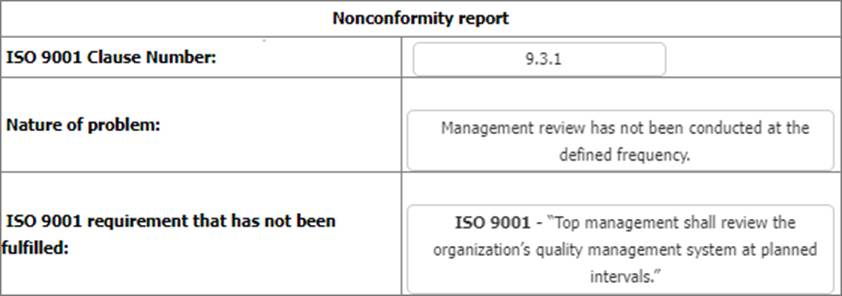
You are carrying out an annual audit at an organisation that offers home security services. You are interviewing the Quality Manager (QM)
You: "Would you tell me about your management review process?"
QM: "The senior management team plans to review the management system every six months. The review follows a set agenda and records are maintained."
You: "May I see the records from the last two management reviews?"
Narrative: The Quality Manager gives you the latest record, which shows the last management review took place nine months ago.
The Quality Manager then gives you the previous management review record, which took place one year before the latest review.
You: "Are there any other review reports in the last two years?
QM: "No, these are the only ones."
You decide to raise a nonconformity.
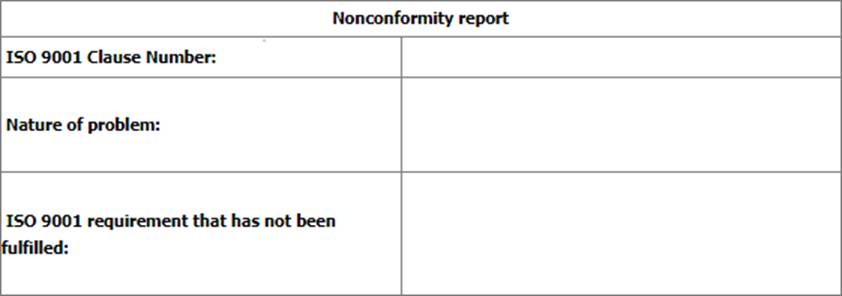
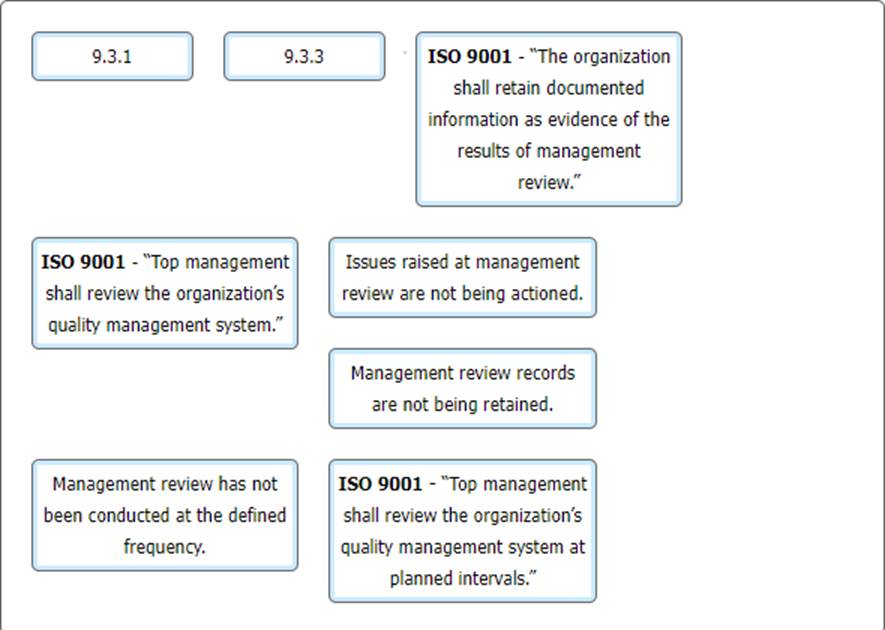
To complete the nonconformity report click on the blank section you want to complete se it is highlighted in red and then click on the applicable text from the options below. Alternatively, drag and drop the options to the appropriate blank section.
Which two of the following statements related to Stage 1 of an initial certification audit against ISO 9001:2015 are true?
- A . During the Stage 1 audit, the audit team:
- B . Reviews the processes with high level of risk
- C . Verifies the degrees of customer satisfaction
- D . Evaluates the conditions of all sites
- E . Evaluates the results of the last management review
- F . Reviews the client’s management system documented information
- G . Verifies the compliance with legal requirements
XYZ Corporation is an organisation that employs 100 people. As the audit team leader, you conduct a certification audit at Stage 1. When reviewing the quality management system (QMS), you find that the objectives have been defined by an external consultant using those of a competitor, but nothing is documented. The Quality Manager complains that this has created a lot of resistance to the QMS, and the Chief Executive is asking questions about how much it will cost.
Which two options describe the circumstances in which you could raise a nonconformity against clause 6.2 of ISO 9001?
- A . The consultant has not interpreted ISO 9001 correctly.
- B . Quality objectives were not established in alignment with the organisation’s quality policy.
- C . Quality objectives are not maintained as documented information.
- D . Establishing quality objectives did not include top management.
- E . The organisation cannot afford to undertake quality objectives all at once.
- F . Quality objectives are not being implemented by the organisations’ personnel.
XYZ Corporation employs 100 people, and during a Stage 1 certification audit, certain issues are identified with the Quality Management System (QMS).
Which two options describe the circumstances in which you could raise a nonconformity against Clause 6.2 of ISO 9001:2015?
- A . Quality objectives are not being implemented by the organisation’s personnel.
- B . The consultant has not interpreted ISO 9001 correctly.
- C . Establishing quality objectives did not include top management.
- D . Quality objectives were not established in alignment with the organisation’s quality policy.
- E . The organisation cannot afford to undertake quality objectives all at once.
- F . Quality objectives are not maintained as documented information.
You are conducting a third-party Stage 1 audit at ABC Ltd, a single-site organisation that manufactures wooden furniture. You interview the Technical Director to learn more about the organisation. The Technical Director explains that they have had a successful year and that obtaining ISO 9001 certification will support the further growth of the business. You ask for an overview of the organisation’s structure and its interrelationships with external interested parties.
The Technical Director shows you a document detailing all business processes and interrelationships. You notice in this document that another organisation called Teak Ltd manufactures wooden furniture on behalf of ABC Ltd. The Technical Director confirms this capability has been accounted for in the scope of the quality management system. You learn that the furniture manufactured by Teak Ltd has accounted for 40% of the sales revenue over the previous 12 months.
Which two of the following options best describe how you would plan the audit of the interrelationship with Teak Ltd during the Stage 2 audit at ABC Ltd?
- A . Verify Teak Ltd supply arrangements as described in the ABC Ltd quality management system
- B . Verify if Teak Ltd are certified to ISO 9001
- C . Verify the controls concerning customer property implemented by Teak Ltd
- D . Verify how ABC Ltd evaluates the performance of Teak Ltd
- E . Verify the quality management system at Teak Ltd by conducting an audit at their site
- F . Verify whether the design processes of Teak Ltd comply with ISO 9001