
Microsoft SC-401 Practice Exams
Last updated on Nov 16,2026- Exam Code: SC-401
- Exam Name: Administering Information Security in Microsoft 365
- Certification Provider: Microsoft
- Latest update: Nov 16,2026
HOTSPOT
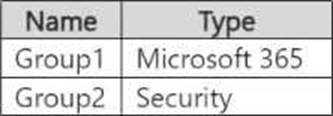
You have a Microsoft 365 E5 subscription that contains the groups shown in the following table.
The subscription contains the resources shown in the following table.

You create a sensitivity label named Label1.
You need to publish Label1 and have the label apply automatically.
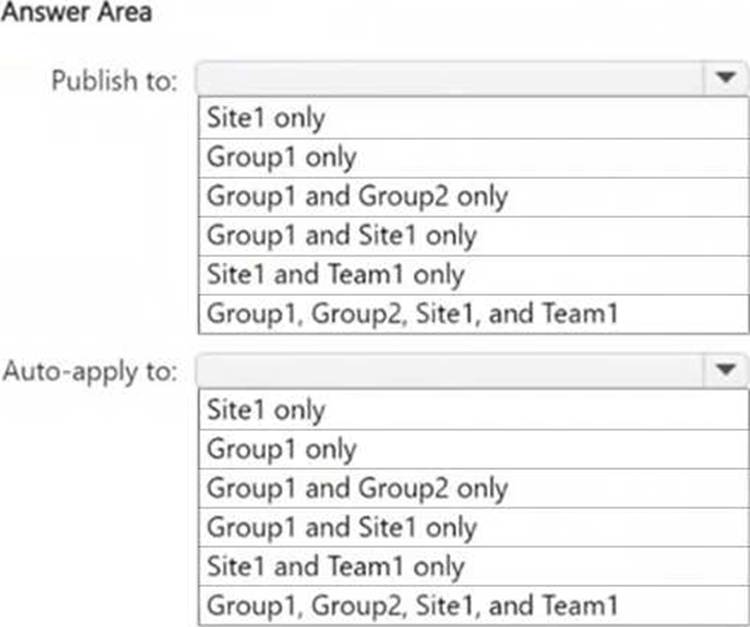
To what can you publish Label1, and to what can Label1 be auto-applied? To answer, select the appropriate options in the answer area. NOTE: Each correct selection is worth one point.
Explanation:
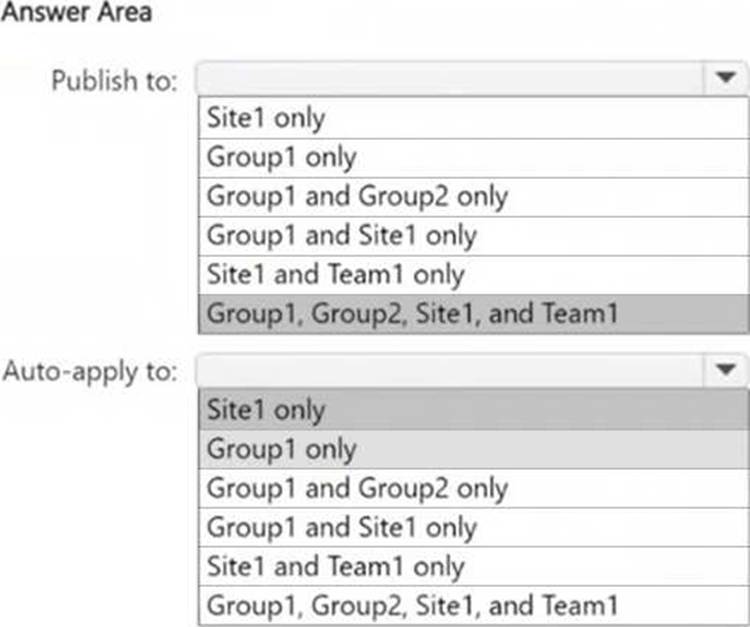
Box 1: Publishing a Sensitivity Label
Sensitivity labels can be published to Microsoft 365 groups, security groups, SharePoint Online sites, and Microsoft Teams. Since we have:
● Group1 (Microsoft 365 group) – Supported
● Group2 (Security group) – Supported
● Site1 (SharePoint Online site) – Supported
● Team1 (Microsoft Teams team) – Supported
This means we can publish Label1 to Group1, Group2, Site1, and Team1.
Box 2: Auto-Applying a Sensitivity Label
Auto-apply policies for sensitivity labels work on:
● SharePoint Online sites (documents)
● OneDrive (documents)
● Exchange email (messages)
However, labels cannot be auto-applied to Microsoft 365 groups or Teams directly because labels are applied to files and emails, not to groups or Teams as entities. Since Site1 (a SharePoint Online site) supports auto-apply, it is the correct option.
HOTSPOT
You have a Microsoft 365 E5 subscription that uses Microsoft Purview.
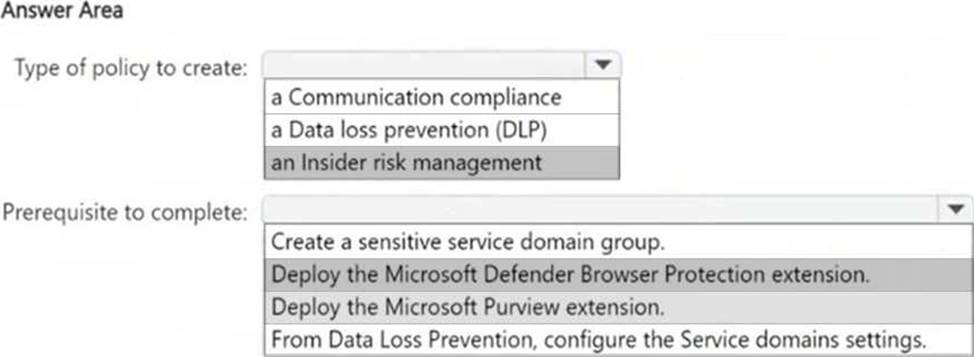
You need ensure that an incident will be generated when a user visits a phishing website.
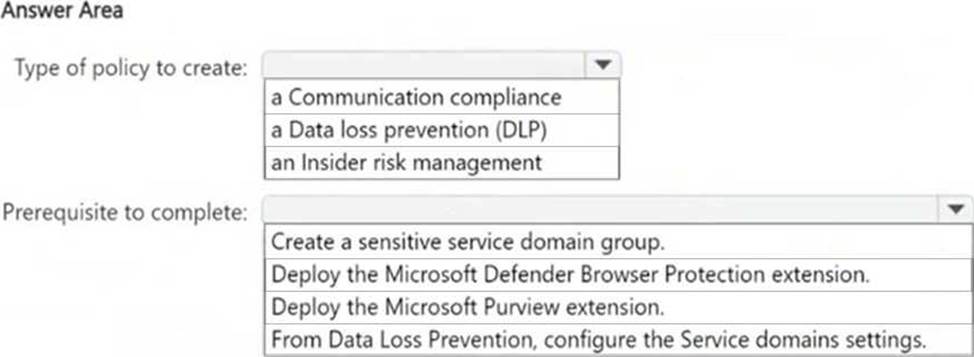
What should you do? To answer, select the appropriate options in the answer area. NOTE: Each correct selection is worth one point.
Explanation:
Box 1: Insider Risk Management policies in Microsoft Purview can be configured to detect risky behavior, such as accessing phishing websites. These policies monitor user activity, generate alerts, and help organizations investigate potential security threats.
Box 2: Microsoft Defender Browser Protection extension helps in detecting unsafe or phishing websites and integrating this detection with Insider Risk Management policies. This extension works with Microsoft Edge and Google Chrome to identify risky browsing activity and trigger alerts.
You have a Microsoft 365 E5 tenant.
You need to add a new keyword dictionary.
What should you create?
- A . a trainable classifier
- B . a retention policy
- C . a sensitivity label
- D . a sensitive info type
D
Explanation:
To add a new keyword dictionary in Microsoft Purview Data Loss Prevention (DLP), you must create a Sensitive Information Type (SIT).
Sensitive Info Types (SITs) allow you to define custom detection rules, including keyword dictionaries, regular expressions, and functions for identifying sensitive content in emails, documents, and other Microsoft 365 locations. A keyword dictionary is a list of predefined words/phrases that Microsoft Purview can use to identify and classify content for DLP policies.
Steps to add a keyword dictionary:
You have a Microsoft 365 E5 tenant.
You need to add a new keyword dictionary.
What should you create?
- A . a trainable classifier
- B . a retention policy
- C . a sensitivity label
- D . a sensitive info type
D
Explanation:
To add a new keyword dictionary in Microsoft Purview Data Loss Prevention (DLP), you must create a Sensitive Information Type (SIT).
Sensitive Info Types (SITs) allow you to define custom detection rules, including keyword dictionaries, regular expressions, and functions for identifying sensitive content in emails, documents, and other Microsoft 365 locations. A keyword dictionary is a list of predefined words/phrases that Microsoft Purview can use to identify and classify content for DLP policies.
Steps to add a keyword dictionary:
Topic 1, Contoso, Ltd Case Study 1
Instructions
This is a case study. Case studies are not timed separately from other exam sections. You can use as much exam time as you would like to complete each case study. However, there might be additional case studies or other exam sections. Manage your time to ensure that you can complete all the exam sections in the time provided. Pay attention to the Exam Progress at the top of the screen so you have sufficient time to complete any exam sections that follow this case study.
To answer the case study questions, you will need to reference information that is provided in the case. Case studies and associated questions might contain exhibits or other resources that provide more information about the scenario described in the case. Information provided in an individual question does not apply to the other questions in the case study.
A Review Screen will appear at the end of this case study. From the Review Screen, you can review and change your answers before you move to the next exam section. After you leave this case study, you will NOT be able to return to it.
To start the case study
To display the first question in this case study, select the "Next" button. To the left of the question, a menu provides links to information such as business requirements, the existing environment, and problem statements. Please read through all this information before answering any questions. When you are ready to answer a question, select the "Question" button to return to the question.
Overview
Contoso, Ltd. is a consulting company that has a main office in Montreal and three branch offices in Seattle, Boston, and Johannesburg.
Existing Environment
Microsoft 365 Environment
Contoso has a Microsoft 365 E5 tenant.
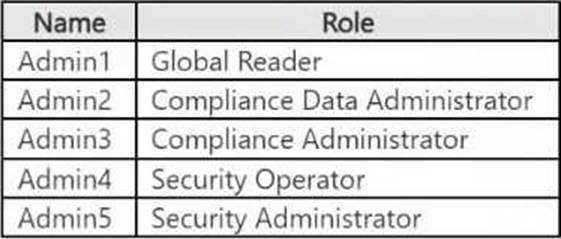
The tenant contains the administrative user accounts shown in the following table.
Users store data in the following locations:
● SharePoint sites
● OneDrive accounts
● Exchange email
● Exchange public folders
● Teams chats
● Teams channel messages
When users in the research department create documents, they must add a 10-digit project code to each document. Project codes that start with the digits 999 are confidential.
SharePoint Online Environment
Contoso has four Microsoft SharePoint Online sites named Site1, Site2, Site3, and Site4.
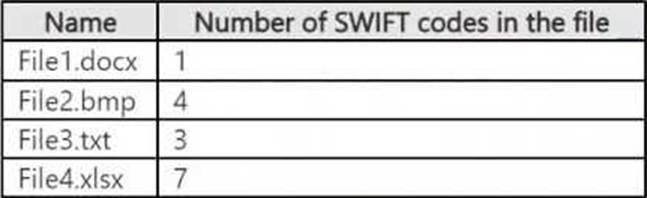
Site2 contains the files shown in the following table.
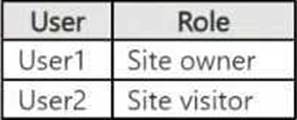
Two users named User1 and User2 are assigned roles for Site2 as shown in the following table.
Site3 stores documents related to the company’s projects. The documents are organized in a folder hierarchy based on the project.
Site4 has the following two retention policies applied:
● Name: Site4RetentionPolicy1
● Locations to apply the policy: Site4
● Delete items older than: 2 years
● Delete content based on: When items were created
● Name: Site4RetentionPolicy2
● Locations to apply the policy: Site4
● Retain items for a specific period: 4 years
● Start the retention period based on: When items were created
● At the end of the retention period: Do nothing
Problem Statements
Management at Contoso is concerned about data leaks. On several occasions, confidential research department documents were leaked.
Requirements
Planned Changes
Contoso plans to create the following data loss prevention (DLP) policy:
● Name: DLPpolicy1
● Locations to apply the policy: Site2
● Conditions:
● Content contains any of these sensitive info types: SWIFT Code
● Instance count: 2 to any
● Actions: Restrict access to the content
Technical Requirements
Contoso must meet the following technical requirements:
● All administrative users must be able to review DLP reports.
● Whenever possible, the principle of least privilege must be used.
● For all users, all Microsoft 365 data must be retained for at least one year.
● Confidential documents must be detected and protected by using Microsoft 365.
● Site1 documents that include credit card numbers must be labeled automatically.
● All administrative users must be able to create Microsoft 365 sensitivity labels.
● After a project is complete, the documents in Site3 that relate to the project must be retained for
10 years.
DRAG DROP
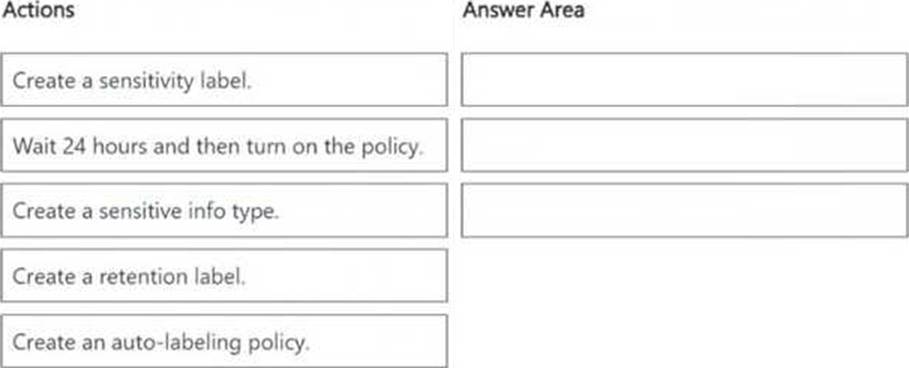
You need to meet the technical requirements for the Site1 documents.
Which three actions should you perform in sequence? To answer, move the appropriate actions from the list of actions to the answer area and arrange them in the correct order.
Explanation:
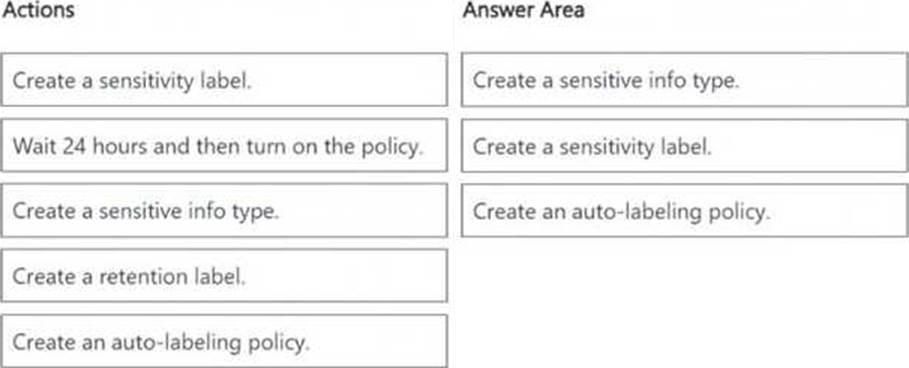
The goal is to automatically label documents in Site1 that contain credit card numbers. To achieve this, we need a sensitivity label with an auto-labeling policy based on a sensitive info type that detects credit card numbers.
Step 1: Create a Sensitive Info Type
● A sensitive info type is needed to detect credit card numbers in documents.
● Microsoft Purview includes built-in sensitive info types for credit card numbers, but we can also create a custom one if necessary.
Step 2: Create a Sensitivity Label
● A sensitivity label is required to classify and protect documents containing sensitive information.
● This label can apply encryption, watermarking, or access controls to credit card data.
Step 3: Create an Auto-Labeling Policy
● An auto-labeling policy ensures that the sensitivity label is applied automatically when credit card numbers are detected in Site1.
● This policy is configured to scan files and automatically apply the correct sensitivity label.
HOTSPOT
You have a Microsoft 365 E5 subscription that contains a user named User1.
You deploy Microsoft Purview Data Security Posture Management for AI (DSPM for AI).
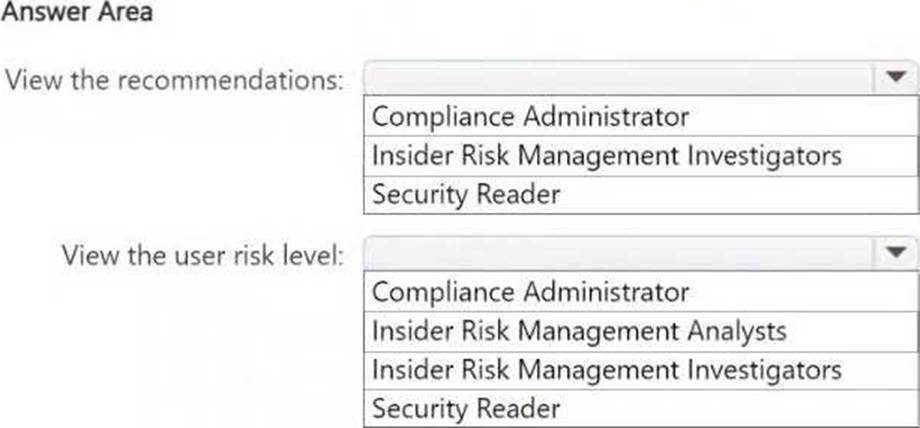
You need to ensure that User1 can perform the following actions:
● View recommendations from the Recommendations page.
● View the user risk level for all events by using Activity explorer.
The solution must follow the principle of least privilege.
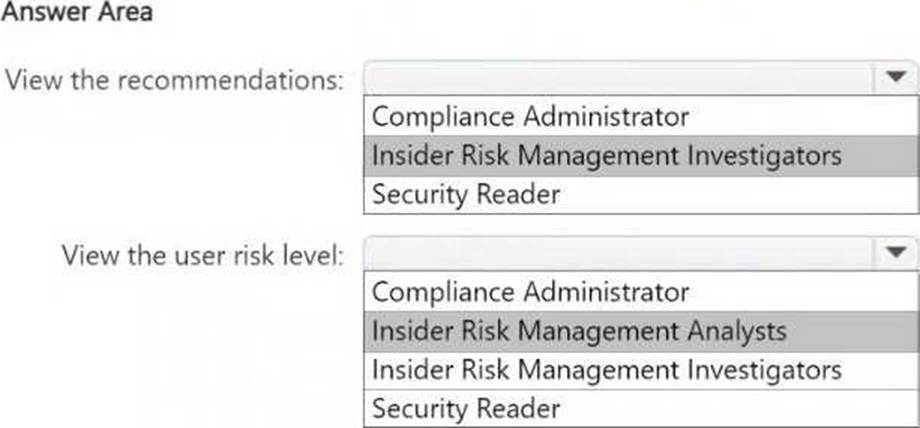
To which role group should you add User1 for each action? To answer, select the appropriate options in the answer area. NOTE: Each correct selection is worth one point.
Explanation:
Box 1: The Insider Risk Management Investigators role allows users to view recommendations related to insider risk cases and Microsoft Purview DSPM for AI insights. This role is appropriate because it grants access to review AI-related risk recommendations without unnecessary administrative privileges.
Box 2: The Insider Risk Management Analysts role allows users to analyze user risk levels and events using Activity Explorer. This follows the principle of least privilege, ensuring that User1 can only view risk levels and investigate but does not gain full administrative control over insider risk policies.
You have a Microsoft 365 tenant.
You have a database that stores customer details. Each customer has a unique 13-digit identifier that consists of a fixed pattern of numbers and letters.
You need to implement a data loss prevention (DLP) solution that meets the following requirements:
● Email messages that contain a single customer identifier can be sent outside your company.
● Email messages that contain two or more customer identifiers must be approved by the company’s data privacy team.
Which two components should you include in the solution? Each correct answer presents part of the solution. NOTE: Each correct selection is worth one point.
- A . a sensitivity label
- B . a sensitive information type
- C . a DLP policy
- D . a retention label
- E . a mail flow rule
B, C
Explanation:
You need to define a custom sensitive information type that recognizes the unique 13-digit identifier format for customer records. Microsoft Purview DLP policies use these types to identify and protect sensitive data.
A Data Loss Prevention (DLP) policy is required to enforce the rules. It will allow emails with a single identifier but trigger an approval workflow when two or more identifiers are detected.
DRAG DROP
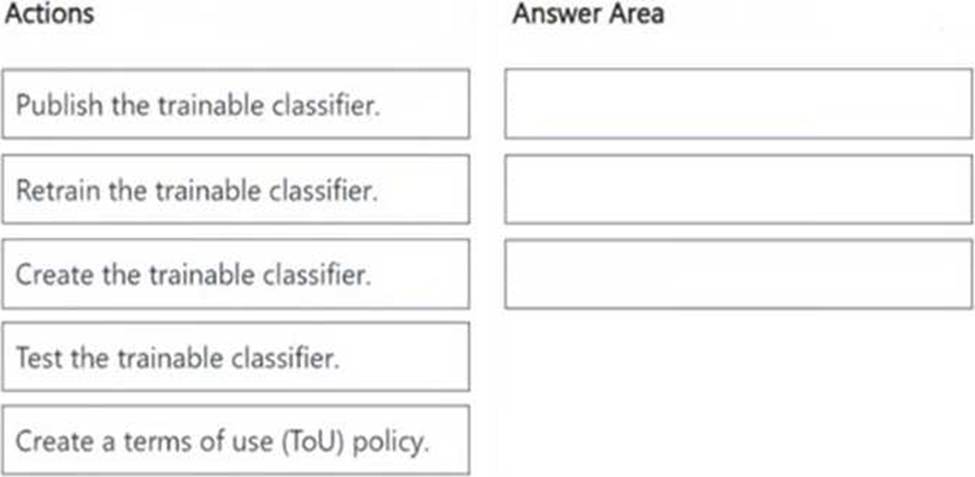
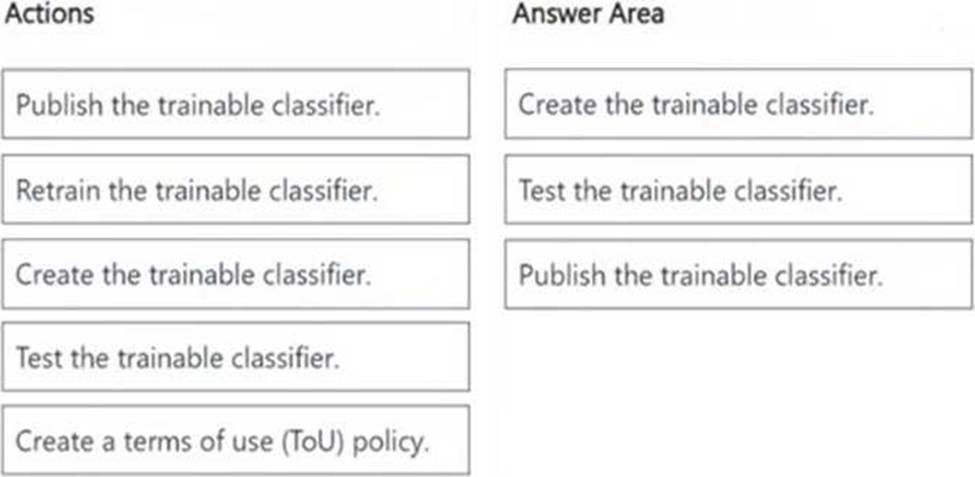
You need to create a trainable classifier that can be used as a condition in an auto-apply retention label policy.
Which three actions should you perform in sequence? To answer, move the appropriate actions from the list of actions to the answer area and arrange them in the correct order.
Explanation:
To create a trainable classifier that can be used in an auto-apply retention label policy, you need to follow these key steps:
DRAG DROP
You need to create a trainable classifier that can be used as a condition in an auto-apply retention label policy.
Which three actions should you perform in sequence? To answer, move the appropriate actions from the list of actions to the answer area and arrange them in the correct order.
Explanation:
To create a trainable classifier that can be used in an auto-apply retention label policy, you need to follow these key steps:
HOTSPOT
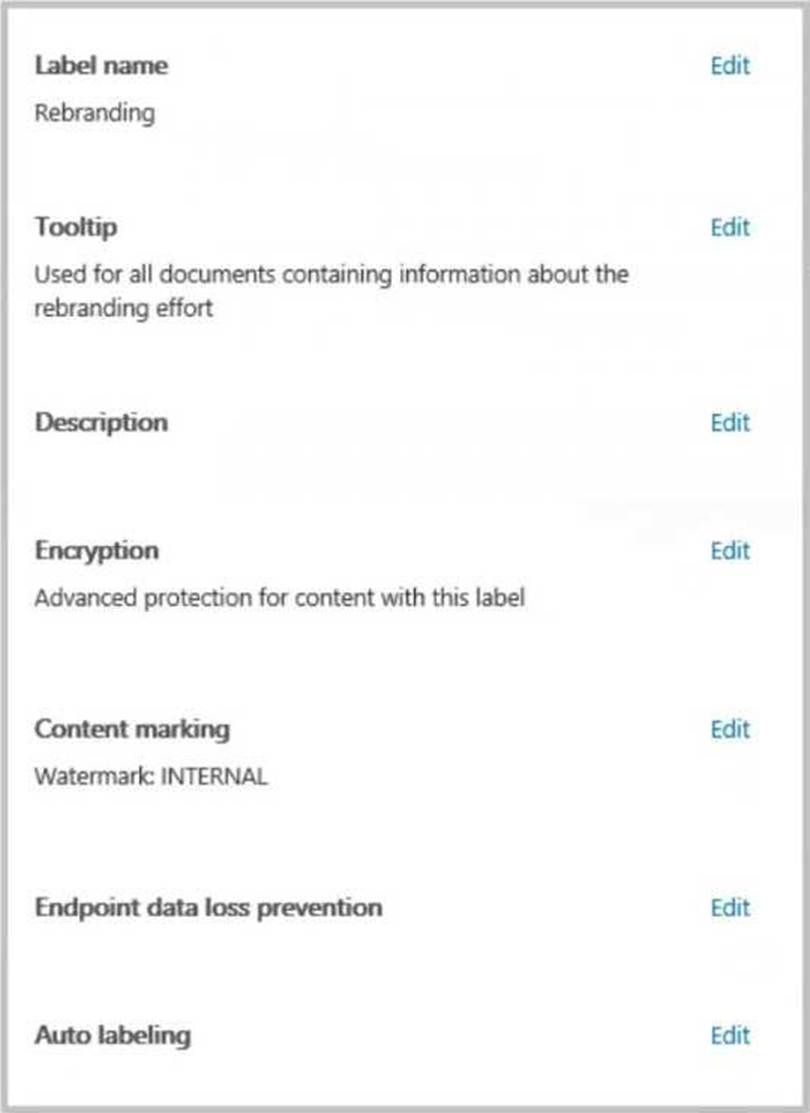
You have a Microsoft 365 sensitivity label that is published to all the users in your Microsoft Entra tenant as shown in the following exhibit.
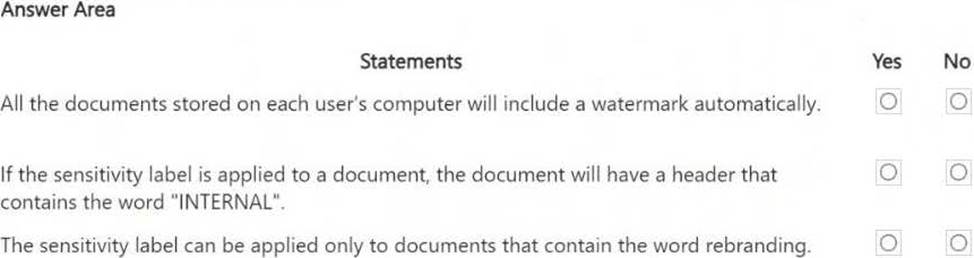
For each of the following statements, select Yes if the statement is true. Otherwise, select No.
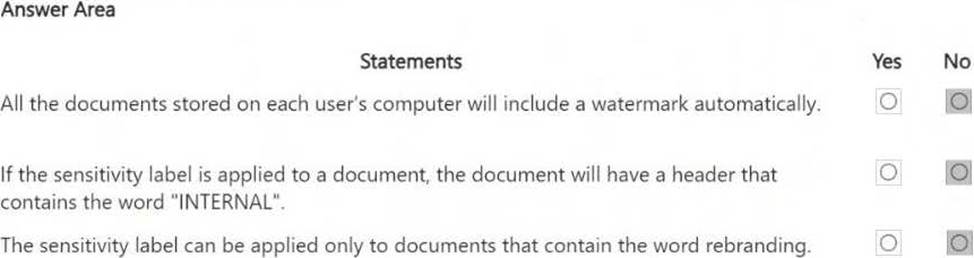
Explanation:
Statement 1 – No. The sensitivity label includes content marking (watermark: INTERNAL), but it only applies to documents where the label is manually or automatically applied, not to all documents by default.
Statement 2 – No. The sensitivity label only specifies a watermark, not a header. If a header marking was configured, it would explicitly appear in the label settings.
Statement 3 – No. There is no indication that auto-labeling is configured to apply the label only to documents with the word "rebranding". Auto-labeling is an optional setting that needs explicit configuration.