Microsoft MB-260 Practice Exams
Last updated on Oct 21,2026- Exam Code: MB-260
- Exam Name: Microsoft Dynamics 365 Customer Insights (Data) Specialist
- Certification Provider: Microsoft
- Latest update: Oct 21,2026
Your organization’s marketing team is in the process of mapping tables and attributes in the data unification process of Dynamics 365 Customer Insights – Dat a. They need your help with this task.
You need to explain to the marketing team how Customer Insights – Data handles the mapping of semantic types for table attributes.
Which two statements should you convey? Each correct answer presents part of the solution. NOTE Each correct selection is worth one point.
- A . Attributes that are automatically mapped to a semantic type cannot be remapped to a custom semantic type.
- B . The Review mapped fields section shows all attributes for which a semantic type is automatically identified.
- C . Attributes must be mapped to the semantic type of ID in order to be used as a primary key for the table.
- D . The Define the data in the unmapped fields section shows attributes that are not automatically mapped to a semantic type.
DRAG DROP
You are a Customer Data Platform Specialist. Your company uses audience insights as their Customer Data Platform.
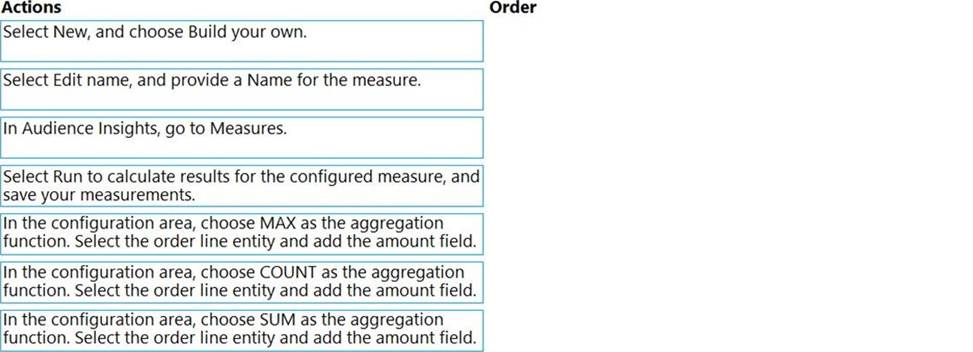
The marketing team wants to know the total amount the customer has spent. The order lines are linked to a profile as part of the point-of-sale data source and through their loyalty ID.
Which five actions should you perform in sequence to create this insight? To answer, move the appropriate actions from the list of actions to the answer area and arrange them in the correct order.
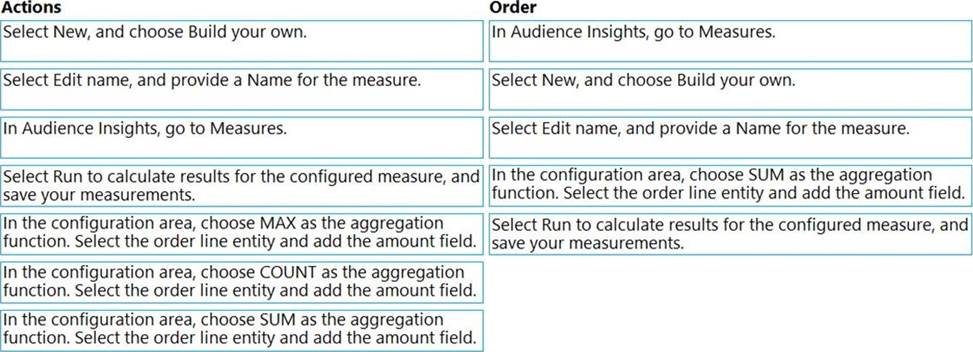
Explanation:
Reference: https://docs.microsoft.com/en-us/dynamics365/customer-insights/audience-insights/measures?tabs=b2c
DRAG DROP
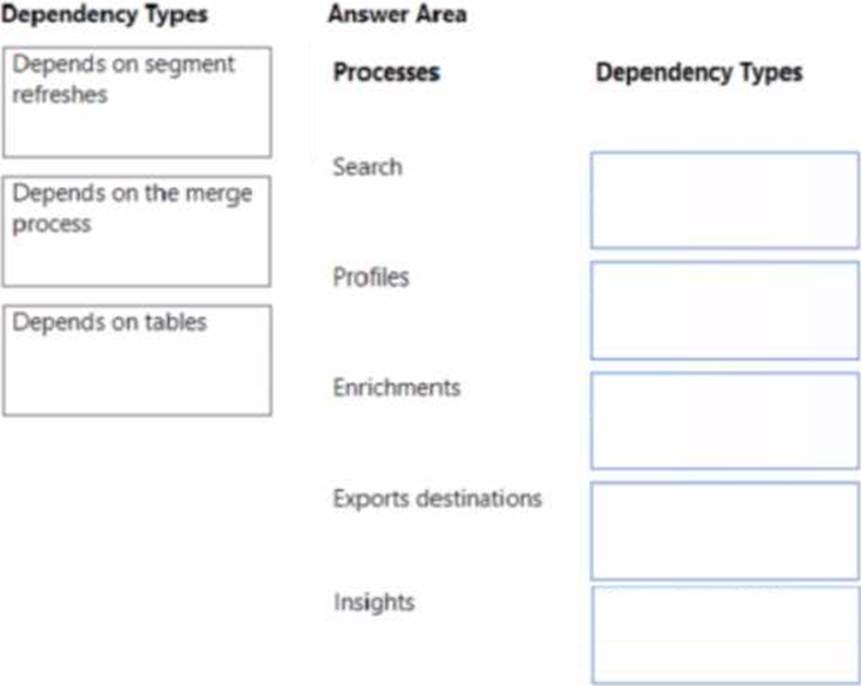
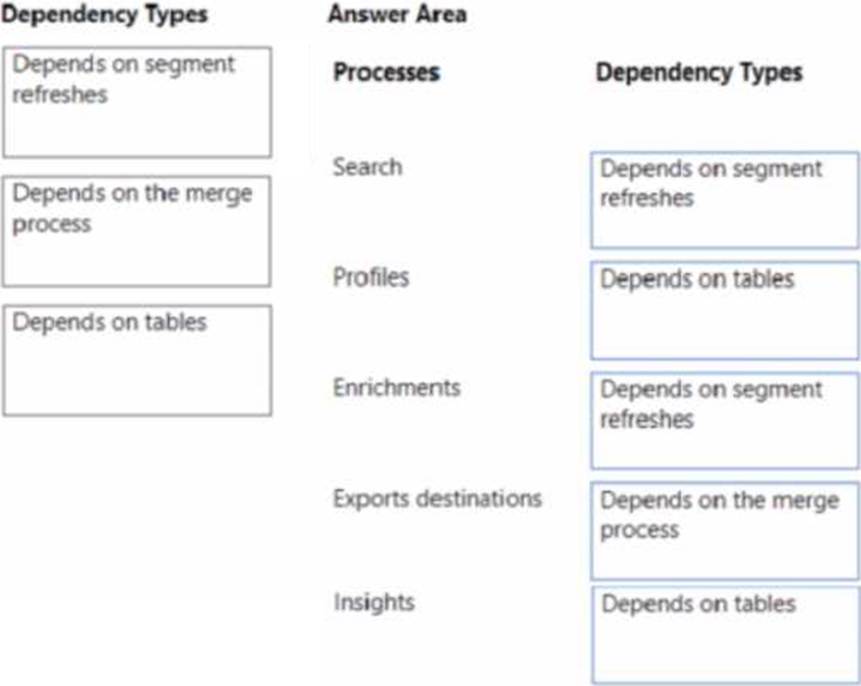
You are reviewing the system status in Microsoft Dynamics 365 Customer Insights. You notice that different refresh processes are not successful. You need to find the step that is blocking these processes from refreshing.
Which dependency types are associated with each process? To answer, drag the appropriate dependency types to the correct processes. Each user group may be used once, more than once, or not at all. You may need to drag the split bar between panes or scroll to view content. NOTE: Each correct match is worth one point.
You are a Customer Data Platform Specialist. You are creating a new measure for business accounts (B2B) in audience insights.
One of the requirements for the new business-level measure is to add a dimension of the city for each business account.
What is needed to ensure that this measure is created as a business-level measure instead of a customer-level measure?
- A . Use the default "CustomerlD* dimension when creating the measure.
- B . Use the default "AccountID" dimension when creating the measure.
- C . Remove the default "AccountlD" dimension when creating the measure.
- D . Remove the default "CustomerlD* dimension when creating the measure.
D
Explanation:
Reference: https://docs.microsoft.com/en-us/dynamics365/customer-insights/audience-insights/measures?tabs=b2b
You have data that needs to be loaded from Microsoft Dataverse into an instance of Microsoft Dynamics 365 Customer Insights.
You need to create a data source that connects to a Dataverse-managed data lake.
Which three statements do you need to be aware of when creating the connection? NOTE: Each correct selection is worth one point.
- A . You can select additional Dataverse tables for synchronization after the data source is created.
- B . Any user account with read permissions on Dataverse tables can be used to select tables for synchronization.
- C . The table count for the data source will stay at zero (0) until all selected tables are synchronized.
- D . Multiple Dynamics 365 Customer Insights data sources can simultaneously use the same Dataverse managed data lake.
- E . You must create a new data source if you need to connect to a different Dataverse managed data lake later.
You need to unify the different data sources within Microsoft Dynamics 365 Customer Insights through the data unification process.
After you selected Create customer profiles on the Review step, you notice that you still need to rename a customer field.
What is the fastest way to perform the correction?
- A . View the details of the running job and cancel the job. Rename the field and run the unification process again.
- B . Wait for the process to finish. Refresh the page, then rename the field and run the unification process again
- C . While the unification process is running, separate and recombine the Customer field. Rename it and run the unification process again.
- D . Rename the field while the unification is in Refreshing status. Changes are still recorded during the current process.
You are a Customer Data Platform Specialist. You successfully installed the Customer Card Add-in and the required add-in control in Dynamics 365 Sales app. You need to show customer enrichment data from audience insights in the Dynamics 365 Sales application.
Which two statements must be true for you to show the required data on a Customer Card Add-in control? Each correct answer presents part of the solution. NOTE: Each correct selection is worth one point.
- A . Customer details control is successfully installed and added to the Contact form.
- B . Active enrichment is applied to customer profiles.
- C . Contacts from Dynamics 365 Sales are included in the audience insights unification process.
- D . Measure Control is successfully installed and added to the Contact form.
AB
Explanation:
Reference: https://docs.microsoft.com/en-us/dynamics365/customer-insights/audience-insights/customer-card-add-in
Note: This question is part of a series of questions that present the same scenario. Each question in the series contains a unique solution that might meet the stated goals. Some question sets might have more than one correct solution, while others might not have a correct solution.
You are a Customer Data Platform Specialist. Your company’s information technology department (IT) has a CSV file stored on one of their Shared Documents folders within their SharePoint sites which they have ingested into audience insights. The file contains a row header with some special characters, columns of different types (quantities, prices, etc.), and some rows with a high proportion of nulls and missing primary keys. You have been asked to clean and transform the data in audience insights to be ready for unification.
What should you do?
Solution: Clean the data by removing any rows where the primary key is missing, delete any leading or trailing zeros on the primary key, and name the query. Click “Next” and your data is now ready for unification.
Does this meet the goal?
- A . Yes
- B . No
B
Explanation:
Reference: https://docs.microsoft.com/en-us/dynamics365/customer-insights/audience-insights/connect-power-query
Your team developed and integrated a batch inferencing pipeline to audience insights. This allows for a new custom machine learning (ML) model to run and deliver new insights to your unified profiles data. Your team is manually running the custom machine learning workflows.
Which statement is correct about allowing your workflow to run automatically with every scheduled refresh?
- A . You can configure scheduled refreshes for audience insights from Azure ML where you developed the custom ML model.
- B . Your team can set up scheduled refreshes that allow your workflow to run automatically.
- C . Your team needs to manually trigger your custom machine learning workflows.
- D . Scheduled refreshes are not supported for custom machine learning models that are connected to audience insights.
B
Explanation:
Reference:
https://docs.microsoft.com/en-us/dynamics365/customer-insights/audience-insights/custom-models
https://docs.microsoft.com/en-us/dynamics365/customer-insights/audience-insights/system#schedule-tab
DRAG DROP
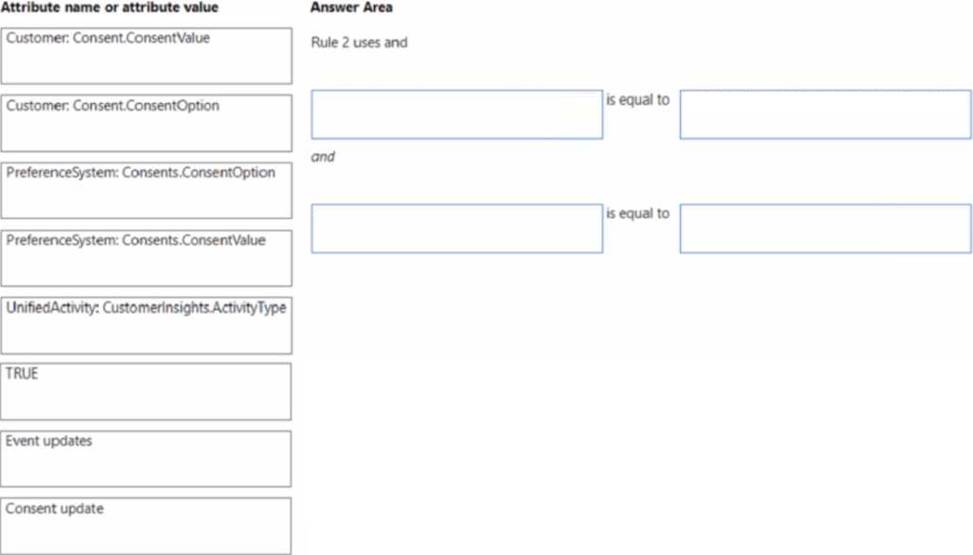
You work for a chain of hotels, and you have created a data source catted Preference System to ingest consent data in Dynamics 365 Customer Insights in an table called Consents.
The Consents table has the following attributes and data types:

You are creating a segment to email information on upcoming events to customers who live in the state of California and whose Average number of nights stayed value is greater than four.
You have already configured the first rule in the segment as follows:
Rule 1 uses and
Customer: Customer Insights.’ All records
and
Customer: CustomerInsightsState is equal to California
and
Customer_Measure: Customerlnsights.Average number of nights stayed is greater than 4
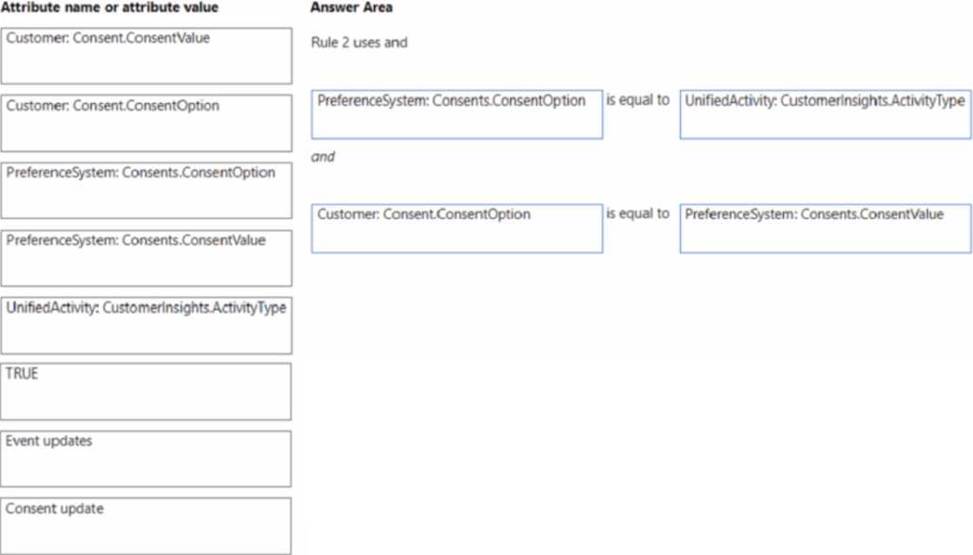
You need to configure the second rule in the segment according to your customers’ consent preferences. This rule will be joined to the first rule with a union operator
Which attribute name or attribute value corresponds to each empty parameter? To answer, drag the appropriate attenuate name or attribute value to the correct empty parameters in the answer area. Each attribute name or attenuate value may be used once, more than once, or not at all. NOTE: Each correct match is worth one point.