
Microsoft DP-700 Practice Exams
Last updated on Nov 16,2026- Exam Code: DP-700
- Exam Name: Microsoft Fabric Data Engineer
- Certification Provider: Microsoft
- Latest update: Nov 16,2026
HOTSPOT
You have a Fabric workspace named Workspace1 that contains the items shown in the following table.
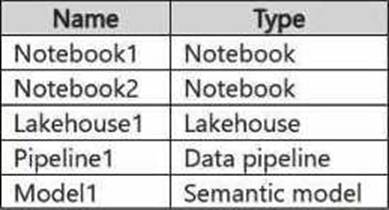
For Model1, the Keep your Direct Lake data up to date option is disabled.
You need to configure the execution of the items to meet the following requirements:
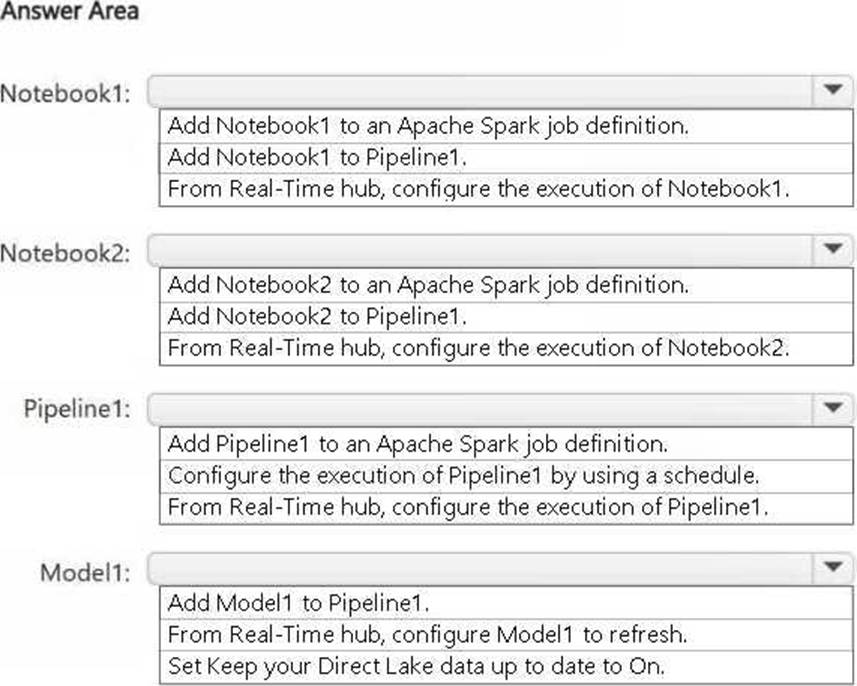
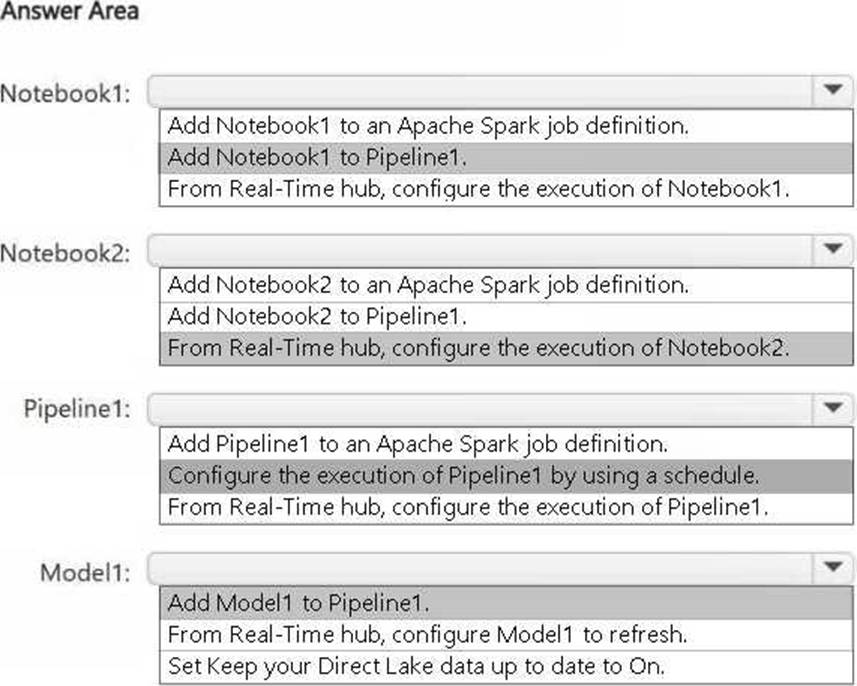
– Notebook1 must execute every weekday at 8:00 AM.
– Notebook2 must execute when a file is saved to an Azure Blob Storage container.
– Model1 must refresh when Notebook1 has executed successfully.
How should you orchestrate each item? To answer, select the appropriate options in the answer area. NOTE: Each correct selection is worth one point.
You have a Fabric workspace that contains a warehouse named Warehouse1.
You have an on-premises Microsoft SQL Server database named Database1 that is accessed by using an on-premises data gateway.
You need to copy data from Database1 to Warehouse1.
Which item should you use?
- A . an Apache Spark job definition
- B . a data pipeline
- C . a Dataflow Gen1 dataflow
- D . an eventstream
B
Explanation:
To copy data from an on-premises Microsoft SQL Server database (Database1) to a warehouse (Warehouse1) in Fabric, a data pipeline is the most appropriate tool. A data pipeline in Fabric is designed to move data between various data sources and destinations, including on-premises databases like SQL Server, and cloud-based storage like Fabric warehouses. The data pipeline can handle the connection through an on-premises data gateway, which is required to access on-premises data. This solution facilitates the orchestration of data movement and transformations if needed.
You have a Fabric workspace that contains an eventstream named EventStreaml. EventStreaml outputs events to a table named Tablel in a lakehouse. The streaming data is souiced from motorway sensors and represents the speed of cars.
You need to add a transformation to EventStream1 to average the car speeds. The speeds must be grouped by non-overlapping and contiguous time intervals of one minute. Each event must belong to exactly one window.
Which windowing function should you use?
- A . sliding
- B . hopping
- C . tumbling
- D . session
You have a Fabric workspace that contains a warehouse named DW1. DW1 is loaded by using a notebook named Notebook1.
You need to identify which version of Delta was used when Notebook1 was executed.
What should you use?
- A . Real-Time hub
- B . OneLake data hub
- C . the Admin monitoring workspace
- D . Fabric Monitor
- E . the Microsoft Fabric Capacity Metrics app
C
Explanation:
To identify the version of Delta used when Notebook1 was executed, you should use the Admin monitoring workspace. The Admin monitoring workspace allows you to track and monitor detailed information about the execution of notebooks and jobs, including the underlying versions of Delta or other technologies used. It provides insights into execution details, including versions and configurations used during job runs, making it the most appropriate choice for identifying the Delta version used during the execution of Notebook1.
Note: This question is part of a series of questions that present the same scenario. Each question in the series contains a unique solution that might meet the stated goals. Some question sets might have more than one correct solution, while others might not have a correct solution.
After you answer a question in this section, you will NOT be able to return to it. As a result, these questions will not appear in the review screen.
You have a Fabric eventstream that loads data into a table named Bike_Location in a KQL database.
The table contains the following columns:
– BikepointID
– Street
– Neighbourhood
– No_Bikes
– No_Empty_Docks
– Timestamp
You need to apply transformation and filter logic to prepare the data for consumption. The solution must return data for a neighbourhood named Sands End when No_Bikes is at least 15. The results must be ordered by No_Bikes in ascending order.
Solution: You use the following code segment:

Does this meet the goal?
- A . Yes
- B . no
B
Explanation:
This code does not meet the goal because it uses order by, which is not valid in KQL. The correct term in KQL is sort by.
Correct code should look like:

Topic 3, Misc. Questions Set
You have a Fabric workspace.
You have semi-structured data.
You need to read the data by using T-SQL, KQL, and Apache Spark. The data will only be written by using Spark.
What should you use to store the data?
- A . a lakehouse
- B . an eventhouse
- C . a datamart
- D . a warehouse
A
Explanation:
A lakehouse is the best option for storing semi-structured data when you need to read it using T-SQL, KQL, and Apache Spark. A lakehouse combines the flexibility of a data lake (which can handle semi-structured and unstructured data) with the performance features of a data warehouse. It allows data to be written using Apache Spark and can be queried using different technologies such as T-SQL (for SQL-based querying), KQL (Kusto Query Language for querying), and Apache Spark (for distributed processing). This solution is ideal when dealing with semi-structured data and requiring a versatile querying approach.
You have a Fabric workspace that contains a lakehouse named Lakehousel.
You plan to create a data pipeline named Pipeline! to ingest data into Lakehousel. You will use a parameter named paraml to pass an external value into Pipeline1!. The paraml parameter has a data type of int
You need to ensure that the pipeline expression returns param1 as an int value.
How should you specify the parameter value?
- A . "@pipeline(). parameters. paraml"
- B . "@{pipeline().parameters.paraml}"
- C . "@{pipeline().parameters.[paraml]}"
- D . "@{pipeline().parameters.paraml}-
DRAG DROP
You are building a data loading pattern by using a Fabric data pipeline. The source is an Azure SQL database that contains 25 tables. The destination is a lakehouse.
In a warehouse, you create a control table named Control.Object as shown in the exhibit. (Click the Exhibit tab.)
You need to build a data pipeline that will support the dynamic ingestion of the tables listed in the control table by using a single execution.
Which three actions should you perform in sequence? To answer, move the appropriate actions from the list of actions to the answer area and arrange them in the correct order.
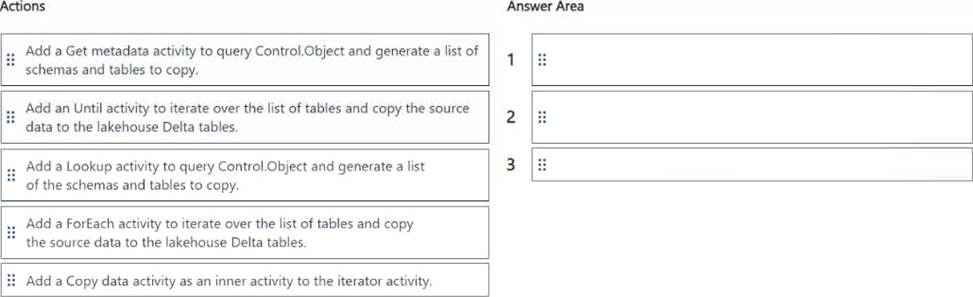
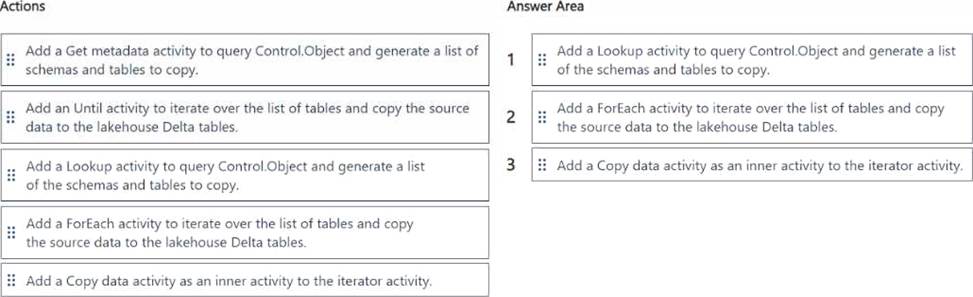
Exhibit.
You have a Fabric workspace that contains a write-intensive warehouse named DW1. DW1 stores staging tables that are used to load a dimensional model. The tables are often read once, dropped, and then recreated to process new data.
You need to minimize the load time of DW1.
What should you do?
- A . Disable V-Order.
- B . Drop statistics.
- C . Enable V-O-der.
- D . Create statistics.
You have a Fabric warehouse named DW1 that contains a Type 2 slowly changing dimension (SCD) dimension table named DimCustomer. DimCustomer contains 100 columns and 20 million rows. The columns are of various data types, including int, varchar, date, and varbinary.
You need to identify incoming changes to the table and update the records when there is a change.
The solution must minimize resource consumption.
What should you use to identify changes to attributes?
- A . a direct attributes comparison for the attributes in the source table.
- B . a hash function to compare the attributes in the DimCustomer table.
- C . a direct attributes comparison across the attributes in the DimCustomer table.
- D . a hash function to compare the attributes in the source table.