Microsoft DP-300 Practice Exams
Last updated on Nov 16,2026- Exam Code: DP-300
- Exam Name: Administering Microsoft Azure SQL Solutions
- Certification Provider: Microsoft
- Latest update: Nov 16,2026
You have an Azure subscription that contains two Azure SQL managed instances named SQLMI1 and SQLMI2. SQLM2 contains a database named DB1 and a user named User1.
User1 drops DB1.
You need to perform a point-in-time restore of DB1 to SQLMI2.
- A . Azure CLI
- B . Transact-SQL
- C . The Azure portal
- D . Azure PowerShell
You have an Azure subscription that contains an Azure SQL database. The database contains a table named tablet.
You execute the following Transact-SQL statements.

You need to reduce the time it takes to perform analytic queries on the database.
Which configuration should you enable?
- A . ROW_ MODE_MEMORY GRANT_FEEDBACK
- B . BATCH MODE_MEMORY GRAIJT_FEEDBACK
- C . BATCH_MODE_ADAPTIVE_TOIMS
- D . BATC H_MODE_ON_ROWSTOR E
HOTSPOT
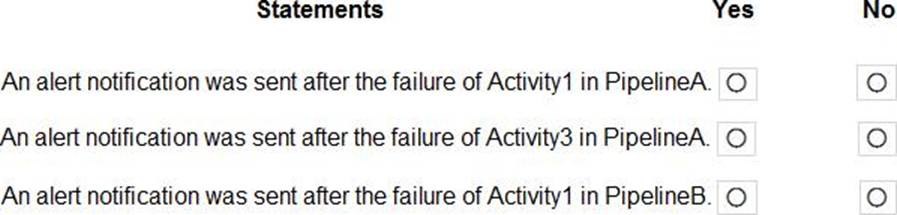
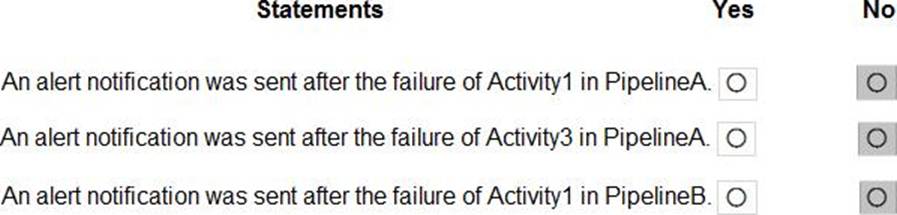
You have an Azure data factory that has two pipelines named PipelineA and PipelineB.
PipelineA has four activities as shown in the following exhibit.

PipelineB has two activities as shown in the following exhibit.

You create an alert for the data factory that uses Failed pipeline runs metrics for both pipelines and all failure types.
The metric has the following settings:
✑ Operator: Greater than
✑ Aggregation type: Total
✑ Threshold value: 2
✑ Aggregation granularity (Period): 5 minutes
✑ Frequency of evaluation: Every 5 minutes
Data Factory monitoring records the failures shown in the following table.

For each of the following statements, select Yes if the statement is true. Otherwise, select No. NOTE: Each correct selection is worth one point.
You have an on-premises Microsoft SQL Server 2019 database named SQL1 that uses merge replication. You need to migrate SQL1 to Azure.
Which service should you use?
- A . Azure SQL Edge
- B . Azure SQL Database
- C . SQL Server on Azure Virtual Machines
- D . Azure SQL Managed instance
HOTSPOT
You have an Azure virtual machine named Server1 that has Microsoft SQL Server installed. Server1 contains a database named DB1.
You have a logical SQL server named ASVR1 that contains an Azure SQL database named ADB1.
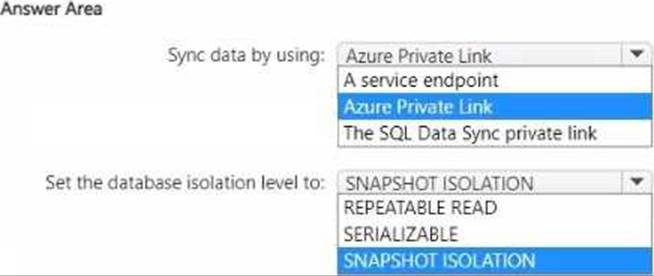
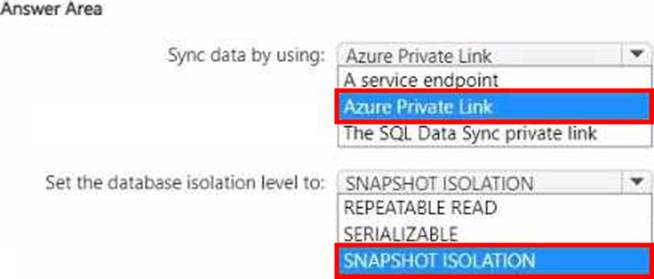
You plan to use SQL Data Sync to migrate DB1 from Server! to ASVR1.
You need to prepare the environment for the migration. The solution must ensure that the connection from Server1 to ADB1 does NOT use a public endpoint.
What should you do? To answer, select the appropriate options in the answer area. NOTE: Each correct selection is worth one point.
You are designing a streaming data solution that will ingest variable volumes of data.
You need to ensure that you can change the partition count after creation.
Which service should you use to ingest the data?
- A . Azure Event Hubs Standard
- B . Azure Stream Analytics
- C . Azure Data Factory
- D . Azure Event Hubs Dedicated
Note: This question is part of a series of questions that present the same scenario. Each question in the series contains a unique solution that might meet the stated goals. Some question sets might have more than one correct solution, while others might not have a correct solution.
After you answer a question in this section, you will NOT be able to return to it. As a result, these questions will not appear in the review screen.
You have two Azure SQL Database servers named Server1 and Server2. Each server contains an Azure SQL database named Database1.
You need to restore Database1 from Server1 to Server2. The solution must replace the existing Database1 on Server2.
Solution: You run the Remove-AzSqlDatabase PowerShell cmdlet for Database1 on Server2. You run the Restore-AzSqlDatabase PowerShell cmdlet for Database1 on Server2.
Does this meet the goal?
- A . Yes
- B . No
You have an Azure virtual machine named VM1 that runs Windows Server 2022 and hosts a Microsoft SQL Server 2019 instance named SQL1.
You need to configure SQL1 to use mixed mode authentication.
Which procedure should you run?
- A . sp_eddremotelogin
- B . xp_grant_login
- C . sp_change_users_login
- D . xp_instance_regwrite
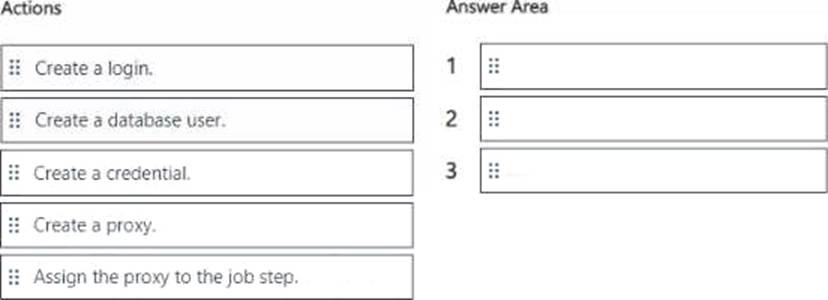
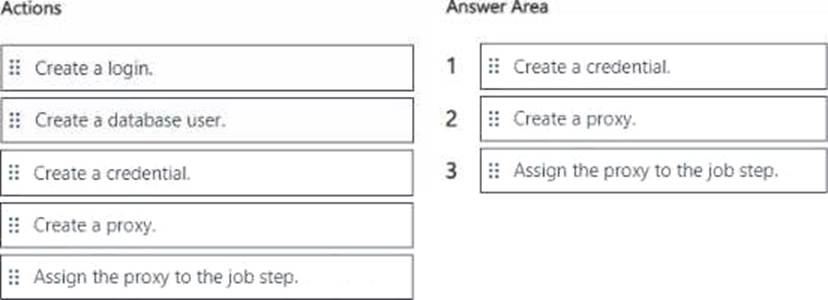
DRAG DROP
You have an Azure subscription that contains an instance of SQL Server on Azure Virtual Machines named SQLVM1 and a virtual machine named Server! that runs Windows Server. SQLVM1 and Server1 are joined to an Active Directory Domain Services (AD DS) domain. Server1 hosts a file share named Share1.
You need to ensure that a SQL Server Agent job step on SQLVM1 can access the files in Share1. The solution must use the principle of least privilege.
Which three actions should you perform in sequence? To answer, move the appropriate actions from the list of actions to the answer area and arrange them in the correct order.