
Microsoft DP-300 Practice Exams
Last updated on Nov 16,2026- Exam Code: DP-300
- Exam Name: Administering Microsoft Azure SQL Solutions
- Certification Provider: Microsoft
- Latest update: Nov 16,2026
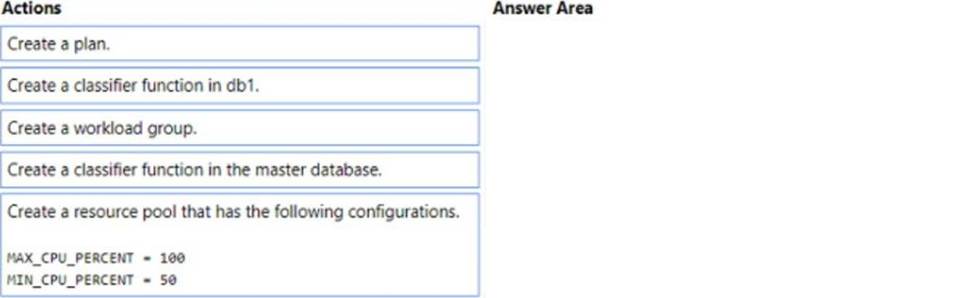
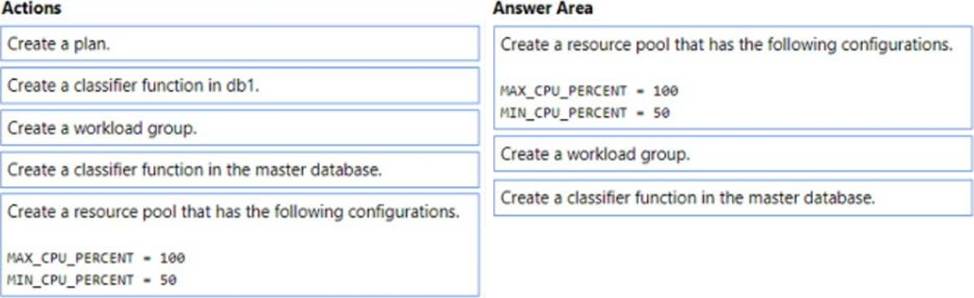
DRAG DROP
You have an Azure subscription that contains an Azure SQL managed instance, a database named db1, and an Azure web app named Appl. Appl uses db1.
You need to enable Resource Governor for a App1. The solution must meet the following requirements:
App1 must be able to consume all available CPU resources.
App1 must have at least half of the available CPU resources always available.
Which three actions should you perform in sequence? To answer. move the appropriate actions from the list of actions to the answer area and arrange them in the correct order. NOTE: More than one order of answer choices is correct. You will receive credit for any of the correct orders you select.
You have an Azure subscription that uses a domain named contoso.com.
You have two Azure VMs named DBServer1 and DBServer2. Each of them hosts a default SQL Server instance. DBServer1 is in the East US Azure region and contains a database named Database A. DBServer2 is in the West US Azure region.
DBServer1 has a high volume of data changes and low latency requirements for data writes.
You need to configure a new availability group for DatabaseA. The secondary replica will reside on DBServer2.
What should you do?
- A . Configure the primary endpoint as TCP://DBServer1.contoso.com:445, configure the secondary endpoint as TCP://DBServer2.contoso.com:445, and set the availability mode to Asynchronous.
- B . Configure the primary endpoint as TCP://DBServer1.contoso.com:445, configure the secondary endpoint as TCP://DBServer2.contoso.com:445, and set the availability mode to Synchronous.
- C . Configure the primary endpoint as TCP://DBServer1.contoso.com:5022, configure the secondary endpoint as TCP://DBServer2.contoso.com:5022, and set the availability mode to Asynchronous.
- D . Configure the primary endpoint as TCP://DBServer1.contoso.com:5022, configure the secondary endpoint as TCP://DBServer2.contoso.com:5022, and set the availability mode to Synchronous.
Note: This question is part of a series of questions that present the same scenario. Each question in the series contains a unique solution that might meet the stated goals. Some question sets might
have more than one correct solution, while others might not have a correct solution.
After you answer a question in this section, you will NOT be able to return to it. As a result, these questions will not appear in the review screen.
You have an Azure Synapse Analytics dedicated SQL pool that contains a table named Table1.
You have files that are ingested and loaded into an Azure Data Lake Storage Gen2 container named container1.
You plan to insert data from the files into Table1 and transform the data. Each row of data in the files will produce one row in the serving layer of Table1.
You need to ensure that when the source data files are loaded to container1, the DateTime is stored as an additional column in Table1.
Solution: You use a dedicated SQL pool to create an external table that has an additional DateTime column.
Does this meet the goal?
- A . Yes
- B . No
SIMULATION
Task 2
You need to configure your user account as the Azure AD admin for the server named sql3700689S.
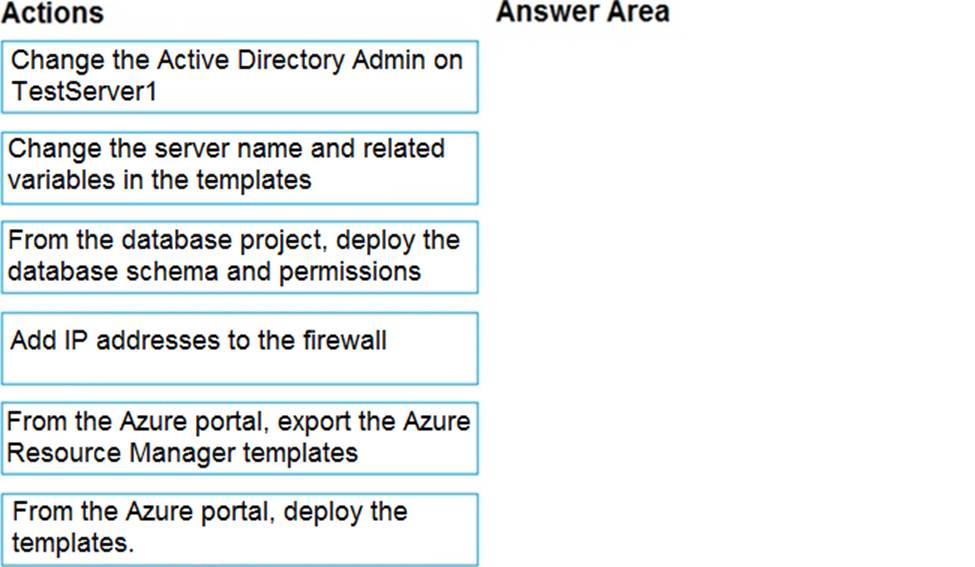
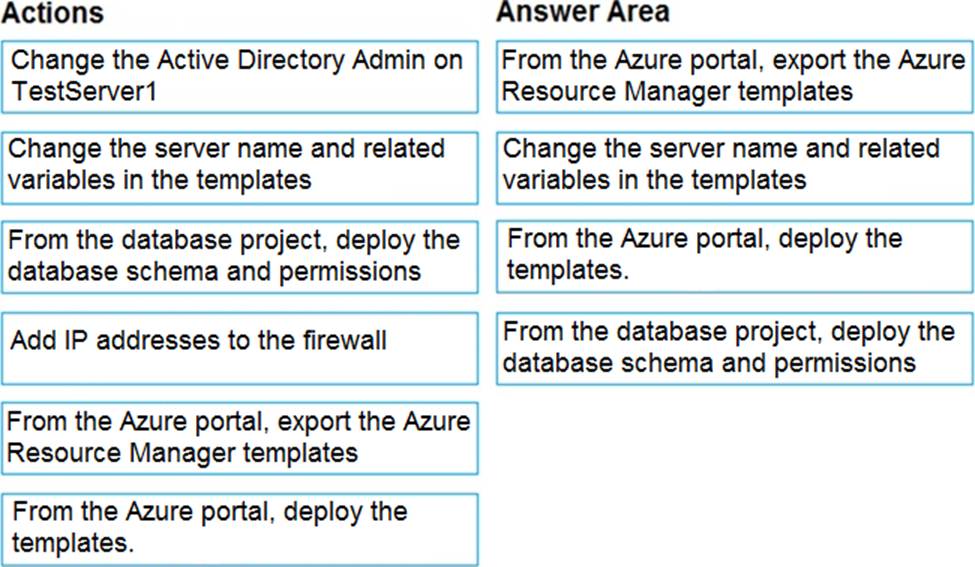
DRAG DROP
You have a resource group named App1Dev that contains an Azure SQL Database server named DevServer1. DevServer1 contains an Azure SQL database named DB1. The schema and permissions for DB1 are saved in a Microsoft SQL Server Data Tools (SSDT) database project.
You need to populate a new resource group named App1Test with the DB1 database and an Azure SQL Server named TestServer1. The resources in App1Test must have the same configurations as the resources in App1Dev.
Which four actions should you perform in sequence? To answer, move the appropriate actions from the list of actions to the answer area and arrange them in the correct order.
HOTSPOT
You have an Azure subscription that contains the resources shown in the following table.

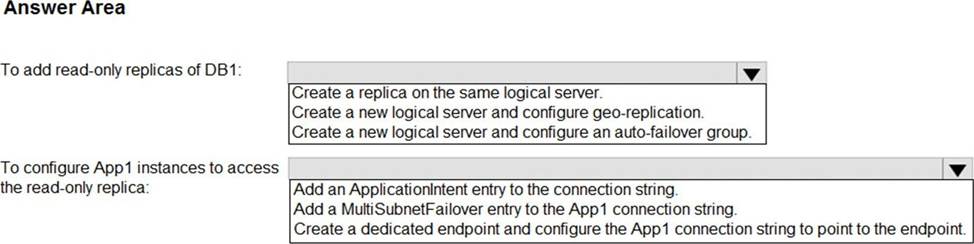
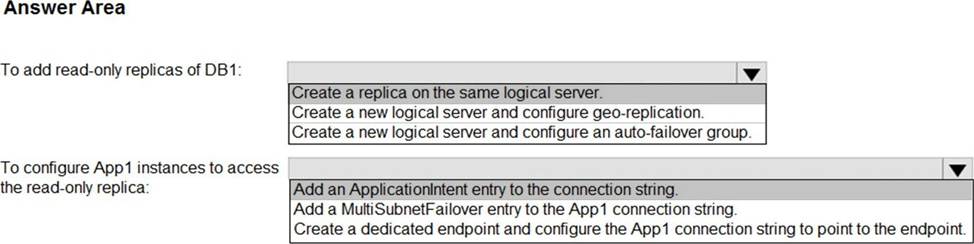
You need to create a read-only replica of DB1 and configure the App1 instances to use the replica.
What should you do? To answer, select the appropriate options in the answer area. NOTE: Each correct selection is worth one point.
Note: This question is part of a series of questions that present the same scenario. Each question in the series contains a unique solution that might meet the stated goals. Some question sets might have more than one correct solution, while others might not have a correct solution.
After you answer a question in this section, you will NOT be able to return to it. As a result, these questions will not appear in the review screen.
You have an Azure Data Lake Storage account that contains a staging zone.
You need to design a daily process to ingest incremental data from the staging zone, transform the data by executing an R script, and then insert the transformed data into a data warehouse in Azure Synapse Analytics.
Solution: You use an Azure Data Factory schedule trigger to execute a pipeline that executes an Azure Databricks notebook, and then inserts the data into the data warehouse.
Does this meet the goal?
- A . Yes
- B . No
You plan to deploy two instances of SQL Server on Azure virtual machines in a highly available configuration that will use an Always On availability group.
You need to recommend a deployment solution that meets the following requirements:
• Provides a Service Level Agreement (SLA) of at least 99.95%
• Replicates databases in the same group synchronously
• Minimizes the latency of database writes
What should you recommend?
- A . Create a proximity group and an availability set. Deploy each virtual machine to the availability set Add both virtual machines to the proximity group.
- B . Create two proximity groups and a single availability set. Deploy both virtual machines to the availability set. Add one virtual machine to each proximity group.
- C . Create two proximity groups and two availability sets. Deploy each virtual machine to a unique availability set. Add one virtual machine to each proximity group.
- D . Create a proximity group and two availability sets. Deploy each virtual machine to a unique availability set. Add both virtual machines to the proximity group.
SIMULATION
Task 5
You need to configure a disaster recovery solution for db1. When a failover occurs, the connection strings to the database must remain the same. The secondary server must be in the West US 3 Azure region.
You need to recommend an availability strategy for an Azure SQL database.
The strategy must meet the following requirements:
✑ Support failovers that do not require client applications to change their connection strings.
✑ Replicate the database to a secondary Azure region.
✑ Support failover to the secondary region.
What should you include in the recommendation?
- A . failover groups
- B . transactional replication
- C . Availability Zones
- D . geo-replication