
Microsoft DP-203 Practice Exams
Last updated on Nov 16,2026- Exam Code: DP-203
- Exam Name: Data Engineering on Microsoft Azure
- Certification Provider: Microsoft
- Latest update: Nov 16,2026
HOTSPOT
You have an Azure subscription that contains an Azure Synapse Analytics dedicated SQL pool named Poo 11 and a storage account. The storage account contains a blob container. The blob container contains multiple CSV files.
You plan to load the files into Pool! by using the following code.
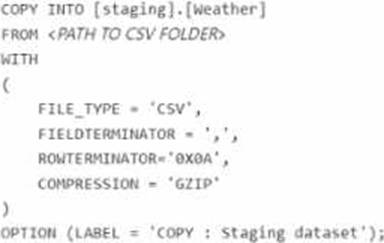
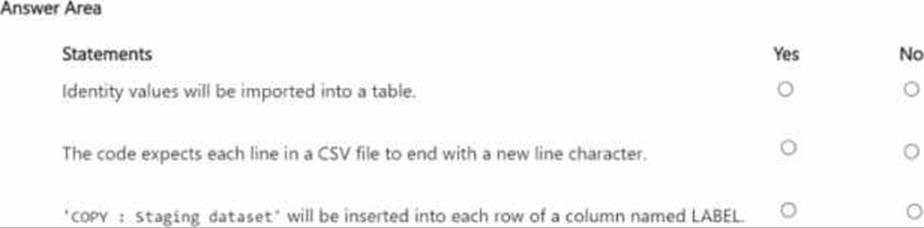
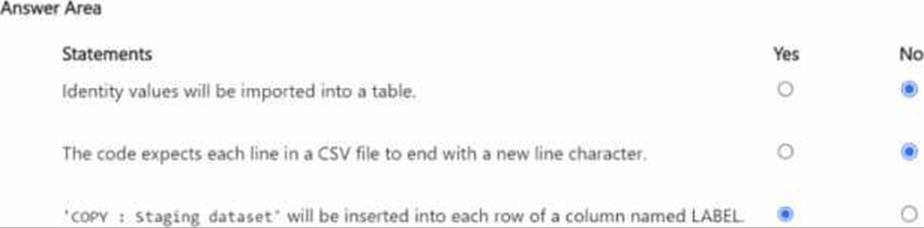
For each of the following statements, select Yes if the statement is true. Otherwise, select No. NOTE: Each correct selection is worth one point.
You use Azure Data Lake Storage Gen2.
You need to ensure that workloads can use filter predicates and column projections to filter data at the time the data is read from disk.
Which two actions should you perform? Each correct answer presents part of the solution. NOTE: Each correct selection is worth one point.
- A . Reregister the Microsoft Data Lake Store resource provider.
- B . Reregister the Azure Storage resource provider.
- C . Create a storage policy that is scoped to a container.
- D . Register the query acceleration feature.
- E . Create a storage policy that is scoped to a container prefix filter.
A company has a real-time data analysis solution that is hosted on Microsoft Azure. The solution uses Azure Event Hub to ingest data and an Azure Stream Analytics cloud job to analyze the data. The cloud job is configured to use 120 Streaming Units (SU).
You need to optimize performance for the Azure Stream Analytics job.
Which two actions should you perform? Each correct answer presents part of the solution. NOTE: Each correct selection is worth one point.
- A . Implement event ordering.
- B . Implement Azure Stream Analytics user-defined functions (UDF).
- C . Implement query parallelization by partitioning the data output.
- D . Scale the SU count for the job up.
- E . Scale the SU count for the job down.
- F . Implement query parallelization by partitioning the data input.
DRAG DROP
You have an Azure Data Lake Storage Gen 2 account named storage1.
You need to recommend a solution for accessing the content in storage1.
The solution must meet the following requirements:
List and read permissions must be granted at the storage account level.
Additional permissions can be applied to individual objects in storage1.
Security principals from Microsoft Azure Active Directory (Azure AD), part of Microsoft Entra, must be used for authentication.
What should you use? To answer, drag the appropriate components to the correct requirements. Each component may be used once, more than once, or not at all. You may need to drag the split bar between panes or scroll to view content. NOTE: Each correct selection is worth one point.


You have an Azure subscription that contains an Azure data factory named ADF1.
From Azure Data Factory Studio, you build a complex data pipeline in ADF1.
You discover that the Save button is unavailable and there are validation errors that prevent the pipeline from being published.
You need to ensure that you can save the logic of the pipeline.
Solution: You enable Git integration for ADF1.
- A . Yes
- B . No
You have an Azure Data Factory pipeline named pipeline1 that includes a Copy activity named Copy1.
Copy1 has the following configurations:
• The source of Copy1 is a table in an on-premises Microsoft SQL Server instance that is accessed by using a linked service connected via a self-hosted integration runtime.
• The sink of Copy1 uses a table in an Azure SQL database that is accessed by using a linked service connected via an Azure integration runtime.
You need to maximize the amount of compute resources available to Copy1. The solution must minimize administrative effort.
What should you do?
- A . Scale up the data flow runtime of the Azure integration runtime.
- B . Scale up the data flow runtime of the Azure integration runtime and scale out the self-hosted integration runtime.
- C . Scale out the self-hosted integration runtime.
Note: This question is part of a series of questions that present the same scenario. Each question in the series contains a unique solution that might meet the stated goals. Some question sets might have more than one correct solution, while others might not have a correct solution.
After you answer a question in this section, you will NOT be able to return to it. As a result, these questions will not appear in the review screen.
You are designing an Azure Stream Analytics solution that will analyze Twitter data.
You need to count the tweets in each 10-second window. The solution must ensure that each tweet is counted only once.
Solution: You use a hopping window that uses a hop size of 10 seconds and a window size of 10 seconds.
Does this meet the goal?
- A . Yes
- B . No
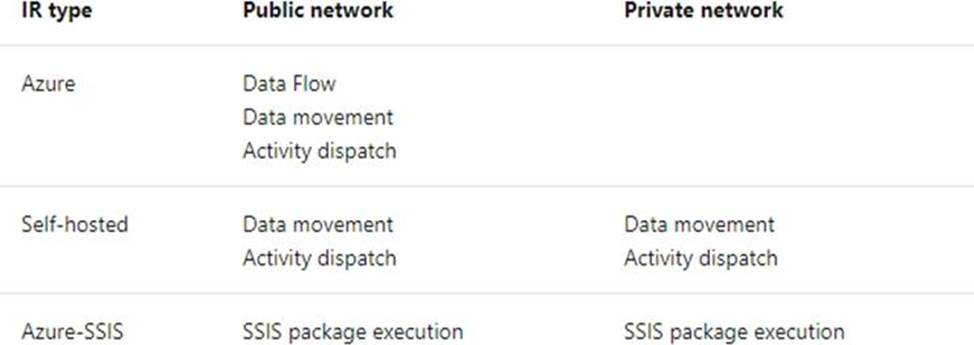
You have an Azure Storage account and a data warehouse in Azure Synapse Analytics in the UK South region.
You need to copy blob data from the storage account to the data warehouse by using Azure Data Factory.
The solution must meet the following requirements:
✑ Ensure that the data remains in the UK South region at all times.
✑ Minimize administrative effort.
Which type of integration runtime should you use?
- A . Azure integration runtime
- B . Azure-SSIS integration runtime
- C . Self-hosted integration runtime
You have an Azure subscription that contains a Microsoft Purview account named MP1, an Azure data factory named DF1, and a storage account named storage. MP1 is configured 10 scan storage1. DF1 is connected to MP1 and contains 3 dataset named DS1. DS1 references 2 file in storage.
In DF1, you plan to create a pipeline that will process data from DS1.
You need to review the schema and lineage information in MP1 for the data referenced by DS1.
Which two features can you use to locate the information? Each correct answer presents a complete solution. NOTE: Each correct answer is worth one point.
- A . the Storage browser of storage1 in the Azure portal
- B . the search bar in the Azure portal
- C . the search bar in Azure Data Factory Studio
- D . the search bar in the Microsoft Purview governance portal
You need to schedule an Azure Data Factory pipeline to execute when a new file arrives in an Azure Data Lake Storage Gen2 container.
Which type of trigger should you use?
- A . on-demand
- B . tumbling window
- C . schedule
- D . storage event