
Microsoft DP-203 Practice Exams
Last updated on Nov 16,2026- Exam Code: DP-203
- Exam Name: Data Engineering on Microsoft Azure
- Certification Provider: Microsoft
- Latest update: Nov 16,2026
To ensure that old sales transaction records are removed efficiently, what type of indexing strategy should be used?
- A . Clustered Columnstore Index
- B . NonClustered Index
- C . FullText Index
- D . Spatial Index
Note: This question is part of a series of questions that present the same scenario. Each question in the series contains a unique solution that might meet the stated goals. Some question sets might have more than one correct solution, while others might not have a correct solution.
After you answer a question in this section, you will NOT be able to return to it. As a result, these questions will not appear in the review screen.
You are designing an Azure Stream Analytics solution that will analyze Twitter data.
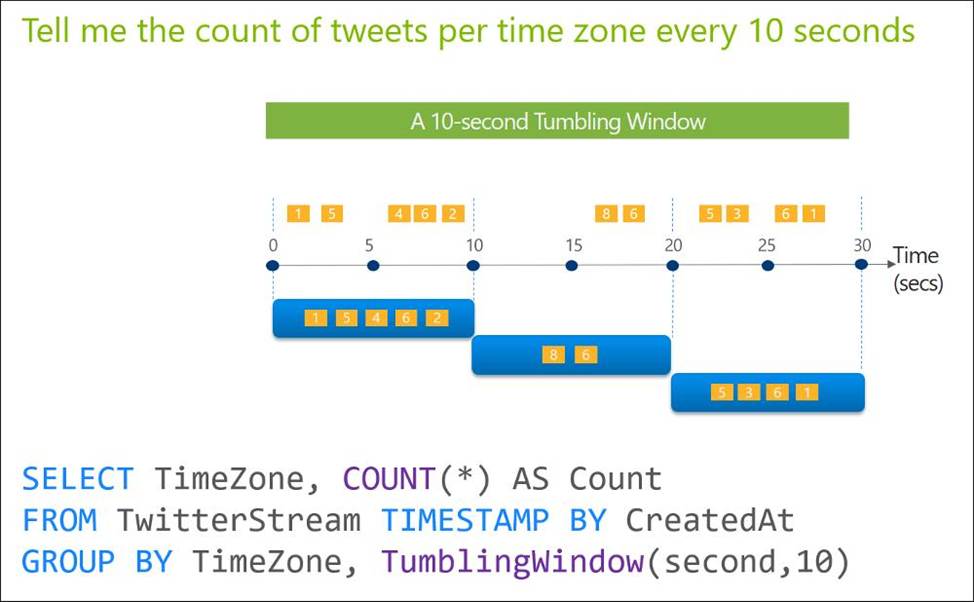
You need to count the tweets in each 10-second window. The solution must ensure that each tweet is counted only once.
Solution: You use a hopping window that uses a hop size of 5 seconds and a window size 10 seconds.
Does this meet the goal?
- A . Yes
- B . No
You plan to implement an Azure Data Lake Storage Gen2 container that will contain CSV files. The size of the files will vary based on the number of events that occur per hour. File sizes range from 4.KB to 5 GB.
You need to ensure that the files stored in the container are optimized for batch processing.
What should you do?
- A . Compress the files.
- B . Merge the files.
- C . Convert the files to JSON
- D . Convert the files to Avro.
You have an Azure Synapse Analytics Apache Spark pool named Pool1.
You plan to load JSON files from an Azure Data Lake Storage Gen2 container into the tables in Pool1.
The structure and data types vary by file.
You need to load the files into the tables. The solution must maintain the source data types.
What should you do?
- A . Use a Get Metadata activity in Azure Data Factory.
- B . Use a Conditional Split transformation in an Azure Synapse data flow.
- C . Load the data by using the OPEHROwset Transact-SQL command in an Azure Synapse Anarytics serverless SQL pool.
- D . Load the data by using PySpark.
Note: This question is part of a series of questions that present the same scenario. Each question in the series contains a unique solution that might meet the stated goals. Some question sets might have more than one correct solution, while others might not have a correct solution.
After you answer a question in this section, you will NOT be able to return to it. As a result, these questions will not appear in the review screen.
You have an Azure Synapse Analytics dedicated SQL pool that contains a table named Table1.
You have files that are ingested and loaded into an Azure Data Lake Storage Gen2 container named container1.
You plan to insert data from the files in container1 into Table1 and transform the data. Each row of data in the files will produce one row in the serving layer of Table1.
You need to ensure that when the source data files are loaded to container1, the DateTime is stored as an additional column in Table1.
Solution: You use an Azure Synapse Analytics serverless SQL pool to create an external table that has an additional DateTime column.
Does this meet the goal?
- A . Yes
- B . No
HOTSPOT
You are implementing an Azure Stream Analytics solution to process event data from devices.
The devices output events when there is a fault and emit a repeat of the event every five seconds until the fault is resolved. The devices output a heartbeat event every five seconds after a previous event if there are no faults present.
A sample of the events is shown in the following table.
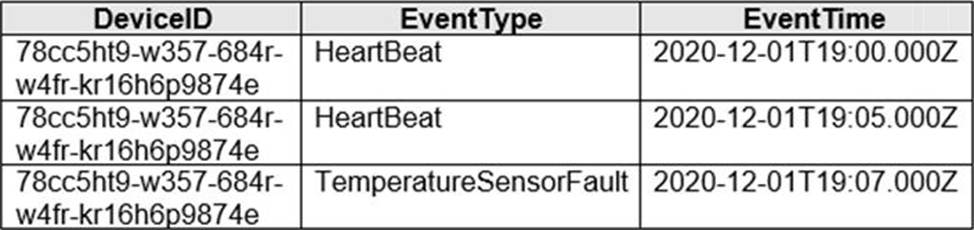
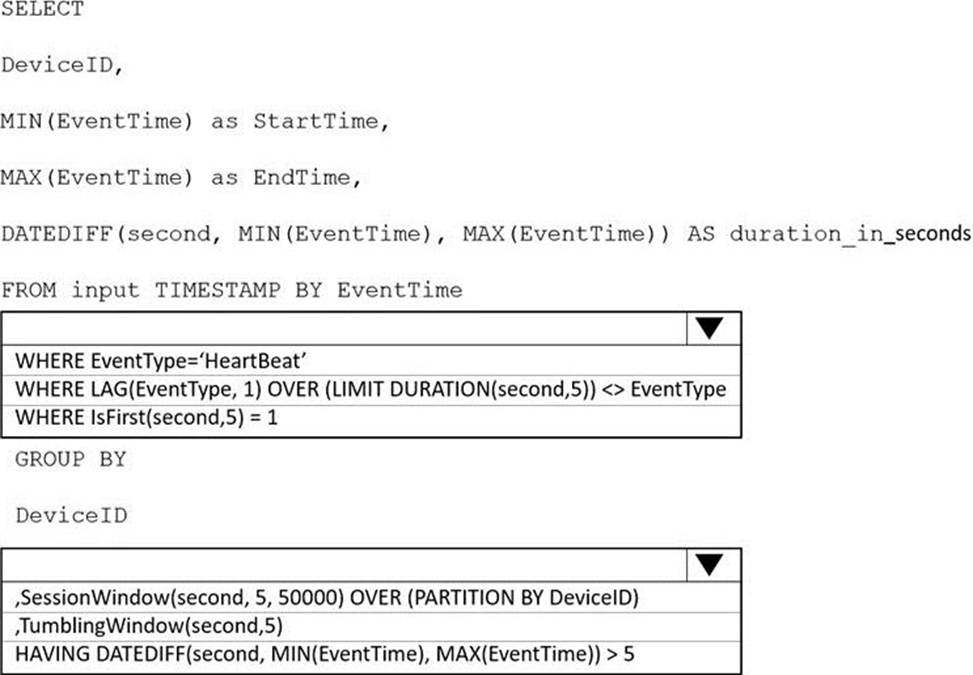
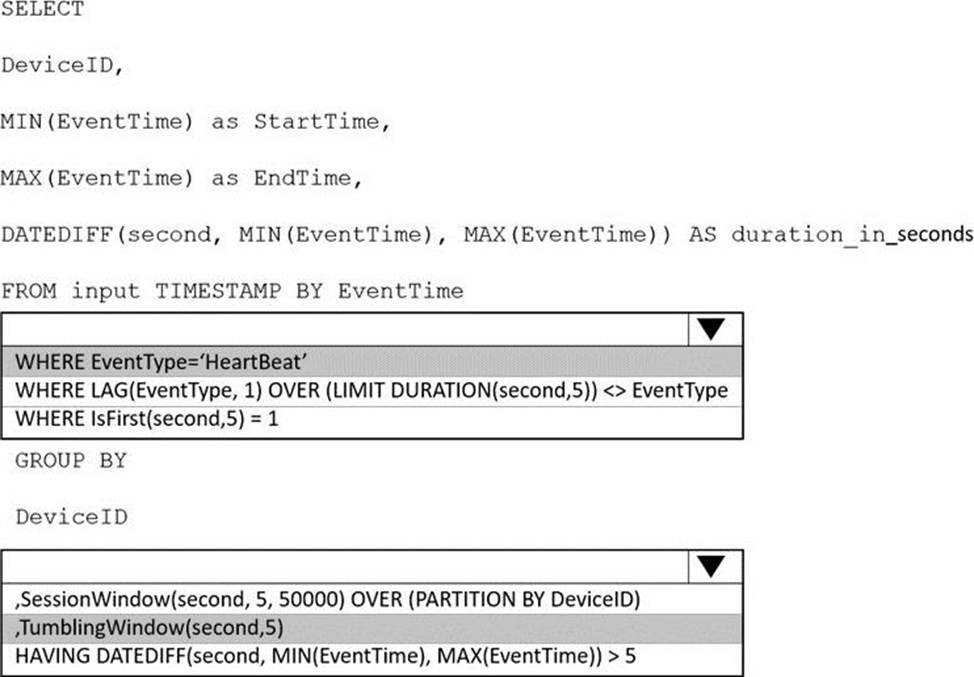
You need to calculate the uptime between the faults.
How should you complete the Stream Analytics SQL query? To answer, select the appropriate options in the answer area. NOTE: Each correct selection is worth one point.
You have an Azure subscription that contains an Azure Synapse Analytics dedicated SQL pool named Pool1.
You have the queries shown in the following table.
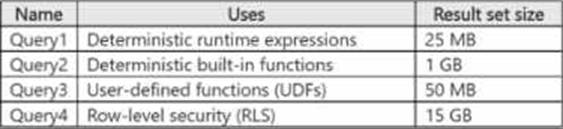
You are evaluating whether to enable result set caching for Pool1.
Which query results will be cached if result set caching is enabled?
- A . Query1 only
- B . Query2 only
- C . Query 1 and Query2 only
- D . Query1 and Query3 only
- E . Query 1, Query2, and Query3 only
You have a table in an Azure Synapse Analytics dedicated SQL pool.
The table was created by using the following Transact-SQL statement.
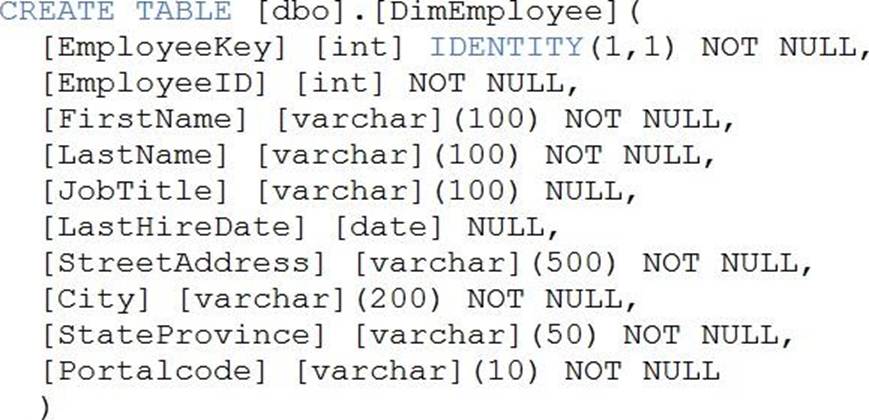
You need to alter the table to meet the following requirements:
✑ Ensure that users can identify the current manager of employees.
✑ Support creating an employee reporting hierarchy for your entire company.
✑ Provide fast lookup of the managers’ attributes such as name and job title.
Which column should you add to the table?
- A . [ManagerEmployeeID] [int] NULL
- B . [ManagerEmployeeID] [smallint] NULL
- C . [ManagerEmployeeKey] [int] NULL
- D . [ManagerName] [varchar](200) NULL
You plan to create a dimension table in Azure Synapse Analytics that will be less than 1 GB.
You need to create the table to meet the following requirements:
• Provide the fastest Query time.
• Minimize data movement during queries.
Which type of table should you use?
- A . hash distributed
- B . heap
- C . replicated
- D . round-robin
You have an Azure Databricks workspace named workspace! in the Standard pricing tier. Workspace1 contains an all-purpose cluster named cluster1.
You need to reduce the time it takes for cluster 1 to start and scale up. The solution must minimize costs.
What should you do first?
- A . Upgrade workspace1 to the Premium pricing tier.
- B . Create a cluster policy in workspace1.
- C . Create a pool in workspace1.
- D . Configure a global init script for workspace1.