
Microsoft DP-203 Practice Exams
Last updated on Nov 16,2026- Exam Code: DP-203
- Exam Name: Data Engineering on Microsoft Azure
- Certification Provider: Microsoft
- Latest update: Nov 16,2026
HOTSPOT
You have a self-hosted integration runtime in Azure Data Factory.
The current status of the integration runtime has the following configurations:
✑ Status: Running
✑ Type: Self-Hosted
✑ Version: 4.4.7292.1
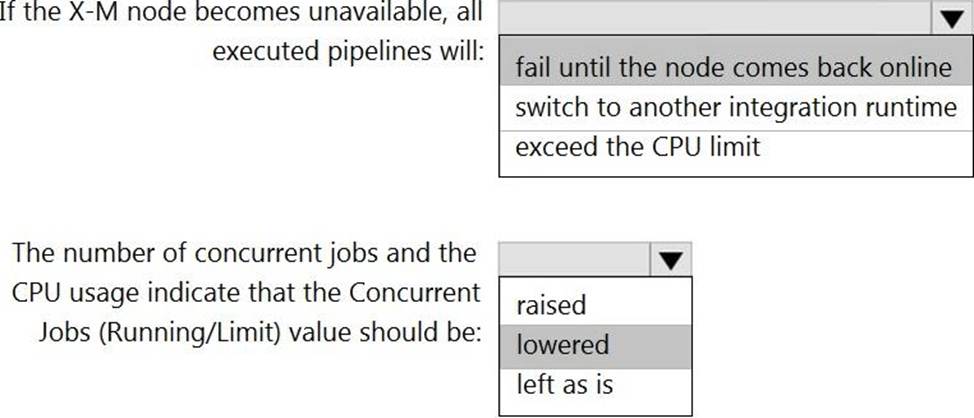
✑ Running / Registered Node(s): 1/1
✑ High Availability Enabled: False
✑ Linked Count: 0
✑ Queue Length: 0
✑ Average Queue Duration. 0.00s
The integration runtime has the following node details:
✑ Name: X-M
✑ Status: Running
✑ Version: 4.4.7292.1
✑ Available Memory: 7697MB
✑ CPU Utilization: 6%
✑ Network (In/Out): 1.21KBps/0.83KBps
✑ Concurrent Jobs (Running/Limit): 2/14
✑ Role: Dispatcher/Worker
✑ Credential Status: In Sync
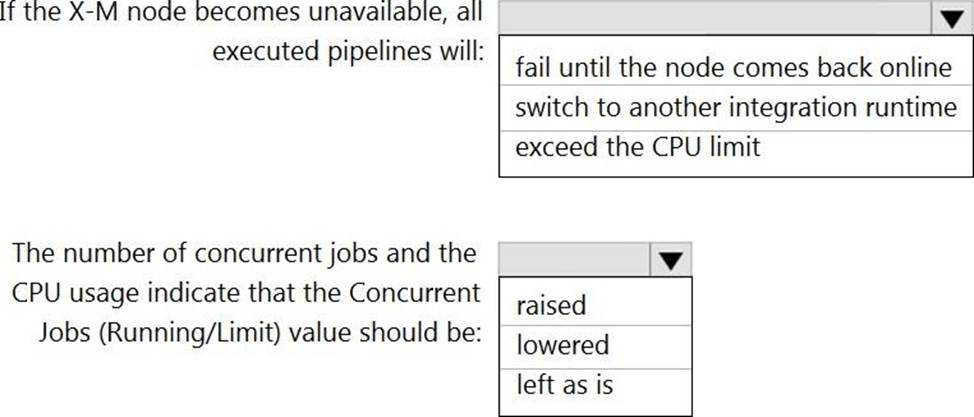
Use the drop-down menus to select the answer choice that completes each statement based on the information presented. NOTE: Each correct selection is worth one point.
You have a SQL pool in Azure Synapse that contains a table named dbo.Customers. The table contains a column name Email.
You need to prevent nonadministrative users from seeing the full email addresses in the Email column. The users must see values in a format of [email protected] instead.
What should you do?
- A . From Microsoft SQL Server Management Studio, set an email mask on the Email column.
- B . From the Azure portal, set a mask on the Email column.
- C . From Microsoft SQL Server Management studio, grant the SELECT permission to the users for all the columns in the dbo.Customers table except Email.
- D . From the Azure portal, set a sensitivity classification of Confidential for the Email column.
Note: This question is part of a series of questions that present the same scenario. Each question in the series contains a unique solution that might meet the stated goals. Some question sets might have more than one correct solution, while others might not have a correct solution.
After you answer a question in this section, you will NOT be able to return to it. As a result, these questions will not appear in the review screen.
You are designing an Azure Stream Analytics solution that will analyze Twitter data.
You need to count the tweets in each 10-second window. The solution must ensure that each tweet is counted only once.
Solution: You use a session window that uses a timeout size of 10 seconds.
Does this meet the goal?
- A . Yes
- B . No
You have an Azure data factory that connects to a Microsoft Purview account. The data ‘factory is
registered in Microsoft Purview.
You update a Data Factory pipeline.
You need to ensure that the updated lineage is available in Microsoft Purview.
What should you do first?
- A . Disconnect the Microsoft Purview account from the data factory.
- B . Locate the related asset in the Microsoft Purview portal.
- C . Execute an Azure DevOps build pipeline.
- D . Execute the pipeline.
You are designing a slowly changing dimension (SCD) for supplier data in an Azure Synapse Analytics dedicated SQL pool.
You plan to keep a record of changes to the available fields.
The supplier data contains the following columns.
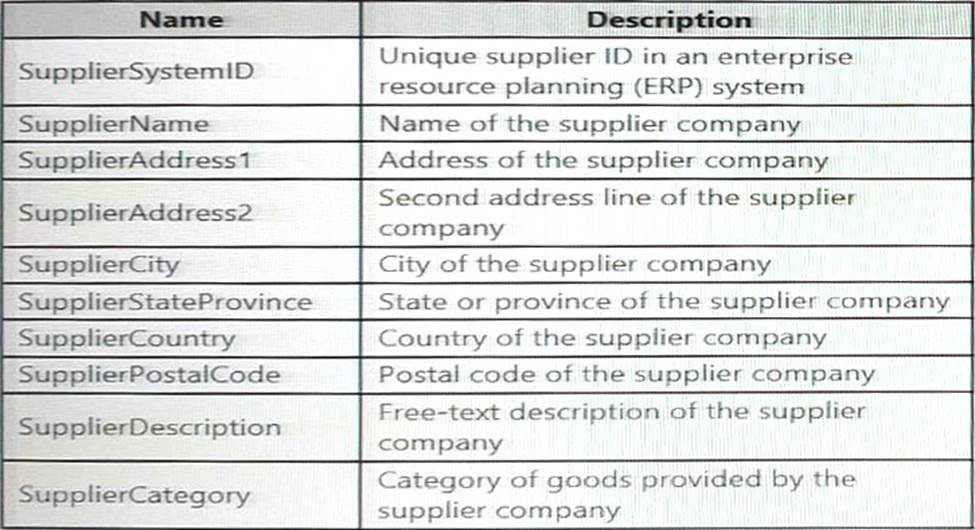
Which three additional columns should you add to the data to create a Type 2 SCD? Each correct answer presents part of the solution. NOTE: Each correct selection is worth one point.
- A . surrogate primary key
- B . foreign key
- C . effective start date
- D . effective end date
- E . last modified date
- F . business key
You have an Azure subscription that contains an Azure Blob Storage account named storage1 and an Azure Synapse Analytics dedicated SQL pool named Pool1.
You need to store data in storage 1. The data will be read by Pool 1.
The solution must meet the following requirements:
✑ Enable Pool1 to skip columns and rows that are unnecessary in a query.
✑ Automatically create column statistics.
✑ Minimize the size of files.
Which type of file should you use?
- A . JSON
- B . Parquet
- C . Avro
- D . CSV
You manage an enterprise data warehouse in Azure Synapse Analytics.
Users report slow performance when they run commonly used queries. Users do not report performance changes for infrequently used queries.
You need to monitor resource utilization to determine the source of the performance issues.
Which metric should you monitor?
- A . Data IO percentage
- B . Local tempdb percentage
- C . Cache hit percentage
- D . DWU percentage
You are planning a solution to aggregate streaming data that originates in Apache Kafka and is output to Azure Data Lake Storage Gen2. The developers who will implement the stream processing solution use Java.
Which service should you recommend using to process the streaming data?
- A . Azure Data Factory
- B . Azure Stream Analytics
- C . Azure Databricks
- D . Azure Event Hubs
You use Azure Stream Analytics to receive Twitter data from Azure Event Hubs and to output the data to an Azure Blob storage account
You need to output the count of tweets during the last five minutes every five minutes. Each tweet must only be counted once.
Which windowing function should you use?
- A . a five-minute Tumbling window
- B . a five-minute Sliding window
- C . a five-minute Hopping window that has a one-minute hop
- D . a five-minute Session window
You have an Azure data factor/ connected to a Git repository that contains the following branches:
• mam: Collaboration branch
• abc: Feature branch
• xyz: Feature branch
You save charges to a pipeline in the xyz branch.
You need to publish the changes to the live service
What should you do first?
- A . Push the code to a remote origin.
- B . Publish the data factory.
- C . Create a pull request to merge the changes into the abc branch.
- D . Create a pull request to merge the changes into the main branch.