Microsoft DP-100 Practice Exams
Last updated on Nov 16,2026- Exam Code: DP-100
- Exam Name: Designing and Implementing a Data Science Solution on Azure
- Certification Provider: Microsoft
- Latest update: Nov 16,2026
You use Azure Machine Learning studio to analyze an mltable data asset containing a decimal column named column1. You need to verify that the column1 values are normally distributed.
Which statistic should you use?
- A . Max
- B . Type
- C . Profile
- D . Mean
DRAG DROP
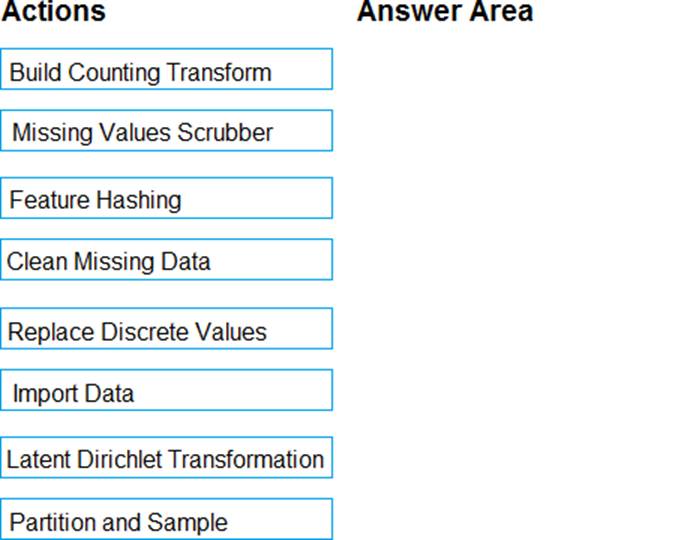
You are creating an experiment by using Azure Machine Learning Studio.
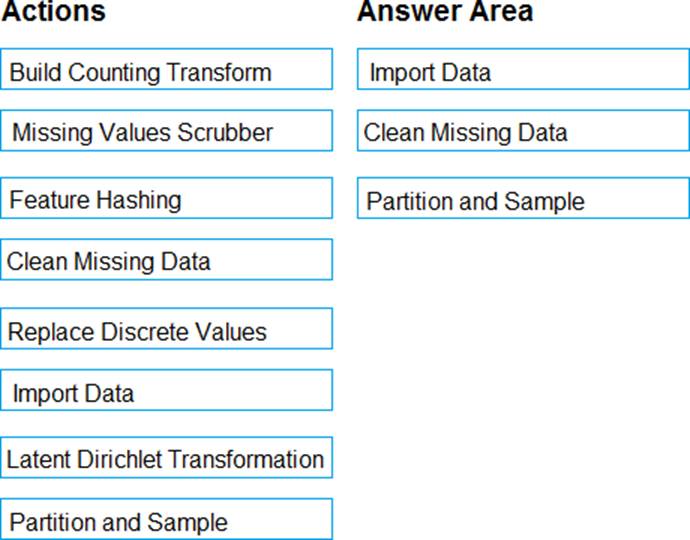
You must divide the data into four subsets for evaluation. There is a high degree of missing values in the data. You must prepare the data for analysis.
You need to select appropriate methods for producing the experiment.
Which three modules should you run in sequence? To answer, move the appropriate actions from the list of actions to the answer area and arrange them in the correct order. NOTE: More than one order of answer choices is correct. You will receive credit for any of the correct orders you select.
You use the Azure Machine Learning SDK in a notebook to run an experiment using a script file in an experiment folder.
The experiment fails.
You need to troubleshoot the failed experiment.
What are two possible ways to achieve this goal? Each correct answer presents a complete solution.
- A . Use the get_metrics() method of the run object to retrieve the experiment run logs.
- B . Use the get_details_with_logs() method of the run object to display the experiment run logs.
- C . View the log files for the experiment run in the experiment folder.
- D . View the logs for the experiment run in Azure Machine Learning studio.
- E . Use the get_output() method of the run object to retrieve the experiment run logs.
Note: This question is part of a series of questions that present the same scenario. Each question in the series contains a unique solution that might meet the stated goals. Some question sets might have more than one correct solution, while others might not have a correct solution.
After you answer a question in this section, you will NOT be able to return to it. As a result, these questions will not appear in the review screen.
You are analyzing a numerical dataset which contains missing values in several columns.
You must clean the missing values using an appropriate operation without affecting the dimensionality of the feature set.
You need to analyze a full dataset to include all values.
Solution: Remove the entire column that contains the missing data point.
Does the solution meet the goal?
- A . Yes
- B . No
You manage an Azure Machine Learning workspace. The development environment for managing the workspace is configured to use Python SDK v2 in Azure Machine Learning Notebooks
A Synapse Spark Compute is currently attached and uses system-assigned identity
You need to use Python code to update the Synapse Spark Compute to use a user-assigned identity.
Solution: Create an instance of the MICIient class.
Does the solution meet the goal?
- A . Yes
- B . No
Note: This question is part of a series of questions that present the same scenario. Each question in the series contains a unique solution that might meet the stated goals. Some question sets might have more than one correct solution, while others might not have a correct solution.
After you answer a question in this section, you will NOT be able to return to it. As a result, these questions will not appear in the review screen.
You are using Azure Machine Learning to run an experiment that trains a classification model.
You want to use Hyperdrive to find parameters that optimize the AUC metric for the model.
You configure a HyperDriveConfig for the experiment by running the following code:
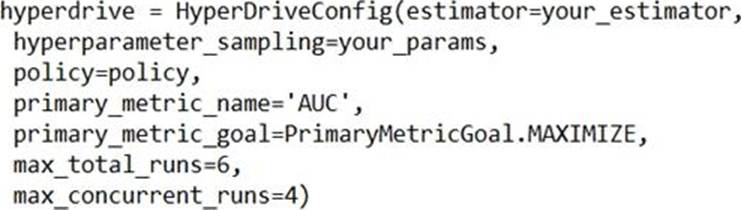
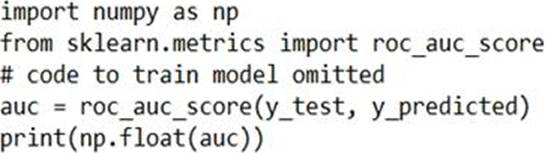
You plan to use this configuration to run a script that trains a random forest model and then tests it with validation data. The label values for the validation data are stored in a variable named y_test variable, and the predicted probabilities from the model are stored in a variable named y_predicted.
You need to add logging to the script to allow Hyperdrive to optimize hyperparameters for the AUC metric.
Solution: Run the following code:
Does the solution meet the goal?
- A . Yes
- B . No
Note: This question is part of a series of questions that present the same scenario. Each question in the series contains a unique solution that might meet the stated goals. Some question sets might have more than one correct solution, while others might not have a correct solution.
After you answer a question in this section, you will NOT be able to return to it. As a result, these questions will not appear in the review screen.
You train a classification model by using a logistic regression algorithm.
You must be able to explain the model’s predictions by calculating the importance of each feature, both as an overall global relative importance value and as a measure of local importance for a specific set of predictions.
You need to create an explainer that you can use to retrieve the required global and local feature importance values.
Solution: Create a MimicExplainer.
Does the solution meet the goal?
- A . Yes
- B . No
HOTSPOT
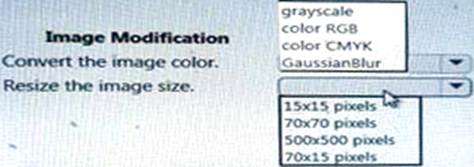
You arc I mating a deep learning model to identify cats and dogs. You have 25,000 color images.
You must meet the following requirements:
• Reduce the number of training epochs.
• Reduce the size of the neural network.
• Reduce over-fitting of the neural network.
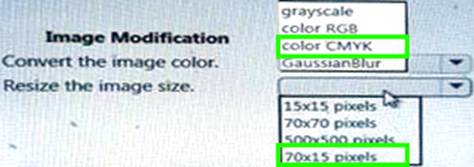
You need to select the image modification values.
Which value should you use? To answer, select the appropriate Options in the answer area. NOTE: Each correct selection is worth one point.
You run an automated machine learning experiment in an Azure Machine Learning workspace.
Information about the run is listed in the table below:

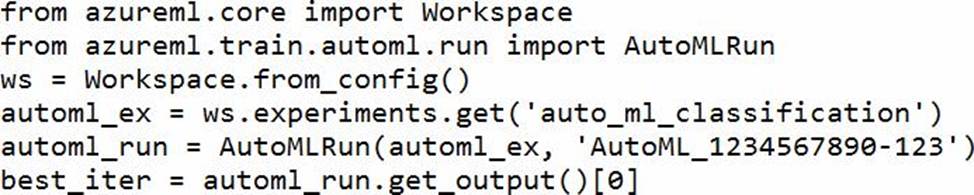
You need to write a script that uses the Azure Machine Learning SDK to retrieve the best iteration of the experiment run.
Which Python code segment should you use?
A)
B)

C)

D)

- A . Option A
- B . Option B
- C . Option C
- D . Option D
HOTSPOT
For each of the following statements, select Yes if the statement is true. Otherwise, select No. NOTE: Each correct selection is worth one point.