
Microsoft AZ-801 Practice Exams
Last updated on Nov 16,2026- Exam Code: AZ-801
- Exam Name: Configuring Windows Server Hybrid Advanced Services
- Certification Provider: Microsoft
- Latest update: Nov 16,2026
You have a three-node failover cluster.
You need to run pre-scripts and post-scripts when Cluster-Aware Updating (CAU) runs. The solution must minimize administrative effort.
What should you use?
- A . Scheduled tasks
- B . Run profiles
- C . Azure Functions
- D . Windows Server Update Serveries (WSUS)
HOTSPOT
Your on-premises datacenter contains physical servers and Hyper-V virtual machines.
You have an Azure subscription.
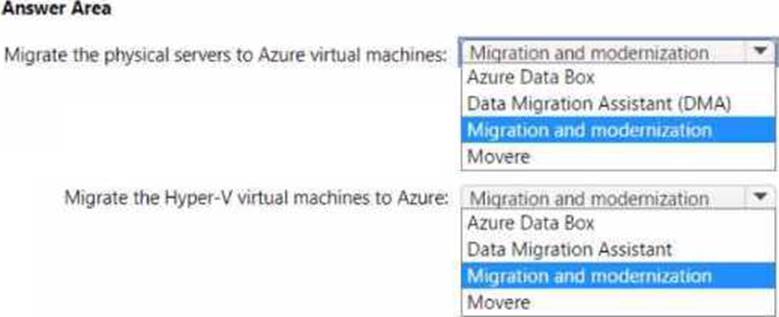
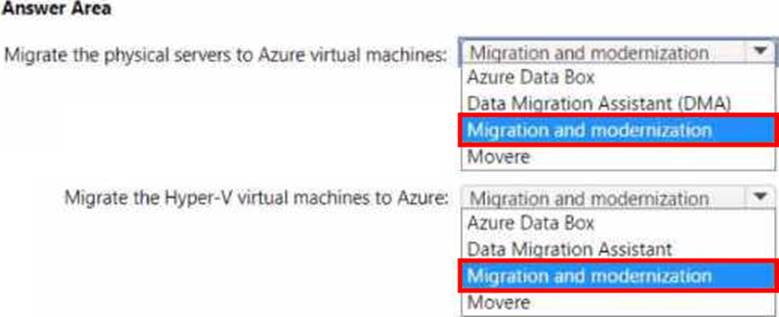
You plan to use Azure Migrate to perform the following tasks:
• Migrate the physical servers to Azure virtual machines.
• Migrate the Hyper-V virtual machines to Azure.
What should you use for each task? To answer, select the appropriate options in the answer area. NOTE: Each correct selection is worth one point.
HOTSPOT
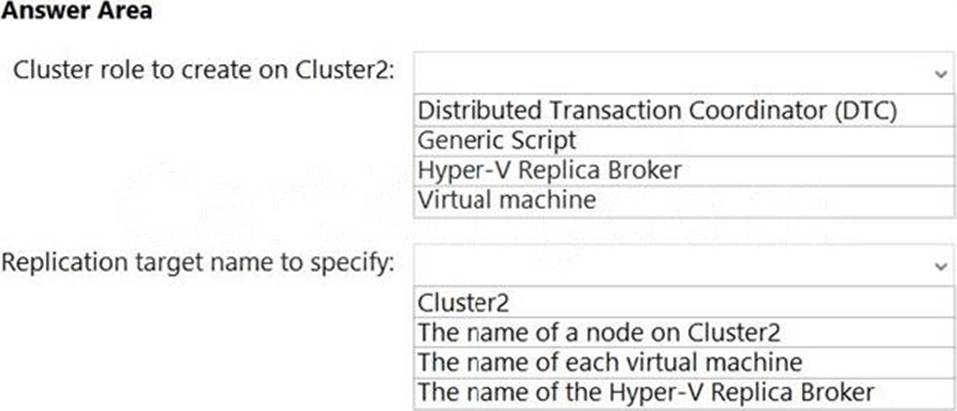
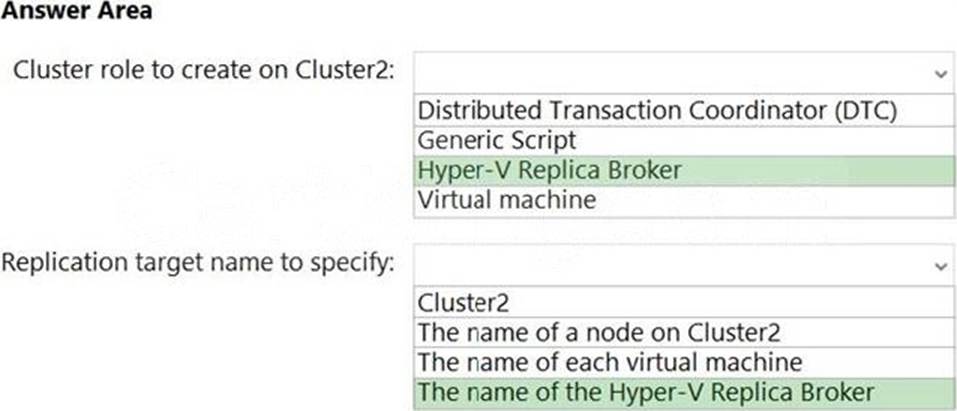
You have a Hyper-V failover cluster named Cluster1 at a main datacenter. Cluster1 contains two nodes that have the Hyper-V server role installed. Cluster1 hosts 10 highly available virtual machines.
You have a cluster named Cluster2 in a disaster recovery site. Cluster2 contains two nodes that have the Hyper-V server role installed.
You plan to use Hyper-V Replica to replicate the virtual machines from Cluster1 to Cluster2.
What should you do? To answer, select the appropriate options in the answer area. NOTE: Each correct selection is worth one point.
Explanation:
Reference: https://docs.microsoft.com/en-us/virtualization/community/team-blog/2012/20120327-why-is-the-hyper-v-replica-broker-required
HOTSPOT
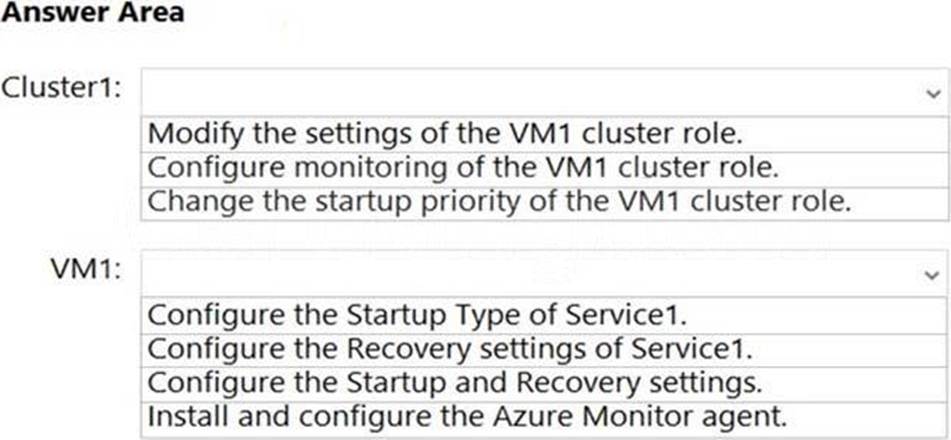
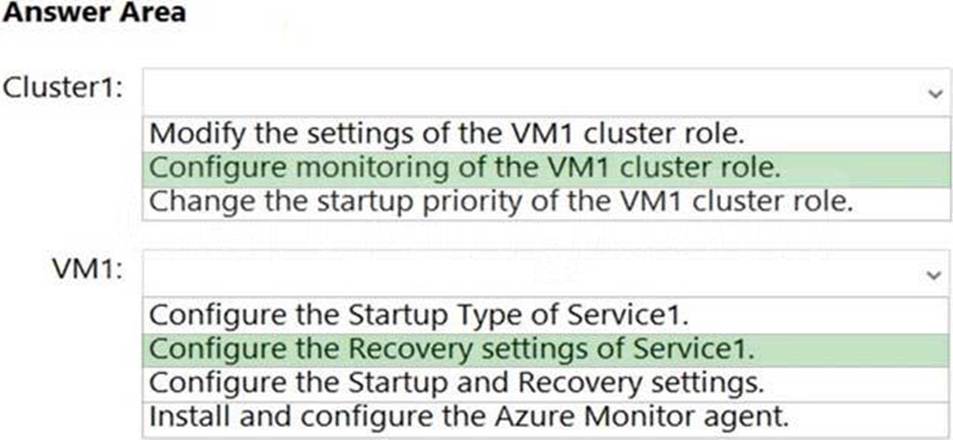
You have a Hyper-V failover cluster named Cluster1 that uses a cloud witness. Cluster1 hosts a virtual machine named VM1 that runs Windows Server.
You need to fail over VM1 automatically to a different node when a service named Service1 on VM1 fails.
What should you do on Cluster1 and VM1? To answer, select the appropriate options in the answer area. NOTE: Each correct selection is worth one point.
Your network contains an Active Directory Domain Service (AD DS) domain named contoso.com. The domain contains three domain controllers named DC1, DC2, and DC3. You connect a Microsoft Defender or identity instances to the domain.
You need to onboard all the domain controllers to Defender for identity.
What should you run the domain controllers?
- A . AzureConnectedMachineAgent,wsl
- B . MARAgentInstaller,exe
- C . Azure ATP Sensor setup,exe
- D . MASetup-AMD64,exe
Which domain controller should be online to meet the technical requirements for DC4?
- A . DC1
- B . DC2
- C . DC3
Note: This question is part of a series of questions that present the same scenario. Each question in the series contains a unique solution that might meet the stated goals. Some question sets might have more than one correct solution, while others might not have a correct solution.
After you answer a question in this section, you will NOT be able to return to it. As a result, these questions will not appear in the review screen.
You have an on-premises server named Server1 that runs Windows Server.
You have a Microsoft Sentinel instance.
You add the Windows Firewall data connector in Microsoft Sentinel.
You need to ensure that Microsoft Sentinel can collect Windows Firewall logs from Server1.
Solution: You install the Microsoft Integration Runtime on Server1.
Does this meet the goal?
- A . Yes
- B . No
You have an Azure virtual machine named VM1 that runs Windows Server.
You plan to deploy a new line-of-business (LOB) application to VM1.
You need to ensure that the application can create child processes.
What should you configure on VM1?
- A . Microsoft Defender Credential Guard
- B . Microsoft Defender Application Control
- C . Microsoft Defender SmartScreen
- D . Exploit protection
A
Explanation:
Reference: https://docs.microsoft.com/en-us/microsoft-365/security/defender-endpoint/customize-exploit-protection?view=o365-worldwide
Your network contains an on-premises Active Directory Domain Services (AD DS) domain. The domain contains two virtual machines named VM1 and VM2 that run Windows Server.
You plan to implement a failover cluster named Cluster1 that will use VM1 and VM2 as nodes.
You need to ensure that Cluster1 can use floating IP addresses.
Which two components should you deploy? Each correct answer presents part-of the solution. NOTE: Each correct selection is worth one point.
- A . Network Load Balancing (NLB)
- B . the Multipoint Services role
- C . the Network Controller role
- D . the Host Guardian Service role
- E . Software Load Balancer (SLB)
You have an Azure virtual machine named VM1. Crash dumps for a process named Process1 are enabled for VM1.
When process1.exe on VM1 crashes, a technician must access the memory dump files on the virtual machine. The technician must be prevented from accessing the virtual machine.
To what should you provide the technician access?
- A . an Azure file share
- B . an Azure Log Analytics workspace
- C . an Azure Blob Storage container
- D . a managed disk
C
Explanation:
Reference: https://docs.microsoft.com/en-us/azure/azure-monitor/agents/diagnostics-extension-overview