
Microsoft AZ-400 Practice Exams
Last updated on Nov 16,2026- Exam Code: AZ-400
- Exam Name: Designing and Implementing Microsoft DevOps Solutions
- Certification Provider: Microsoft
- Latest update: Nov 16,2026
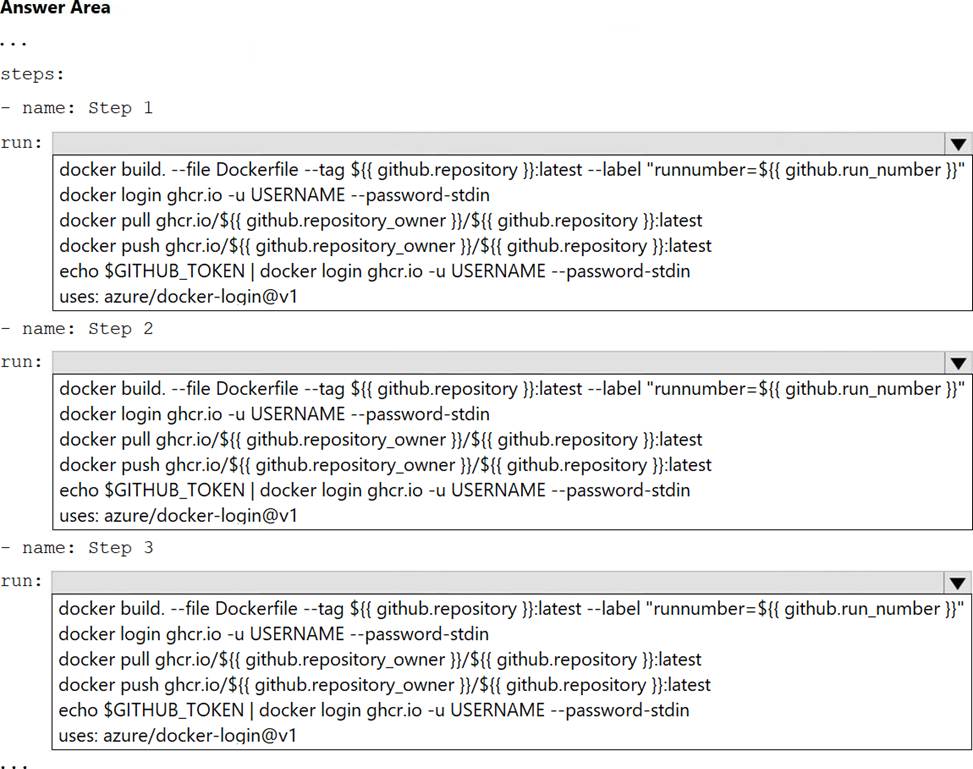
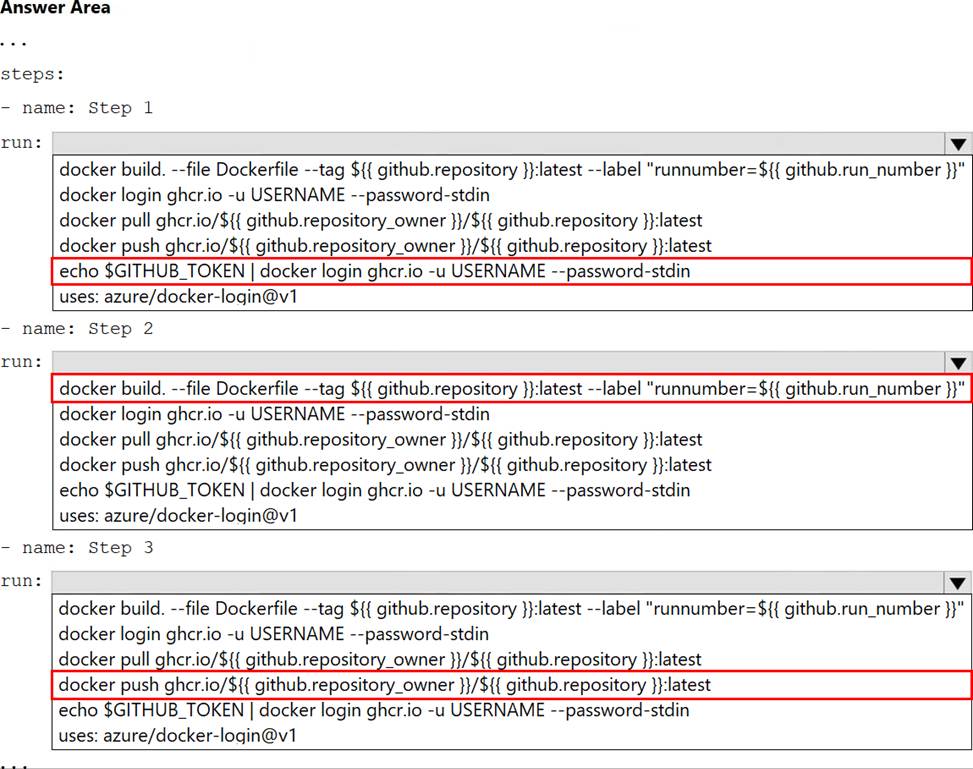
HOTSPOT
You have a GitHub repository.
You plan to use the repository to create a container.
You need to configure GitHub Actions to deploy the container to GitHub Container Registry.
How should you complete the script? To answer, select the appropriate options in the answer area. NOTE: Each correct selection is worth one point.
You plan to deploy a solution that will include multiple microservices.
You need to recommend a deployment strategy for the microservices.
The solution must meet the following requirements:
• Enable testing and monitoring of changes during a gradual rollout.
• Control the number of users that will receive new code releases.
Which strategy should you recommend?
- A . progressive exposure
- B . A/B
- C . feature toggle
- D . blue/green
DRAG DROP –
You have an Azure subscription that contains a resources group named RG1.
RG1 contains the following resources:
✑ Four Azure virtual machines that run Windows Server and have Internet Information Services (IIS) installed.
✑ SQL Server on an Azure virtual machine.
✑ An Azure Load Balancer.
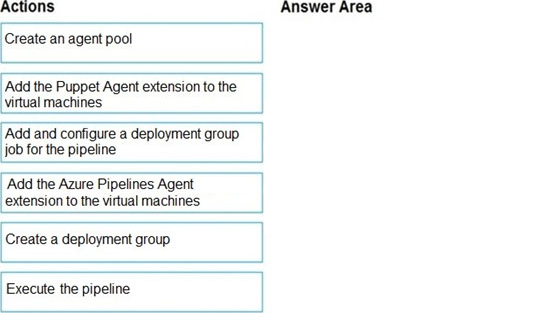
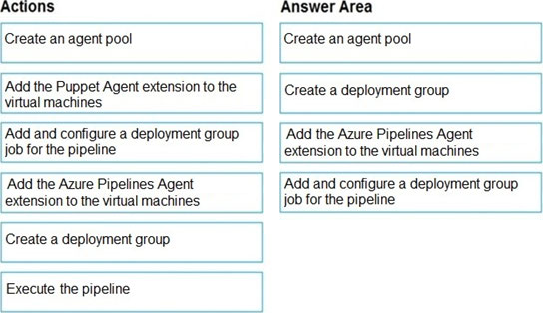
You need to deploy an application to the virtual machines in RG1 by using Azure Pipelines.
Which four actions should you perform in sequence? To answer, move the appropriate actions from the list of actions to the answer area and arrange them in the correct order. NOTE: More than one order of answer choices is correct. You will receive credit for any of the correct orders you select.
Testlet 3
Introductory Info
Case Study
This is a case study. Case studies are not timed separately. You can use as much exam time as you would like to complete each case. However, there may be additional case studies and sections on this exam. You must manage your time to ensure that you are able to complete all questions included on this exam in the time provided.
To answer the questions included in a case study, you will need to reference information that is provided in the case study. Case studies might contain exhibits and other resources that provide more information about the scenario that is described in the case study. Each question is independent of the other questions in this case study.
At the end of this case study, a review screen will appear. This screen allows you to review your answers and to make changes before you move to the next section of the exam. After you begin a new section, you cannot return to this section.
To start the case study
To display the first question in this case study, click the Next button. Use the buttons in the left pane to explore the content of the case study before you answer the questions. Clicking these buttons displays information such as business requirements, existing environment, and problem statements. If the case study has an All Information tab, note that the information displayed is identical to the information displayed on the subsequent tabs. When you are ready to answer a question, click the Question button to return to the question.
Overview
Contoso, Ltd. is a manufacturing company that has a main office in Chicago.
Existing Environment
Contoso plans to improve its IT development and operations processes by implementing Azure DevOps principles. Contoso has an Azure
subscription and creates an Azure DevOps organization.
The Azure DevOps organization includes:
The Docker extension
A deployment pool named Pool7 that contains 10 Azure virtual machines that run Windows Server 2019 The Azure subscription contains an Azure Automation account.
Requirements
Planned changes
Contoso plans to create projects in Azure DevOps as shown in the following table.
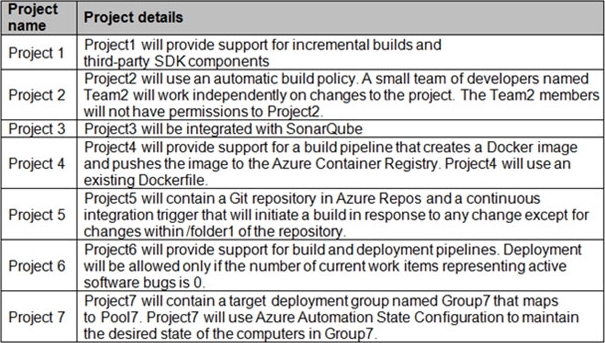
Technical requirements –
Contoso identifies the following technical requirements:
Implement build agents for Project1.
Whenever possible, use Azure resources.
Avoid using deprecated technologies.
Implement a code ow strategy for Project2 that will:
– Enable Team2 to submit pull requests for Project2.
– Enable Team2 to work independently on changes to a copy of Project2.
– Ensure that any intermediary changes performed by Team2 on a copy of Project2 will be subject to the same restrictions as the ones defined in the build policy of Project2.
Whenever possible, implement automation and minimize administrative effort. Implement Project3, Project5, Project6, and Project7 based on the planned changes.
Implement Project4 and configure the project to push Docker images to Azure Container Registry.
You add the virtual machines as managed nodes in Azure Automation State Configuration. You need to configure the managed computers in Pool7.
What should you do next?
- A . Modify the RefreshMode property of the Local Configuration Manager (LCM).
- B . Run the Register-AzureRmAutomationDscNode Azure Powershell cmdlet.
- C . Modify the ConfigurationMode property of the Local Configuration Manager (LCM).
- D . Install PowerShell Core.
Your company uses Azure DevOps and Microsoft Azure Active Directory (Azure AD), part of Microsoft Entra.
Only users who have accounts in Azure AD can access the Azure DevOps environment.
You need to ensure that only devices that are connected to the on-premises network can access the Azure DevOps environment.
What should you do?
- A . Assign the Stakeholder access level to all users.
- B . In Azure DevOps, configure Security in Project Settings.
- C . In Azure AD, configure conditional access.
- D . In Azure AD, configure risky sign-ins.
Note: The question is included in a number of questions that depicts the identical set-up. However, every question has a distinctive result.
Establish if the solution satisfies the requirements.
You run the Register-AzureRmAutomationDscNode command in your company’s environment.
You need to make sure that your company’s test servers remain correctly configured, regardless of configuration drift.
Solution: You set the -ConfigurationMode parameter to ApplyAndAutocorrect.
Does the solution meet the goal?
- A . Yes
- B . No
You manage source code control and versioning by using GitHub.
You need to ensure that a PowerShell script is executed automatically before rebase operations are performed.
What should you use?
- A . a package
- B . GitHub Copilot
- C . a webhook
- D . a gist
You are designing a YAML template for use with Azure Pipelines. The template will include the output le parameter.
Which two methods can you use to reference the parameter? Each correct answer presents a complete solution. NOTE: Each correct selection is worth one point.
- A . ${{parameters.output file}}
- B . $(parameters[‘output file’])
- C . $(parameters.output file)
- D . $(parameters[output file])
- E . ${{parameters[‘output file’]}}
Introductory Info
Case Study
This is a case study. Case studies are not timed separately. You can use as much exam time as you would like to complete each case. However, there may be additional case studies and sections on this exam. You must manage your time to ensure that you are able to complete all questions included on this exam in the time provided.
To answer the questions included in a case study, you will need to reference information that is provided in the case study. Case studies might contain exhibits and other resources that provide more information about the scenario that is described in the case study. Each question is independent of the other questions in this case study.
At the end of this case study, a review screen will appear. This screen allows you to review your answers and to make changes before you move to the next section of the exam. After you begin a new section, you cannot return to this section.
To start the case study
To display the first question in this case study, click the Next button. Use the buttons in the left pane to explore the content of the case study before you answer the questions. Clicking these buttons displays information such as business requirements, existing environment, and problem statements. If the case study has an All Information tab, note that the information displayed is identical to the information displayed on the subsequent tabs. When you are ready to answer a question, click the Question button to return to the question.
Overview
Contoso, Ltd. is a manufacturing company that has a main office in Chicago.
Existing Environment
Contoso plans to improve its IT development and operations processes by implementing Azure DevOps principles. Contoso has an Azure
subscription and creates an Azure DevOps organization.
The Azure DevOps organization includes:
The Docker extension
A deployment pool named Pool7 that contains 10 Azure virtual machines that run Windows Server 2019 The Azure subscription contains an Azure Automation account.
Requirements
Planned changes
Contoso plans to create projects in Azure DevOps as shown in the following table.
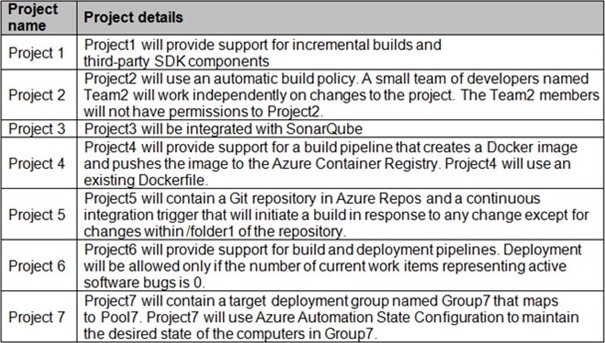
Technical requirements
Contoso identifies the following technical requirements:
Implement build agents for Project1.
Whenever possible, use Azure resources.
Avoid using deprecated technologies.
Implement a code ow strategy for Project2 that will:
– Enable Team2 to submit pull requests for Project2.
– Enable Team2 to work independently on changes to a copy of Project2.
– Ensure that any intermediary changes performed by Team2 on a copy of Project2 will be subject to the same restrictions as the ones defined in the build policy of Project2.
Whenever possible, implement automation and minimize administrative effort. Implement Project3, Project5, Project6, and Project7 based on the planned changes.
Implement Project4 and configure the project to push Docker images to Azure Container Registry.
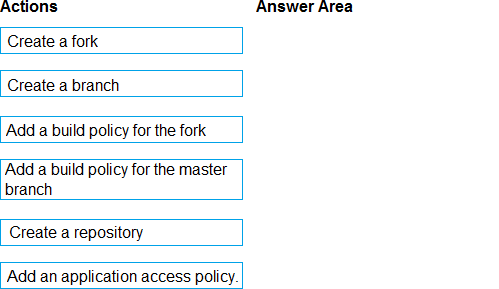
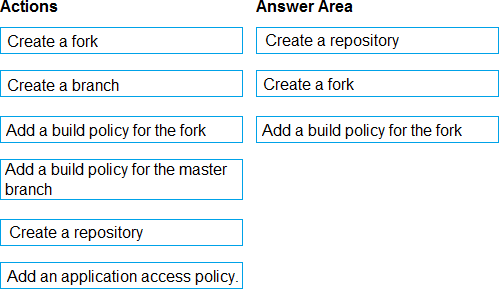
DRAG DROP
You need to implement the code ow strategy for Project2 in Azure DevOps.
Which three actions should you perform in sequence? To answer, move the appropriate actions from the list of actions to the answer area and arrange them in the correct order.

You have a private GitHub repository.
You need to display the commit status of the repository on Azure Boards.
What should you do first?
- A . Configure multi-factor authentication (MFA) for your GitHub account.
- B . Add the Azure Pipelines app to the GitHub repository.
- C . Add the Azure Boards app to the repository.
- D . Create a GitHub action in GitHub.