
Microsoft AZ-400 Practice Exams
Last updated on Nov 16,2026- Exam Code: AZ-400
- Exam Name: Designing and Implementing Microsoft DevOps Solutions
- Certification Provider: Microsoft
- Latest update: Nov 16,2026
Your company has an Azure DevOps environment that can only be accessed by Azure Active Directory users.
You are instructed to make sure that the Azure DevOps environment can only be accessed from devices connected to the company’s on-premises network.
Which of the following actions should you take?
- A . Assign the devices to a security group.
- B . Create a GPO.
- C . Configure Security in Project Settings from Azure DevOps.
- D . Configure conditional access in Azure Active Directory.
Your company hosts a web application in Azure. The company uses Azure Pipelines for the build and release management of the application.
Stakeholders report that the past few releases have negatively affected system performance.
You configure alerts in Azure Monitor.
You need to ensure that new releases are only deployed to production if the releases meet defined performance baseline criteria in the staging environment first.
What should you use to prevent the deployment of releases that fall to meet the performance baseline?
- A . an Azure Scheduler job
- B . a trigger
- C . a gate
- D . an Azure function
HOTSPOT
You are designing YAML-based Azure pipelines for the apps shown in the following table.
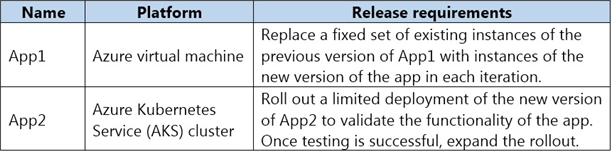
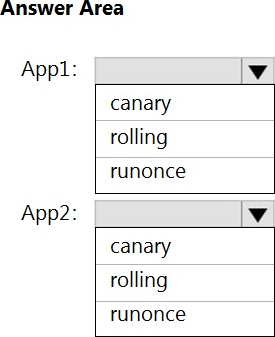
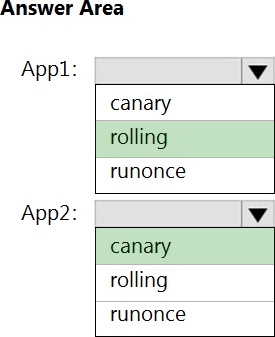
You need to configure the YAML strategy value for each app. The solution must minimize app downtime.
Which value should you configure for each app? To answer, select the appropriate options in the answer area. NOTE: Each correct selection is worth one point.
You manage a project by using Azure Boards. You manage the project code by using GitHub.
You have three work items that have IDs of 456, 457, and 458.
You need to create a pull request that will be linked to all the work items. The solution must set the state of work item 456 to done.
What should you add to the commit message?
- A . Done #456, #457, #458
- B . Fixes #456, #457, #458
- C . Fixes #AB456, #A8457, #A8458
- D . #AB456, #AB457, #AB458
Completed #AB456
Note: This question is part of a series of questions that present the same scenario. Each question in the series contains a unique solution that might meet the stated goals. Some question sets might have more than one correct solution, while others might not have a correct solution.
After you answer a question in this section, you will NOT be able to return to it. As a result, these questions will not appear in the review screen.
Your company uses Azure DevOps to manage the build and release processes for applications.
You use a Git repository for applications source control.
You need to implement a pull request strategy that reduces the history volume in the master branch.
Solution: You implement a pull request strategy that uses fast-forward merges.
Does this meet the goal?
- A . Yes
- B . No
Your company uses a Git repository in Azure Repos to manage the source code of a web application. The master branch is protected from direct updates.
Developers work on new features in the topic branches.
Because of the high volume of requested features, it is di cult to follow the history of the changes to the master branch.
You need to enforce a pull request merge strategy. The strategy must meet the following requirements:
✑ Consolidate commit histories.
✑ Merge the changes into a single commit.
Which merge strategy should you use in the branch policy?
- A . squash merge
- B . fast-forward merge
- C . Git fetch
- D . no-fast-forward merge
Note: This question is part of a series of questions that present the same scenario. Each question in the series contains a unique solution that might meet the stated goals. Some question sets might have more than one correct solution, while others might not have a correct solution.
After you answer a question in this section, you will NOT be able to return to it. As a result, these questions will not appear in the review screen.
Your company uses Azure DevOps to manage the build and release processes for applications.
You use a Git repository for applications source control.
You need to implement a pull request strategy that reduces the history volume in the master branch.
Solution: You implement a pull request strategy that uses an explicit merge.
Does this meet the goal?
- A . Yes
- B . No