
Microsoft AZ-204 Practice Exams
Last updated on Oct 21,2026- Exam Code: AZ-204
- Exam Name: Developing Solutions for Microsoft Azure
- Certification Provider: Microsoft
- Latest update: Oct 21,2026
DRAG DROP
You are developing an Azure solution to collect inventory data from thousands of stores located around the world. Each store location will send the inventory data hourly to an Azure Blob storage account for processing.
The solution must meet the following requirements:
✑ Begin processing when data is saved to Azure Blob storage.
✑ Filter data based on store location information.
✑ Trigger an Azure Logic App to process the data for output to Azure Cosmos DB.
✑ Enable high availability and geographic distribution.
✑ Allow 24-hours for retries.
✑ Implement an exponential back off data processing.
You need to configure the solution.
What should you implement? To answer, select the appropriate options in the answer area. NOTE: Each correct selection is worth one point.
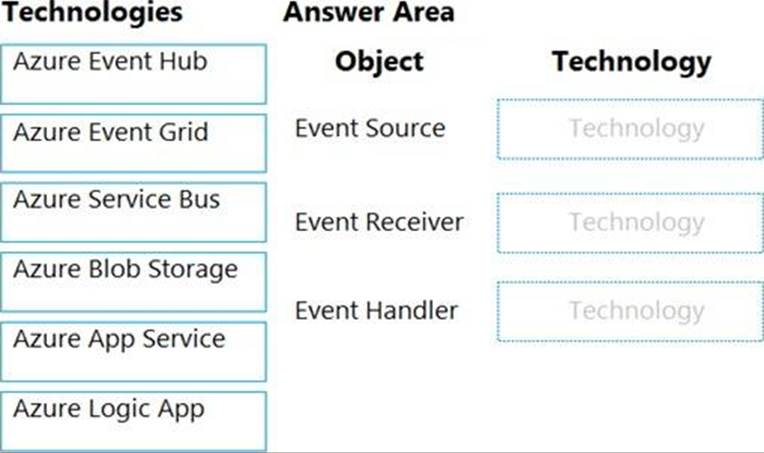
Explanation:
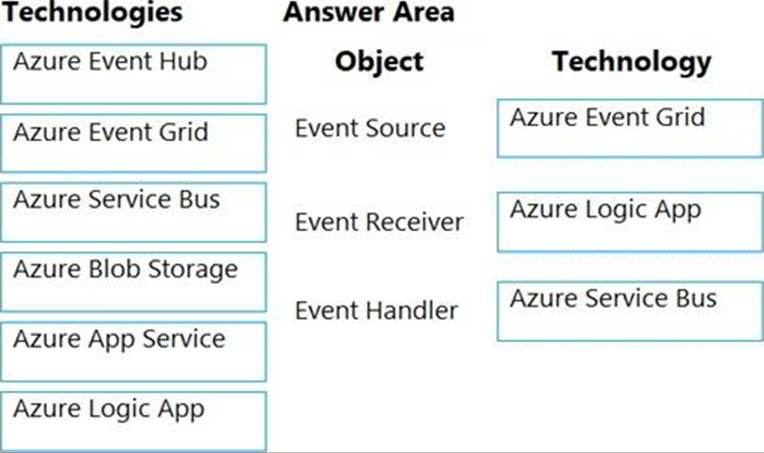
Box 1: Azure Event Grid
Blob storage events are pushed using Azure Event Grid to subscribers such as Azure Functions, Azure Logic Apps, or even to your own http listener. Event Grid provides reliable event delivery to your applications through rich retry policies and dead-lettering.
Box 2: Azure Logic App
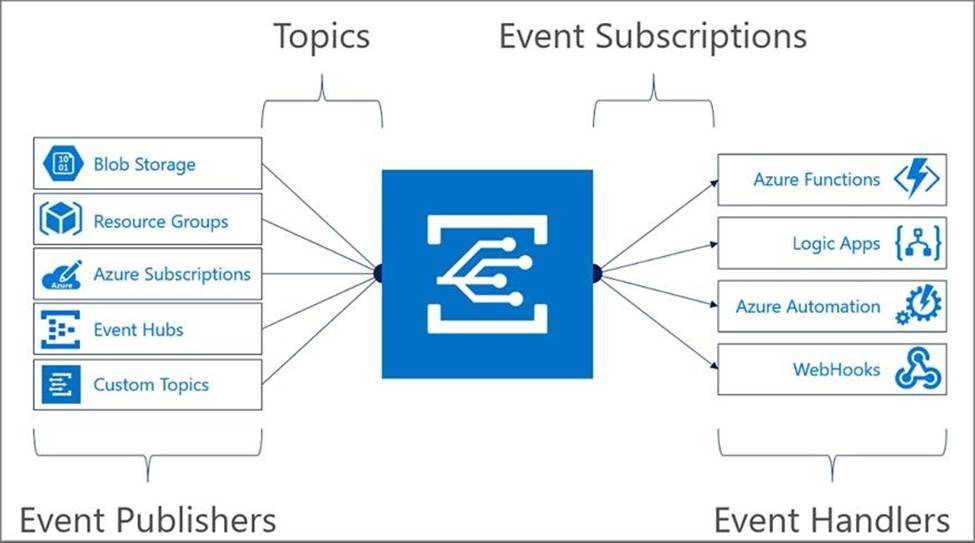
Event Grid uses event subscriptions to route event messages to subscribers. This image illustrates the relationship between event publishers, event subscriptions, and event handlers.
Box 3: Azure Service Bus
The Event Grid service doesn’t store events. Instead, events are stored in the Event Handlers, including ServiceBus, EventHubs, Storage Queue, WebHook endpoint, or many other supported Azure Services.
Reference:
https://docs.microsoft.com/en-us/azure/storage/blobs/storage-blob-event-overview
https://docs.microsoft.com/en-us/java/api/overview/azure/messaging-eventgrid-readme
You are developing a solution that will use a multi-partitioned Azure Cosmos DB database. You plan to use the latest Azure Cosmos DB SDK for development.
The solution must meet the following requirements:
✑ Send insert and update operations to an Azure Blob storage account.
✑ Process changes to all partitions immediately.
✑ Allow parallelization of change processing.
You need to process the Azure Cosmos DB operations.
What are two possible ways to achieve this goal? Each correct answer presents a complete solution. NOTE: Each correct selection is worth one point.
- A . Create an Azure App Service API and implement the change feed estimator of the SDK. Scale the API by using multiple Azure App Service instances.
- B . Create a background job in an Azure Kubernetes Service and implement the change feed feature of the SDK.
- C . Create an Azure Function to use a trigger for Azure Cosmos DB. Configure the trigger to connect to the container.
- D . Create an Azure Function that uses a Feedlterator object that processes the change feed by using the pull model on the container. Use a FeedRange objext to parallelize the processing of the change feed across multiple functions.
CD
Explanation:
Azure Functions is the simplest option if you are just getting started using the change feed. Due to its simplicity, it is also the recommended option for most change feed use cases. When you create an Azure Functions trigger for Azure Cosmos DB, you select the container to connect, and the Azure Function gets triggered whenever there is a change in the container. Because Azure Functions uses the change feed processor behind the scenes, it automatically parallelizes change processing across your container’s partitions.
Note: You can work with change feed using the following options:
✑ Using change feed with Azure Functions
✑ Using change feed with change feed processor
Reference:
https://docs.microsoft.com/en-us/azure/cosmos-db/read-change-feed
https://docs.microsoft.com/en-us/azure/cosmos-db/change-feed-pull-model
https://docs.microsoft.com/en-us/azure/cosmos-db/read-change-feed#azure-functions
https://docs.microsoft.com/en-us/azure/cosmos-db/change-feed-pull-model#using-feedrange-for-parallelization
HOTSPOT
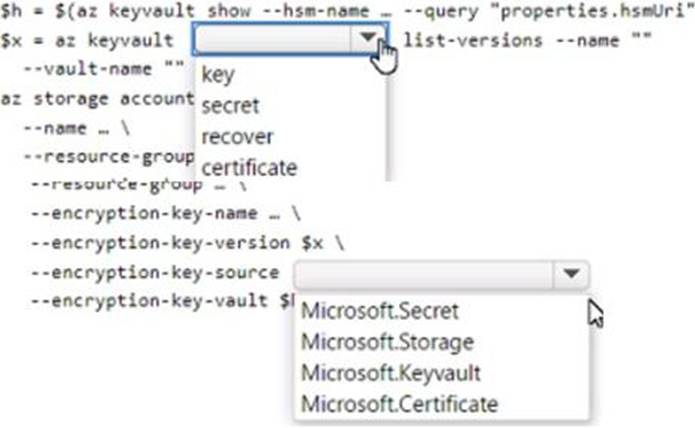
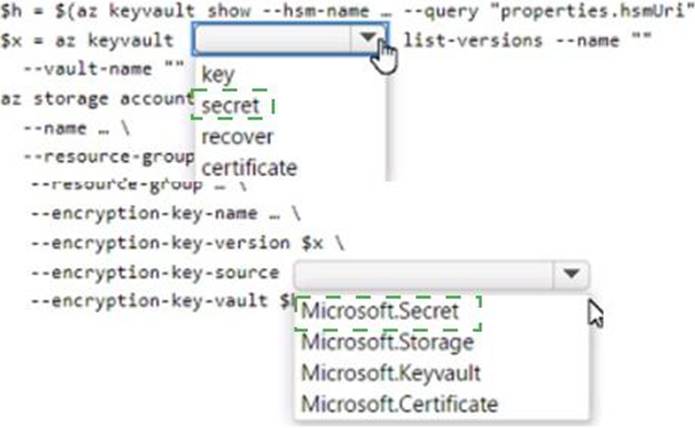
You are developing an application that uses Azure Storage to store customer data. The data must only be decrypted by the customer and the customer must be provided a script to rotate keys.
You need to provide a script to rotate keys to the customer.
How should you complete the command? To answer, select the appropriate options in the answer area. NOTE: Each correct selection is worth one point.
Explanation:
Secret
Microsoft Secret
HOTSPOT
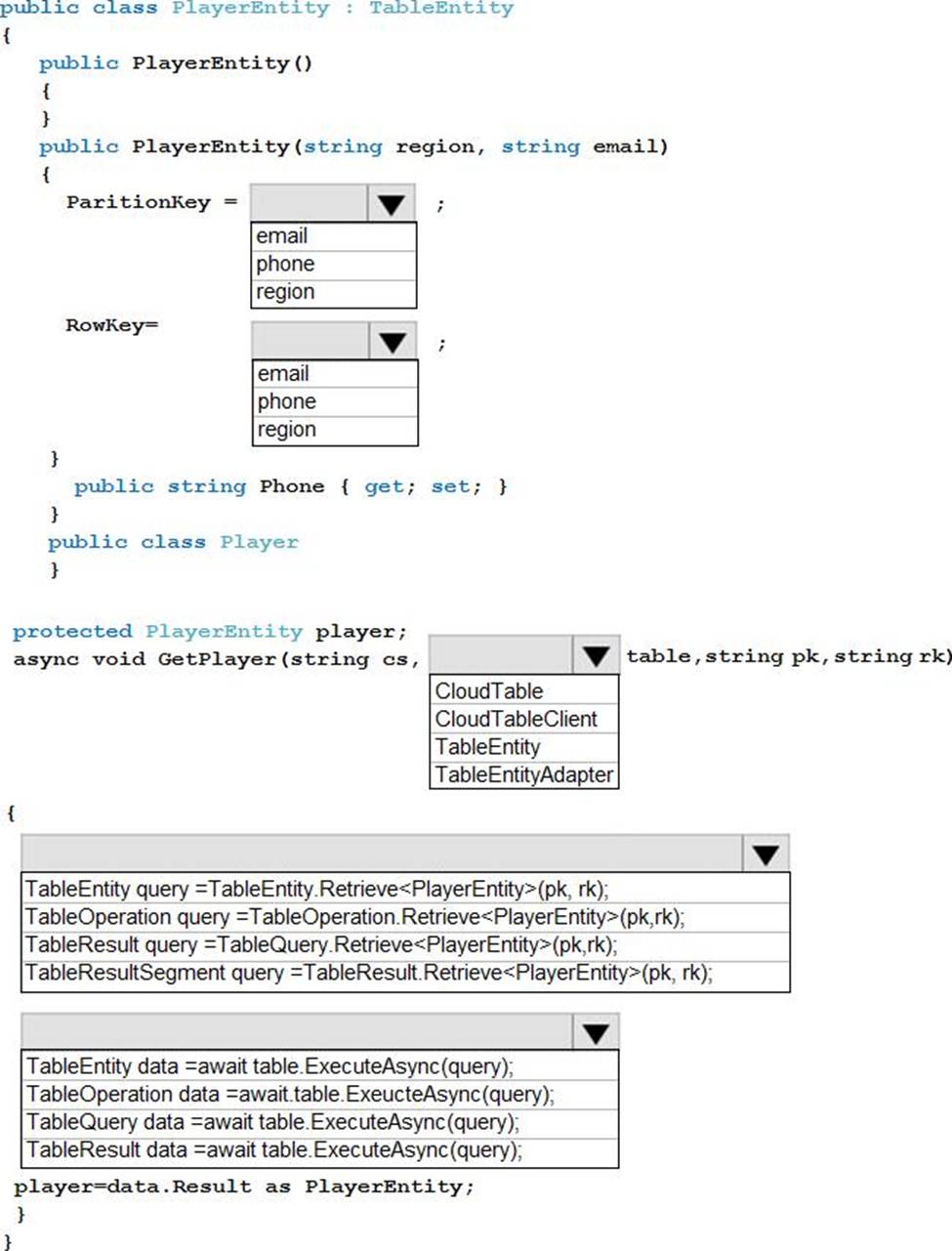
You are developing an app that manages users for a video game. You plan to store the region, email address, and phone number for the player. Some players may not have a phone number. The player’s region will be used to load-balance data.
Data for the app must be stored in Azure Table Storage.
You need to develop code to retrieve data for an individual player.
How should you complete the code? To answer, select the appropriate options in the answer area. NOTE: Each correct selection is worth one point.
Explanation:
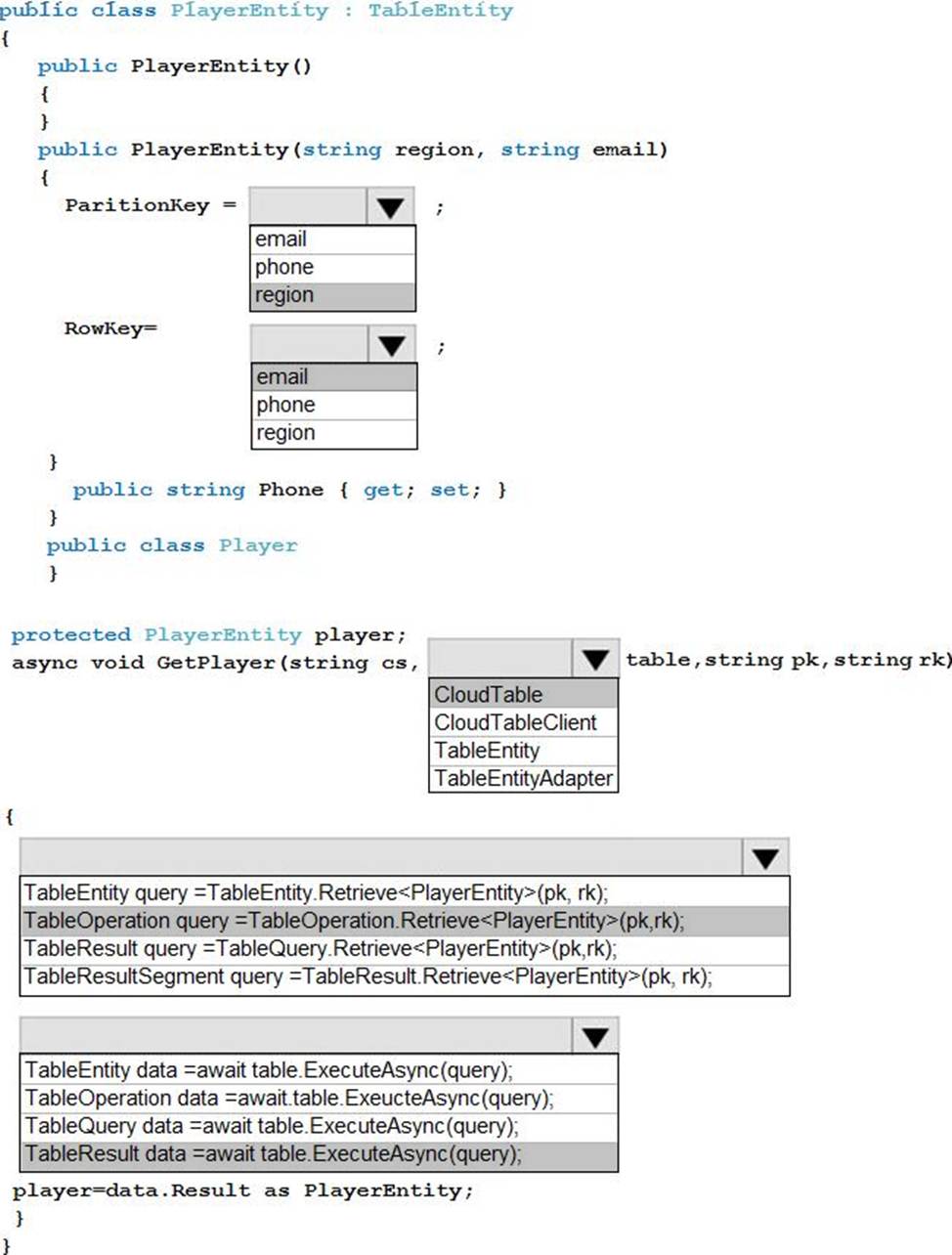
Box 1: region
The player’s region will be used to load-balance data.
Choosing the PartitionKey.
The core of any table’s design is based on its scalability, the queries used to access it, and storage operation requirements. The PartitionKey values you choose will dictate how a table will be partitioned and the type of queries that can be used. Storage operations, in particular inserts, can also affect your choice of PartitionKey values.
Box 2: email
Not phone number some players may not have a phone number.
Box 3: CloudTable
Box 4 : TableOperation query =..
Box 5: TableResult
Reference: https://docs.microsoft.com/en-us/rest/api/storageservices/designing-a-scalable-partitioning-strategy-for-azure-table-storage
You ate developing a web application that uses the Microsoft identity platform to authenticate users and resources. The web application calls several REST APIs.
The APIs require an access token from the Microsoft identity platform.
You need to request a token.
Which three properties should you use? Each correct answer presents part of the solution. NOTE: Each correct selection is worth one point.
- A . Application secret
- B . Redirect URI/URL
- C . Application name
- D . Supported account type
- E . Application ID
You are developing a software solution for an autonomous transportation system. The solution uses large data sets and Azure Batch processing to simulate navigation sets for entire fleets of vehicles.
You need to create compute nodes for the solution on Azure Batch.
What should you do?
- A . In the Azure portal, create a Batch account.
- B . In a .NET method, call the method: BatchClient.PoolOperations.CreatePool
- C . In Python, implement the class: JobAddParameter
- D . In Python, implement the class: TaskAddParameter
B
Explanation:
A Batch job is a logical grouping of one or more tasks. A job includes settings common to the tasks, such as priority and the pool to run tasks on. The app uses the BatchClient.JobOperations.CreateJob method to create a job on your pool.
Incorrect Answers:
C, D: To create a Batch pool in Python, the app uses the PoolAddParameter class to set the number of nodes, VM size, and a pool configuration.
Reference: https://docs.microsoft.com/en-us/azure/batch/quick-run-dotnet
https://docs.microsoft.com/en-us/azure/batch/quick-run-python
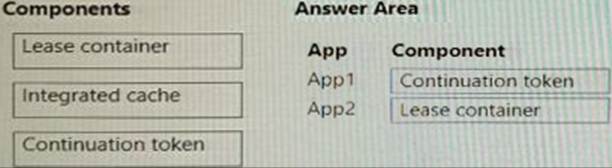
DRAG DROP
You have an Azure Cosmos DB for NoSQL account.
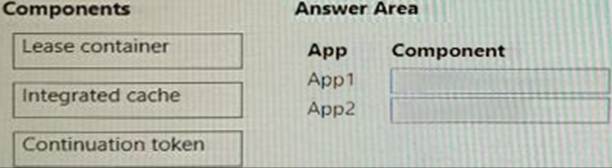
You plan to develop two apps named App1 and App2 that will use the change feed functionality to track changes to containers.
App1 will use the pull model and App2 will use the push model.
You need to choose the method to track the most recently processed change in App1 and App2.
Which component should you use? To answer, drag the appropriate components to the correct apps. Each component may be used once, more than once, or not at all. You may need to drag the split bar between panes or scroll to view content. NOTE: Each correct selection is worth one point.
Note: This question is part of a series of questions that present the same scenario. Each question in the series contains a unique solution that might meet the stated goals. Some question sets might have more than one correct solution, while others might not have a correct solution.
After you answer a question in this section, you will NOT be able to return to it. As a result, these questions will not appear in the review screen.
You develop an HTTP triggered Azure Function app to process Azure Storage blob data. The app is triggered using an output binding on the blob.
The app continues to time out after four minutes. The app must process the blob data.
You need to ensure the app does not time out and processes the blob data.
Solution: Use the Durable Function async pattern to process the blob data.
Does the solution meet the goal?
- A . Yes
- B . No
B
Explanation:
Instead pass the HTTP trigger payload into an Azure Service Bus queue to be processed by a queue trigger function and return an immediate HTTP success response.
Note: Large, long-running functions can cause unexpected timeout issues. General best practices include:
Whenever possible, refactor large functions into smaller function sets that work together and return responses fast. For example, a webhook or HTTP trigger function might require an acknowledgment response within a certain time limit; it’s common for webhooks to require an immediate response.
You can pass the HTTP trigger payload into a queue to be processed by a queue trigger function. This approach lets you defer the actual work and return an immediate response.
Reference: https://docs.microsoft.com/en-us/azure/azure-functions/functions-best-practices
Note: This question is part of a series of questions that present the same scenario. Each question in the series contains a unique solution that might meet the stated goals. Some question sets might have more than one correct solution, while others might not have a correct solution.
After you answer a question in this section, you will NOT be able to return to it. As a result, these questions will not appear in the review screen.
You are developing an Azure Service application that processes queue data when it receives a message from a mobile application. Messages may not be sent to the service consistently.
You have the following requirements:
✑ Queue size must not grow larger than 80 gigabytes (GB).
✑ Use first-in-first-out (FIFO) ordering of messages.
✑ Minimize Azure costs.
You need to implement the messaging solution.
Solution: Use the .Net API to add a message to an Azure Storage Queue from the mobile application.
Create an Azure VM that is triggered from Azure Storage Queue events.
Does the solution meet the goal?
- A . Yes
- B . No
B
Explanation:
Don’t use a VM, instead create an Azure Function App that uses an Azure Service Bus Queue trigger.
Reference: https://docs.microsoft.com/en-us/azure/azure-functions/functions-create-storage-queue-triggered-function