
Microsoft AZ-204 Practice Exams
Last updated on Oct 21,2026- Exam Code: AZ-204
- Exam Name: Developing Solutions for Microsoft Azure
- Certification Provider: Microsoft
- Latest update: Oct 21,2026
HOTSPOT
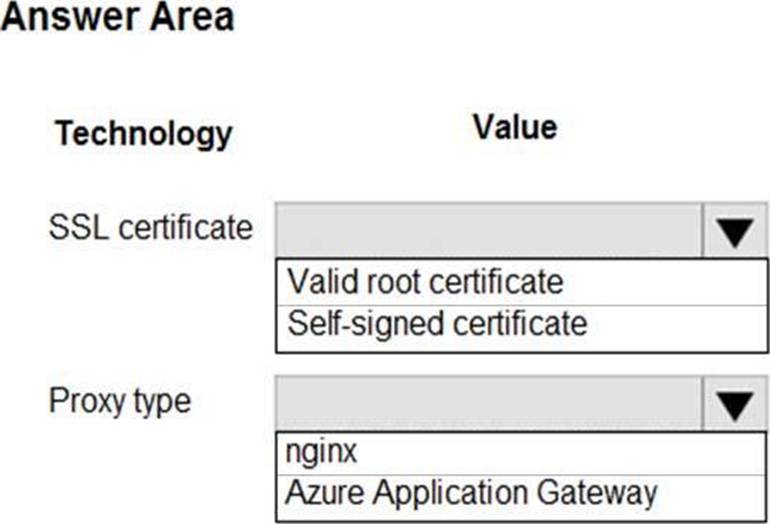
You need to ensure that network security policies are met.
How should you configure network security? To answer, select the appropriate options in the answer area. NOTE: Each correct selection is worth one point.
Explanation:
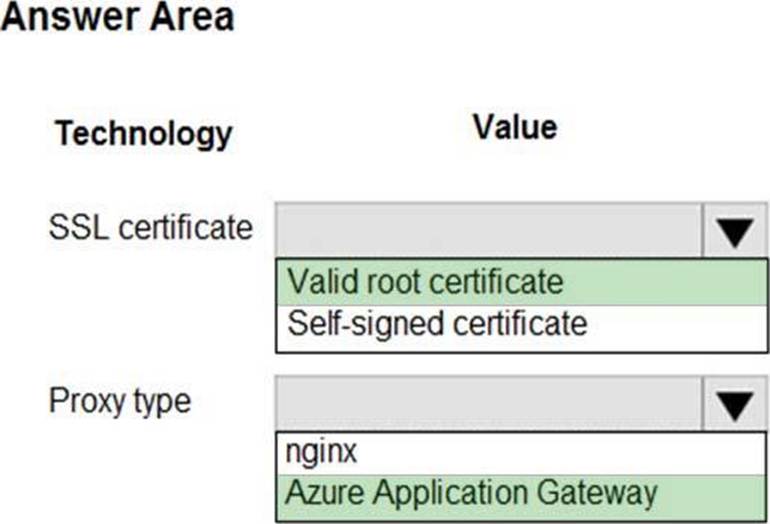
Box 1: Valid root certificate
Scenario: All websites and services must use SSL from a valid root certificate authority.
Box 2: Azure Application Gateway
Scenario:
Any web service accessible over the Internet must be protected from cross site scripting attacks.
All Internal services must only be accessible from Internal Virtual Networks (VNets)
All parts of the system must support inbound and outbound traffic restrictions.
Azure Web Application Firewall (WAF) on Azure Application Gateway provides centralized protection of your web applications from common exploits and vulnerabilities. Web applications are increasingly targeted by malicious attacks that exploit commonly known vulnerabilities. SQL injection and cross-site scripting are among the most common attacks.
Application Gateway supports autoscaling, SSL offloading, and end-to-end SSL, a web application firewall (WAF), cookie-based session affinity, URL path-based routing, multisite hosting, redirection, rewrite HTTP headers and other features.
Note: Both Nginx and Azure Application Gateway act as a reverse proxy with Layer 7 loadbalancing features plus a WAF to ensure strong protection against common web vulnerabilities and exploits.
You can modify Nginx web server configuration/SSL for X-XSS protection. This helps to prevent cross-site scripting exploits by forcing the injection of HTTP headers with X-XSS protection.
Reference: https://docs.microsoft.com/en-us/azure/web-application-firewall/ag/ag-overview
https://www.upguard.com/articles/10-tips-for-securing-your-nginx-deployment
You are a developing a SaaS application that stores data as key value pairs.
You must make multiple editions of the application available. In the lowest cost edition, the performance must be best-effort, and there is no regional failover.
In higher cos! editions customers must be able to select guaranteed performance and support for multiple regions. Azure costs must be minimized.
Which Azure Cosmos OB API should you use for the application?
- A . Core
- B . MongoDB
- C . Cassandra
- D . Table API
Note: This question is part of a series of questions that present the same scenario. Each question in the series contains a unique solution that might meet the stated goals. Some question sets might have more than one correct solution, while others might not have a correct solution.
After you answer a question in this section, you will NOT be able to return to it. As a result, these questions will not appear in the review screen.
You are developing an Azure solution to collect point-of-sale (POS) device data from 2,000 stores located throughout the world. A single device can produce 2 megabytes (MB) of data every 24 hours. Each store location has one to five devices that send data.
You must store the device data in Azure Blob storage. Device data must be correlated based on a device identifier. Additional stores are expected to open in the future.
You need to implement a solution to receive the device data.
Solution: Provision an Azure Event Grid. Configure the machine identifier as the partition key and enable capture.
Does the solution meet the goal?
- A . Yes
- B . No
A
Explanation:
Reference: https://docs.microsoft.com/en-us/azure/event-grid/compare-messaging-services
HOTSPOT
You are developing an Azure App Service hosted ASP.NET Core web app to deliver video on-demand streaming media. You enable an Azure Content Delivery Network (CDN) Standard for the web endpoint. Customer videos are downloaded from the web app by using the following example URL.: http://www.contoso.com/content.mp4?quality=1
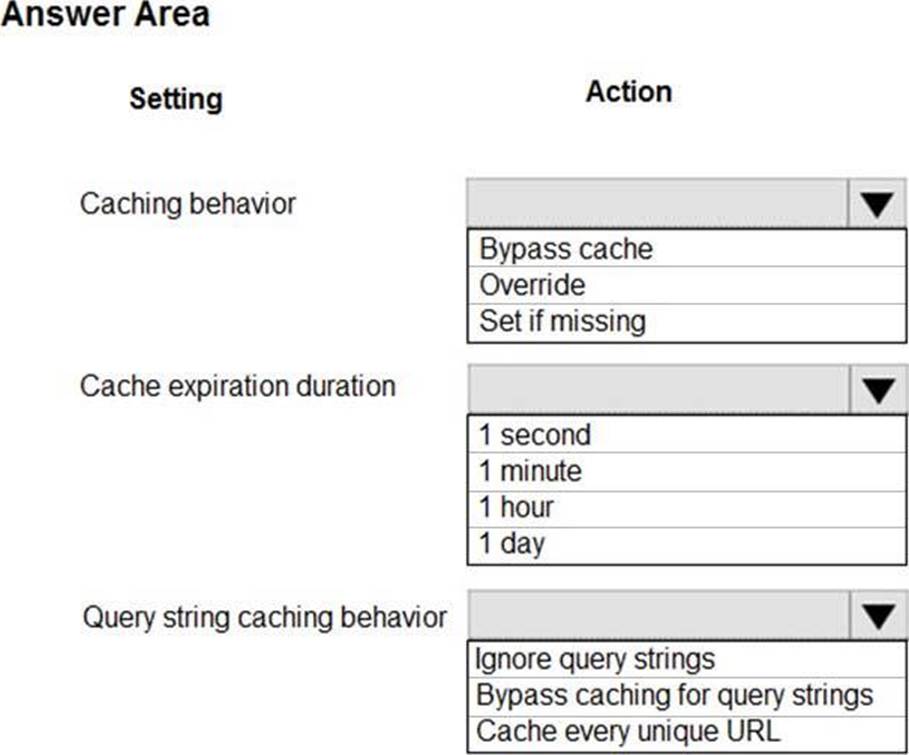
All media content must expire from the cache after one hour. Customer videos with varying quality must be delivered to the closest regional point of presence (POP) node.
You need to configure Azure CDN caching rules.
Which options should you use? To answer, select the appropriate options in the answer area. NOTE: Each correct selection is worth one point.
Explanation:
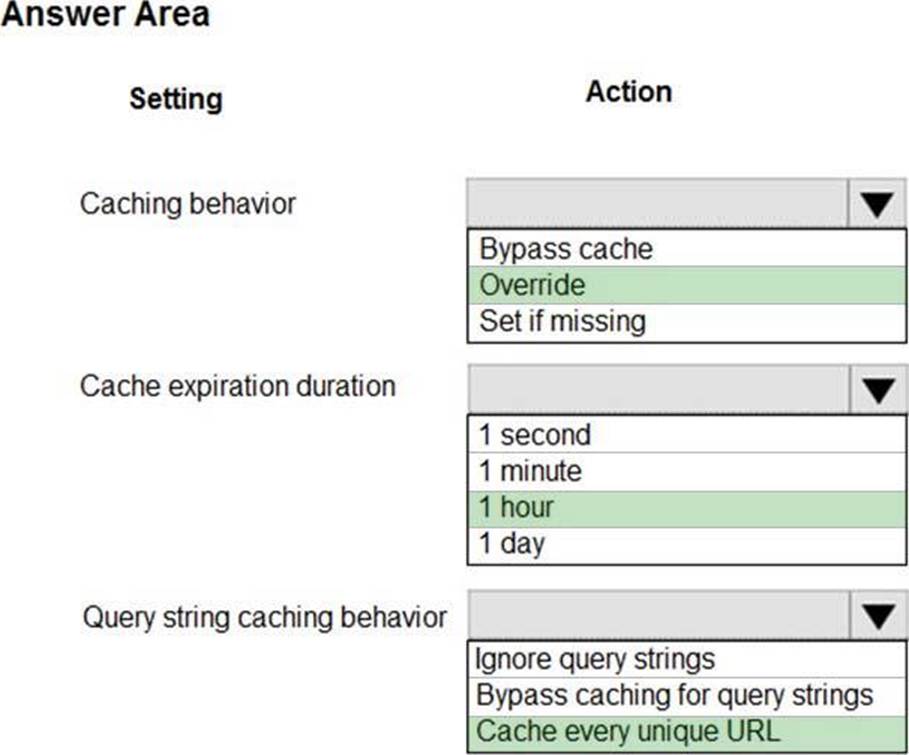
Box 1: Override
Override: Ignore origin-provided cache duration; use the provided cache duration instead.
This will not override cache-control: no-cache.
Set if missing: Honor origin-provided cache-directive headers, if they exist; otherwise, use the provided cache duration.
Incorrect:
Bypass cache: Do not cache and ignore origin-provided cache-directive headers.
Box 2: 1 hour
All media content must expire from the cache after one hour.
Box 3: Cache every unique URL
Cache every unique URL: In this mode, each request with a unique URL, including the query string, is treated as a unique asset with its own cache. For example, the response from the origin server for a request for example.ashx?q=test1 is cached at the POP node and returned for subsequent caches with the same query string. A request for example.ashx?q=test2 is cached as a separate asset with its own time-to-live setting.
Incorrect Answers:
Bypass caching for query strings: In this mode, requests with query strings are not cached at the CDN POP node. The POP node retrieves the asset directly from the origin server and passes it to the requestor with each request.
Ignore query strings: Default mode. In this mode, the CDN point-of-presence (POP) node passes the query strings from the requestor to the origin server on the first request and caches the asset. All subsequent requests for the asset that are served from the POP ignore the query strings until the cached asset expires.
Reference: https://docs.microsoft.com/en-us/azure/cdn/cdn-query-string
DRAG DROP
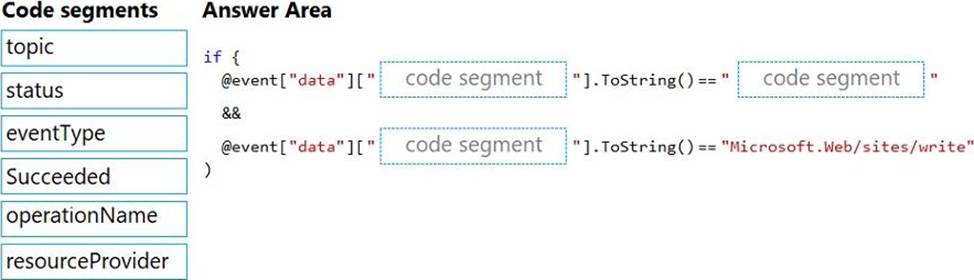
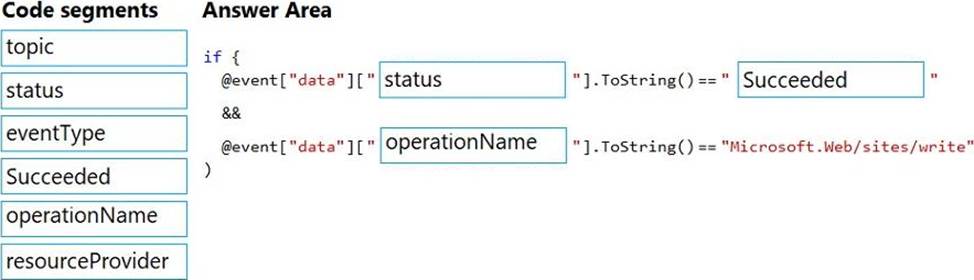
You need to add code at line EG15 in EventGridController.cs to ensure that the Log policy applies to all services.
How should you complete the code? To answer, drag the appropriate code segments to the correct locations. Each code segment may be used once, more than once, or not at all. You may need to drag the split bar between panes or scroll to view content. NOTE: Each correct selection is worth one point.
Explanation:
Scenario, Log policy: All Azure App Service Web Apps must write logs to Azure Blob storage.
Box 1: Status
Box 2: Succeeded
Box 3: operationName
Microsoft.Web/sites/write is resource provider operation. It creates a new Web App or updates an existing one.
Reference: https://docs.microsoft.com/en-us/azure/role-based-access-control/resource-provider-operations
DRAG DROP
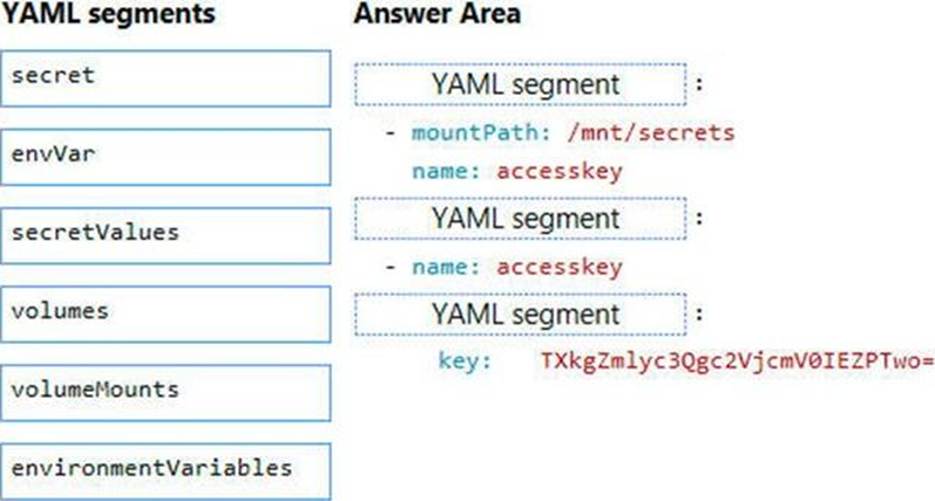
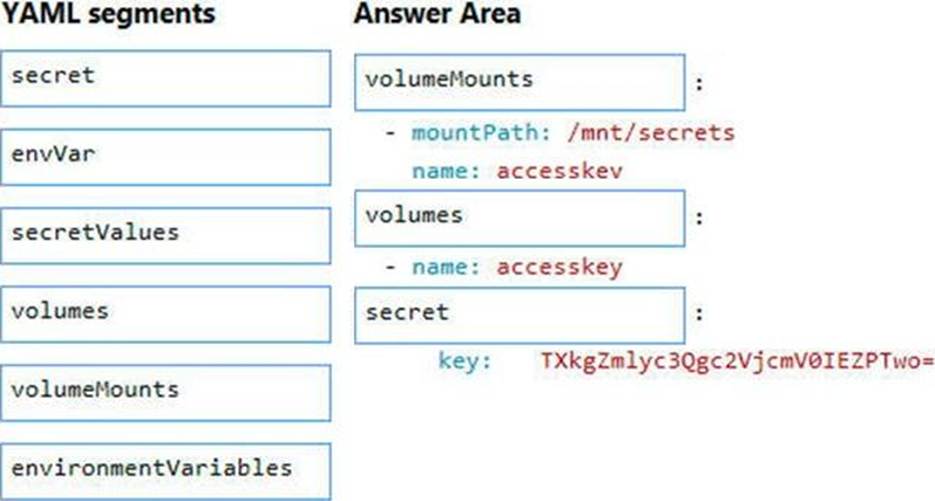
You need to add YAML markup at line CS17 to ensure that the ContentUploadService can access Azure Storage access keys.
How should you complete the YAML markup? To answer, drag the appropriate YAML segments to the correct locations. Each YAML segment may be used once, more than once, or not at all. You may need to drag the split bar between panes or scroll to view content. NOTE: Each correct selection is worth one point.
Explanation:
Box 1: volumeMounts
Example:
volumeMounts:
– mountPath: /mnt/secrets
name: secretvolume1
volumes:
– name: secretvolume1 secret:
mysecret1: TXkgZmlyc3Qgc2VjcmV0IEZPTwo=
Box 2: volumes
Box 3: secret
Reference: https://docs.microsoft.com/en-us/azure/container-instances/container-instances-volume-secret
DRAG DROP
You need to add YAML markup at line CS17 to ensure that the ContentUploadService can access Azure Storage access keys.
How should you complete the YAML markup? To answer, drag the appropriate YAML segments to the correct locations. Each YAML segment may be used once, more than once, or not at all. You may need to drag the split bar between panes or scroll to view content. NOTE: Each correct selection is worth one point.
Explanation:
Box 1: volumeMounts
Example:
volumeMounts:
– mountPath: /mnt/secrets
name: secretvolume1
volumes:
– name: secretvolume1 secret:
mysecret1: TXkgZmlyc3Qgc2VjcmV0IEZPTwo=
Box 2: volumes
Box 3: secret
Reference: https://docs.microsoft.com/en-us/azure/container-instances/container-instances-volume-secret
You have 100 Azure virtual machines (VMs) with the system-assigned managed identity enabled.
You need to identify the value of the object ID attribute for each of the identities.
Which command should you use?
- A . az resource show
- B . az ad signed-in-user list-owned-objects
- C . az ad user show
- D . Get-AzVM