Microsoft AZ-204 Practice Exams
Last updated on Nov 16,2026- Exam Code: AZ-204
- Exam Name: Developing Solutions for Microsoft Azure
- Certification Provider: Microsoft
- Latest update: Nov 16,2026
You need to implement the processing of enqueuer inventory items.
Which message value should you use?
- A . Session identifier
- B . Sequence number
- C . Partition key
- D . Time stamp
HOTSPOT
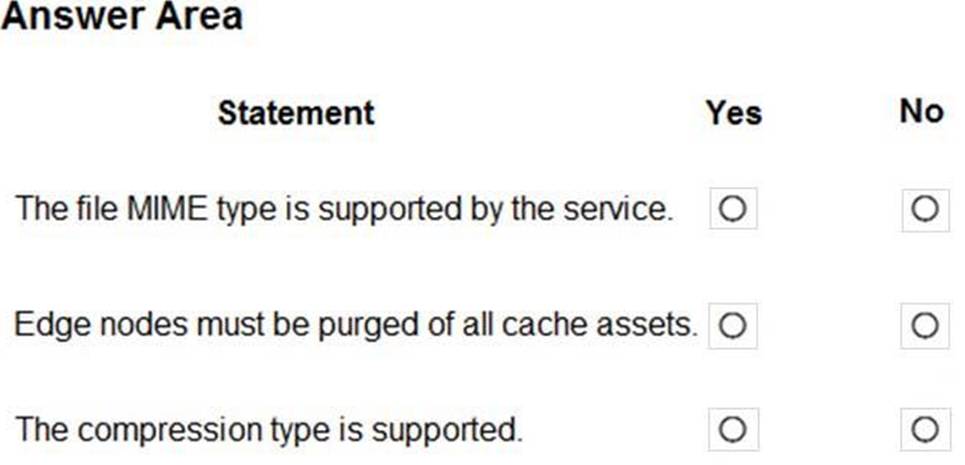
You are using Azure Front Door Service.
You are expecting inbound files to be compressed by using Brotli compression. You discover that inbound XML files are not compressed. The files are 9 megabytes (MB) in size.
You need to determine the root cause for the issue.
To answer, select the appropriate options in the answer area. NOTE: Each correct selection is worth one point.
Explanation:
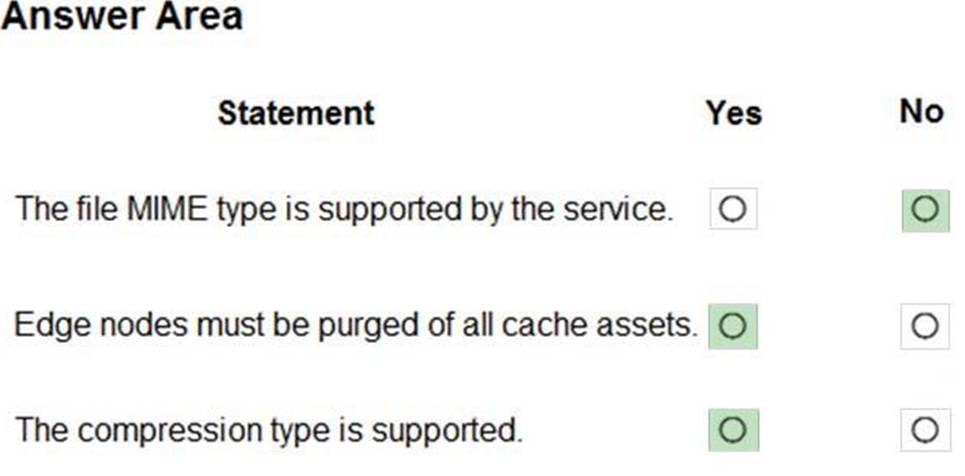
Box 1: No
Front Door can dynamically compress content on the edge, resulting in a smaller and faster response to your clients. All files are eligible for compression. However, a file must be of a MIME type that is eligible for compression list.
Box 2: No
Sometimes you may wish to purge cached content from all edge nodes and force them all to retrieve new updated assets. This might be due to updates to your web application, or to quickly update assets that contain incorrect information.
Box 3: Yes
These profiles support the following compression encodings: Gzip (GNU zip), Brotli
Reference: https://docs.microsoft.com/en-us/azure/frontdoor/front-door-caching
HOTSPOT
You are using Azure Front Door Service.
You are expecting inbound files to be compressed by using Brotli compression. You discover that inbound XML files are not compressed. The files are 9 megabytes (MB) in size.
You need to determine the root cause for the issue.
To answer, select the appropriate options in the answer area. NOTE: Each correct selection is worth one point.
Explanation:
Box 1: No
Front Door can dynamically compress content on the edge, resulting in a smaller and faster response to your clients. All files are eligible for compression. However, a file must be of a MIME type that is eligible for compression list.
Box 2: No
Sometimes you may wish to purge cached content from all edge nodes and force them all to retrieve new updated assets. This might be due to updates to your web application, or to quickly update assets that contain incorrect information.
Box 3: Yes
These profiles support the following compression encodings: Gzip (GNU zip), Brotli
Reference: https://docs.microsoft.com/en-us/azure/frontdoor/front-door-caching
You need to test the availability of the corporate website.
Which two test types can you use?
- A . Custom testing using the TrackAvailability API method
- B . Standard
- C . URL Ping
- D . Multi-step
HOTSPOT
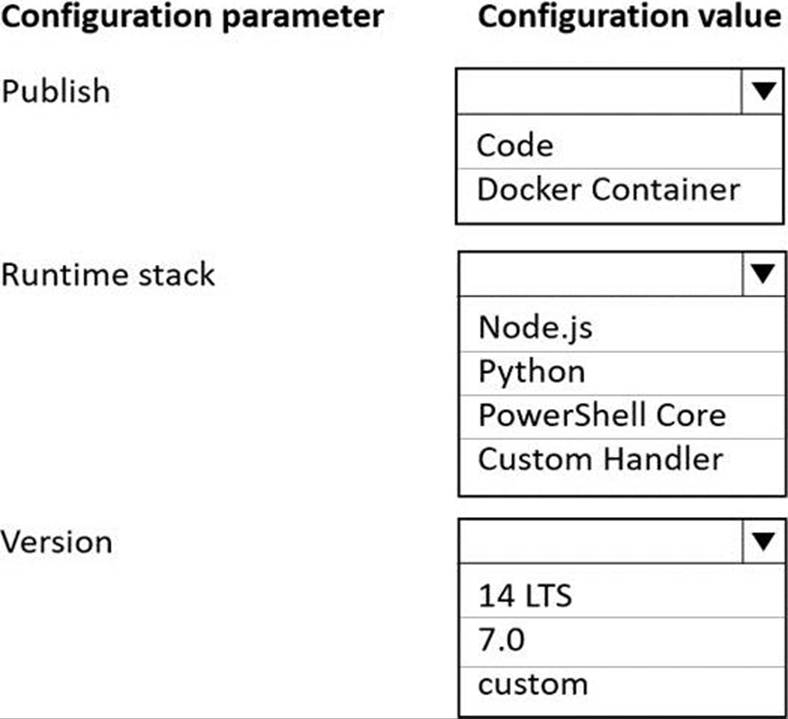
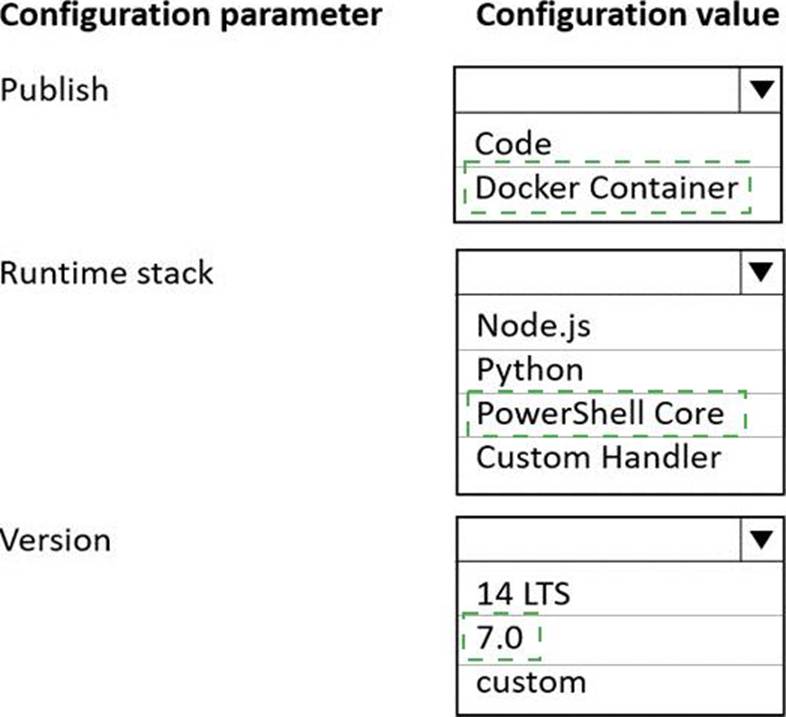
You are developing an Azure Function App. You develop code by using a language that is not supported by the Azure Function App host. The code language supports HTTP primitives.
You must deploy the code to a production Azure Function App environment.
You need to configure the app for deployment.
Which configuration values should you use? To answer, select the appropriate options in the answer area. NOTE: Each correct selection is worth one point.
Explanation:
Box 1: Docker container
A custom handler can be deployed to every Azure Functions hosting option. If your handler requires operating system or platform dependencies (such as a language runtime), you may need to use a custom container. You can create and deploy your code to Azure Functions as a custom Docker container.
Box 2: PowerShell core
When creating a function app in Azure for custom handlers, we recommend you select .NET Core as the stack. A "Custom" stack for custom handlers will be added in the future.
PowerShell Core (PSC) is based on the new .NET Core runtime.
Box 3: 7.0
On Windows: The Azure Az PowerShell module is also supported for use with PowerShell 5.1 on Windows.
On Linux: PowerShell 7.0.6 LTS, PowerShell 7.1.3, or higher is the recommended version of PowerShell for use with the Azure Az PowerShell module on all platforms.
Reference:
https://docs.microsoft.com/en-us/azure/azure-functions/functions-create-function-linux-custom-image
https://docs.microsoft.com/en-us/powershell/azure/install-az-ps?view=azps-7.1.0
You are developing a software solution for an autonomous transportation system. The solution uses large data sets and Azure Batch processing to simulate navigation sets for entire fleets of vehicles.
You need to create compute nodes for the solution on Azure Batch.
What should you do?
- A . In the Azure portal, create a Batch account.
- B . In a .NET method, call the method: BatchClient.PoolOperations.CreatePool
- C . In Python, implement the class: JobAddParameter
- D . In Python, implement the class: TaskAddParameter
B
Explanation:
A Batch job is a logical grouping of one or more tasks. A job includes settings common to the tasks, such as priority and the pool to run tasks on. The app uses the BatchClient.JobOperations.CreateJob method to create a job on your pool.
Incorrect Answers:
C, D: To create a Batch pool in Python, the app uses the PoolAddParameter class to set the number of nodes, VM size, and a pool configuration.
Reference: https://docs.microsoft.com/en-us/azure/batch/quick-run-dotnet
https://docs.microsoft.com/en-us/azure/batch/quick-run-python
HOTSPOT
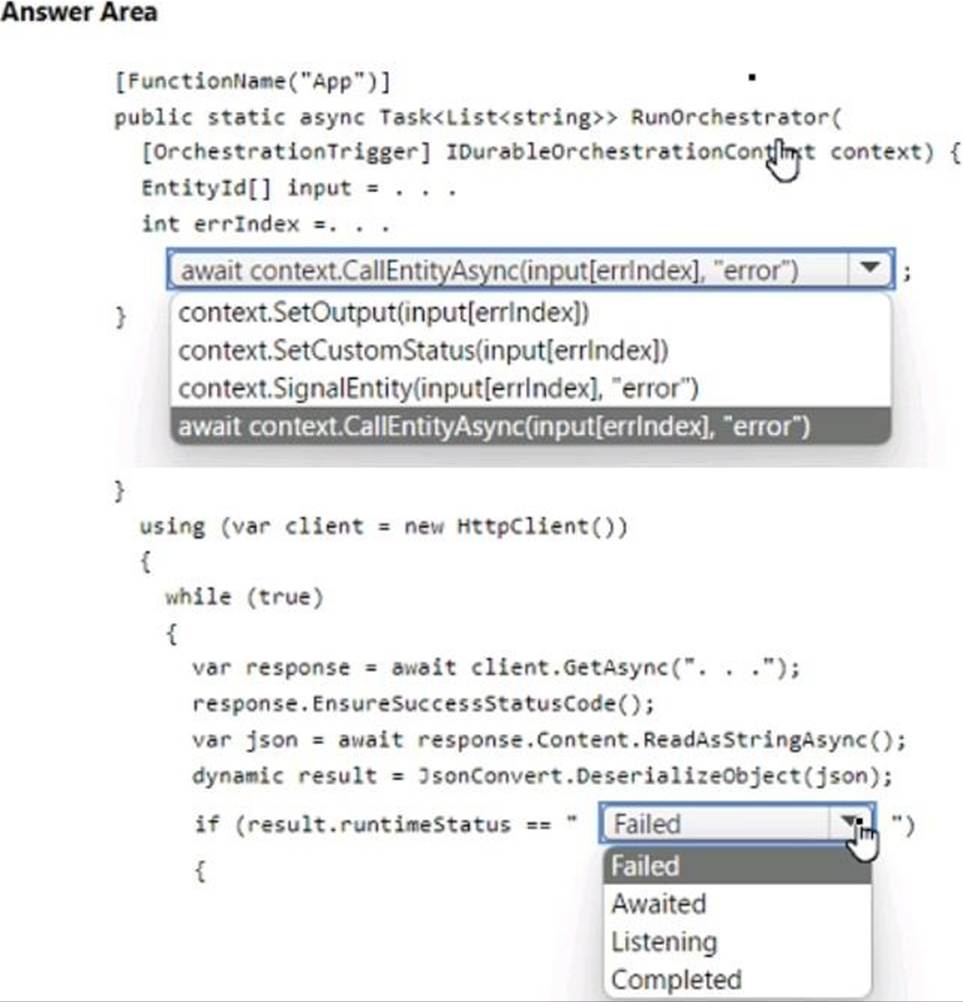
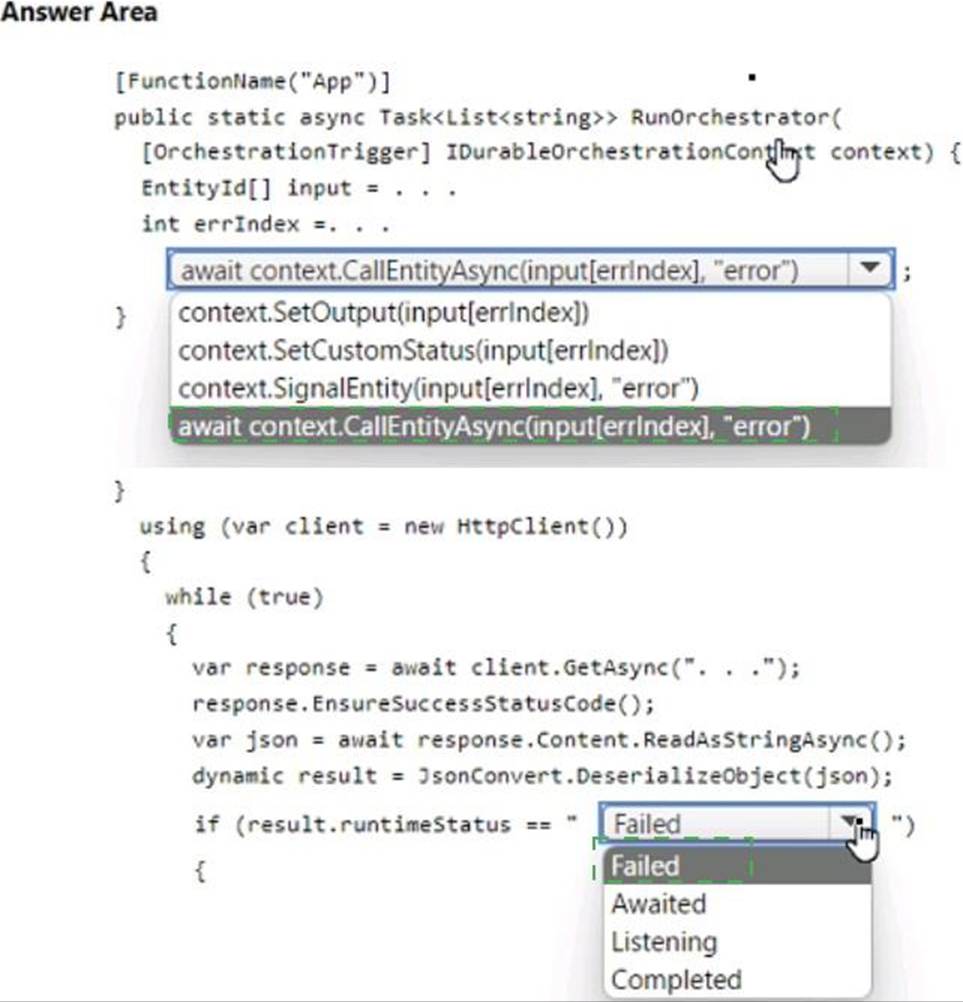
You are developing an Azure Durable Function based application that processes a list of input values. The application is monitored using a console application that retrieves JSON data from an Azure Function diagnostic endpoint.
During processing a single instance of invalid input does not cause the function to fail. Invalid input must be available to the monitoring application.
You need to implement the Azure Durable Function and the monitoring console application.
How should you complete the code segments? To answer, select the appropriate options in the answer area. NOTE: Each correct selection is worth one point.
Topic 1, Windows Server 2016 virtual machine
Case study
This is a case study. Case studies are not timed separately. You can use as much exam time as you would like to complete each case. However, there may be additional case studies and sections on this exam. You must manage your time to ensure that you are able to complete all questions included on this exam in the time provided.
To answer the questions included in a case study, you will need to reference information that is provided in the case study. Case studies might contain exhibits and other resources that provide more information about the scenario that is described in the case study. Each question is independent of the other questions in this case study.
At the end of this case study, a review screen will appear. This screen allows you to review your answers and to make changes before you move to the next section of the exam. After you begin a new section, you cannot return to this section.
To start the case study
To display the first question in this case study, click the Next button. Use the buttons in the left pane to explore the content of the case study before you answer the questions. Clicking these buttons displays information such as business requirements, existing environment, and problem statements. If the case study has an All Information tab, note that the information displayed is identical to the information displayed on the subsequent tabs. When you are ready to answer a question, click the Question button to return to the question.
Current environment
Windows Server 2016 virtual machine
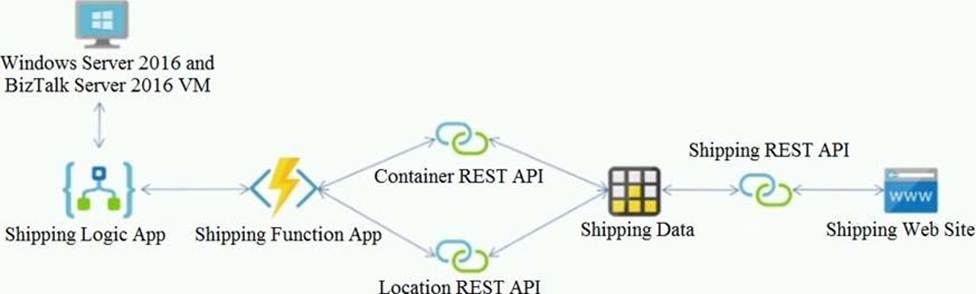
This virtual machine (VM) runs BizTalk Server 2016. The VM runs the following workflows:
– Ocean Transport C This workflow gathers and validates container information including container contents and arrival notices at various shipping ports.
– Inland Transport C This workflow gathers and validates trucking information including fuel usage, number of stops, and routes.
The VM supports the following REST API calls:
– Container API C This API provides container information including weight, contents, and other attributes.
– Location API C This API provides location information regarding shipping ports of call and trucking stops.
– Shipping REST API C This API provides shipping information for use and display on the shipping website.
Shipping Data
The application uses MongoDB JSON document storage database for all container and transport information.
Shipping Web Site
The site displays shipping container tracking information and container contents. The site is located at http://shipping.wideworldimporters.com/
Proposed solution
The on-premises shipping application must be moved to Azure. The VM has been migrated to a new Standard_D16s_v3 Azure VM by using Azure Site Recovery and must remain running in Azure to complete the BizTalk component migrations. You create a Standard_D16s_v3 Azure VM to host BizTalk Server.
The Azure architecture diagram for the proposed solution is shown below:
Requirements
Shipping Logic app
The Shipping Logic app must meet the following requirements:
– Support the ocean transport and inland transport workflows by using a Logic App.
– Support industry-standard protocol X12 message format for various messages including vessel content details and arrival notices.
– Secure resources to the corporate VNet and use dedicated storage resources with a fixed costing model.
– Maintain on-premises connectivity to support legacy applications and final BizTalk migrations.
Shipping Function app
Implement secure function endpoints by using app-level security and include Azure Active Directory (Azure AD).
REST APIs
The REST API’s that support the solution must meet the following requirements:
– Secure resources to the corporate VNet.
– Allow deployment to a testing location within Azure while not incurring additional costs.
– Automatically scale to double capacity during peak shipping times while not causing application downtime.
– Minimize costs when selecting an Azure payment model.
Shipping data
Data migration from on-premises to Azure must minimize costs and downtime.
Shipping website
Use Azure Content Delivery Network (CDN) and ensure maximum performance for dynamic content while minimizing latency and costs.
Issues
Windows Server 2016 VM
The VM shows high network latency, jitter, and high CPU utilization. The VM is critical and has not been backed up in the past. The VM must enable a quick restore from a 7-day snapshot to include in-place restore of disks in case of failure.
Shipping website and REST APIs
The following error message displays while you are testing the website:
Failed to load http://test-shippingapi.wideworldimporters.com/: No ‘Access-Control-Allow-Origin’ header is present on the requested resource. Origin ‘http://test.wideworldimporters.com/’ is therefore not allowed access.
HOTSPOT
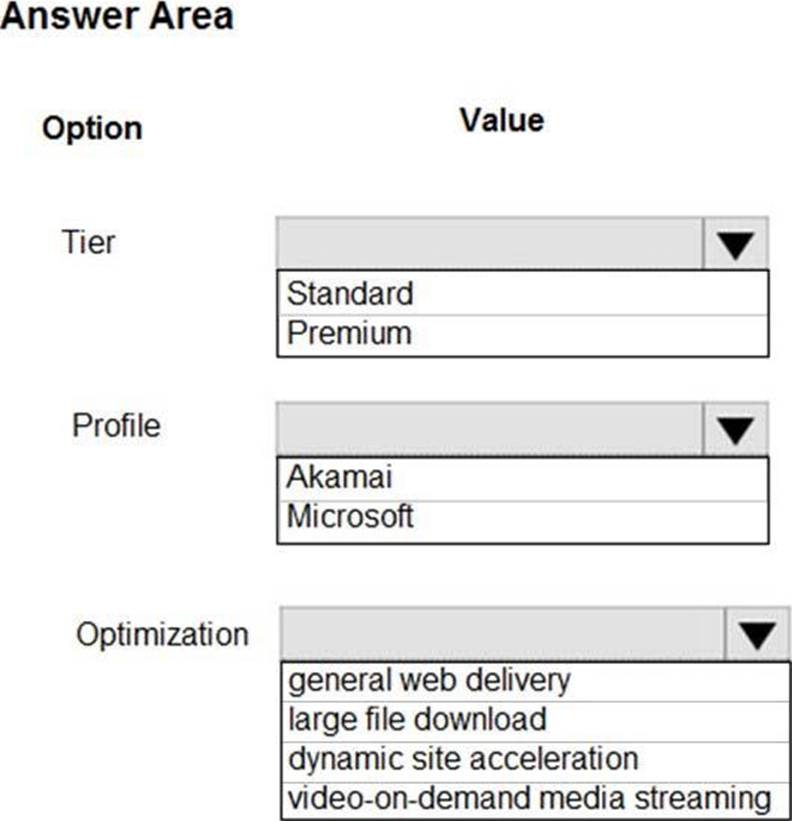
You need to configure Azure CDN for the Shipping web site.
Which configuration options should you use? To answer, select the appropriate options in the answer area. NOTE: Each correct selection is worth one point.
Explanation:
Scenario: Shipping website
Use Azure Content Delivery Network (CDN) and ensure maximum performance for dynamic content while minimizing latency and costs.
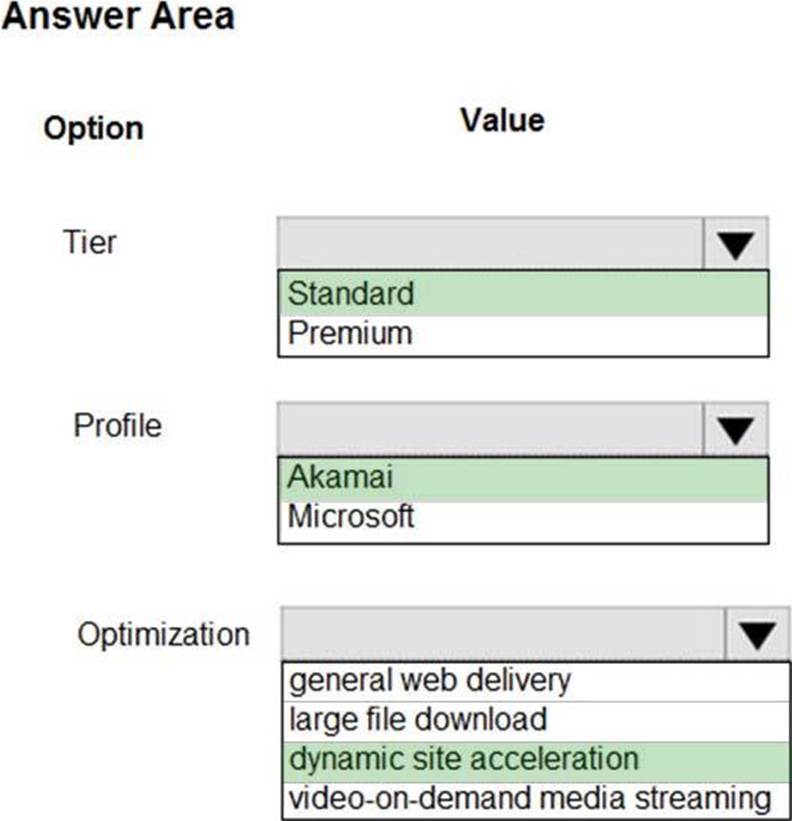
Tier: Standard
Profile: Akamai
Optimization: Dynamic site acceleration
Dynamic site acceleration (DSA) is available for Azure CDN Standard from Akamai, Azure CDN Standard from Verizon, and Azure CDN Premium from Verizon profiles.
DSA includes various techniques that benefit the latency and performance of dynamic content.
Techniques include route and network optimization, TCP optimization, and more.
You can use this optimization to accelerate a web app that includes numerous responses that aren’t cacheable. Examples are search results, checkout transactions, or real-time data. You can continue to use core Azure CDN caching capabilities for static data.
Reference: https://docs.microsoft.com/en-us/azure/cdn/cdn-optimization-overview
HOTSPOT
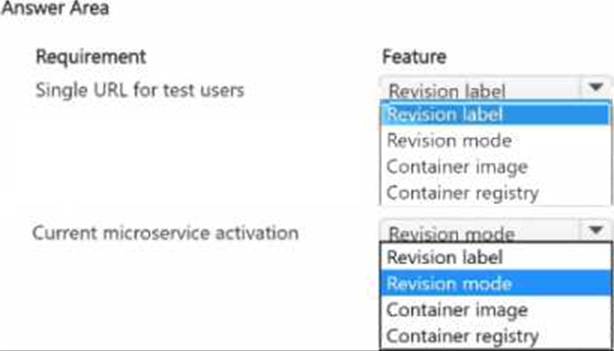
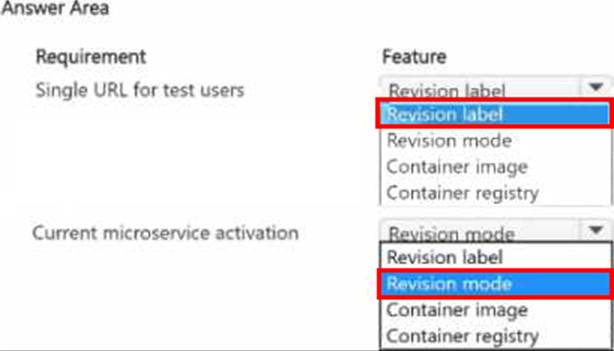
You are developing several microservices to run on Azure Container Apps. External HTTP ingress traffic has been enabled for the microservices. A deployed microservice must be updated to allow users to test new features.
You have the following requirements:
• Enable and maintain a single URL for the updated microservice to provide to test users.
• Update the microservice that corresponds to the current microservice version
You need to configure Azure Container Apps.
Which features should you configure? To answer, select the appropriate options in the answer area.